They Called Her ‘The Mole Woman’ and Bet She’d Be Dead by Christmas… They Didn’t Know What Was Sleeping Beneath Her Feet
PART 3
Her hands trembling in the lantern light, Brida broke the seal and unfolded the letter inside.
“If you have found this box, you are digging on my land.
This means one of two things: either you are a thief, in which case put this back and leave the mountain — or you are family, in which case, welcome.
Sit down.
I have things to tell you.”
It was signed: Aldis Perin.
Brida’s heart pounded as she read on, Ash’s warm weight pressed against her side, the winter dark closing in around the small circle of lantern light.
“The mountain beneath your feet contains a thermal spring,” the letter explained.
“It rises from a source roughly 200 feet below this ridge, warming the surrounding rock to a stable 54 degrees year-round.
I discovered it in 1876.
I built nothing here — I didn’t want to draw attention.
I told no one except my nephew Gunnar, because I trusted him, and because I needed someone in the family to know before I die.”
Then came the words that turned Brida’s blood to ice.
“I must warn you — my nephew Court has been asking about this land for years.
He has hired surveyors.
He has offered me money.
I have refused.
If he ever learns what truly lies beneath this ground, he will not stop until he has it.”
Brida sat in the cold, silent ruins with the letter in her lap, and suddenly everything clicked into place with horrifying clarity.
Aldis hadn’t died of a weak heart.
A man who split his own wood and herded his own flock at 9,000 feet past the age of sixty didn’t just stop one autumn night.
And Gunnar — her Gunnar — hadn’t wasted away from a “slow lung fever” like the doctor claimed.
A creeping weakness.
A steady decline that matched nothing in her father’s medical almanac.
It matched something being administered.
Brida didn’t weep.
She was past weeping.
What she felt instead was colder, harder — a fury that burned clean and gave off no heat at all, and an absolute certainty of what she intended to do with it.
The walls kept rising through November.
Owen taught, Seth executed with an instinct for stone that surprised even the grown man.
Hilda came twice a week with soup and hard-won wisdom: “Keep the back wall lower than the front.
Water finds a straight line faster than you’d believe.”
By the third of December, Judge Delt himself climbed the mountain, walked the finished walls in silence, pressed his palm to the packed-earth wall — and withdrew the custody petition without another word.
There was still the roof to finish.
Five massive granite slabs, moved by rope and pry bar and sheer stubborn will.
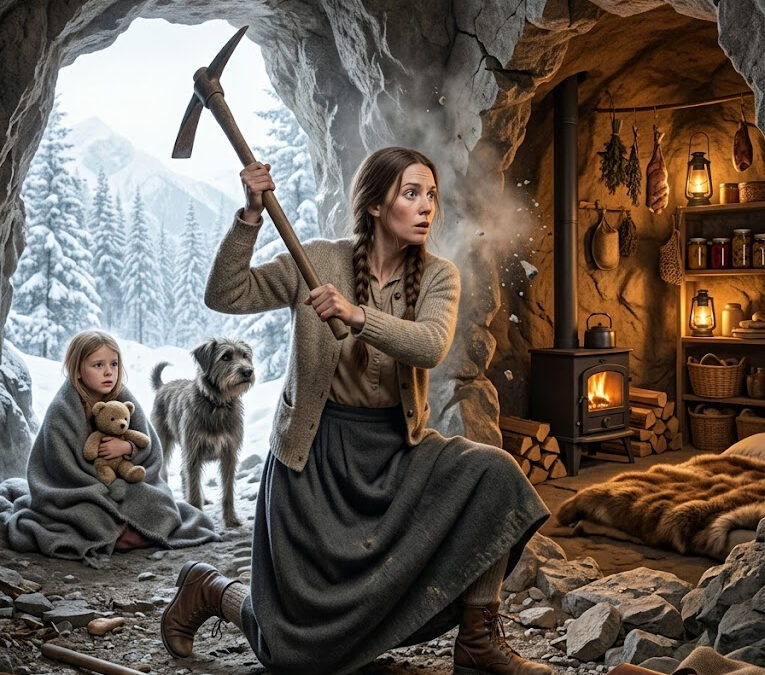
On the final slab, disaster nearly struck — a corner swung loose and crashed toward little Ren, standing near the entrance with her wooden horse clutched in both hands.
Brida threw herself between her daughter and the falling stone.
It caught on the wall just four inches from her back.
“Mama built a warm nest,” Ren whispered afterward, unshaken.
“Inside the mountain.”
Brida closed her eyes and held her daughter tight.
She was going to finish this house.
And nothing — nothing — was going to take it from her.
💪
The roof was sealed with clay, covered in soil, layered with turf until the entire structure vanished into the hillside like a fold in the earth itself.
Only a low stone doorway and a careful chimney gave away that anyone lived there at all.
Two days before the solstice, Hilda climbed up one final time before the weather turned.
She stood in the doorway, looked west, and her face changed.
“My knees have gone quiet,” she said.
“That’s worse.
It means it’s already decided.”
She turned to Brida.
“It’s coming in twenty-four hours, maybe less.
It will be the worst thing you’ve ever seen.
You’ll be all right, though.
The mountain has you.”
She was right on both counts.
The storm that struck Colorado that December would kill 67 people across four counties.
It struck the turf roof of the earth house and simply…
Passed over it.
Inside, the little tin stove burned steady.
The thermometer read 54 degrees while the world outside dropped past twenty below.
Ren slept through the first impact entirely.
But on the third night, Ash rose from his place by the door — hackles up, a low sound rumbling in his chest that Brida had never heard from him before.
She smelled it a heartbeat later.
Smoke.
Not the clean pine smoke of her stove — smoke being pushed back down the chimney instead of drawing up and out.
Someone had blocked it.
From the outside.
In the middle of a killing blizzard.
Brida wrapped Ren in every blanket she had, grabbed Owen Driscoll’s revolver from the shelf, and climbed onto her own roof into a wall of horizontal snow and screaming wind — where she found a figure crouched at the chimney, packing it shut with both hands.
He turned.
And even through the storm, she could see the shock on his face — not that she’d come, but at what he found in her eyes when she got there.
“This was always going to end one way, Brida,” Court Voss said.
“I’ve been patient.”
“You poisoned your uncle,” she said, leveling the revolver across the chimney stack.
“You poisoned my husband.
You climbed a mountain in a blizzard to smoke out a woman and a child.
Get down from my roof — or I will put you down from it.”
He came at her.
She didn’t try to hold ground she couldn’t hold.
She’d built this roof with her own hands — she knew every ridge, every joint, every place turf met stone.
When he drove her toward the eastern edge, she let him.
She stepped aside at the exact moment his own momentum carried him past her, toward the lip where the turf ended and the granite fell away into the dark.
For one frozen second, he hung there — arms wide, boots scrabbling on frozen turf, his face no longer the mask of a patient, calculating man but the face of someone who had just understood the ground beneath him was gone.
Then the edge took him.
The storm swallowed the sound of his fall completely.
Brida cleared the chimney with her bare, bleeding hands and climbed back down to her daughter.
She barred the door.
She sat on the floor with her back against the warm earth wall, held Ren close, and finally — finally — she wept.
Not in fear.
In release.
For Gunnar.
For Aldis.
For the frightened 22-year-old woman she’d been three months earlier, and would never be again.
When they found Court’s body in the snow days later, and later still the arsenic in his room and a letter in his own precise hand confessing everything, the county closed its investigation.
There would be no trial.
Only truth, finally, entered into the record.
The land — and everything beneath it — was hers.
Fully.
Forever.
What followed wasn’t just survival.
It was legacy.
Owen Driscoll built his own earth house on his pasture the following spring, with Brida correcting his chimney placement by four crucial feet.
Seth Hollis built one for his mother, then went on to study architecture on a scholarship arranged by the very doctor who once told Brida her walls would collapse before Christmas.
Within four years, eight earth houses dotted the mountainside around Dunore — families who would never again lose a child to a winter with no mercy in it.
A scientist eventually confirmed what Brida had always known in her hands and her heart: the mountain wasn’t just insulating her home.
It was giving off real heat, from a source even deeper than anyone first believed.
Hilda Baxter died in her sleep in 1888, having climbed that mountain nineteen times to bring soup and blankets to a woman she’d never met before that first November.
“That’s the kind of thing that saves a person’s life,” Brida told her grave.
“Not the soup.
The not waiting to be asked.”
Ash, the old gray dog who dug the very first hole and gave his life to guarding a mother and daughter through the worst winter Colorado had ever seen, lived to be old — truly old — and died peacefully by the door in 1899.
Brida buried him there, in the warmest ground on the whole ridge, and carved into his stone: “He listened first.
He came first.
He stayed.”
Ren grew up, went east on scholarship, became an architect herself — and in 1950, at the age of 86, Brida Voss died in the very earth house she’d carved out of a mountain with a pickaxe and $47 and absolutely nothing left to lose.
Her daughter set a second stone beside the first:
“She did not fight the winter.
She let the winter pass overhead.
The mountain is still warm.
The mountain is still there.”
Today, that house still stands.
Visitors walk the same seven miles Brida once walked with a baby on her back and a dog at her side.
They step through the low stone door.
They press their palms to the earthen wall.
And every single one of them feels it — the warmth that was never a legend at all.
The warmth of a woman who was told she had nothing, and built a home out of exactly that.
THE END








