Then my knees softened, and I lowered myself onto the kitchen floor with my back against the cabinet. The tile was cool through my dress. From where I sat, I could see one of Tessa’s napkins crumpled under her chair.
For four hours, she sat beside me. She read from a battered mystery novel, stopping every few pages to ask whether I wanted water, a blanket, the television lower, the window shade adjusted. She did not perform. She did not post a picture. She did not ask about money, documents, the house, or what would happen later.
“You do not have to come every time,” I told her.
“I know,” she said, not looking up from the page. “I want to.”
I turned my face toward the window so she would not see me cry.
Holden texted twice during those weeks. Polite, brief messages. How are treatments progressing? Thinking of you. Tessa sent a wellness basket with printed card stock and no handwritten note. Dashel called once, mostly to ask whether insurance was processing everything correctly.
I noticed.
I did not chase.
There is a powerful loneliness in not chasing people you once begged life to keep close. But there is peace in it too. Peace feels strange at first when you have spent decades mistaking anxiety for love.
Months passed. My strength returned slowly. My hair thinned but did not disappear entirely. My appetite came and went. Marguerite drove me to appointments when Hazel could not. Neighbors brought casseroles. My church friend Linda left porch flowers every Friday. The world, I learned, is full of people willing to show up quietly if you stop staring only at the door your own children walked out of.
Christmas came with cold rain and the smell of cinnamon in the kitchen.
I invited Holden, Tessa, Dashel, and Hazel for dinner because I did not want truth to arrive through rumor. Priya had told me I was under no obligation to explain my estate plan while alive. Marguerite told me the same thing with more colorful language. But I had spent thirty years managing my children’s feelings by withholding my own.
I was done doing that.
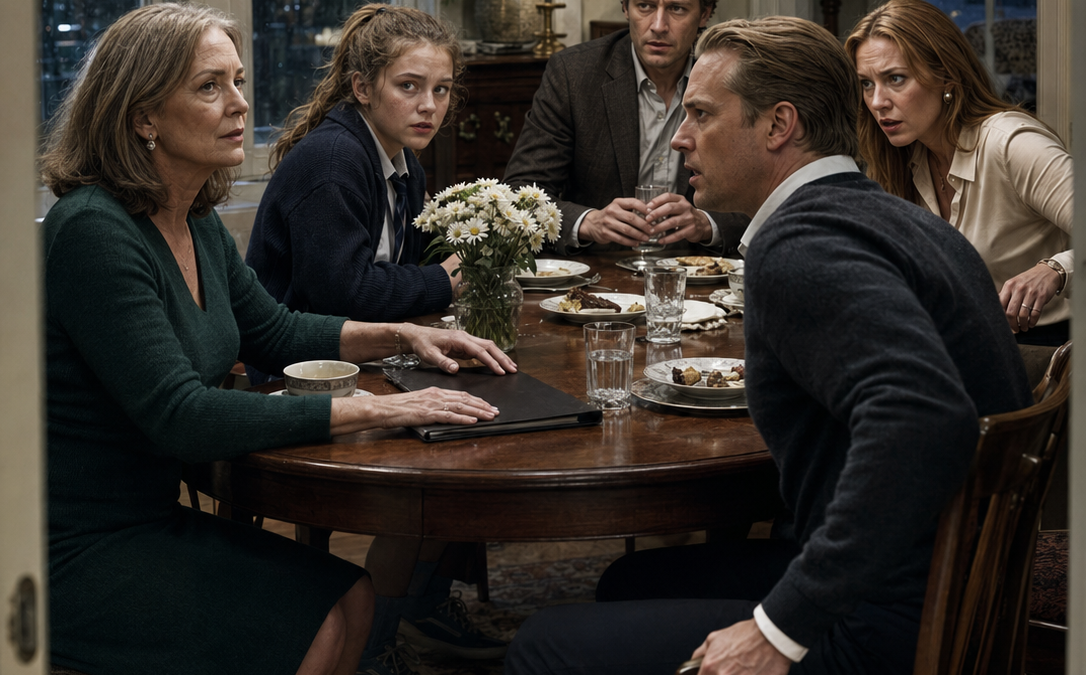
Hazel arrived first with daisies in a mason jar even though daisies were out of season and likely overpriced. She placed them in the center of the table.
“These looked like you,” she said.
Holden came next, carrying wine. Tessa arrived with a store-bought pie and a smile too bright to be natural. Dashel brought nothing but himself, which was at least honest.
Dinner was careful. Not warm. Careful.
After dessert, I placed my folded hands on the table.
“I need to tell you something,” I said.
Holden’s eyes sharpened. Tessa’s smile faded. Dashel sat very still.
I told them about the phone call from Dr. Castellan. The corrected report. The twenty-minute gap between their leaving and my learning the truth. I told them how long I had sat on the kitchen floor. I told them about the locks. Not the ring. Not yet. Some truths deserve timing.
Then I told them I had updated my will.
Tessa’s fork touched her plate with a tiny sound.
“The house will pass to Hazel when she is older,” I said. “A portion of the accounts will create a scholarship in your father’s name. Each of you will receive a modest amount.”
For a moment, no one spoke.
The dining room felt exactly as it had the night Holden asked about the will, except this time I was not afraid of the silence.
Holden recovered first.
“You changed everything because of one bad dinner?”
“No,” I said. “I changed everything because of the twenty minutes after it.”
His brow furrowed.
“The twenty minutes when you believed I had very little time left and decided my lack of paperwork mattered more than my fear. The twenty minutes when all three of you left me alone with a cold dinner because my answers did not satisfy you. The twenty minutes before you knew the truth had changed.”
Tessa’s eyes filled. I noticed, painfully, that the tears arrived only after the will was mentioned. Not when I described the kitchen floor. Not when I described sitting with corrected medical news alone. Not when I described the sound of the front door closing.
“Mom,” she said. “We were scared.”
I looked at her.
“Fear asks whether I am in pain before it asks about paperwork.”
Dashel swallowed.
“That is not fair.”
“Maybe not,” I said. “But it is accurate.”
Holden leaned back, jaw tight. “You are punishing us.”
“I am not punishing you. I am believing you.”
That sentence changed the air in the room.
Hazel looked down at her hands. Dashel closed his eyes. Tessa turned her face toward the window. Holden stared at me with something that was not anger exactly. It was the discomfort of seeing himself reflected without flattering light.
“You showed me who you were when you thought there was nothing left to gain,” I said. “I believed you.”
Nobody had an answer for that.
Tessa tried once more, voice lower now. “Can we talk about this like a family? Without attorneys and trusts and documents?”
“We are talking like a family,” I said. “This is what it looks like when a mother finally tells the truth instead of managing everyone’s reaction for them.”
Holden pushed back his chair.
The sound was softer than the first time.
Maybe that was growth. Maybe it was only the rug beneath the table.
He did not leave immediately. None of them did. That was new. They sat in the discomfort because there was nowhere respectable to put it down.
Three weeks later, Holden came alone.
He parked in the driveway and knocked instead of using the spare key he no longer had. When I opened the door, he looked smaller without his usual armor of cologne, coat, and certainty.
“Can we talk?” he asked.
I let him in.
We sat at the kitchen table where everything had cracked open. For a while, neither of us spoke. Outside, a delivery truck passed slowly. Somewhere down the street, a leaf blower started and stopped.
“I keep replaying that dinner,” he said.
I folded my hands around my mug.
“I keep trying to figure out when I became someone who could say that to you.”
“What have you decided?”
He looked toward the sideboard, where Thomas’s photograph still sat.
“I do not think it happened in one moment,” he said. “I think it happened slowly. Every time I let a text replace a visit. Every time I told myself you were fine because it was easier than asking. Every time I thought success meant being too busy for the people who made it possible.”
It was the most honest thing he had said to me in over a decade.
“Thank you,” I said.
He looked at me quickly, almost hopefully.
“Does it change anything?”
“It changes how I see you today,” I said. “It does not change the will.”
His face fell, but he nodded.
For the first time, I saw him accept a consequence without immediately trying to negotiate it.
That mattered.
It did not erase.
Tessa did not come alone. She sent messages at first, long ones filled with soft words and careful explanations. Eventually, months later, she admitted she had taken the sapphire ring. She said she had panicked. She said she wanted something of Grandma’s before “everything became complicated.” There was that word again, though by then it had lost its power over me.
I told her to return it.
She did.
Not in person. She mailed it in a padded envelope with a note that said, I’m sorry. I kept both the ring and the note. One in the jewelry box. One in the folder with the doorbell stills. Forgiveness, I have learned, does not require destroying evidence.
Dashel remained the quietest. He called more often after Christmas, though the calls were awkward. Sometimes he asked about my appointments. Sometimes about the house. Sometimes he said nothing for long stretches, and I let the silence sit between us without rescuing him from it. That was new too.
I am sixty-four now.
My treatment went well. Dr. Castellan still apologizes more often than she needs to, though I understand why. A clerical error nearly let my family’s performance of love stand unchallenged forever. That is a strange thing to be grateful for, and I am not sure grateful is the word. But there are mornings when I sit on my porch with coffee and think about how close I came to never knowing.
The house is still mine. The porch still creaks. Thomas’s glasses remain in the ceramic dish. Hazel planted daisies along the side yard last spring, kneeling in the dirt in her school clothes, mud on her knees, completely unconcerned about ruining a perfectly good pair of jeans. When the flowers bloomed, simple white petals and yellow centers, she took a picture and set it as my phone background.
She comes most Sundays now.
Sometimes she brings takeout. Sometimes textbooks. Sometimes nothing but herself. We sit on the porch, watch neighbors walk their dogs, and let the kind of ordinary quiet settle around us that does not ask to be photographed or rewarded.
That, I have decided, is what love looks like when it is not trying to prove anything.
I still see Holden, Tessa, and Dashel. Holidays. Birthdays. Occasional lunches. The relationships are not gone. They are different. Some bridges do not burn to the ground; they simply stop being the road you use to get home.
There are days I mourn that.
Of course I do.
A mother does not stop loving her children because she finally sees them clearly. Clarity is not a switch that turns tenderness off. It is a lamp that shows you where the furniture really is, so you stop bruising yourself in the dark.
Sometimes I reach for my phone to call Tessa about a recipe, or to ask Dashel something about an account, or to tell Holden that the magnolia tree finally bloomed early. Then I pause. Not because I hate them. I do not. But because the old instinct no longer fits the new truth.
I used to think the saddest thing would be finding out I had limited time.
I was wrong.
The saddest thing was discovering who started counting my belongings before they finished asking how I felt.
But the most freeing thing was discovering I did not have to hand my future to people just because they expected it.
One evening not long ago, Hazel and I sat on the porch as the sun dropped behind the oaks. The daisies moved in the breeze. She was filling out scholarship applications on her laptop, frowning at an essay prompt like it had personally offended her.
“Grandma,” she said suddenly.
“Yes?”
“Do you ever wish none of it happened?”
I watched a car roll slowly past the house. The driver lifted a hand. I waved back.
“I wish the diagnosis had been correct from the start,” I said. “I wish I had not spent four days afraid in that particular way. I wish your mother, your uncles, and I had never sat through that dinner.”
Hazel looked down.
“But no,” I said. “I do not wish I had stayed blind.”
She nodded like she understood more than I wanted a seventeen-year-old to understand.
Later that night, after she left, I stood in the kitchen and looked at the table. The same table. The same chairs. The same light above it. For a long time, I had thought rooms held pain forever. Now I know they can hold turning points too.
That table had witnessed my children leave.
It had also witnessed me stay.
I stayed long enough to answer the doctor’s call. Long enough to change the locks. Long enough to call Priya. Long enough to plant my feet in my own life and decide that love without loyalty would no longer write the final pages for me.
I picked up the vase of daisies Hazel had brought that week and set it in the center of the table.
Then I turned off the light.
For once, the house did not feel empty.
It felt mine.
THE END








