She sent the cancellation email while I was still on the phone. It landed in my inbox with a clean subject line and the kind of finality only corporate systems can provide.
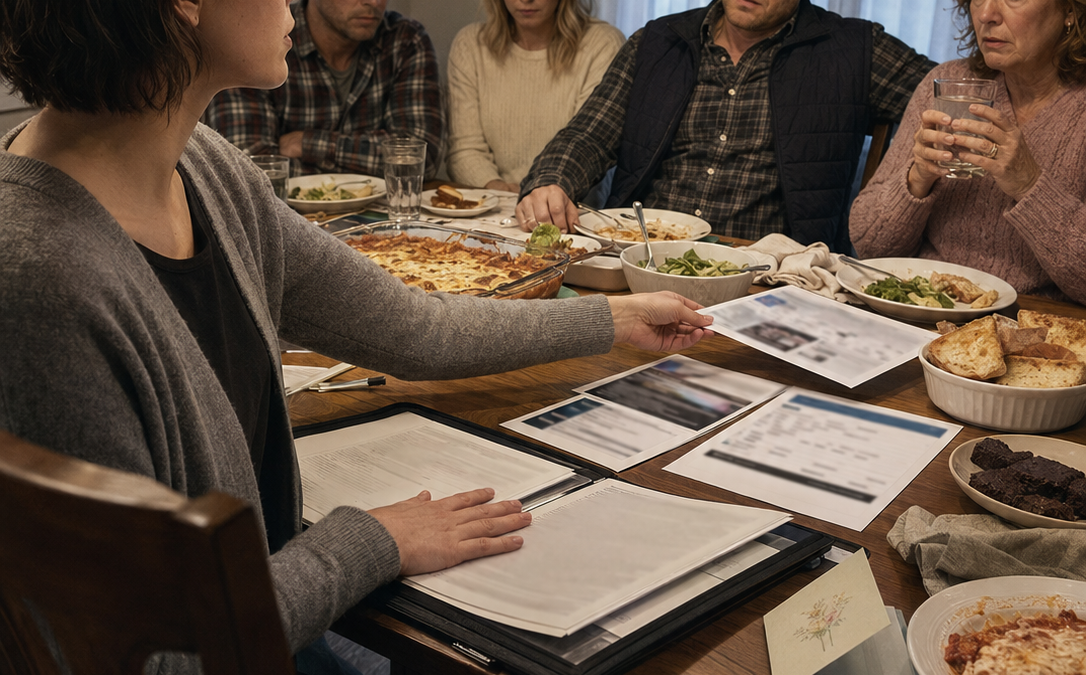
The next few months were not clean.
Families rarely respect a new boundary the first time they meet it.
Ryan tested it first. He sent me a link for a beach rental in June and wrote, You’re better at these sites. Can you handle?
I wrote back, No.
He sent a thumbs-up reaction, then nothing for three days.
My mother called to ask if I knew where she had stored the airline login I had made for her. I told her I didn’t, which was true enough. Megan asked whether I was “still mad,” and I told her I was still healing. She didn’t like that answer because it did not give her a deadline.
But gradually, the world adjusted around the shape of my no.
Not gracefully.
But it adjusted.
Naomi became my emergency contact in every system that mattered. When I told her, she cried a little, then tried to cover it by calling me ridiculous for not asking sooner. She came over one Sunday with groceries and sat on my couch while I made tea. We didn’t discuss my family for the first hour. She told me about her neighbor’s cat, a work meeting, a new bakery near her office. It felt strange and beautiful to be with someone who did not turn my pain into a task.
Patricia and I exchanged one more card.
I sent a thank-you note to the hospital, addressed to her unit. I did not overexplain. I simply wrote that her kindness had mattered. Two weeks later, another card arrived. This one had a little blue bird on the front.
Take good care, she had written. You deserve steady people.
I kept both cards on a small shelf by my kitchen window.
Spring came slowly.
My eyebrow healed into a faint line that makeup could cover but I usually didn’t bother hiding. My ribs stopped reminding me of themselves every time I laughed. My car came back from the shop with a new bumper and a slight smell of cleaning solvent that lasted for weeks. Life resumed its ordinary humiliations and gifts: grocery lists, laundry, deadlines, coffee too hot to drink, sunlight on the floor.
In April, Ryan called.
I almost did not answer.
Then I did.
“Hey,” he said.
“Hey.”
A pause.
“I booked the lake house myself.”
I looked out the window, surprised by the smallness of the announcement and the weight beneath it.
“Good.”
“It was annoying.”
“I know.”
“I didn’t realize how many forms there were.”
“I know.”
He laughed once, not comfortably.
Then he said, “I’m sorry about the hospital.”
I held still.
“I should have called,” he continued. “Even if I didn’t know everything. I saw the missed hospital number later. I told myself it was probably nothing because it was easier than dealing with the fact that I didn’t answer.”
That was a real sentence.
A hard one.
I sat down at the kitchen table.
“Thank you for saying that.”
“I don’t know how to fix it.”
“You don’t fix it by asking for the old version of me back.”
He was quiet.
“Yeah,” he said. “I’m starting to get that.”
We did not become close again all at once. Maybe we never would. But after that call, when he invited me to dinner, the invitation sounded like an invitation. Not a logistics request wearing family clothing.
In May, my mother came to my apartment alone.
She brought soup in a glass container and a small bouquet of grocery-store tulips. She stood in my entryway looking suddenly older than she had at Sunday dinner, not frail, just less certain of the script.
“I should have come after the hospital,” she said.
“Yes.”
She nodded.
“I didn’t because I was ashamed. And because Ryan was upset about the cabin, and somehow I let that become the louder thing.”
I took the soup from her.
“That happens a lot in this family.”
“I know.”
We sat at the kitchen table. The tulips leaned toward the light. Patricia’s cards were visible on the shelf by the window, and I saw my mother notice them.
She did not comment.
That was wise.
We ate soup quietly. She asked about my headaches. I answered. She asked whether I was driving over bridges again. I told her yes, but slower than before. She asked if I needed anything, and when I said no, she did not turn the no into a performance.
As she was leaving, she looked back from the hallway.
“Who is your emergency contact now?”
“Naomi.”
A flicker crossed her face.
Pain, maybe.
Consequence.
“I understand,” she said.
And to her credit, she did not ask me to change it back.
The lake house trip happened without me in June.
Ryan booked it. Megan brought food. Swann drove his truck. My mother sent one photo to the group chat, and for once, the caption did not sting. Maybe because I had been invited and had chosen not to go. Maybe because the reservation was not under my name. Maybe because I was spending that weekend with Naomi at a small art fair by the river, drinking lemonade and buying a ceramic bowl I did not need.
On Saturday afternoon, my phone buzzed.
A message from Ryan.
Hope your weekend is good.
I looked at it for a moment.
Then I wrote back, Yours too.
That may not sound like much.
It was.
By the first anniversary of the accident, I had stopped calling that morning the worst day of my life.
It was not.
It was painful. It was frightening. It left a scar and a deductible and a folder full of proof I wish I had not needed. But it also did something no argument had ever managed to do.
It made the invisible visible.
It showed me the architecture of my family role in one clean, unbearable sequence: emergency call, no answer; road trip post, red heart; Venmo request; cabin urgency; anger when I touched the one lever that belonged to me.
Once I saw it, I could not unsee it.
Once I could not unsee it, I could stop maintaining it.
That morning, a year later, I drove across the same overpass.
The weather was clear. The sky was pale blue. Cars moved normally around me. My hands tightened on the wheel at first, but then the road opened ahead, and I kept going.
I did not stop.
Afterward, I went to breakfast alone at a diner near the river. I ordered eggs, toast, and coffee. The waitress called me hon without making it mean anything. Sunlight came through the window and warmed the table. I took Patricia’s card from my bag because I still carried it sometimes, folded inside the clarity folder, though the folder had become thinner over time.
I read her blue-ink signature again.
Patricia.
Just a name.
Just a person who had stayed ten minutes.
Sometimes that is enough to remind you what showing up looks like.
My family is different now.
Not perfect. Not healed in the way people like to imagine at the end of a story. My mother still sometimes reaches for old habits, then catches herself. Ryan still gets defensive before he gets honest. Megan still wants everyone to be fine faster than anyone is actually fine. Swann remains mostly absent, which may be his most respectful contribution.
But I am different too.
That is the part I trust more.
My card is not on file.
My emergency contact is someone who answers.
My phone is not a family switchboard.
My yes has become more valuable because it is no longer automatic.
And the space between estranged and reconciled, the one I once thought would feel like failure, has become a place where I can breathe. It has boundaries. It has quiet mornings. It has soup from people who mean it and cards from people who owed me nothing. It has room for grief, but not for pretending.
The accident report still sits in the folder, folded at the crease where I first held it with sore hands.
Single-vehicle collision, icy overpass, 6:14 a.m.
It does not say that a woman named Patricia sat beside me when no one came.
It does not say that a cracked phone screen showed me exactly where I stood.
It does not say that a $3,100 request became the first door I closed.
Reports rarely include the real point.
They record impact.
Not awakening.
But I know what happened.
I went into that week as the person everyone could count on to absorb the cost.
I came out as the person who finally asked why the cost was always mine.
And when my phone buzzes now, when a family name lights the screen, I no longer reach for it like a reflex. I look at it. I breathe. I decide.
Sometimes I answer.
Sometimes I don’t.
Either way, the reservation is no longer under my name.
THE END








