“No. They will learn that I canceled an important event the night before because my family decided my sister’s news mattered more.”
Part 1 of 5:
“Cancel your engagement party.”
My mother said it from the middle of my kitchen with the confidence of someone changing a dinner reservation she had made herself.
I was standing at the sink, drying the last of the wineglasses we planned to take to Lavender Crest the following morning. The soft yellow light above the island reflected in the glass, and for a moment I watched my mother’s face distort across its curved surface.
Behind her, my fiancé, Daniel, had gone completely still.
I placed the glass carefully on the towel.
“Why?”
“Ashley was promoted today.”
My mother crossed her arms over her pale blue sweater. She had come directly from my sister’s apartment, still wearing the pearl earrings she saved for important family occasions. Her expression suggested the promotion had not merely been announced. It had created a new law of nature.
“I heard,” I said. “I called her this afternoon.”
“Then you understand how important this is.”
“I understand that she earned a promotion.”
“She has been working toward this for years.”
“I know.”
“She is now regional vice president.”
“I know that too.”
My mother glanced toward Daniel, perhaps expecting him to help translate the obviousness of her request.
He did not.
“The family needs to celebrate together,” she continued. “Ashley’s company wants to make a formal announcement, and several senior executives may attend. We cannot have everyone divided between two events.”
“My engagement party has been planned for six months.”
“It can be moved.”
“A hundred and twenty people have confirmed.”
“People change plans all the time.”
“The caterer has already prepared half the menu.”
“That is what deposits are for.”
“The flowers arrive tomorrow morning.”
“Then use them for Ashley’s event.”
The sentence landed more clearly than everything before it.
She did not want me to postpone the party.
She wanted to take it.
The food, flowers, guests, venue, staff, and work Daniel and I had put into the evening had already become available in her mind. Ashley’s success had appeared, and my celebration had transformed into a collection of resources waiting to be reassigned.
“What exactly are you asking me to do?” I said.
My mother’s expression softened with relief. She thought I was beginning to cooperate.
“Keep it simple. Tell your friends there has been a family scheduling issue. We can still use Lavender Crest tomorrow night, but the focus should be Ashley’s promotion. You and Daniel can announce another engagement date later.”
Daniel leaned one hand against the kitchen island.
“Another engagement date?”
My mother gave him a patient smile.
“I don’t mean the engagement itself. I mean the party.”
“The date is tomorrow,” he said.
“And there will be other tomorrows.”
I looked down at the dish towel in my hand.
For thirty-two years, I had been the flexible daughter.
That was the word my family used.
Flexible.
It sounded like praise when I was young. Teachers called me easygoing. Relatives said I never made trouble. My mother told people I could adapt to anything.
What it really meant was that I had learned to move before anyone needed to push me.
When Ashley’s dance recital conflicted with my eighth-grade awards ceremony, we attended the recital.
When her college orientation fell on my twenty-first birthday, we celebrated my birthday the following weekend with a grocery-store cake.
When she married her first husband, I changed the launch date of my small event-planning company because my mother insisted no one could focus on two major things in the same month.
Ashley had not always asked for these sacrifices.
That mattered.
Sometimes she benefited quietly. Sometimes she looked uncomfortable. Once or twice, she even objected.
But the family system never required her to object for long.
My mother considered Ashley’s life the main calendar. Everyone else’s plans were written in pencil around it.
“I’m not canceling the party,” I said.
My mother blinked.
“What?”
“I said I’m not canceling it.”
“Emily, don’t be difficult.”
The word arrived right on schedule.
Difficult meant I had remained still when expected to move.
“This is not about being difficult.”
“Ashley’s promotion is a major professional milestone.”
“So is my engagement.”
“You have been engaged for four months.”
“And tomorrow is the celebration we planned.”
“You can celebrate anywhere.”
“So can Ashley.”
My mother stared at me.
Daniel looked down, hiding the smallest smile.
“That is not the point,” she said.
“It seems exactly like the point.”
“Ashley’s company may send executives. This could affect her future.”
“My guests have booked flights. Daniel’s parents drove in from Indianapolis today. My college roommate is already at a hotel downtown.”
“They will understand.”
Her face tightened.
“You are making this into a competition.”
“I did not come here asking Ashley to cancel anything.”
“She does not have an event to cancel.”
“Then she is free to plan one.”
My mother exhaled sharply and turned toward Daniel.
“Can you talk some sense into her?”
He lifted his eyes.
“I think Emily is making perfect sense.”
“This is a family issue.”
“I am going to be her family.”
The room became quiet.
My mother looked back at me.
“You will regret making a permanent problem over one evening.”
I folded the dish towel and placed it beside the sink.
“You came into my home and told me to cancel my engagement party so my sister could use it.”
“I said we could combine the celebrations.”
“No. You said the focus would change, my guests would be informed, and Ashley would use the arrangements.”
“You are twisting my words.”
“I am repeating them.”
Her cheeks flushed.
“A mature person would recognize that family requires sacrifice.”
“I have recognized that for years.”
“Then act like it.”
Something inside me became very calm.
That calm confused her more than anger would have.
I smiled.
“We’ll see.”
She stared at me.
“What does that mean?”
“It means tomorrow is already planned.”
“Emily—”
“I need to finish packing the glasses.”
Daniel opened the front door.
My mother looked from him to me, waiting for the familiar apology. The one where I softened the disagreement, offered a compromise, or reassured her that I understood why Ashley’s moment deserved special treatment.
None came.
She picked up her purse.
“I hope you think carefully about the kind of tone you’re setting for this family.”
I met her eyes.
“I am.”
After the door closed, Daniel remained in the hallway for several seconds.
Then he returned to the kitchen.
“You were magnificent.”
“I dried a wineglass.”
“You dried it with authority.”
I laughed once, though my stomach was tight.
He came around the island and placed both hands gently on my waist.
“Are you all right?”
“I don’t know.”
“Do you want to cancel?”
“No.”
“Do you want to tell them?”
I looked toward the stack of event boxes beside the dining room wall.
“No.”
Daniel studied my face.
“Still?”
“Especially now.”
Six years earlier, I had purchased Lavender Crest through an LLC with a name no one in my family connected to me.
The venue sat twenty minutes outside Lexington, Kentucky, at the end of a narrow road lined with oak trees and low stone walls. The original estate had been built in the 1920s by a family that raised thoroughbred horses. By the time I first saw it, the main house had been empty for nearly a decade.
The roof leaked.
The ballroom floor had buckled.
Ivy covered most of the eastern windows, and the old greenhouse was missing three large panels of glass.
I fell in love with it immediately.
I was twenty-six then, recently divorced from a man who believed my event-planning business would become respectable only after he took over its finances. The marriage ended quickly once I discovered he had been using company money to cover personal debts.
My mother called the divorce embarrassing.
Ashley called it necessary.
That was one of the reasons I never considered my sister an enemy, even when the family’s attention bent around her. She had driven across town the night I left my husband, carried boxes down three flights of stairs, and slept on my new apartment floor because I had not yet purchased a couch.
The conflict between us was not simple.
Real family conflicts rarely are.
Ashley loved me.
She had also spent her whole life inside a system designed to make her comfort feel natural and my accommodation feel voluntary.
After the divorce, I worked constantly.
I planned corporate dinners, nonprofit galas, retirement parties, weddings, university receptions, and once a birthday celebration for a golden retriever whose owners rented a string quartet.
I saved every possible dollar.
My former professor, Margaret Ellison, became my first investor after I showed her the Lavender Crest property. She had inherited money from an aunt and wanted to place part of it into a project that restored an old Kentucky building rather than replacing one.
We created Blue Heron Hospitality.
No family names.
No public announcement.
I invested everything I had and borrowed the rest through a commercial rehabilitation loan. For four years, every profitable event funded another section of the restoration.
The roof came first.
Then electrical work.
The ballroom floor.
The kitchen.
The greenhouse became a glass reception pavilion overlooking a lavender garden we planted in long, careful rows.
The name Lavender Crest came from that field.
By the fifth year, the venue was booked most weekends from spring through Christmas.
My family knew I managed events there.
They did not know I owned it.
At first, the secrecy had been practical. The loan was fragile. The renovation could have failed. I did not want questions, opinions, or the familiar family enthusiasm that sometimes arrived only after success seemed safe.
Later, it became a form of protection.
My mother treated anything I owned as something the family might reasonably use.
When I leased a lake cabin for business retreats, she asked whether Ashley could host a bridal weekend there.
When I purchased a delivery van, my father volunteered it for a cousin’s move.
When my company hired a graphic designer, my mother assumed he could create free invitations for a family reunion.
None of the requests seemed unreasonable alone.
Together, they taught me that private success remained private longer when no one knew where to reach for it.
Daniel knew.
Margaret knew.
My closest friends knew.
The venue staff knew.
Ashley did not.
Part of me had been curious about how my family would behave at Lavender Crest if they believed I was merely a client using someone else’s property.
The answer came the night before my engagement party.
My mother had not asked whether the venue owner would permit a change.
She had assumed my plans were the only obstacle.
After she left, Daniel and I drove to Lavender Crest.
The venue glowed beneath exterior lights when we arrived. Staff members moved between the ballroom and kitchen. White linen covered the tables. Small brass candleholders waited in careful rows.
Lena Brooks, the venue director, met us near the entrance carrying a clipboard.
“Your mother called.”
I stopped.
“When?”
“Twenty minutes ago.”
Daniel looked at me.
“What did she say?”
Lena checked her notes.
“She introduced herself as the mother of tomorrow’s guest of honor.”
I almost laughed.
“Which guest of honor?”
“That was my question.”
Lena continued.
“She said there had been a family change and requested that we replace your engagement signage with promotion materials for someone named Ashley. She also asked whether the lavender-and-cream floral design could be adjusted to include corporate blue.”
Daniel stared at the ceiling.
“Corporate blue.”
“She said invoices could remain under your account.”
“Of course they could.”
Lena looked concerned.
“I told her no changes could be made without authorization from the contract holder.”
“What did she say?”
“She asked to speak with the owner.”
Daniel turned away, shoulders shaking with silent laughter.
“What did you tell her?” I asked.
“That the owner was unavailable.”
“Technically true,” he said.
Lena handed me the clipboard.
“There was one more request. She asked whether Ashley could make a formal speech before your engagement toast.”
I read the notes.
“Did she cancel anything?”
“No. She could not authenticate the account.”
I handed the clipboard back.
“Keep everything exactly as planned.”
“Already done.”
She hesitated.
“Do you want security informed?”
“Not yet.”
“What if she arrives with additional guests?”
“The guest list is final. No one enters without a place card or direct approval from me or Daniel.”
Lena nodded.
As she walked away, Daniel leaned against the entry table.
“Are you still not telling them?”
“Not tonight.”
“She tried to rebrand your engagement party after you said no.”
“I know.”
“She called your employees and asked for the owner.”
“I know.”
“The owner is you.”
“I remain aware.”
He came closer.
“I trust you. I only want to make sure silence is still serving you.”
I looked through the ballroom doors.
The tables were arranged in a soft arc around a low platform. Lavender linen runners crossed the cream tablecloths. The candles had not yet been lit, but the brass reflected the warm ceiling lights.
At the far end of the room stood a walnut display wall Daniel and I had designed together. It held photographs from our relationship: hiking in Red River Gorge, cooking in my apartment, painting one of Lavender Crest’s guest rooms, laughing beneath an umbrella during a thunderstorm.
Near the center was a photograph of us standing in the unfinished ballroom years earlier.
My family had seen the picture.
They thought we were visiting one of my work sites.
The truth had been visible all along.
“I don’t want to tell them in an argument,” I said.
“Then how?”
“I want them to walk into reality without me having to defend it.”
The next morning, I arrived at Lavender Crest before seven.
Fog rested low over the lavender rows. Dew silvered the stone path. The oak trees along the drive stood dark against a pale spring sky.
I unlocked the main door with my own key.
That small action steadied me.
Inside, the building smelled of coffee, flowers, polished wood, and bread warming in the kitchen.
The florist arrived at seven-thirty carrying buckets of white roses, lavender, ranunculus, and eucalyptus. By eight, the ballroom had begun to resemble the picture Daniel and I had carried privately for months.
His parents arrived shortly after nine.
Marilyn and Thomas Caldwell had driven from Indianapolis and stayed at a hotel near downtown. They treated my work with the uncomplicated respect of people who believed asking questions was more useful than making assumptions.
Marilyn hugged me in the entry hall.
“You look tired.”
“My mother visited last night.”
“That explains it.”
Daniel had told them.
Thomas glanced toward the ballroom.
“Does your family know yet?”
“No.”
He smiled slightly.
“They will.”
Marilyn touched my arm.
“Do you want us nearby when they arrive?”
“I want you enjoying yourselves.”
“We can do both.”
By ten-thirty, the photographer was documenting the final setup. The caterer arranged charcuterie boards in the greenhouse pavilion. Musicians tuned near the ballroom windows.
I walked through each space with a checklist, though Lena had already completed every task.
The process was familiar.
Check the candles.
Check the microphones.
Confirm dietary requests.
Confirm vendor meals.
Confirm the cake delivery.
Routine calmed me.
At eleven, Daniel found me beside the seating chart.
“You have checked that board four times.”
“Five.”
“No one has changed seats.”
“That sounds like something someone says right before changing seats.”
He stood beside me.
The chart divided our guests among twelve tables. Friends, colleagues, extended family, former professors, neighbors, and employees who had helped build the life we were celebrating.
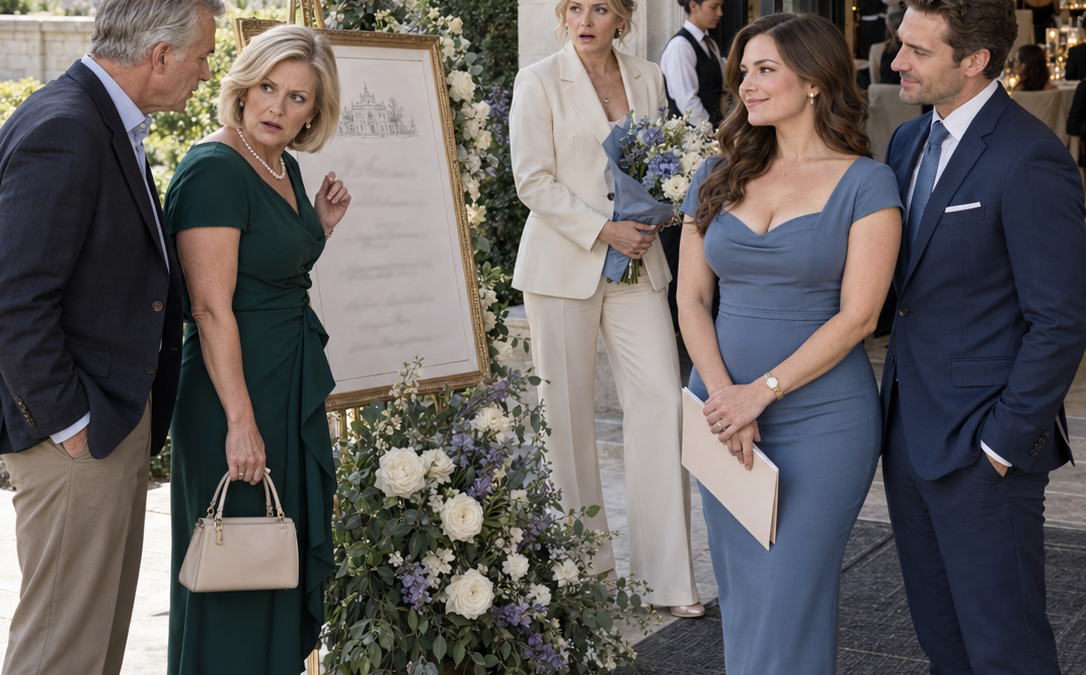
Part 2 of 5: By the time my family arrived at Lavender Crest, more than a hundred guests were already inside celebrating Daniel and me. Friends had brought flowers, the ballroom was filled with sunlight, and one simple sign stood at the entrance: Private Engagement Celebration, hosted by Emily Hart and Daniel Caldwell, Lavender Crest owned and operated by Blue Heron Hospitality, Emily Hart, Founder.
My mother saw it first.
She stopped so suddenly that my father nearly walked into her. Ashley followed her gaze, then looked at me. Behind them stood three business executives my mother had brought despite never receiving permission to turn the engagement party into a promotion event.
“You own this place?” Mom asked.
“Yes.”
“Since when?”
“Six years.”
That answer forced several assumptions to collapse at once. The staff she had been calling reported to me. The venue she tried to rearrange belonged to my company. The owner she had asked to speak with was the daughter standing in front of her.
Ashley looked stunned too.
“Why didn’t you tell us?”
“Because I didn’t want the venue treated like a family resource.”
Mom called that unfair, but I reminded her that she had tried to change my event the night before and had arrived with uninvited corporate guests anyway.
Ashley went pale.
“Mom told them there would be a promotion toast.”
The executives immediately understood what had happened. One apologized and said they could celebrate Ashley at the office on Monday. They congratulated Daniel and me, then returned to their car without argument.
My mother watched them leave.
“You embarrassed her.”
“I didn’t invite her coworkers to an event where they had no place cards.”
Before anyone entered, I made one condition clear: there would be no promotion announcement, corporate speech, or alteration to the program.
Mom resisted.
Ashley did not.
“Mom, that’s fine.”
Then something unexpected happened. Ashley admitted she had never asked for my celebration to be taken over. She had been told I agreed to combine the events.
“She said no,” Ashley told our mother.
“She said we’ll see.”
“Mom.”
That single word carried years of exhaustion.
Then Ashley looked at me.
“I’m sorry.”
I told her I was proud of her promotion and that we should celebrate it properly.
“Not like this,” she said.
For the first time, my sister chose not to benefit from the system that had so often favored her.
“You deserve something special,” Mom insisted.
Ashley looked at her.
“So does she.”
Part 3 of 5: The engagement party began exactly as Daniel and I had planned. There was no public confrontation and no triumphant announcement about who owned the venue. Guests ate, laughed, and offered toasts while my family sat among everyone else rather than at some privileged head table.
During the greenhouse ceremony, Daniel promised never to treat my independence as something he needed to overcome. He promised not to call control protection and not to let comfort become an excuse for silence.
When it was my turn, I told him what I had finally learned.
“I spent a long time believing kindness meant making myself easy to rearrange. You taught me that love can ask for compromise without asking for disappearance.”
I promised that neither of us would have to become smaller for the other to feel secure.
Afterward, Ashley found me near the greenhouse doors and asked to talk. We walked through the lavender field while she carried her heels in one hand.
She admitted she truly had not known Mom planned to replace my engagement celebration. She had been told I offered Lavender Crest for a combined event.
Then she asked the question she should have asked years earlier.
“How did I not know you owned all of this?”
“You didn’t ask many questions about my work.”
The truth landed hard.
Ashley admitted that although she had not always requested our mother’s favoritism, she had benefited from it and rarely stopped it. She even told me that on my twenty-first birthday she had wanted to return early from orientation, but Mom convinced her I preferred celebrating later because I did not like attention.
“I liked attention,” I said.
“I know that now.”
Ashley began understanding something I had spent years trying not to name: our mother had made me “flexible” because flexibility made her own choices easier to justify.
Then Ashley said something even more honest.
“I liked being the child whose events mattered.”
I did not punish her for saying it.
I appreciated that she finally could.
Near sunset, my mother approached me alone. She still believed I should have told the family about Lavender Crest earlier and accused me of enjoying the moment she discovered the truth.
“I enjoyed knowing you couldn’t override me,” I said.
“That isn’t very different.”
“It feels different when you’re the person being overridden.”
For once, she had no immediate defense.
Eventually she apologized for calling the venue after I had refused her request. It was not a complete apology. She still insisted the additional executives could easily have been accommodated.
I laughed.
“That part needs work.”
“It does.”
Nothing was fully repaired.
But the conversation had moved one inch closer to honesty, and sometimes one inch is enough to begin.
Part 4 of 5: Three weeks later, Ashley held her own promotion dinner at a downtown restaurant. The invitation came directly from her, not through Mom. It was small, appropriate, and entirely hers.
During the meal, Ashley thanked her colleagues, then looked toward me.
“My sister taught me something this month. An accomplishment does not become more important by taking space away from someone else’s.”
After dinner, she gave me a framed photograph from the engagement party. Daniel and I were standing inside the greenhouse with lavender visible beyond the glass.
On the back she had written: Your moment stayed yours. I’m glad it did.
I kept it in my office.
My relationship with Mom changed much more slowly. She continued testing the boundary through smaller requests. Could a cousin use Lavender Crest at a reduced rate? Could the family use the greenhouse for Christmas pictures? Could Ashley’s department receive special access because it might bring future business?
Each time, I answered as the owner.
Sometimes yes, with a contract.
Sometimes no.
Mom hated the paperwork at first.
Eventually she began respecting it.
A year later, she called the venue herself to arrange an anniversary party. She introduced herself as my mother, then asked about pricing, availability, and policies exactly like any other client.
Lena called me afterward.
“She followed every procedure.”
Progress can look remarkably ordinary.
Daniel and I married at Lavender Crest the following spring. Ashley stood beside me as maid of honor. Mom arrived early and, for perhaps the first time in her life, touched nothing she had not been asked to touch. She did not rearrange flowers, alter seating, or question the schedule.
Before the ceremony, she stepped into the doorway while I was getting ready.
For one second, I remembered the old version of her telling me to cancel my engagement because Ashley had experienced a better day.
This time she looked only at me.
“You look beautiful.”
“Thank you.”
Then she said something small that mattered enormously.
“I’m ready when you are.”
The timing belonged to me.
Years later, Daniel and I expanded Blue Heron Hospitality and restored a second property, an old brick hotel near Louisville. This time, I told my family before construction began. Mom asked whether she could tour it. I said yes. She wore practical shoes and asked permission before entering rooms marked for contractors.
Ashley later booked the finished hotel for a leadership retreat.
She paid the standard rate.
I sent champagne to her room anyway.
Generosity felt entirely different once it was chosen instead of assumed.
Part 5 of 5: Lavender Crest is still mine. Near the main entrance hangs a framed copy of the sign from our engagement party. I did not preserve it to remember my mother’s embarrassment. I kept it because that sign marked the day I finally stopped confusing compliance with kindness.
For years, I believed I could protect what I built only by keeping it hidden. The engagement party taught me something better: a boundary is not real because no one knows where it is. It becomes real when someone reaches it, pushes against it, and you allow it to remain standing.
My mother reached mine in the kitchen, through phone calls, and finally at Lavender Crest with three executives and an alternate plan. Nothing explosive happened. No one was thrown out. No screaming match ruined the party. My family simply walked into a place they assumed they could rearrange and discovered that my life had already been built beyond their control.
The ownership papers mattered. The contracts mattered. The staff, guest list, and sign mattered. But the most important evidence was my calm. I no longer needed to persuade anyone that the evening belonged to me because I had stopped behaving as though ownership was negotiable.
The night before that party, Mom told me to cancel my life because Ashley had experienced a better day. I smiled and said, “We’ll see.”
By the following afternoon, she did.
THE END








