“My parents removed me from the guest list and informed the planner that I’m no longer family.”
PART 1:
“The invitation has been formally withdrawn.”
The woman on the phone said it carefully, as if choosing the right tone could soften the sentence.
I was sitting behind the glass desk in my office thirty floors above downtown Seattle, halfway through a quarterly report, when the call came in. Rain had begun streaking the windows, turning the buildings across Elliott Bay into gray shapes.
I had almost let the unfamiliar number go to voicemail.
Instead, I answered.
“Is this Nicholas Miller?”
“Yes.”
“My name is Laura Vance. I’m coordinating Daniel Miller and Isabella Hart’s wedding.”
My brother’s wedding.
For a second, something warm moved through me. Daniel and I had not been close for years, but I still remembered him at eight years old following me around the neighborhood on a bicycle too large for him, trying desperately to prove he could keep up.
“Of course,” I said. “Is something wrong?”
The pause was small.
Still long enough.
“There’s been a change in the guest list.”
I sat straighter.
“What kind of change?”
“I was asked by your parents to contact you directly.”
Paper shuffled on her end.
I could hear how much she hated this assignment.
“Your invitation has been rescinded.”
The word landed with almost comic formality.
Rescinded.
Not changed.
Not reconsidered.
Not, we think maybe it would be better if you didn’t come.
Rescinded.
I looked through the window at the rain.
“Understood.”
Laura hesitated.
“There’s one more thing.”
“Go ahead.”
“They wanted me to pass along a message.”
Her voice became noticeably uncomfortable.
“What message?”
Another pause.
Then she read it.
“They said, ‘Nicholas is no longer part of this family, and his presence is not needed at the celebration.’”
For several seconds, neither of us spoke.
I had spent ten years being treated as if I occupied some unofficial space just outside the Miller family portrait.
This was different.
This was a declaration.
And my parents had made a stranger deliver it.
“Mr. Miller?”
“I’m here.”
“I’m very sorry.”
“You didn’t write the message.”
“No.”
“Then you have nothing to apologize for.”
I leaned back.
“Just to confirm, the wedding is still scheduled at Ocean Vista Grand Resort?”
“Yes.”
“The last Saturday this month?”
“Yes.”
“The Grand Ocean Ballroom?”
“That’s correct.”
I looked at the clock.
2:15 p.m.
“Thank you, Laura.”
“For what?”
“For being professional.”
I ended the call.
Then I sat in silence.
There was no dramatic anger.
No urge to throw anything.
No sudden need to call my parents and demand an explanation.
What I felt was quieter.
Clarity.
For years, I had believed some part of me was still waiting for my parents to reconsider who they thought I was.
Now they had saved me the effort.
They had made their decision explicit.
I turned my chair toward the rain-darkened city.
Ocean Vista Grand Resort.
Top-tier wedding package.
Two hundred thirty guests.
Grand Ocean Ballroom.
Three-day room block.
Seventy-five thousand dollars already paid.
I knew every number because Ocean Vista belonged to me.
Not metaphorically.
Not through some vague investment.
I owned the company that owned the resort.
My parents did not know.
Daniel did not know.
Apparently, Laura did not know either.
That was not an accident.
I had spent most of my adult life learning that privacy is different from secrecy.
Secrecy is hiding something because you are ashamed.
Privacy is deciding who has earned access.
My family had stopped earning access years ago.
I pressed the intercom.
“Chloe?”
My executive assistant answered immediately.
“Yes?”
“Could you come in?”
She appeared less than a minute later.
Chloe Evans had worked with me since our headquarters was a second-floor office above a laundromat in Bellevue. She had seen me sleep beneath conference tables, survive venture meetings on vending-machine coffee, and walk into negotiations where every person in the room expected me to lose.
She studied my face.
“What happened?”
“My family just disinvited me from Daniel’s wedding.”
She blinked.
“What?”
“They also informed the wedding planner that I’m no longer family.”
Chloe slowly closed the office door.
“The wedding at Ocean Vista?”
“Yes.”
Her eyebrows rose.
“Oh.”
“Get Jessica Chen on the phone.”
Our general counsel.
“And Michael Abernathy.”
“Resort GM?”
“Yes.”
Chloe did not ask why.
That was one of the reasons she remained excellent at her job.
Within five minutes, I had both of them on a conference line.
Jessica spoke first.
“Nicholas. What’s going on?”
“Michael, do you have the Miller-Hart wedding file?”
Keyboard sounds.
“Yes, sir. Grand Ocean package. Fully paid. We’re three weeks out.”
“I want the booking canceled.”
Silence.
Michael cleared his throat.
“Canceled?”
“Yes.”
Jessica cut in.
“Nicholas, before you do anything, tell me the context.”
Another silence.
Then Jessica sighed.
“I see.”
Michael said nothing.
I continued.
“Refund every dollar they paid.”
“All seventy-five thousand?”
“Yes.”
“Any cancellation fee?”
“None.”
I thought for a moment.
“Add ten thousand for inconvenience.”
Jessica said, “You know that doesn’t automatically eliminate potential contract issues.”
“I know.”
“What reason are we giving?”
“Owner-required exclusive use of the property.”
Michael hesitated.
“That is technically accurate if you intend to use it.”
“I do.”
“For what?”
I looked at the rain.
“I haven’t decided yet.”
Jessica groaned softly.
“That answer does not improve my legal confidence.”
“You’ll review the contract before anything goes out.”
“I will.”
“If there’s any clause that prevents us from doing this cleanly, tell me.”
“And if there isn’t?”
“Cancel it.”
Michael’s tone became formal.
“Understood.”
“One more thing.”
“Yes?”
“No one tells them who the owner is.”
Jessica immediately understood.
“Nicholas.”
“I’m not asking anyone to lie.”
“I know.”
“I’m asking the resort to send the cancellation under ordinary management channels.”
“That’s defensible.”
“Good.”
I ended the call.
Chloe was still standing near the door.
“You okay?”
“No.”
That surprised her.
I think she expected the polished answer.
I rubbed both hands over my face.
“But I will be.”
She nodded.
Then quietly left.
The invitation had arrived three weeks earlier.
Heavy cream paper.
Embossed lettering.
My name in dark blue calligraphy.
Nicholas Miller.
I remember standing at my kitchen island holding it and feeling ridiculous optimism.
Maybe that was why the phone call hurt.
Because some stupid part of me had believed the invitation meant something.
Daniel and Isabella.
Ocean Vista Grand Resort.
My own resort.
I had almost laughed when I saw the venue.
The company had purchased Ocean Vista two years earlier as part of a seven-property hospitality acquisition. I had never told my family.
Why would I?
My mother still referred to my career as “the computer thing.”
The invitation had felt like an olive branch.
Maybe, I thought, they were finally ready to act like I belonged.
So I called Mom.
She answered on the third ring.
“Hello?”
“Hi, Mom.”
There was a pause.
“Nicholas.”
Her voice lost warmth so quickly I could almost hear the door close.
“Is something wrong?”
That was always her assumption.
If I called, something must be wrong.
“No. I got Daniel’s invitation.”
“Oh.”
“It’s beautiful.”
“Yes. Isabella’s family has wonderful taste.”
“I’m happy for them.”
“So are we.”
Another pause.
“It’s a very expensive wedding,” she continued. “Your father is stressed, but Daniel deserves something special. He’s worked very hard to build a stable life.”
Stable.
My mother could turn a compliment to one child into a verdict on another without changing her tone.
“That’s good.”
“How are you?”
The question was automatic.
“Good.”
“Still doing your computer business?”
I looked around the kitchen of the Seattle penthouse I owned outright.
The computer business had recently acquired a European competitor, employed more than eight hundred people, and held management interests in a hospitality group with properties from California to the Caribbean.
“It’s going fine.”
“That’s nice, dear.”
I knew what came next.
“Listen, I have the florist on the other line.”
“Of course.”
“We’ll see you at the wedding.”
Then she hung up.
I stood at the island with the invitation in front of me.
There had been a time when calls like that ruined my evening.
Now they merely exhausted me.
My family’s story about me began when I was twenty-five.
Dad had helped me land a comfortable job after college at a large enterprise software firm.
Good salary.
Health insurance.
Stock options.
Office tower.
Everything Richard Miller believed a serious adult should want.
I lasted four years.
The work was fine.
The problem was that I had spent those years watching small hotels struggle with expensive reservation systems designed for giant chains.
I saw an opportunity.
Simple booking infrastructure.
Inventory management.
Guest communication.
Payment tools.
Software small operators could actually afford.
When I quit to build it, Dad stared at me across the dining-room table.
“You’re leaving a six-figure job for hotel software?”
“Yes.”
“Why?”
“Because there’s a gap in the market.”
“There are already hotel systems.”
“They’re built for major operators.”
“And you think you know better than companies worth billions?”
“I think I know something they don’t care about.”
Daniel smirked into his wine.
Dad leaned back.
“Son, steady income beats a pipe dream every time.”
“I disagree.”
“You’ll be asking for your old job back in six months.”
Mom touched his wrist.
“Richard.”
“What? Somebody needs to be honest with him.”
Daniel said nothing.
He did not have to.
The expression on his face said enough.
He was three years younger than me and had always been more fluent in the language my parents respected.
Good university.
Law school.
Corporate firm.
Suburban home.
Predictable trajectory.
If life was a train schedule, Daniel never missed a connection.
I had left the station entirely.
For the first two years, Dad’s prediction looked plausible.
I worked sixteen-hour days.
Burned through savings.
Moved into a smaller apartment.
Paid myself less than the junior developers I hired.
At Christmas, Mom asked whether I had “started applying anywhere sensible.”
At Thanksgiving, Dad recommended I call an old colleague.
When the company signed its first major regional hotel group, I tried telling them.
Dad asked how much profit we had made.
I told him we were reinvesting.
He shook his head.
“So no profit.”
“That’s not how—”
Daniel interrupted with news that he had been promoted.
The table erupted in congratulations.
I stopped explaining.
Five employees became twenty.
Twenty became ninety.
We reached profitability.
Then international expansion.
Then private equity interest.
Eventually, Omali Hotel Group approached us about an acquisition.
Eighty-seven million dollars.
Cash.
I sold.
Kept a significant stake in the combined entity.
Then joined the board.
Three years later, after restructuring, acquisitions, and a management buyout involving several investors, I became controlling owner of what we renamed Ocean Vista Hospitality Group.
Seven premium properties.
Roughly two thousand employees.
My parents thought my startup had failed.
Not because I told them that.
Because they had stopped asking.
The week after I received Daniel’s invitation, I had drinks with Ben Carter.
We had known each other since high school.
At one point, I considered him my closest friend.
We sat in a quiet bar near Pioneer Square.
“So you’re going to Daniel’s wedding?”
“Apparently.”
“At Ocean Vista?”
“Yep.”
“Nice place.”
“I’ve heard.”
He laughed.
“You still weird with your parents?”
“Define weird.”
“You know.”
I took a sip.
“They invited me. That’s progress.”
“Maybe you should let the old stuff go.”
I looked at him.
“Have you ever noticed that people who weren’t hurt are always extremely generous with forgiveness schedules?”
Ben raised both hands.
“Fair.”
I should have stopped there.
Instead, I said something honest.
“I just wish they would see me.”
His expression changed.
Not much.
Enough that I remember it now.
“What do you mean?”
“Not the guy who quit Dad’s perfect job. Not the family cautionary tale. Just me.”
“They probably do.”
“No.”
I stared into the glass.
“They’ve had a version of me in their heads for ten years. I’m tired of competing with it.”
Ben looked down.
“You’re jealous of Daniel?”
“That isn’t what I said.”
“I know. I’m asking.”
“No.”
“Not even a little?”
“I’m jealous that he gets loved without explaining himself.”
That was probably the most vulnerable sentence I had said to anyone in months.
A week later, Mom called.
“Nicholas, I spoke with Ben Carter’s mother.”
I stood in my office.
“That sounds dangerous.”
“This isn’t funny.”
“What happened?”
“She said Ben is concerned about you.”
I felt the floor shift slightly.
“Concerned how?”
“He says you’re struggling and resentful about Daniel’s wedding.”
My jaw tightened.
“He said that?”
“He said seeing Daniel’s success is difficult for you.”
“That’s not what I told him.”
Mom sighed.
“Nicholas, please. We don’t want drama.”
“I’m not creating drama.”
“This is Daniel’s day.”
“I know.”
“Can you, for once, just be happy for your brother?”
She hung up before I answered.
I called Ben.
He did not pick up.
He texted twenty minutes later.
Busy. Call tomorrow.
I never did.
Aunt Carol called the next morning.
Mom’s younger sister.
Carol was the family distributor of information nobody had officially requested distributed.
“Nicky.”
I hated when she called me that.
“Hi, Aunt Carol.”
“I hear you’re feeling down.”
“I’m fine.”
“There’s no shame in having complicated emotions.”
“I don’t have complicated emotions.”
“Daniel has always had things easier.”
I closed my eyes.
There it was.
The bait.
“You don’t need to comfort me.”
“I’m not comforting you. I’m saying I understand.”
“You don’t.”
“Oh, honey.”
Her voice softened.
“This wedding is extravagant. And with your business being so unpredictable—”
“My business isn’t unpredictable.”
“I know. I know. You’re a fighter.”
I stared at my office wall.
“You always land on your feet.”
“Carol.”
“We just worry you might say something at the wedding if you feel cornered.”
I became very still.
“Say something?”
“You know how family gatherings can be.”
“So you think I might ruin Daniel’s wedding.”
“I didn’t say that.”
“You called to make sure I understood that everybody thinks I might ruin Daniel’s wedding.”
She was silent.
Then:
“We love you.”
I ended the call.
After that, the rescinded invitation was not surprising.
It was merely confirmation.
At 5:47 the evening I canceled the booking, Michael Abernathy’s office sent the formal notice.
PART FINAL:
Complete refund.
Ten-thousand-dollar inconvenience payment.
No accusation.
No insult.
No mention of me.
Just a professional statement:
An ownership-level scheduling conflict required exclusive use of the property.
The booking could no longer be honored.
Daniel called the planner first.
Then his lawyer.
Then Ocean Vista management.
Then, eventually, Laura called me.
Her voice sounded strained.
“Nicholas, I’m sorry.”
“For what?”
“The resort canceled.”
“I heard.”
“How?”
I let the question sit.
She rushed onward.
“Your family is extremely upset. They think I made some mistake. Daniel is talking about breach of contract. Your father is threatening to sue. Isabella is devastated.”
“I’m sorry they’re treating you that way.”
“I know this is an outrageous request.”
“Go ahead.”
“Would you join a conference call?”
“With my family?”
“Yes.”
“Why?”
“They won’t listen to me.”
“And you think they’ll listen to the man they just removed from the wedding?”
A helpless little laugh.
“When you say it that way, no.”
I almost refused.
Then I thought about Laura being blamed for a decision she did not make.
“Fine.”
“You will?”
“For you.”
The conference line opened into chaos.
Dad’s voice first.
“This is complete incompetence.”
Isabella crying.
Daniel arguing with Laura.
Mom talking over everyone.
Then Daniel realized I was on.
“Nicholas?”
“Hello, Daniel.”
“What are you doing here?”
“Laura asked me to join.”
His laugh was sharp.
“Of course she did.”
Silence spread slowly.
Then his voice changed.
“I know this is you.”
I looked at the city outside my office.
“What is me?”
“The cancellation.”
“How?”
“You called somebody. Complained. Lied. Did something.”
“Why would I?”
“Because you’re jealous.”
I said nothing.
Daniel continued.
“You couldn’t stand it. You never could.”
Dad joined.
“Is this true?”
I still did not answer.
Instead:
“Laura?”
“Yes?”
“The cancellation notice referred to venue ownership?”
“It did.”
“Can you read the exact phrase?”
Paper rustled.
“‘A non-negotiable directive from ownership requiring exclusive use of the property.’”
“Thank you.”
Daniel snapped, “Stop playing games.”
“I’m not playing.”
“You sabotaged my wedding.”
“You’re assuming again.”
Dad said, “If you know something, say it.”
I took a breath.
“Laura, would you please add Michael Abernathy to the line?”
“The general manager?”
“Yes.”
Dad scoffed.
“What is some hotel manager going to tell us?”
“Probably something useful.”
Laura placed us on hold.
Generic piano music filled the line.
Mom whispered, not quietly enough, “This is exactly what Carol warned us about.”
Dad muttered something about “making a spectacle.”
Then the music stopped.
Michael came on.
“This is Michael Abernathy.”
Dad took immediate control.
“Mr. Abernathy, Richard Miller. I’m the groom’s father. Your property has canceled a fully paid wedding three weeks before the date. I want an explanation.”
Michael remained calm.
“Mr. Miller, I understand your frustration.”
“Do you?”
“Yes.”
“Then fix it.”
“The decision came from ownership.”
“Who owns the place?”
I almost smiled.
Before Michael answered, I said, “Michael, Nicholas Miller here.”
His tone changed instantly.
Not dramatically.
Professionally.
“Good afternoon, Mr. Miller.”
No one spoke.
“I received your instructions and legal review has confirmed the cancellation.”
“Thank you.”
Dad said, “Why is he talking to you like that?”
Daniel laughed nervously.
“This is ridiculous.”
I said, “Michael, for clarity, could you explain who owns Ocean Vista Hospitality Group?”
Michael did not hesitate.
“Ocean Vista Hospitality Group is privately controlled by Nicholas Miller Holdings. Mr. Nicholas Miller is the founder, chairman, and controlling owner.”
Silence.
Absolute.
No breathing.
No shifting.
Nothing.
Mom finally whispered, “What?”
Daniel said, “That’s not possible.”
Michael continued.
“The group currently operates seven premium hospitality properties in North America and the Caribbean.”
Dad spoke slowly.
“His company failed.”
I leaned back.
“No, Dad.”
The words came out quietly.
“You stopped listening.”
Daniel made a sound like a laugh that never became one.
I continued.
“My software company was acquired three years ago.”
“For how much?” Daniel asked.
I could have refused.
Instead, I said, “Michael?”
Keyboard clicks.
Michael replied, “The publicly reported acquisition value was eighty-seven million dollars.”
Somebody inhaled sharply.
Mom started crying.
I felt no satisfaction.
That surprised me.
For years, I thought proving them wrong would feel wonderful.
Instead, it felt like arriving at a party after everyone had already gone home.
Mom said, “Why didn’t you tell us?”
I nearly laughed.
“Tell you?”
“Nicholas—”
“I tried.”
She became quiet.
“I told you about the first hotel contract. You changed the subject to Daniel’s promotion.”
“I don’t remember.”
“I do.”
I turned toward Dad.
“You told me I’d be begging for my old job back in six months.”
“I was worried.”
“You weren’t curious.”
“That’s not fair.”
“Neither was the story you told about me for ten years.”
Daniel said, “So you canceled the wedding because we removed you.”
Isabella spoke for the first time in several minutes.
Her voice was small.
“Nick, is that what happened?”
I softened.
“You didn’t remove me.”
She was silent.
“My parents did.”
“Yes.”
“And they told the planner I was no longer family.”
“I didn’t know they said that.”
I believed her.
Daniel did not interrupt.
I continued.
“The resort refunded everything.”
“That doesn’t give us another venue,” Daniel said.
“No.”
“You knew that.”
“Yes.”
“You wanted us to panic.”
I thought about it.
“Yes.”
At least that was honest.
Dad said, “That’s cruel.”
I closed my eyes.
“Maybe.”
The admission quieted him.
“But canceling a reservation at my property after being told I’m not part of the family using it is not the central issue.”
“Then what is?”
“The fact that none of you knew who I was.”
No one answered.
“You didn’t have to know I owned hotels.”
I spoke more slowly.
“You didn’t have to understand software. You didn’t need financial statements or press releases. You just had to ask me a question and listen to the answer.”
Mom said, “We loved you.”
“I know.”
“Then why are you talking like we didn’t?”
“Because love that never bothers to learn who someone became can feel a lot like memory.”
Silence.
I let it remain.
Then Daniel said the thing I had never expected.
“What are we supposed to do?”
He sounded scared.
Not arrogant.
Not angry.
Just scared.
Every major venue within driving distance was booked.
Guests had flights.
Hotels.
Vendors.
Isabella’s parents had paid deposits.
I looked at the rain.
I could have ended the call there.
Part of me wanted to.
Instead, another part remembered Daniel at eight years old pedaling too hard to keep up.
“Ocean Vista is off the table.”
Daniel exhaled.
“Of course.”
“But I have another property.”
Nobody spoke.
“A private estate on Catalina Island.”
Isabella said, “What?”
“It’s used for executive retreats. Weddings occasionally.”
I continued.
“It can handle your guest count.”
Daniel’s voice changed.
“You’re offering it?”
“Yes.”
Mom gasped.
“I’ll cover venue costs.”
“Nicholas—”
“Catering. Staff. Transportation coordination. Basic production.”
Daniel sounded stunned.
“Why?”
“Because Isabella didn’t disown me.”
A long pause.
“And because I don’t actually want your marriage to begin with this.”
Daniel was silent.
“But I have one condition.”
“Anything.”
“No.”
I almost smiled.
“Do not say anything until you hear it.”
He stopped.
“My invitation is restored.”
“That’s it?”
“No.”
I looked at the desk.
“I don’t attend as the relative everybody tolerates because I solved a problem.”
The line was quiet.
“I attend as your brother.”
Daniel took a long breath.
“And if you don’t want me there as your brother, I don’t host the wedding.”
Mom began, “Nicholas, of course—”
“Not you.”
I cut her off.
“Daniel decides.”
Another silence.
Then my brother spoke.
“Come to my wedding.”
I waited.
He started again.
“Nick.”
His voice was uneven.
“I want you there.”
Not perfect.
But real enough.
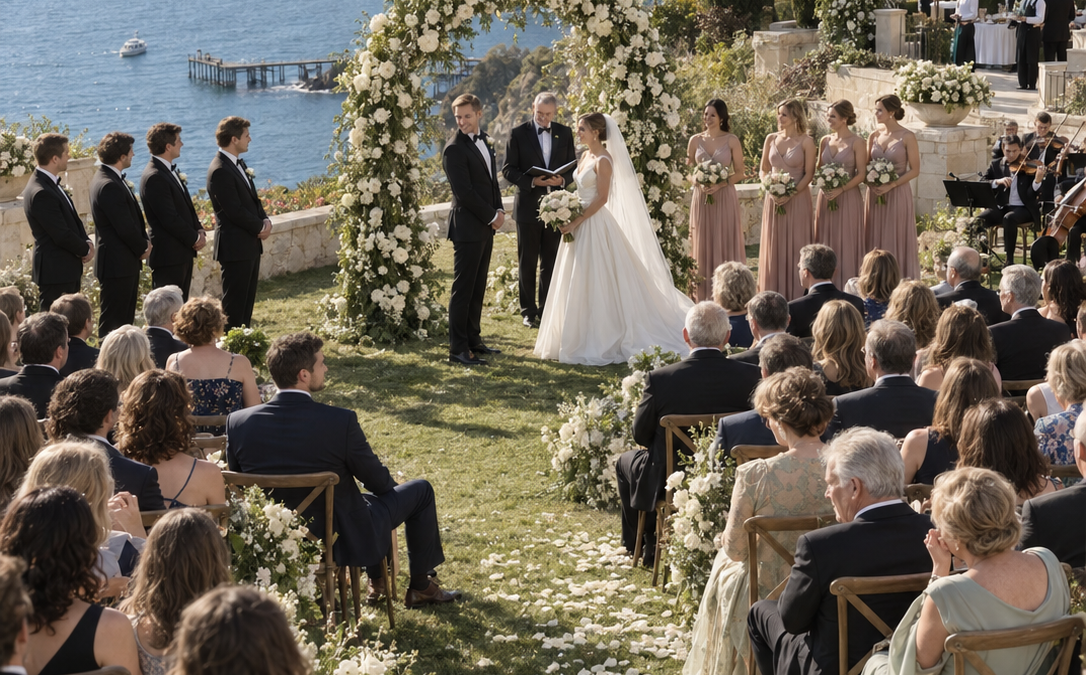
Two months later, I stood on a bluff above the Pacific watching staff finish the ceremony setup.
The Catalina property was not technically an island resort, despite what people later called it.
It was a private coastal estate attached to a small hospitality operation on the island.
White stone buildings.
Gardens.
An event lawn overlooking the ocean.
Private dock.
Enough guest cottages for immediate family and close friends.
The rest of the wedding guests stayed at nearby hotels.
The sun was warm.
The sky was clear.
A string quartet rehearsed near the ceremony arch.
For the first time in years, my family entered a space where I did not feel like the outsider.
They did.
Mom walked through the main house staring at everything.
Dad asked Michael Abernathy three separate questions about property operations before finally realizing Michael genuinely reported to me.
Daniel arrived quieter than usual.
The week after the conference call, he had called me alone.
No parents.
No Isabella.
“I owe you an apology.”
I waited.
“I believed them.”
“About what?”
“That you were failing.”
“You wanted to believe it too.”
He sighed.
“Yes.”
That honesty got my attention.
“Why?”
“Because if you were failing, then I was winning.”
I sat quietly.
Daniel continued.
“I didn’t realize we were competing until you stopped competing.”
“We weren’t supposed to be.”
“I know.”
“Do you?”
“I’m trying.”
That was the first conversation we had in years that felt like two brothers instead of two roles assigned by our parents.
On the wedding day, Daniel saw me take my seat in the front row.
He caught my eye.
Then gave me a small nod.
It was not an apology.
It was not forgiveness.
It was a recognition.
The ceremony was beautiful.
Isabella looked genuinely happy.
Daniel looked like the version of himself I remembered before family expectations hardened around him.
For forty minutes, I forgot everything else.
I was simply his brother.
At the reception, Isabella found me alone on the terrace.
“Nick?”
“You should be dancing.”
“So should you.”
“I have standards.”
She smiled.
Then became serious.
“I owe you an apology.”
“You really don’t.”
“I do.”
She looked toward the ballroom.
“I heard the stories about you.”
I said nothing.
“I believed them because everyone told the same version.”
“That’s how family stories work.”
“I saw how they treated you.”
She swallowed.
“And I didn’t question it.”
I looked at her.
“Thank you for saying that.”
“This wedding is more beautiful than anything I imagined.”
“I’m glad.”
“But I don’t mean thank you for the wedding.”
She looked directly at me.
“I mean thank you for giving Daniel another chance.”
That landed harder.
“He’s changing.”
“People don’t change in two months.”
“No.”
She smiled faintly.
“But sometimes they finally notice they need to.”
The next morning, after most guests left, the immediate family stayed for breakfast on the patio.
No ballroom.
No flowers.
No planner.
No audience.
Just coffee, fruit, eggs, and the kind of silence people create when the event is over and there is no longer anything beautiful to hide behind.
Daniel spoke first.
“There’s something I haven’t told anyone.”
Isabella looked at him.
Dad lowered his coffee.
Daniel’s hands were clasped together.
“I’m in trouble financially.”
Mom stared.
“What do you mean?”
“My firm isn’t paying what you think.”
Dad frowned.
“You made partner.”
“I made junior partner.”
“That’s still—”
“Dad.”
Daniel’s voice sharpened.
“Please.”
Dad stopped.
“The house is too expensive.”
Isabella looked down.
“Her parents helped with the down payment.”
Mom looked shocked.
Daniel continued.
“We put wedding expenses on credit cards before the resort refund.”
Dad’s face changed.
“You told me everything was covered.”
“I lied.”
“Why?”
Daniel laughed once.
Not happily.
“Because I’m the successful one.”
The sentence sat heavily between us.
He looked at me.
“You know what that means.”
I did.
“If I admitted I was struggling, then the entire story falls apart.”
Mom whispered, “Daniel…”
“You and Dad spent years telling everyone how stable I was.”
“You are stable.”
“No.”
Daniel shook his head.
“I was performing stability.”
He looked at his hands.
“When the venue canceled, I panicked because I thought the whole performance was about to collapse.”
I watched Dad.
For the first time, he looked less angry than confused.
As if the child he believed he understood had suddenly spoken another language.
Daniel continued.
“And attacking Nick was easy.”
He met my eyes.
“Everyone had already agreed he was the problem.”
That sentence hurt.
But it also sounded like truth.
Dad leaned back.
“So this is our fault now?”
Isabella spoke quietly.
“Nobody said that.”
Daniel looked at him.
“I made my choices.”
Then:
“But I made some of them because I thought disappointing you would be worse than drowning quietly.”
Dad looked away.
Mom began crying.
Nobody rushed to comfort her.
Not because we did not care.
Because for once, the discomfort belonged in the room.
Then our cousin Leo wandered out from the house holding his phone.
He was twenty-one and still possessed the dangerous innocence of someone who had not yet learned which family conversations were loaded.
“Aunt Eleanor?”
Mom wiped her face.
“Yes?”
“Aunt Carol posted like fifty pictures from last night.”
My mother stiffened.
“What did she say?”
Leo read.
“‘So proud of Daniel and Isabella for having a beautiful day despite unnecessary jealousy and family drama. True family lifts people up instead of tearing them down.’”
The patio became still.
Leo frowned.
“That’s weird.”
“Why?”
“She said almost the same thing to me before the wedding.”
I looked at him.
“What did she say?”
“She called me last month asking whether you were mad about Daniel getting married.”
My stomach tightened.
“What did you tell her?”
“I said I didn’t know.”
Leo scrolled.
“She kept asking if you had money problems.”
Mom’s face went pale.
Daniel looked at me.
Then at her.
“Aunt Carol told Mom Ben was worried about Nick.”
Mom whispered, “Ben’s mother told me that.”
“No,” Leo said innocently. “Aunt Carol told my mom she had heard from Ben’s mother too.”
We all looked at each other.
The structure became visible at once.
Ben had probably said something careless.
Maybe even jealous.
Carol amplified it.
Added concern.
Connected people.
Turned uncertainty into narrative.
Then acted shocked when the narrative produced damage.
Mom pressed her fingers to her forehead.
“Oh my God.”
Dad frowned.
“Carol would never—”
Mom looked at him.
“She would.”
It was the first time she contradicted him that morning.
“She absolutely would.”
Dad fell silent.
Mom turned toward me.
“Nicholas.”
Her voice broke.
“What have we done?”
I expected anger inside myself.
Instead, I felt tired.
“You believed what fit.”
“I should have called you.”
“Yes.”
“I should have asked.”
“Yes.”
Daniel said, “We all should have.”
No dramatic forgiveness followed.
That would have been dishonest.
The wedding did not repair ten years.
The resort did not erase the phone call.
My ownership did not magically make old wounds valid.
But something important changed on that patio.
Nobody could return to the old story without knowingly choosing a lie.
Months passed.
Mom began calling occasionally.
Not with advice.
Questions.
“How did the Vancouver property opening go?”
The first time, I nearly asked who she was and what she had done with Eleanor Miller.
Dad called me about a business decision.
Not to correct me.
To ask my opinion.
“I’m considering selling one of the warehouses.”
“Why?”
He explained.
I listened.
Then gave him my thoughts.
At the end he said, “Thank you.”
Nothing more.
It felt enormous.
Daniel and Isabella sold the oversized suburban house.
Moved somewhere smaller.
Daniel transferred to a less prestigious firm with better hours.
Dad hated the decision.
Daniel did it anyway.
That mattered.
One afternoon, I received a text from Daniel.
Screenshot of an article about hospitality logistics.
Thought this might affect your western properties next quarter. Curious what you think.
I stared at it.
Not because the article mattered.
Because my brother had finally asked me about my work.
Not my money.
Not my resort.
My work.
I typed:
Drinks Thursday?
His reply came immediately.
Absolutely, brother.
Brother.
The word should have been ordinary.
Instead, I read it twice.
There were still boundaries.
Aunt Carol remained mostly outside my life.
Ben apologized once by email.
I accepted the apology without restoring the friendship.
My parents and I learned to speak carefully.
Sometimes awkwardly.
We were not a perfect family reborn through one spectacular wedding.
We were simply people who had finally lost the excuse of ignorance.
That was enough to begin.
A year after Daniel’s wedding, I returned to the Catalina property alone.
No guests.
No event staff.
No flowers.
I stood on the same terrace where Isabella apologized and watched the sun drop toward the Pacific.
For years, I believed success would fix how my family saw me.
It didn’t.
Success merely exposed how little their version of me had depended on reality.
Eighty-seven million dollars did not make me more worthy of respect than I had been when I was coding above a laundromat.
Seven resorts did not transform me from failure into son.
Ownership did not create value.
It revealed prejudice.
That distinction changed everything.
My parents had been wrong about my career.
But if all I had wanted was to prove them wrong financially, I would still have been accepting their scoreboard.
The real victory was smaller.
I no longer needed to be impressive to deserve a seat at the table.
Daniel no longer needed to pretend he was perfect to keep one.
And our parents were finally learning that loving children meant knowing them, not assigning them roles and protecting those roles from inconvenient facts.
I thought again about the phone call from Laura.
He’s not family anymore.
At the time, the sentence felt like an ending.
It was not.
It was the moment I stopped begging to belong to a version of family built on conditions.
I canceled the wedding because they told me I was outside the circle.
Then, unexpectedly, I gave Daniel another venue because I realized I did not want my pain to become the architecture of his marriage.
Those two decisions looked contradictory from the outside.
They weren’t.
The cancellation was a boundary.
The island was a choice.
For most of my life, my family believed power meant deciding who mattered.
I eventually learned something better.
Power is having the ability to decide and not always choosing the cruelest option.
I had enough money to cancel a wedding.
Enough property to host another one.
Enough influence to embarrass everyone who had dismissed me.
None of those things healed anything.
What mattered was that when Daniel finally said, “Come as my brother,” I was willing to believe the sentence might become true if he did the work after saying it.
He did.
Not perfectly.
Neither did I.
But one evening months later, sitting across from him in a quiet bar, Daniel raised his glass and said, “I owe you something.”
“What?”
“A question.”
“That sounds ominous.”
He smiled.
“Tell me how you built the company.”
I looked at him.
“From the beginning?”
“From the beginning.”
No comparison.
No skepticism.
No punch line waiting.
Just curiosity.
I began with the old office above the laundromat.
The first customer.
The first developer we hired.
The month we nearly ran out of cash.
The hotel owner in Oregon who took a chance on us.
Daniel listened for nearly an hour.
When I finished, he shook his head.
“I missed all of that.”
“Yes.”
“I’m sorry.”
“I know.”
He lifted his glass.
“To Streamline.”
I touched mine against it.
“To actually asking questions.”
He laughed.
Then we drank.
Outside, Seattle rain blurred the streetlights.
Nothing cinematic happened.
No dramatic revelation.
No resort manager appeared to confirm my net worth.
It was just two brothers sitting at a table learning who the other had become.
And after everything that had happened, that ordinary moment felt more valuable than the island.
THE END
If you came here from Facebook because this story pulled you in, please go back to the Facebook post, tap like, and comment exactly “Well told” to support the storyteller. That small action means more than it seems and helps give the writer the motivation to keep bringing more stories like this to readers.








