“I’m sick. Thaddius left the country with his family. He locked my medication away, took my phone, disabled the home controls, and told the building not to disturb me.”
Part 1 of 5:
“Your medication is not the center of everyone’s life, Seraphina.”
Thaddius said it without raising his voice.
That was what made the words so cold.
He stood beside the vanity in our Tribeca penthouse wearing a tailored charcoal coat, one hand resting on the handle of a silver suitcase. Behind him, the bedroom door remained open just wide enough for me to see his mother and sister crossing the living room with designer luggage.
Clarice was discussing Paris.
Genevieve was debating whether her cream wool coat would photograph better beside the Eiffel Tower or outside the hotel in Rome.
Their voices drifted through the apartment as lightly as if I were not lying beneath three blankets, too weak to stand.
I had been ill for months with a severe autoimmune condition that had turned ordinary tasks into negotiations with my own body. On good days, I could walk from the bed to the kitchen. On bad days, lifting a glass of water required both hands.
My treatment had finally begun working, but only because I followed a strict schedule. Missing a dose did not mean instant catastrophe. It meant pain, fever, weakness, and the possibility of losing the fragile progress my doctors had fought to build.
The medication sat in a temperature-controlled case on the vanity.
I looked at Thaddius.
“It’s time,” I said. My voice was little more than a whisper. “Please bring me the case and a glass of water.”
He glanced at his watch.
“The car will be downstairs in twenty minutes.”
“Then this will take two.”
His jaw tightened.
For several seconds, neither of us spoke.
Snow pressed against the floor-to-ceiling windows. The Manhattan skyline had disappeared behind a gray winter haze, leaving only the faint outlines of neighboring buildings.
Clarice appeared in the doorway wearing a camel-colored travel suit and a silk scarf tied at her throat.
“We are already late,” she said. “The driver has been circling because the building won’t let him wait at the entrance.”
I turned toward her.
“You’re leaving tonight?”
Clarice looked genuinely surprised by the question.
“Of course we are.”
“For how long?”
“Several weeks. Perhaps longer if we decide to extend the Mediterranean portion.”
I waited for someone to smile.
No one did.
Genevieve entered behind her, holding a small jewelry case in one hand.
“We told you about the trip,” she said.
“You discussed it at Thanksgiving. I thought it was canceled after I got sick.”
Clarice gave a quiet, impatient sigh.
“Why would it be canceled?”
I stared at her.
“Because I can’t safely stay alone.”
“You have delivery apps,” Genevieve said. “The building has staff.”
“The building staff cannot administer medication.”
Thaddius folded his arms.
“You have made yourself completely dependent.”
The accusation landed with such precision that for a moment I forgot how to breathe.
Before the illness, I had worked twelve-hour days, negotiated multimillion-dollar contracts, reviewed market reports at midnight, and kept our household running without asking anyone where the extra work came from.
Now I needed help opening a medicine case, and my husband spoke as though dependence were a moral failure.
“I need care,” I said. “Temporarily.”
“You have needed care for months.”
“I am recovering.”
“Are you?”
His eyes moved over my face, my thinning hair, and the hollow place beneath my cheekbones.
He did not look worried.
He looked inconvenienced.
The truth was that Thaddius had not built the life surrounding us.
I had.
The penthouse belonged to me before our marriage. I purchased it through a private trust established by my parents. The company where Thaddius served as chief executive had begun with my capital, my licenses, my investor relationships, and years of work I completed before he ever entered the boardroom.
I gave him the title because I believed marriage meant sharing success.
I stepped away from public leadership because he said the company needed a visible executive who could entertain clients, travel constantly, and project confidence.
At first, I admired the way he carried the role.
Then he began speaking as though the role had created the company.
Clarice told her friends that her son rescued a struggling business and transformed it into a Manhattan success story. Genevieve called herself part of a “financial family” whenever she wanted access to my corporate cards.
I corrected no one.
I thought dignity meant allowing people to enjoy a version of events that made them feel secure.
Lying in that bed, I finally understood the danger of giving other people ownership of a story they had not earned.
“Thaddius,” I said, “put the medication beside me before you leave.”
He turned toward the vanity.
Relief moved through me too soon.
He picked up the white case, examined the digital lock, and pressed a button. The screen flashed once. Then he carried it across the room and placed it inside the bottom drawer of the dresser.
He closed the drawer.
The small key went into his coat pocket.
“What are you doing?”
“Removing temptation.”
“I don’t understand.”
“You have been taking extra doses.”
“No, I haven’t.”
“You are always asking for medication.”
“Because it is scheduled.”
Clarice rested one hand against the doorframe.
“Thaddius is trying to protect you from overreacting every time you feel uncomfortable.”
“This is not discomfort.”
Genevieve looked away, but not before I saw the unease in her face.
She knew.
Perhaps not everything, but enough.
Thaddius walked to the nightstand and picked up my phone.
“I’ll keep this with me so you can rest without upsetting yourself over business messages.”
My pulse quickened.
“Put it down.”
“You need sleep.”
“I need my phone.”
“The concierge knows you are not receiving visitors.”
I looked toward the bedroom door.
“What did you tell them?”
“That you are under medical rest and should not be disturbed.”
“Did you tell them I would be alone?”
He did not answer.
Clarice adjusted her gloves.
“We have spent enough time on this.”
I tried to sit up.
Pain moved through my ribs and lower back. My arms trembled beneath my weight. I made it halfway before the room blurred and I fell against the pillows.
Genevieve took one step toward me.
Clarice stopped her with a look.
Thaddius slipped my phone into his briefcase.
“The house account will cover deliveries,” he said. “There is food in the refrigerator.”
“I cannot reach the kitchen.”
“You can when you want something badly enough.”
I stared at the man I had married.
His face was composed. His collar was perfect. A faint trace of expensive cologne hung in the air between us.
Once, I believed his calm meant strength.
Now I saw how useful calm could be when someone wanted cruelty to look reasonable.
“What happens if I need a doctor?”
“You have the building call button.”
“The bedside panel is connected to the home system.”
“And?”
“You told the technician it was being updated.”
His expression changed slightly.
That was when I understood.
The disconnected panel.
The missing phone.
The locked medication.
The instructions to the concierge.
This was not careless travel planning.
It was a system.
“Why are you doing this?” I asked.
Thaddius looked toward his mother and sister, then back at me.
“Because the company needs stability.”
“What does that have to do with my medication?”
“You signed succession documents years ago.”
“Temporary proxy documents.”
“You gave me authority to operate the business if you became medically unavailable.”
“Operate it. Not own it.”
He smiled without warmth.
“You always did enjoy technical distinctions.”
Clarice’s gaze moved toward the windows.
Genevieve gripped the handle of her carry-on.
The room seemed to narrow around us.
“You expect me to become unavailable,” I said.
Thaddius leaned closer, lowering his voice.
“I expect nature to take its course.”
The words were quiet enough that his mother and sister could pretend not to hear.
“You are very ill, Seraphina. The doctors have said there are no guarantees. If something happens while we are gone, the company will need leadership. The family will need access to the accounts. The estate will need someone practical.”
“My treatment is working.”
“If you say so.”
“Give me the key.”
He straightened.
“No.”
I looked at Clarice.
“You are leaving me like this?”
She pressed her lips together.
“My son has carried this family long enough. Perhaps some quiet will help you appreciate him.”
I turned to Genevieve.
She would not meet my eyes.
Thaddius lifted his suitcase.
“We are not doing this all night.”
He walked out.
Clarice followed.
Genevieve remained in the doorway for one second longer.
“Seraphina,” she said softly.
I waited.
Her eyes moved toward the locked dresser drawer.
Then Clarice called her name from the living room.
Genevieve left without finishing the sentence.
The apartment door closed several minutes later.
I heard the electronic lock engage.
Then the lights went out.
The heating system slowed to silence.
The smart-home panel beside the bed went dark.
For a few seconds, the city’s winter light remained in the room. Then the storm thickened, and even that disappeared.
I lay beneath the blankets listening to the building settle around me.
No phone.
No medication.
No working panel.
No one expected to enter.
Thaddius believed my illness had already reduced me to a legal condition he could manage.
Incapacitated.
Unavailable.
Soon, perhaps, absent.
Fear arrived first.
It moved through my body faster than the fever, tightening my throat and making every sound seem far away.
Then grief followed.
Not grief for the business.
Not for the penthouse.
For the years I had spent interpreting indifference as stress, entitlement as insecurity, and control as devotion.
I had hidden the truth about my family because I wanted to know whether Thaddius loved me without access to the Vale name.
My father, Sterling Vale, chaired a global property and logistics company. My mother, Vivien, had inherited commercial buildings across three states and expanded them into a respected investment portfolio.
I left their world in my twenties after a bitter argument about independence.
They believed Thaddius was impressed by proximity to wealth.
I insisted he loved me.
To prove it, I made myself smaller.
I told his family my parents lived modestly in Missouri and that we were not close. I funded my own company through a trust account they could not trace to the Vale holdings. I allowed Thaddius to believe my success came from quiet bookkeeping and fortunate timing.
My parents disapproved, but they never stopped protecting me from a distance.
My father kept a private number active for one reason.
“If you ever need me,” he had said, “you will not have to explain before I come.”
For years, pride prevented me from calling.
That night, pride became the least important thing in the room.
Beneath the left side of the mattress was an old emergency phone.
It had no internet access, no smart features, and no connection to our home accounts. I kept it charged because long before my illness, a security consultant advised company owners to maintain an independent communication method during major outages.
Thaddius had laughed when he heard the suggestion.
“Who carries a phone from twenty years ago?”
I did.
The mattress felt impossibly heavy.
I turned onto my side one inch at a time, pausing each time the room spun. My hand slid beneath the fitted sheet and reached into the narrow space below.
Nothing.
I stretched farther.
Pain moved through my shoulder.
My fingertips brushed hard plastic.
The phone slipped deeper.
For twenty minutes, I fought for three inches of movement.
When I finally pulled it free, the small screen glowed pale green in the darkness.
The battery showed nearly full.
I cried when I saw it.
Not from fear.
From the simple relief of holding one thing Thaddius had failed to control.
I dialed my father’s number.
It rang three times.
“Hello?”
His voice was older than I remembered.
“Dad.”
Silence.
Then his chair scraped sharply against a floor.
“Seraphina?”
“It’s me.”
“Where are you?”
“At home.”
“What happened?”
I tried to speak clearly, but my breath kept breaking.
My father did not interrupt.
“Can you move?”
“Barely.”
“Are the children there?”
“We don’t have children.”
It was an old ache between us, made irrelevant by the immediate danger.
“Is anyone else inside?”
“No.”
“Stay on the line.”
“I’m sorry.”
“Not now.”
His voice shook once, then became steady.
“Your mother is calling the building manager. I am contacting your medical team. Keep the phone beside you. Do not attempt to stand.”
Part 2 of 5: My parents found me before Thaddius ever bothered to ask whether I had survived.
For three days, I stayed in a monitored hospital unit while doctors restarted treatment, corrected the dehydration, and slowly reversed the damage caused by the cold and missed medication. My mother remained beside me whenever I woke. My father sat silently with financial newspapers he barely read. Neither of them asked why I had stayed away for so long. Neither said they had warned me about Thaddius. Their refusal to turn rescue into judgment hurt almost as much as everything else.
On the eighth morning, Sterling showed me the corporate-card activity. Thaddius had taken supplementary cards for himself, Clarice, and Genevieve. Their European trip had become a parade of luxury hotels, designer stores, jewelry, private tours, rental cars, and expensive restaurants. In eight days they had charged more than forty thousand dollars to company accounts.
My father offered to cancel every card immediately.
“No.”
He stared at me.
“I want the complete record.”
That was when I learned something even more important. The building had automatically sent Thaddius an emergency-access notice after I was taken to the hospital. He had not responded. He had not called the concierge. He had not contacted the hospital.
They did not even know whether I was alive.
They kept spending anyway.
Attorney Adrian Vance arrived that afternoon and began laying out the legal structure of my life. The penthouse belonged solely to me through a trust created before the marriage. I owned ninety-five percent of the company. Thaddius was not an owner. He was an employee serving as chief executive through a revocable proxy.
While I was hospitalized, he had already begun trying to expand his authority. His lawyer contacted the board claiming my health made me incapable of managing the company. He sought access to reserve accounts, control over executive signers, and authority to begin succession planning.
He had also contacted a physician asking for a letter declaring me permanently disabled. The doctor refused because he had never treated me. Then Thaddius contacted an estate attorney about gaining control of the penthouse and company if I did not recover.
He had prepared for my property before confirming whether I needed help.
So I gave Adrian one instruction.
Prepare everything.
For the next seventy-four days, I recovered while Thaddius and his family kept spending.
By day sixty-eight, the total had passed two hundred thousand dollars.
Meanwhile, I learned to stand again.
Then to walk.
Then to return home.
And on the seventy-fourth day, I sat in my own penthouse waiting for the elevator doors to open.
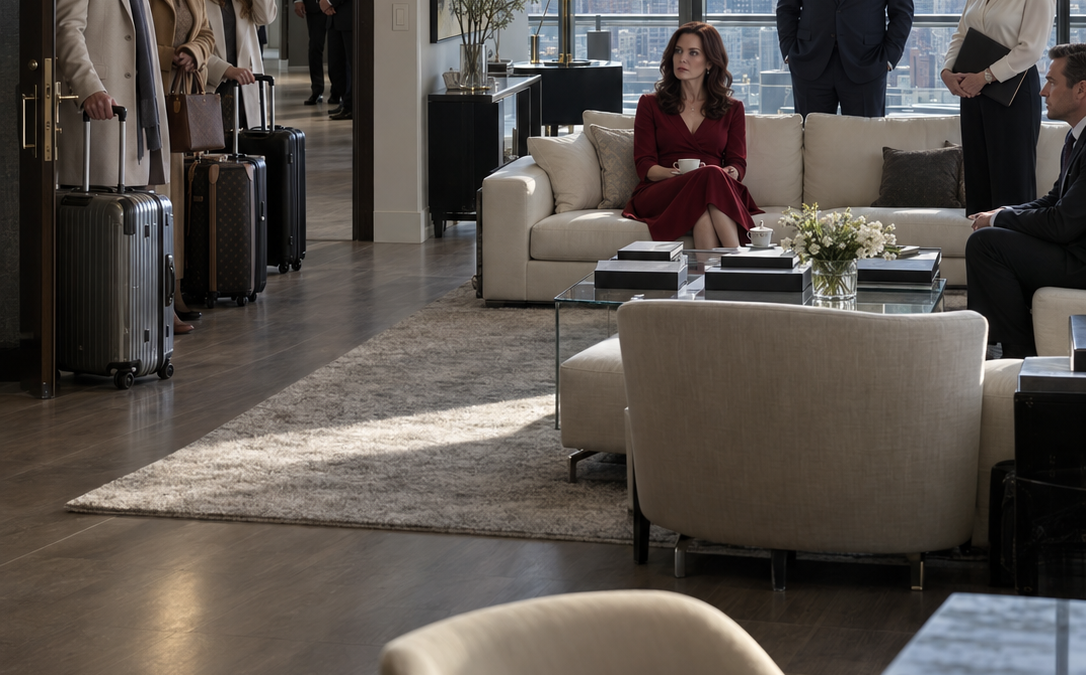
Part 3 of 5: At 3:15 that afternoon, luggage wheels rolled down the hallway.
Thaddius tried the keypad first. The new access code rejected him. Clarice complained about the flight. Genevieve suggested trying her birthday. None of the codes worked.
Then the building manager opened the door from inside.
I was sitting on the sofa in a deep red wool dress with a cup of tea between my hands. My father stood near the windows. My mother waited in the dining room. Adrian sat beside the final legal folders.
Thaddius froze.
So did Clarice and Genevieve.
“Welcome home.”
When Thaddius recognized Sterling Vale, the color left his face. He had seen my father in business publications but had never met him because I had hidden my family background for years, partly to discover whether anyone loved me without the name attached.
Genevieve whispered, “You’re a Vale?”
That was the least important revelation in the room.
Adrian introduced himself and laid out the building records: the apartment systems had been manually disabled from Thaddius’s administrator account. The water had been shut off. The medication drawer had been locked. Concierge instructions had been left telling staff not to disturb me.
Clarice insisted they believed I could manage.
My mother answered quietly.
“You did not call once to find out.”
Then came the spending records.
More than two hundred thousand dollars, organized by person, date, city, and card.
Clarice said they thought those were family funds.
“They were corporate accounts.”
“But Thaddius was chief executive.”
“He was an authorized employee.”
Thaddius finally snapped.
“I built that company.”
“No,” I said. “You ran it. I built it.”
Adrian placed the board resolution on the table.
Effective that morning, Thaddius’s executive proxy had been revoked. His employment was terminated for misuse of corporate resources, unauthorized succession planning, and breach of fiduciary duty.
Then all three phones began sounding at once.
Supplementary cards terminated.
Executive access revoked.
Expense privileges suspended.
Thaddius checked the banking app and demanded to know what I had done with the joint accounts.
“Protected them pending review.”
Clarice asked where they were supposed to go.
I reminded them that each had personal money.
Genevieve admitted their own accounts were nearly empty.
My father looked at Thaddius.
“You spent her money because protecting yours felt safer.”
That sentence silenced the room.
Thaddius asked to speak with me privately.
“No.”
He said he had been scared of losing everything.
“You were afraid of losing access.”
Then he told me he loved me.
Once, that sentence would have broken through every boundary I had.
This time, I understood the distinction.
“You loved the life I funded. You loved the title I gave you. When I became inconvenient, you treated my recovery like an obstacle.”
“I can change.”
“Perhaps. You will make that change outside my home, outside my company, and outside my finances.”
Adrian handed him the final envelope.
Divorce papers.
A schedule for retrieving his belongings.
Notice that future communication would go through counsel.
When the building manager asked them to leave, Thaddius paused at the threshold.
“Was any of it real?”
“Yes,” I told him. “My love was real. Yours may have been too, before you decided love entitled you to everything I owned.”
Then I closed the penthouse door myself.
Part 4 of 5: The next morning, Thaddius went to the Midtown headquarters and discovered his badge no longer opened the turnstiles. Human Resources met him in the lobby with a termination packet and a box containing his personal belongings.
Clarice tried using her supplementary card at a department store.
Declined.
Genevieve attempted to extend their hotel stay.
Declined.
They were not homeless or helpless. They simply had to begin living within money that actually belonged to them.
That distinction infuriated them.
Three days later, all three appeared in the company lobby accusing me publicly of stealing the family fortune and taking advantage of Thaddius while I was ill. Employees began gathering. Phones came out. My communications director asked whether we should release the home-security footage.
“No.”
I did not want private suffering turned into entertainment simply because I finally had the stronger position.
The company issued one short statement instead. It confirmed that I was the majority owner, that Thaddius’s authority had been revoked under the operating agreement, and that an independent review had found unauthorized personal use of corporate accounts. Ownership records and the board resolution were attached.
Facts did what public humiliation could not.
Over the following months, every version of Thaddius’s story failed against documentation. He said he built the company; incorporation and ownership records showed otherwise. He claimed the European expenses were approved compensation; no such agreement existed. He called the penthouse marital property; the deed and trust contradicted him. He said the apartment systems had malfunctioned; the building logs showed manual changes from his account.
Each explanation survived only until it met a record.
The divorce took nine months. I did not ask to leave him destitute. The court divided what legally belonged to each of us, required partial reimbursement for unauthorized spending, and confirmed that neither the penthouse nor the company transferred to him through marriage.
Clarice and Genevieve returned or repaid several luxury purchases bought with corporate funds. Genevieve transferred to a public university, found part-time work, and learned what tuition, rent, groceries, and transportation actually cost. Clarice downsized. Thaddius eventually found consulting work with a smaller firm where his decisions required approval.
Their lives did not end.
Their entitlement did.
I returned to the company gradually. Instead of occupying Thaddius’s old executive office, I converted it into a shared training and board space. My original office remained at the end of the hall, filled with photographs and maps from the company’s earliest years.
One photograph showed me at twenty-eight inside an unfinished warehouse.
For years, I thought strength meant never needing anyone.
I finally understood that my real mistake had been confusing endless giving with love.
My parents and I began rebuilding too. There were no dramatic reconciliations, just Sunday lunches and difficult apologies. My father admitted that protection had sometimes become control. I admitted that independence had become disappearance.
A year later, I created a company medical-support fund for employees facing serious illness. It covered temporary home care, transportation, and financial guidance so no employee would ever have to depend entirely on a spouse for access to treatment.
When a director asked why the company should take responsibility for something families usually handled, I answered simply.
“Because families can fail. Systems should not.”
Part 5 of 5: Two years after the night I called my father, I stood again in the bedroom where Thaddius had locked away my medication and shut down the apartment around me. My disease was controlled, though not cured. Some mornings my hands still trembled, and some evenings exhaustion arrived without warning. Recovery had not made me invincible. It had simply returned ownership of my life.
I took the old emergency phone from the safe cabinet and placed it beside the earliest photograph of the company. My father looked at it and corrected me when I called it the reason I survived. The phone was only a tool, he said. I was the reason I made the call. He was right. For years, I believed asking for help surrendered power. What finally saved me was understanding that silence had been giving power to the people who benefited from it.
Thaddius spent seventy-four days believing he was rising into a permanent life of luxury. I spent those same seventy-four days learning to stand again. When he returned, he brought designer luggage and plans for property he never owned. I returned with records, legal authority, and one certainty that mattered more than any asset: no marriage, title, family name, or act of love gives another person ownership of you. The strongest moment was never when his cards stopped working or his badge failed. It was the instant that old phone lit up in the dark and I chose to call someone who would listen.
THE END








