I went to the bank asking for $6,000 to fix my furnace. The banker quietly closed her office door and said, “Your trust holds $28 million.” I stared at her, stunned. My son had kept it from me for nine years—and that very morning, he had filed papers seeking control of my affairs…
Part 1:
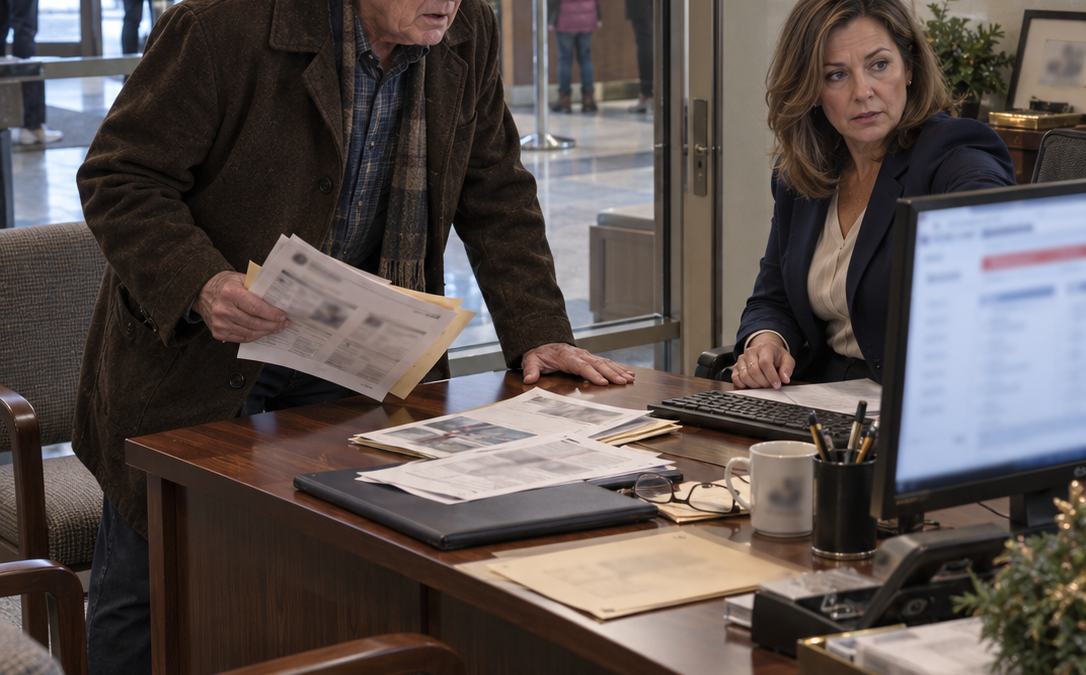
“Mr. Mercer, why are you asking us for $6,000?”
Helen Brooks kept her voice low, but the question seemed to change the pressure inside her office.
Beyond the glass wall, Lake County Mutual was having an ordinary December afternoon. Customers in winter coats waited with deposit slips. A little boy circled the Christmas tree while his mother pretended not to notice. Somewhere near the teller counter, a printer kept producing receipts with the soft mechanical rhythm of a machine that had no reason to believe anything unusual was happening.
Ten minutes earlier, Helen had been a courteous bank manager reviewing my application for a small home-repair loan.
Now the shade over her office window was halfway down, the door was locked, and the woman across the desk was looking at me as though she had found something she wished she had not.
“My furnace quit Tuesday night,” I said.
I rested both hands on the manila folder in my lap. Inside were three estimates. The cheapest replacement came in just under six thousand dollars.
“The house was forty-six degrees when I woke up. I can manage with space heaters for a few days, but January is coming.”
Helen turned her monitor farther away from the lobby.
“That isn’t what I mean.”
She tapped the screen.
I saw my full name.
Raymond Mercer.
I saw the last four digits of my Social Security number.
Then I saw a balance.
For several seconds, the number did not make sense because nothing in my life had prepared me to understand it as mine.
$28,412,619.
I read it twice.
Then once more.
“There’s been a mistake.”
Helen did not answer immediately.
I was seventy-two years old. I had spent thirty-eight years maintaining electrical systems for the railroad. I had retired with a pension, Social Security, a modest savings account, and a Craftsman house with green shutters that my wife, Margaret, and I had paid off years before.
At least, that was what I believed.
According to my son, Daniel, nearly everything else had disappeared during Margaret’s final illness and my heart surgery the following year.
I clipped coupons.
I drove a fourteen-year-old Buick.
I had delayed repairing the back porch because Daniel said we needed to be careful.
When the furnace failed, he had told me there simply wasn’t six thousand dollars available for a replacement.
I looked at Helen again.
“That can’t be mine.”
“The account is a family trust,” she said carefully. “You are listed as the primary lifetime beneficiary.”
I stared at her.
“What trust?”
That question seemed to confirm whatever had frightened her.
Helen took a breath.
“Our bank acquired the fiduciary company that administers it. The older records were consolidated into our system last week. When I ran your loan application, your Social Security number triggered a match.”
My throat went dry.
“Who controls it?”
Helen hesitated.
That hesitation told me more than the answer.
“My son?”
She nodded once.
“Daniel Mercer is listed as acting distribution adviser under an incapacity provision. There is also a corporate co-trustee.”
I did not raise my voice.
I did not ask her to repeat the balance.
I did not picture vacations, houses, new cars, or the fishing boat Margaret used to tease me about wanting.
I thought of Margaret in a hospital room nine years earlier, thin beneath a white blanket, saying, “Make sure the children don’t let money turn them into strangers.”
At the time, I had assumed she meant the small portfolio she had inherited from her father.
I slid the furnace estimates onto Helen’s desk.
“Print everything you are legally allowed to give me.”
“There are restrictions.”
“I understand.”
“As beneficiary, you have a right to request an accounting.”
“Then start there.”
She studied me for several seconds.
“Do you have an attorney?”
“Not anymore.”
“Do you have somewhere else you can stay tonight?”
That question tightened something behind my ribs.
“Why would I need somewhere else?”
Helen rotated the monitor slightly.
A notation had been entered into the trust file that morning.
Petition for permanent guardianship pending.
Supporting documents received from Daniel Mercer.
I read the line slowly.
My son was asking a court to decide that I could no longer make major decisions for myself on the same day I had walked into a bank and accidentally discovered a fortune he had never told me existed.
I closed the folder.
My knees felt steady when I stood, although I could hear my heartbeat.
“Mrs. Brooks, please don’t call Daniel.”
“Bank policy may require our trust department to notify the acting adviser that you requested records.”
“I’m not asking you to break a rule.”
I buttoned my old wool coat.
“I’m asking you to follow every rule very carefully.”
For the first time since the number appeared on the screen, some warmth returned to her face.
“I can do that.”
I reached the door, then stopped.
“And cancel the loan application.”
Helen almost smiled.
Neither of us found it funny.
“Mr. Mercer?”
I turned.
“This account may belong to you,” she said. “That doesn’t necessarily mean the money is safe.”
I thought I understood.
By sunset, I would realize I did not.
The twenty-eight million dollars was only the trail Daniel had failed to hide completely.
What he had really taken from me was much harder to put into numbers.
Outside, the temperature was twenty-one degrees.
I sat in my Buick with the engine running and watched people move through the bank’s revolving doors. My first instinct was to call Daniel.
That embarrassed me almost immediately.
The instinct had been trained into me.
Whenever something went wrong, I called my son.
When an insurance statement looked confusing, I called Daniel.
When the county sent a property-tax notice I did not understand, I called Daniel.
When my debit card stopped working at the grocery store, I called Daniel, and he explained that he had moved money “for my protection.”
He was forty-five, well dressed, controlled, and very good at making control sound like care.
Nine years earlier, after my bypass surgery, I had awakened in the hospital and found him beside my bed with a legal pad.
Margaret had been gone only six months.
Grief had made ordinary things difficult in ways I had never expected.
I could repair a signal cabinet outdoors in a February storm, but I could not open an envelope addressed to Margaret and me without losing the afternoon.
Daniel saw that.
“Let me handle the bills for a while, Dad.”
It sounded like love.
I signed a temporary financial power of attorney while a nurse watched.
The document was supposed to expire after ninety days.
After I recovered, Daniel continued helping.
At first he showed me statements.
Then the statements stopped coming.
“Everything’s online now.”
When I asked for passwords, he told me the websites were confusing and full of scams.
That should have irritated me.
Instead, I chose to hear concern.
Eventually my pension began flowing into a household account he monitored. Each month, a smaller amount appeared in my checking account for groceries, utilities, gas, and ordinary expenses.
If I needed extra, I asked.
Daniel never called it an allowance.
Neither did I.
That did not change what it had become.
“There isn’t much left after Mom’s care,” he would say whenever I mentioned repairs. “We have to make it last.”
Margaret’s final year had been expensive.
Daniel showed me spreadsheets with medical costs, home care, therapy, legal fees, insurance gaps.
I had never added the columns myself.
A man can spend his entire life teaching his children honesty and still make the mistake of never checking whether they learned it.
My phone rang on the passenger seat.
Daniel.
For one foolish second, I wondered whether he already knew.
I let it ring four times.
“Hello?”
“Dad. Where are you?”
His voice was bright.
Casual.
Too casual.
“Out.”
“We stopped by. Vanessa and I. Your car was gone.”
“I had errands.”
“In this weather?”
“The roads are clear.”
A pause followed.
Daniel disliked answers he had not anticipated.
“Did you go to the pharmacy?”
“Among other places.”
“What other places?”
I looked across the parking lot toward Helen’s shaded office.
“Why?”
He laughed, but the laugh arrived late.
“Because your furnace is out and you’re supposed to be taking it easy. Vanessa found a retirement community with immediate availability. Just temporarily.”
“I’m not moving.”
“Nobody said permanently. Think of it as a short stay.”
“I can sleep in my own house.”
“Dad, this stubbornness is exactly what worries me.”
His voice softened.
That voice had worked on me for years.
“You left the stove on last month.”
“I left a kettle on for six minutes while I reset a breaker.”
“You forgot it.”
“I knew where it was.”
“This is what I mean. You always have an explanation.”
In the background, Vanessa murmured something.
Daniel covered the phone.
The sound became muffled.
I heard two words anyway.
Bank.
Today.
When he returned, the brightness was gone.
“Did you try to take out a loan?”
There it was.
“Who told you?”
“I get credit alerts.”
“We never agreed to that.”
“It’s part of looking out for you.”
“The furnace needs replacing.”
“I told you I would handle it.”
“You told me there wasn’t enough money.”
“There isn’t enough money to throw six thousand dollars at the first contractor who scares you.”
“I had three estimates.”
Silence.
For years, I had interpreted Daniel’s silences as patience.
That afternoon I finally heard the machinery inside them.
Calculation.
“Which bank?” he asked.
“Why does that matter?”
“Dad.”
“I’ll see you Sunday.”
“We’re coming back tonight.”
“No.”
“The house is cold.”
“Then I’ll wear a sweater.”
“Tell me where you are.”
I watched my breath cloud the windshield.
“I’m seventy-two years old, Daniel. I don’t need permission to run errands.”
“This isn’t about permission. It’s about safety.”
“Goodbye.”
I ended the call.
My hand shook.
That angered me more than the conversation.
I held it against the steering wheel until it stopped.
There was only one lawyer I could think of.
Arthur Bell had handled Margaret’s father’s estate and drafted our wills. I had not spoken to him since Margaret’s funeral.
His office sat above an old pharmacy in downtown Mason Creek. He was a quiet man with steel-gray hair, careful handwriting, and the habit of listening so completely that people sometimes told him more than they intended.
I called expecting a receptionist.
Arthur answered himself.
“Bell and Pierce.”
“Arthur. Raymond Mercer.”
He went silent.
So silent that I checked the screen to make sure the call had not dropped.
“Raymond,” he finally said. “Where are you?”
“In my car outside Lake County Mutual.”
“Are you alone?”
It was the second time in half an hour someone had asked me that.
“Yes.”
“Tell me exactly what happened.”
I told him.
The trust.
The balance.
Helen.
Daniel.
The guardianship notation.
Arthur did not interrupt until I mentioned Margaret’s trust.
“Do not go home yet.”
“Everyone keeps telling me that.”
“Because Daniel has been trying to build a case that you cannot safely manage your own affairs. A house without heat could be used to support that story.”
“You think he did something to my furnace?”
“I think we assume nothing. We document everything.”
I looked out at the parking lot.
“Arthur, did you know about the trust?”
Another silence.
“Yes.”
The word hurt more than it should have.
“How long?”
“I knew Margaret created it. I did not know how valuable it had become. After your surgery, Daniel sent me a letter terminating my services on your behalf.”
“I never did that.”
“I know that now.”
“Why didn’t you come to the house?”
“I did.”
I closed my eyes.
“Twice. The first time Daniel said you were sleeping. The second time he said you were staying with him after rehabilitation. I wrote three letters. All came back.”
Another person I had blamed for disappearing from my life had been pushed away in my name.
Arthur’s voice softened.
“Come to my office. Park behind the building. I’ll arrange for a licensed heating inspector to meet us at your house later.”
“I’m not running from my son.”
“No.”
Arthur paused.
“You’re stepping out of the room while he arranges the furniture.”
His office had hardly changed.
The same brass lamp stood on his desk. The same framed photograph showed Arthur and Margaret’s father beside a lake holding fish with the grave expressions men use when they are secretly delighted.
Only Arthur looked older.
Then again, so did I.
He locked the office door and poured coffee.
“You’re worried,” I said.
“I’m angry.”
“At Daniel?”
“At myself.”
He opened a fireproof cabinet and removed a thick blue binder.
Margaret Anne Mercer Irrevocable Family Trust.
Seeing her name stopped me.
Arthur rested one hand on the cover.
“Before we open this, I need to ask you the same questions Daniel’s attorney may eventually ask.”
He asked the date.
I answered.
He asked what I had eaten for breakfast.
“Oatmeal, raisins, half a grapefruit.”
He asked how I had driven to his office.
I gave him the route, the intersection where the city had repaired a water main, and the location of a delivery van parked behind his building with a cracked left taillight.
Arthur’s mouth twitched.
“Any falls?”
“No.”
“Missed medication?”
“No.”
“Memory diagnosis?”
“No.”
“Then we arrange an independent medical evaluation.”
“My doctor knows me.”
“Who schedules appointments with him?”
I knew the answer.
“Daniel.”
Arthur opened the binder.
Margaret had come from money, although strangers would never have guessed it from the way we lived.
Her father, Samuel Hale, had started with a small machine shop that produced precision components. Over the years, Hale Surgical Systems became a respected regional manufacturer.
Margaret owned a minority block of shares.
We never lived on that money.
My railroad salary paid the bills. Dividends were reinvested.
“The shares are for later,” Margaret used to say.
Later had apparently become twenty-eight million dollars.
The trust named me sole lifetime beneficiary after her death.
It could pay for my housing, health, maintenance, travel, comfort, and general welfare.
After my death, what remained would be divided equally between Daniel and our daughter, Rebecca.
“Equal?” I asked.
Arthur looked up.
“Yes.”
“Daniel told me Rebecca was effectively cut out.”
“Why would he tell you that?”
“Because of what she did to Margaret.”
Arthur closed the binder halfway.
“What do you believe she did?”
“She pressured Margaret about the shares while Margaret was sick. Daniel showed me emails.”
“Did Rebecca admit that?”
“She tried to explain.”
“And?”
I looked down at the coffee.
“I wouldn’t listen.”
Arthur turned to the incapacity section.
A family adviser could be activated only if two independent physicians certified that I could not make major financial decisions. Daniel was the first nominee. Rebecca was the second.
Then Arthur showed me a clause Margaret had insisted on.
Any adviser who concealed significant trust information from me, used trust assets for personal gain, or deliberately acted against my interests could be permanently removed.
If that adviser was also a future beneficiary, the trust could treat that person as having died before me for inheritance purposes.
I read the paragraph twice.
“Margaret wrote this?”
“She insisted on it.”
“Why?”
“She had watched relatives fight over her father’s estate.”
Arthur turned another page.
“She wanted incentives aligned with honesty.”
A hard knock sounded at the office door.
We both looked up.
The knock came again.
“Raymond Mercer?” a man called from the hall.
Arthur walked to the front window, glanced down, and returned.
“Court papers.”
“That fast?”
His expression answered me.
“Daniel planned this before today.”
The envelope was thick.
The petition described me as increasingly confused, financially vulnerable, forgetful, unsafe behind the wheel, unable to manage medication, and unable to maintain my residence.
Attached photographs showed peeling paint on my back porch, a scorched kettle, unopened mail, and my thermostat reading forty-six degrees.
The thermostat photograph had been taken that morning.
“He was in my house.”
Arthur examined the page.
“You said Daniel told you he stopped by.”
I nodded.
Another attachment showed me in a hospital bed after bypass surgery nine years earlier, groggy from medication and briefly confusing Daniel with my late brother.
I remembered that morning.
Daniel had stood beside the bed holding his phone.
I thought he was sending Rebecca an update.
“He kept that for nine years.”
Arthur’s expression hardened.
“The hearing is Monday.”
I kept turning pages.
The petition listed Rebecca’s location as unknown.
Then, on another form, I saw an address in Cedar Falls.
Forty-three miles away.
For eight years, I had believed my daughter lived somewhere in Arizona.
At my house that afternoon, the heating inspector took less than five minutes to identify the problem.
His name was Luis. He wore work boots and had oil on one cuff.
He opened the furnace cabinet and held up a small safety switch.
“This was disconnected.”
“Could it happen accidentally?” Arthur asked.
“Not this way.”
Luis pointed to a retaining clip resting neatly inside the cabinet.
“Someone removed the clip first.”
He reconnected the switch.
Warm air moved through the vents.
The furnace was fine.
I paid eighty-five dollars for the service call.
It was the most reassuring invoice I had seen all day.
We documented the house carefully.
The refrigerator was stocked.
My medications sat in a labeled organizer.
Paid utility bills were filed in a drawer.
The mail Daniel had photographed as “unopened” had been pulled from a recycling box and consisted mostly of advertising.
Then we found something neither Arthur nor I had placed there.
A cream envelope sat on the kitchen table.
Brookstone Senior Living.
Inside was an admission agreement.
A room had been reserved for me beginning Monday afternoon.
The monthly cost was $9,200.
The payment authorization named Margaret’s trust.
A nonrefundable community fee had already been marked paid.
I lowered myself into Margaret’s old chair.
That kitchen table had been part of our family longer than some marriages last.
Daniel had done homework there.
Rebecca had built science-fair projects there.
Margaret had rolled pie dough there.
During her final months, we had sat at that table late at night pretending not to be frightened.
Now my son’s paperwork described the same house as an unsafe property I irrationally refused to leave.
“Why now?” I asked. “If Daniel has controlled things for years, why rush this week?”
Arthur laid the Brookstone agreement beside the court petition.
“Because something changed.”
My phone rang.
Helen Brooks.
“Mr. Mercer, I’m sorry to call after business hours.”
“What happened?”
“Our compliance department found a distribution instruction submitted yesterday.”
Arthur moved closer.
“How much?”
“Four-point-seven million dollars.”
For the first time all afternoon, I laughed.
It was a short, empty sound.
“For what?”
“A commercial property. The request says the property would provide housing and long-term income for you.”
“What property?”
“A former hotel outside West Bridge.”
Arthur looked at me.
Helen continued.
“The purchasing entity is VDM Living Holdings.”
“VDM?”
“Vanessa and Daniel Mercer.”
The room went quiet.
“Can the bank stop it?” Arthur asked.
“The transaction was scheduled for Monday. Because Mr. Mercer appeared today and disputed the incapacity designation, compliance has placed a temporary hold.”
“Will Daniel know?”
“He may already have received an automated notice.”
That explained the speed.
Daniel needed authority before Monday.
Helen was not finished.
She had also found seven years of payments to Veil Management Group, a company owned by Vanessa.
Roughly thirty-one thousand dollars per month.
The descriptions claimed “beneficiary support,” “property oversight,” and “care coordination.”
Vanessa visited me perhaps twice a month.
Sometimes she ordered prescriptions online.
Sometimes she called the cable company.
Usually she reminded me that Daniel was doing a great deal for me and I should be grateful.
Thirty-one thousand dollars per month.
I looked at the table Daniel had once used for math homework.
Arthur spoke carefully after the call ended.
“Raymond, this is larger than a family disagreement.”
“He’s my son.”
“I know.”
“I taught him to ride a bicycle in that driveway.”
Arthur said nothing.
“I worked overtime after he damaged his first car because I wanted him to learn responsibility without carrying one mistake forever.”
Still Arthur waited.
“And someone disconnected my furnace.”
“We don’t know Daniel did it.”
“No.”
I looked toward the warm-air vent.
“We only know he photographed the result.”
Arthur pointed at Rebecca’s address.
“Do you want me to call her?”
I thought about the last time I had seen my daughter.
She had stood on our porch after Margaret’s funeral, her face swollen from crying.
Daniel had stood behind me with one hand on my shoulder while I told Rebecca I had seen the emails.
She kept saying, “Dad, please let me show you.”
I closed the door.
For eight years, I had lived with that decision.
“No,” I said.
Then I stopped.
“No. I need to do it.”
Rebecca lived in a small brick duplex near Cedar Falls Community College.
A paper snowflake hung in the front window.
A child’s bicycle leaned beside the garage.
“I didn’t know she had children.”
Arthur turned off the engine.
“One son.”
I stared at him.
“His name is Noah. He’s seven.”
“You knew?”
“Rebecca called me after he was born.”
“Did she send a picture?”
“Yes.”
I swallowed.
“I never got it.”
“I know.”
The porch light came on before we reached the door.
A boy appeared behind the glass, saw two older men, then vanished into the hallway.
Rebecca opened the door.
She was forty-eight.
In my mind she had remained forty.
Her dark hair was shorter now, silver beginning near the temples.
She had Margaret’s eyes.
For a moment, nobody moved.
“Dad.”
I had rehearsed explanations during the drive.
None survived that word.
“I was wrong.”
Her fingers tightened around the edge of the door.
“I was wrong about you,” I said. “I don’t know how much yet. Enough that I should have come years ago.”
She looked at Arthur.
“What happened?”
“Daniel filed for guardianship,” Arthur said. “Raymond discovered Margaret’s trust.”
All color left Rebecca’s face.
She stepped aside immediately.
Inside, the boy watched from the hallway.
Rebecca bent toward him.
“Noah, this is my father. Your grandfather.”
Noah studied me.
“The train grandpa?”
My heart seemed to stop.
“You told him about me?”
Rebecca’s eyes filled.
“I told him the good parts.”
Noah came closer holding a model locomotive with one loose wheel.
“Mom says you can fix anything on a train.”
“Most things.”
My voice failed on the second word.
He handed me the locomotive as if he had been waiting seven years to do it.
Rebecca sent him upstairs, then led us into a small dining room.
Papers covered half the table.
Bank statements.
Certified-mail receipts.
Printed emails.
Old photographs.
Call logs.
Folders marked by year.
Arthur stared.
“You kept everything.”
Rebecca folded her arms.
“I knew someday Daniel would go too far.”
She looked at the papers instead of me.
“I just didn’t know whether Dad would still be alive when it happened.”
I deserved that sentence.
She opened a red folder.
The first email was familiar.
I had seen it after Margaret’s funeral.
It appeared to show Rebecca telling Daniel to get me away from Margaret so Margaret could transfer the shares.
Then Rebecca placed another printout beside it.
“This is the real message.”
The differences were small.
The meaning was not.
Her original message told Daniel to stop pressuring Margaret, to involve me, and to have Arthur review anything Margaret signed.
The version I had seen eight years earlier reversed nearly every important sentence.
“He changed it,” I said.
“He created an email address that looked almost identical to mine. He altered three messages.”
“Why didn’t you show me?”
Her expression cracked.
“I tried.”
She pushed a certified envelope toward me.
My address.
Returned.
Recipient declined.
The handwriting on the return notation looked like Daniel’s.
Another letter had been sent to my rehabilitation center.
Returned as patient discharged.
I had still been there.
Then she showed me forty-seven attempted calls.
Most lasted only a few seconds.
Daniel had managed my phone plan.
Rebecca’s number had been blocked.
“I came to the house four times,” she said. “Vanessa said you were sleeping. Twice nobody answered. The last time Daniel met me in the driveway.”
“What did he say?”
“That you would call security if I came back.”
“Why did you stop?”
She looked tired rather than angry.
“I was pregnant. My marriage was ending. I was working two jobs. And every time I tried to reach you, something in my life became harder.”
She took a breath.
“Daniel contacted people around me and told them I was trying to take advantage of you. He told relatives I couldn’t be trusted. Eventually I realized I could destroy my own life trying to get through a door you had already closed.”
“I’m sorry.”
“That doesn’t restore eight years.”
“No.”
“It doesn’t give Noah a grandfather at his kindergarten program.”
“No.”
“It doesn’t give me Mom’s last Christmas back.”
I closed my eyes.
That Christmas returned with painful clarity.
Margaret asking where Rebecca had gone.
Me saying Rebecca had chosen work over family.
Margaret turning toward the window and saying nothing.
“No,” I whispered. “It doesn’t.”
Rebecca’s voice softened only slightly.
“Then why are you here?”
“Because Daniel is trying to have someone else control my life.”
She watched me.
“Because he hid your mother’s trust. Because I finally know he lied about you.”
I looked at the folders between us.
“But even if none of that were happening, I should have come.”
Her face changed.
“What were you afraid of?”
I answered before I could protect myself from the truth.
“That after your mother died, there would be no family left unless I held tightly to the child who stayed closest.”
Rebecca looked away.
“I chose the one who made me dependent,” I said, “and punished the one who told me to ask questions.”
Nobody spoke.
Then Noah appeared in the doorway.
“Can you fix the wheel now?”
Rebecca wiped one cheek.
“Not now, honey.”
I held out my hand.
“Let me see.”
The axle had slipped from a shallow groove.
Arthur handed me the small multitool he carried.
I guided the wheel back into place.
Noah rolled the locomotive across the table.
It moved perfectly.
He grinned.
“Mom was right.”
Rebecca looked at me for a long time.
“You can stay for coffee,” she said.
Then she glanced at the folders.
“After that, we work.”
We worked nearly until midnight.
Rebecca had spent years collecting pieces of a puzzle without ever seeing the complete picture.
The next morning, Helen began supplying the missing pieces.
PART FINAL:
Before the bank opened, Arthur, Rebecca, and I were taken through a side entrance into a conference room upstairs.
Three binders waited on the table.
The first documented the growth of Margaret’s trust.
When she died, the Hale Surgical shares had been worth roughly $3.2 million.
Two years later, the company was acquired by a larger manufacturer.
Cash and stock from the sale stayed inside the trust.
Good investments and favorable markets increased the value dramatically.
At its peak, the account had exceeded thirty-one million dollars.
The second binder showed distributions.
Some were ordinary.
Property taxes.
Insurance premiums.
Medical bills.
Household expenses.
Others were not.
Veil Management had received more than $2.5 million.
VDM Living had received a large development advance.
A luxury dealership had been paid for two vehicles labeled beneficiary transportation.
I had never driven either vehicle.
Private-club dues had been classified as social wellness.
Family vacations had been described as support-related travel.
While I stayed home reheating soup and delaying repairs, money from Margaret’s trust had funded a lifestyle I had been told we could not afford.
The third binder contained Daniel’s certifications.
Each quarter, he had signed statements confirming that distributions were for my benefit and that no undisclosed conflict existed.
His signature appeared again and again.
I turned every page.
Eighty-seven signatures.
Anger told me to stop looking.
I kept going.
“How much?” I finally asked.
“At least $3.7 million in direct payments to entities connected to Daniel or Vanessa,” the compliance officer said. “Potentially more. The four-point-seven-million-dollar hotel transaction did not settle.”
Rebecca leaned forward.
“Why did anyone approve this?”
The answer was worse than I expected.
The trust file described me as permanently incapable of managing my affairs and living under Daniel’s full-time supervision.
Veil Management submitted monthly care reports.
According to those reports, I needed daily help preparing meals, dressing, traveling to appointments, and completing basic household tasks.
Some months, Vanessa had barely entered my house.
“Who verified these reports?” Arthur asked.
“A former trust officer named Colin Reed approved most distributions.”
“Any relationship with Daniel?”
“We’re reviewing that.”
Helen opened another folder.
The original incapacity certifications.
The first letter came from my cardiologist shortly after surgery.
It said I was temporarily unable to manage complex decisions while hospitalized and taking strong medication.
Temporary.
Underlined.
The second letter came from a neurologist I had never met.
It described a permanent decline.
“I don’t know this doctor.”
Rebecca pointed to the letterhead.
“I called years ago. The office had no record of Dad.”
Arthur examined the signature.
The trust also required yearly recertification.
None existed.
One temporary letter and one questionable letter had effectively erased my voice for nine years.
Then we reviewed the hotel transaction.
VDM planned to convert an old roadside hotel into an assisted-living facility.
An independent appraisal valued the property at about $2.1 million.
Margaret’s trust was being asked to purchase it for $4.7 million.
The seller had ties to Vanessa’s family.
Afterward, the same trust would pay to house me there.
Arthur stared at the figures.
“That’s why Monday matters.”
The compliance officer pushed a form toward me.
It requested suspension of nonessential distributions while the bank completed its review.
I read every line.
Then I explained the document back to him before signing.
Helen watched.
She knew exactly what that moment meant.
I did too.
For years, Daniel had described me as someone who needed documents explained to him.
Now I was making sure everyone in the room could later say I understood precisely what I signed.
My phone vibrated.
Six messages from Daniel.
Dad, I know you’re confused.
Arthur is manipulating you.
Rebecca has always wanted Mom’s money.
Please come home so we can talk privately.
You’re putting the family at risk.
The final message stayed on my screen.
If you love us, don’t do anything until Sunday dinner.
If you love us.
Daniel had learned to turn love into a debt only he could calculate.
Rebecca read it.
“There is no Sunday dinner.”
I put the phone down.
“There will be.”
Arthur frowned.
“Raymond.”
“He wants me at his table because he believes sitting across from me as my son will make everyone forget he has also been managing my money.”
“You want him to talk?”
“For nine years, other people have spoken for me.”
I looked at the binders.
“I want to hear what he says when he still thinks he can.”
Before we left the bank, Arthur found something else inside an older trust file.
A sealed letter.
Margaret had written it shortly before her death.
It was not legally controlling. It was guidance, she had written, for the family.
The file showed that a copy had been mailed to Daniel’s house while I was in rehabilitation.
Rebecca had never received one.
Neither had I.
Arthur handed it to me.
I recognized Margaret’s handwriting immediately.
My dear Ray,
If you are reading this, then I have left you with the one task I most wanted to share with you: growing old.
I stopped.
Rebecca turned toward the window.
I continued.
Margaret wrote that she knew loneliness might make me generous in ways that were not healthy. She told me the trust existed so I could live freely, repair the house, travel if I wished, and even buy the fishing boat I always claimed I did not want.
Then she wrote about the children.
Daniel has ambition and charm.
Rebecca has courage and a tongue that sometimes arrives before patience.
Neither is better loved.
Neither should control the other.
If one tries to turn you against the other, stop and demand proof in the same room.
I lowered the letter.
Arthur removed his glasses.
There was one final paragraph.
Most of all, Ray, do not confuse peace with silence.
If anyone claims you cannot speak for yourself, insist that your voice be heard first, loudly and in person.
Keep arguing for your own life.
Always yours,
Margaret.
The room stayed silent.
“She knew us,” Rebecca whispered.
“Better than we knew ourselves,” I said.
That afternoon, I completed an independent medical evaluation at University Hospital.
It lasted nearly three hours.
Memory tests.
Reasoning questions.
Medication review.
Driving history.
Financial scenarios.
The doctor asked me to draw a clock, explain compound interest, remember five words, and describe the trust dispute in my own language.
When he finished, he folded his hands.
“Mr. Mercer, you show normal age-related slowing and some mild delayed recall.”
I waited.
“You do not meet the clinical criteria for dementia. You demonstrate decision-making capacity.”
“Put that in language a judge won’t misunderstand.”
He smiled.
“That is exactly what I intend to do.”
Sunday evening, I drove alone to Daniel’s house.
Arthur disliked the plan.
Rebecca disliked it more.
We compromised.
Arthur waited at a diner six minutes away.
I carried a small recording device inside my shirt.
Daniel’s house stood above the West Bridge golf course behind limestone columns and a heated driveway.
He had once told me the mortgage was crushing him.
Years earlier, I had given him forty thousand dollars from what I believed was one of my last investment accounts to help with the down payment.
The trust records suggested the house had been purchased without the mortgage he described.
Vanessa opened the door.
She wore a cream sweater and the expression of someone exhausted by caring too much.
“Oh, Raymond.”
She hugged me.
“Come in. You must be freezing.”
Daniel stood near the fireplace.
He looked confident again.
A bottle of my favorite bourbon waited on the bar.
“Dad.”
“You asked me to come.”
“I’ve been calling.”
“I know.”
His eyes moved toward the driveway.
“Did Rebecca bring you?”
“I drove.”
His smile tightened.
“Let’s eat.”
The dining table was set for three.
Margaret’s silver candlesticks stood in the center.
I stopped.
“Those were your mother’s.”
Daniel followed my gaze.
“You gave them to us when you downsized.”
“I never downsized.”
“After surgery, Dad. You don’t remember everything.”
It was a small lie.
Compared with millions, almost nothing.
Yet it revealed the entire design.
Every disagreement became evidence against my memory.
Dinner began.
Roast beef.
Potatoes.
Wine.
Vanessa filled my glass twice before I had finished half of it.
I switched to water.
For twenty minutes, they performed family life.
Traffic.
Weather.
Holiday plans.
Daniel discussed a commercial project.
Vanessa asked whether I had taken my evening medication.
Nobody mentioned Margaret’s trust.
Finally, I put down my fork.
“Why did you tell me Mom’s money was gone?”
Daniel looked at Vanessa.
Then at me.
“It was complicated.”
“Make it simple.”
He leaned back.
“Mom’s shares went into a trust. After surgery, you weren’t in a condition to manage it.”
“Nine years ago.”
“Your condition didn’t improve the way we hoped.”
“I drive. I cook. I prepare my own taxes. I volunteer at the rail museum.”
“With help.”
“Whose idea was thirty-one thousand dollars a month for Vanessa’s company?”
Vanessa’s expression hardened.
Daniel put one hand over hers.
“Veil coordinates your care.”
“Name three services it performed last month.”
“This isn’t an audit.”
“It concerns my money.”
Daniel’s jaw tightened.
“This is our table.”
There it was.
Not concern.
Ownership.
I let the silence stretch.
“When did you decide I no longer deserved the truth?”
“Dad, you were broken after Mom died.”
“I was grieving.”
“You couldn’t open your mail.”
“For a while.”
“You called me crying.”
“For a while.”
“You needed someone.”
“Yes.”
His eyes brightened, as if I had finally agreed with him.
“That’s exactly what I’m saying.”
“No. It isn’t.”
I leaned forward.
“I needed someone for a while. You needed me to need you forever.”
Vanessa looked down.
I continued.
“Did you alter Rebecca’s emails?”
Daniel’s expression changed.
“She’s filling your head with things.”
“Did you block her number?”
“She was upsetting you.”
“Did you send letters in my name?”
“You asked me to handle communication.”
“Did I ask you to tell Arthur I wanted no contact?”
“You don’t remember how bad things were.”
“Did I?”
For the first time, Daniel lost the polished calm he wore like another suit.
“You begged me to make everything stop.”
He pushed back from the table.
“Mom was gone. Rebecca was threatening legal action. Bills were everywhere. You sat in that house talking to Mom as if she were still there, and I held everything together.”
The words landed harder than I expected.
Yes.
After Margaret died, I had spoken to her sometimes.
I still did.
I had known she was gone every second.
Grief was not confusion.
It was love looking for somewhere to go.
“So you lied,” I said.
“I made decisions.”
“And when I recovered?”
“You didn’t recover the way you think you did.”
“According to a neurologist I never met?”
Daniel’s shoulders went rigid.
“Dr. Vargas,” I said. “Do you remember him?”
Vanessa stood.
“This conversation should stop.”
“Sit down,” Daniel said.
She stared at him.
Then slowly sat.
I looked at my son.
“Where did the second medical letter come from?”
“The trust company needed documentation.”
“The cardiologist’s temporary letter wasn’t enough?”
Daniel said nothing.
The silence answered more than he intended.
I repeated his words.
“The trust company needed documentation.”
He looked at me.
“You think the bank is going to hand you twenty-eight million dollars because you walked in asking for a furnace loan?”
“I’m not asking them to hand me anything.”
“There will be hearings. Experts. Every strange thing you’ve ever done will become part of the discussion. Every forgotten name. Every missed appointment. Every time you talked to Mom after she died.”
“You recorded me in the hospital.”
“I documented your condition.”
“Nine years ago.”
“I was protecting this family.”
I looked around the enormous room.
The stone fireplace.
The tall windows.
Margaret’s candlesticks.
“You protected it very comfortably.”
Vanessa slid a folder onto the table.
“There’s a way to end this without tearing the family apart.”
Inside were four documents.
One authorized my voluntary admission to Brookstone.
One confirmed Daniel as permanent financial agent.
One released Veil Management from future claims.
The last asked the bank to approve the hotel investment.
I looked at them.
“You brought me here to sign.”
“We brought you here to avoid a long court fight,” Vanessa said.
Daniel moved closer.
“If a professional guardian is appointed, a stranger could control where you live. Legal costs could consume millions. Rebecca will keep fighting. Sign these, and nothing changes except that you move somewhere warm and safe.”
“Nothing changes.”
“You’ll have the best suite at Brookstone.”
“And you’ll visit?”
“Every week.”
“You visit twice a month now.”
Daniel exhaled.
“You’re difficult sometimes, Dad.”
He said it gently.
That made it worse.
I picked up the pen.
Daniel and Vanessa looked at each other.
“I want one change.”
Daniel softened.
“What?”
“Two hundred thousand dollars to Rebecca.”
Vanessa stared at me.
“For what?”
“To settle the family dispute you keep claiming she created.”
Daniel considered it.
“We can discuss that later.”
“Put it in writing now.”
“Tonight is about your care.”
“Then I don’t sign.”
Vanessa stood again.
“Raymond, after everything we’ve done—”
Daniel raised his hand.
“Fine.”
He went to his office for a laptop.
While he typed, I turned the documents toward me.
Years earlier, a railroad foreman had taught me never to sign a safety report I had not personally checked.
“A signature is a piece of your life,” he used to say. “Don’t leave it where somebody else can use it.”
I signed every document.
Raymond Merton.
Not Raymond Mercer.
Merton had been Margaret’s teasing name for me whenever I tracked mud through her kitchen.
From across the table, the signatures looked close enough.
Legally, they were worthless.
Daniel printed a separate request concerning Rebecca.
I signed that one the same way.
Then I asked for copies.
Vanessa walked toward the doorway while Daniel gathered the papers.
“You’re tired,” she said.
“And you’re standing between me and the door.”
She stopped.
For a moment, Daniel looked at me differently.
Not with concern.
With fear.
He understood that I understood the room.
He made copies.
At the door, he rested one hand on my shoulder.
“You made the right choice.”
“Did I?”
“Once the hotel closes, everything will settle down.”
“And the bank hold?”
“The court order will resolve it tomorrow.”
“You sound certain.”
“I have the truth.”
I looked at my son.
“So do I.”
Arthur was waiting in the diner parking lot.
I handed him the copies and recorder.
“Did you sign?”
“Raymond Merton signed.”
Arthur stared at me.
Then he laughed once.
“Margaret would be proud.”
“She’d say I should have read the documents before dinner.”
“That too.”
Monday morning, the courthouse smelled of floor wax, coffee, and wet winter coats.
Daniel arrived with Vanessa and two attorneys.
He wore a dark suit.
Vanessa had removed nearly all her jewelry.
They had dressed to look burdened rather than wealthy.
Daniel approached.
“Dad, you shouldn’t be here.”
“It’s a hearing about my life.”
Arthur stepped between us.
“All communication through counsel.”
Rebecca entered a few minutes later.
Daniel saw her.
His practiced expression disappeared.
“You brought her.”
“She brought herself.”
Judge Eleanor Hayes began promptly.
Daniel’s attorney presented the hospital recording first.
There I was on a large screen, pale after surgery, briefly calling Daniel by my brother’s name.
Then came the photograph of the cold thermostat.
The scorched kettle.
The mail.
The peeling porch paint.
Each ordinary imperfection had been arranged into a portrait of helplessness.
Daniel testified about my grief.
He described real mistakes and enlarged them just enough to sound convincing.
That was his greatest strength.
He rarely built a story from pure fiction.
He built it from selected truth.
Arthur asked about Veil Management.
Daniel said he did not know the exact amount Vanessa’s company had received.
Arthur asked whether the company had actually provided the daily services described.
Daniel’s answers became less precise.
Then Arthur submitted the heating inspector’s report.
The furnace had not failed.
It had been deliberately switched off in a reversible way.
The independent doctor testified that I had decision-making capacity and no diagnosis that justified removing my autonomy.
Helen Brooks testified next.
She described the loan application.
My questions.
My surprise.
The trust balance.
“She read the suspension request?” Arthur asked.
“Yes.”
“Did he understand it?”
“He explained it back to us accurately before signing.”
Rebecca testified last.
She described the altered emails, blocked calls, returned letters, and eight years of failed attempts to reach me.
Daniel’s attorney suggested she wanted the inheritance.
Rebecca did not raise her voice.
“I wanted my father to stop believing I betrayed my mother,” she said. “I did not know the trust was worth twenty-eight million dollars until this weekend.”
The judge recessed.
When she returned, she denied Daniel the broad authority he had requested.
However, because the financial questions were enormous and the family claims were complicated, she temporarily appointed an independent professional named Elaine Foster to review major residential and medical decisions for fourteen days.
The hotel money remained frozen.
Brookstone could not receive me.
Daniel could not move me.
But for two weeks, some of my choices required another person’s approval.
Outside the courtroom, Daniel stopped beside the elevator.
“You see what Rebecca did? Now a stranger is involved.”
I pressed the elevator button.
“You signed the consent papers last night,” he said quietly.
“Read the signature.”
His confidence shifted.
“Merton,” I said. “Your mother’s name for me when I tracked mud into the kitchen.”
The elevator doors began closing.
“You tricked me.”
“No, Daniel.”
I looked at him through the narrowing space.
“I finally read what you put in front of me.”
Elaine Foster visited my home that afternoon.
She inspected every room.
Reviewed my medications.
Checked food.
Asked me to prepare lunch while she watched.
I made grilled cheese and tomato soup.
“Do you usually eat like this?” she asked.
“Only when someone is testing whether I can make lunch.”
She almost smiled.
Elaine was cautious, but unlike Daniel, she did not seem invested in the answer.
That mattered.
Two nights later, Arthur and I were sorting through boxes from his old office archive when I found a yellow note written by Margaret.
Ask Samuel’s old accountant about Daniel’s proposal.
Ray must be told together with Rebecca.
No side meetings.
Rebecca joined us by video call.
When she saw the note, she became still.
“I remember that.”
“What proposal?”
“Daniel wanted Mom to move the Hale shares into an investment partnership he was creating. She refused.”
“Why?”
“She said it borrowed too much.”
Arthur searched through old files.
No proposal.
No accountant.
Then Rebecca asked one question that changed the case again.
“What about Mom’s computer?”
“Daniel took the laptop after the funeral.”
“Did he take her backups?”
I remembered a small black drive Margaret connected every Sunday evening.
“She kept backup drives with her cameras.”
The cedar chest was still in my attic.
Inside were camera bodies, old lenses, instruction books, and three portable hard drives wrapped in a dish towel.
One contained photographs.
The second contained photographs and household records.
The third was encrypted.
The password hint read:
The safest investment.
“The house,” I said.
Margaret had called paying off our mortgage the safest investment we would ever make.
I entered our street number and her nickname for the house.
The drive opened.
Folders filled the screen.
Taxes.
Trust drafts.
Hale shares.
Medical records.
Then:
Daniel Proposal.
Inside were scanned partnership documents, emails, and an audio file recorded six weeks before Margaret died.
I pressed play.
At first, there was only rustling.
Then Margaret’s tired voice.
“I’m recording because I’m tired of being told I misunderstood.”
Daniel answered.
“Mom, nobody is saying that.”
“You asked me to sign the partnership papers after Ray left for the pharmacy.”
“Because he gets emotional about money.”
“It is our money.”
“It’s Hale money.”
“My father meant it to protect this family.”
Daniel’s voice became harder.
“Rebecca has already tried to turn Dad against me. If you give them equal access later, she’ll ruin everything.”
“Neither of you controls the trust while Ray lives.”
“He can’t manage it.”
“He can manage himself.”
“Not after you’re gone.”
Margaret paused.
When she spoke again, every word was clear.
“If you ever use my death to make your father feel helpless, you will lose more than this money.”
Another pause.
“You will lose him.”
The recording ended.
No one moved.
Margaret had described Daniel’s future choice before he made it.
The hard drive contained the partnership proposal too.
Daniel had wanted the trust to invest nearly all its Hale shares into a company he controlled, with management fees paid directly to him.
Across every page, Margaret had written one word.
DECLINED.
Three days after her refusal, Daniel had emailed her.
If you lock the shares away with Dad as beneficiary, you are handing responsibility to a man who cannot manage it. When things go wrong, do not expect me to fix everything for free.
Arthur read the last two words twice.
“For free.”
Rebecca looked toward me.
“Then Veil started billing the trust.”
The bank’s own review uncovered another conflict.
The former trust officer who approved many early payments had received a large “business development loan” from a company connected to Daniel and Vanessa.
The loan was never meaningfully repaid.
The officer had also overridden internal warnings about Veil’s address, its growing fees, and the missing annual medical reviews.
Beside each override appeared essentially the same explanation:
Adviser confirms continuing incapacity.
Beneficiary contact may cause distress.
Daniel’s name appeared again and again.
The bank suspended him from the adviser role immediately.
Elaine returned my car keys that afternoon.
“I completed my assessment,” she said. “I found no reason to restrict ordinary daily decisions. I’ll recommend ending the temporary arrangement.”
I turned the keys over in my palm.
“Thank you.”
“You shouldn’t have to thank someone for returning a right that should never have disappeared.”
“You followed the order.”
“Yes.”
She looked toward Margaret’s photograph.
“And I learned something too. Caution can protect people. But caution becomes another kind of control if we stop asking the person what they actually want.”
For the first time since walking into the bank, I felt the ground settle under me.
Then Vanessa came to my house alone.
She carried Margaret’s silver candlesticks in a shopping bag.
Arthur joined the conversation by speakerphone.
Vanessa placed the candlesticks on my kitchen table.
“These belong to you.”
“They always did.”
She remained standing.
“Daniel said you gave them to us.”
“Did you believe him?”
Her face changed.
“In the beginning.”
“And later?”
She did not answer.
I waited.
Finally, she sat.
“I knew the care reports overstated what we did.”
“How much?”
“They became worse over time.”
“You signed reports saying you helped me dress.”
“The forms used standard categories.”
“I was spending Wednesdays repairing equipment at the rail museum.”
“I didn’t know.”
“You knew enough to bill for it.”
Vanessa looked toward the speakerphone.
Arthur said nothing.
She opened her purse and placed a flash drive on the table.
“This contains company emails, invoices, and messages.”
I did not touch it.
“What else?”
She hesitated.
“The furnace work order.”
For the first time since the bank, my calm nearly broke.
“What furnace work order?”
Vanessa looked down.
“Daniel wanted the house to look neglected before the guardianship request. He asked my brother to document deferred maintenance.”
“The furnace.”
“My brother disconnected the safety switch. It was supposed to be reversible.”
“You photographed the thermostat.”
She nodded.
“You left the Brookstone papers.”
“Yes.”
“You made my house cold so you could use the cold house as proof that I shouldn’t live there.”
“The hotel closing was Monday. If that transaction failed, everything else would start coming apart.”
I walked to the window.
Snow rested on the porch rail Margaret had repainted every few summers.
My life had become a deadline on somebody else’s business calendar.
“What do you want?”
Vanessa wiped her hands against her coat.
“Protection.”
“From what?”
“Financial claims. Public consequences. I’ll return what I can. The cars. Jewelry. Funds still in Veil’s accounts. I’ll cooperate.”
“And you want me to say you were another victim?”
“Daniel lied to me too.”
“Did he force you to sign the reports?”
“No.”
“Did he force you to participate in the furnace plan?”
“No.”
“Did he force you to stand between me and the door Sunday night?”
Her eyes filled.
“No.”
“Then I won’t purchase your honesty with another lie.”
She pushed the flash drive toward me.
“You’ll need this.”
“If it contains evidence, Arthur will arrange for it to be handled properly.”
Vanessa stood.
“Daniel said you would forgive him.”
“I may.”
She looked surprised.
“That doesn’t mean I will erase what happened.”
“He said fathers protect their sons.”
“For a long time, he was right.”
“What changed?”
I looked at Margaret’s candlesticks.
“I finally understood that protecting someone from every consequence is not the same thing as loving them.”
The full hearing came less than two weeks later.
This time, the trust dispute and guardianship issues were heard together.
Daniel sat without Vanessa.
The confidence he wore at the first hearing had thinned.
The bank presented a detailed accounting.
Money had flowed from Margaret’s trust into Veil, VDM, luxury vehicles, private-club expenses, questionable travel, and business arrangements connected to Daniel and Vanessa.
The hotel transaction was displayed beside the independent appraisal.
Then came the furnace records.
A message from Daniel to Vanessa instructed her to obtain visible evidence that my house was too cold for me to remain there.
Vanessa’s company work order instructed a contractor to make the heating interruption reversible.
The independent geriatric specialist testified again.
Elaine testified too.
“Mr. Mercer does not need a substitute decision-maker,” she said. “He needs accurate information and freedom from interference.”
Rebecca took the stand.
A digital expert had confirmed that the emails attributed to her came from an imitation address tied to an old business contact associated with Daniel.
Rebecca did not exaggerate.
She simply told the truth.
Eight years without her father.
A child who knew his grandfather only through stories.
Letters returned.
Calls blocked.
A mother’s final Christmas damaged by lies neither of us understood at the time.
Vanessa testified afterward.
She admitted signing inaccurate care reports.
She admitted participating in the furnace plan.
She admitted helping prepare the documents placed in front of me at Sunday dinner.
Most importantly, she acknowledged that the second medical certification had been assembled from information that did not reflect an actual independent evaluation of me.
Then Arthur played the recording from dinner.
Daniel’s voice filled the courtroom.
The trust company needed documentation. The cardiologist’s letter wasn’t enough.
Finally, Arthur played Margaret’s recording.
If you ever use my death to make your father feel helpless, you will lose more than this money.
You will lose him.
Daniel closed his eyes.
Then I testified.
Arthur asked about my work.
My pension.
My medications.
The furnace.
The loan.
Helen’s office.
The number on the screen.
“What did you think when you learned the trust held more than twenty-eight million dollars?”
“I thought the bank had made a mistake.”
“Were you pleased?”
“No.”
“Why?”
“Because the manager looked afraid for me.”
He asked about my dependence on Daniel.
I told the truth, including parts that embarrassed me.
After Margaret died, I sometimes ignored mail.
I called Daniel crying.
I forgot an appointment once.
I left a kettle heating while I went downstairs to reset a breaker.
I had spoken to Margaret’s photograph.
“Do those things mean you cannot make decisions?” Arthur asked.
“No.”
“What do they mean?”
“That I’m seventy-two years old and human.”
“Why did you trust Daniel?”
“Because he was my son. Because he stayed close. Because every time he took another decision away from me, he called it help.”
“Did you consent to his management of Margaret’s trust?”
“I did not know the trust existed.”
“Did you authorize millions in payments to companies connected to him?”
“No.”
“Did you choose Brookstone?”
“No.”
“What do you want now?”
I looked at Judge Hayes.
“My keys. My house. My bank statements. The right to make a good decision or a bad decision without grief being treated as a diagnosis.”
Nobody moved.
“I want my daughter’s name cleared. I want professionals managing the trust openly. And I want my son to stop calling control love.”
Daniel’s attorney stood for cross-examination.
He asked whether I still spoke to Margaret’s photograph.
“Yes.”
“You understand she is gone?”
“Every minute of every day.”
“Yet you talk to her?”
“Sometimes the dead are easier to trust than the living.”
The courtroom became very quiet.
He asked whether Rebecca now visited me frequently.
“Yes.”
Whether she remained a future beneficiary.
“Yes.”
Whether I might change my estate plan to reward her.
“I might.”
He raised an eyebrow.
“I might also spend an irresponsible amount on the fishing boat Margaret told me to buy.”
A small laugh moved through the room.
Even Judge Hayes briefly smiled.
The attorney waited for the laughter to stop.
“Mr. Mercer, without Daniel, isn’t it true that after your wife died your bills, healthcare, and property might have fallen into disorder?”
I considered the question carefully.
“Yes.”
He seemed surprised.
“So your son did help you.”
“Yes.”
The attorney glanced toward the judge.
I continued.
“He helped me when I was weak. That is why everything afterward worked.”
The attorney turned back.
I looked directly at him.
“A stranger at my door could not have entered my life so easily.”
Then I looked at Daniel.
“My son already had a key.”
The attorney had no more questions.
Judge Hayes recessed for nearly two hours.
When she returned, she read her decision slowly.
She found that I had capacity and did not require guardianship.
The temporary restrictions ended immediately.
She found that Daniel had concealed significant trust information, acted against my financial interests, and used a misleading incapacity process to maintain control.
He was permanently removed from every trust role.
Margaret’s Article Eleven provision was triggered.
For purposes of the trust inheritance, Daniel would receive nothing.
The bank was ordered to complete a full accounting, seek recovery of improper distributions, and preserve disputed assets.
I requested that Rebecca not be appointed in Daniel’s place.
That surprised nearly everyone except Rebecca.
Instead, an independent committee would oversee major trust decisions: a professional fiduciary, an accountant, and an elder-law advocate.
No child would control another family member’s daily life through Margaret’s money.
Then Judge Hayes looked at Daniel.
“Age does not make a person’s rights negotiable,” she said. “Protection exists to preserve dignity, not replace it.”
The hearing ended.
My life belonged to me again.
Daniel waited in the hallway.
His attorneys stood several yards away.
For the first time in years, he did not look like a businessman, adviser, or devoted caretaker.
He looked like my son.
Tired.
Older.
Afraid.
“Dad.”
I waited.
He tried to explain the hotel.
The business.
The trust growth.
The care he had provided.
Every explanation contained enough truth to make the rest painful.
Finally he said, “You can tell them you don’t want this pursued any further.”
There it was.
The request beneath every other request.
“What would you do if I did?”
Hope entered his face.
“I’d return everything I can. Sell the house. Sell the cars. Go to counseling. Rebuild this.”
“Would you admit in writing what you did?”
His hope weakened.
“My lawyer says I shouldn’t.”
“Would you apologize to Rebecca publicly?”
“That could complicate things.”
“Would you admit the guardianship petition was wrong?”
“I’d admit you’re capable now.”
“Now?”
He looked away.
Even at the edge of losing everything, Daniel still needed one doorway through which he could escape responsibility.
I stepped closer.
“I remember when you were five.”
He looked at me.
“You took three dollars from your mother’s purse and bought candy for every child on our street.”
Daniel’s face tightened.
“You cried because you thought giving the candy away made taking the money acceptable.”
His eyes filled.
“Your mother told you something that night. Do you remember?”
He shook his head.
“She said a kind purpose doesn’t clean dishonest hands.”
“Dad—”
“I can forgive that little boy.”
My voice nearly failed.
“I can forgive the frightened son who handled my bills after surgery. Someday I may even forgive the man standing in front of me.”
Daniel was crying now.
“But I will not hide what happened just to keep you comfortable.”
“I’m your son.”
“Yes.”
That was the hardest word I said all day.
“That is why this hurts.”
He wiped his face.
“So you’re choosing Rebecca.”
“No.”
I shook my head.
“I’m choosing the truth. You are the one who spent years making me believe only one child could remain.”
He looked toward the stairwell.
“Mom would hate this.”
“Your mother warned us about this.”
He walked away.
I leaned against the wall after he disappeared.
Arthur came to stand beside me.
“Was I cruel?”
“No.”
“It felt cruel.”
Arthur waited a moment.
“Boundaries often feel cruel when a relationship has survived by pretending there were none.”
Rebecca came upstairs.
She did not ask what Daniel had said.
She simply took my hand.
We stood there until I was ready to walk.
The financial cases took longer than the headlines.
Over the following year, money was recovered from company accounts, vehicle sales, insurance coverage, and property connected to the disputed transactions.
The hotel purchase had never closed, which protected millions that might otherwise have been difficult to recover.
Vanessa cooperated fully with the financial review and accepted formal consequences for the reports she had signed and the arrangements she had helped create.
Daniel eventually accepted responsibility too.
Not immediately.
For months, he continued describing himself as the person who had tried to save a family that could not manage without him.
Then investigators examining old business backups recovered drafts and revisions that placed his name directly inside decisions he had insisted belonged to other people.
After that, the explanations became shorter.
The formal outcome included restitution, substantial financial penalties, restrictions, and a period in which Daniel’s freedom and business life were sharply limited.
I did not ask anyone for special treatment.
I did not ask for extra punishment either.
I learned there was a difference between revenge and consequences.
Revenge would have required me to spend more years letting Daniel determine what I did.
Consequences required only that I stop rescuing him from his own choices.
I wrote to him once a month.
Nothing dramatic.
Weather.
The rail museum.
Noah’s baseball games.
A maple limb that came down during a spring storm.
For six months, Daniel did not answer.
Then one afternoon, a letter arrived.
Dad,
I keep trying to write an apology that doesn’t sound like a defense.
Every version has a reason in it.
Mom died.
My business was failing.
Colin showed me how the trust provision worked.
Vanessa wanted the house.
You needed help.
Rebecca hated me.
All those things happened.
None of them made my hand sign your name.
I stopped reading.
Then continued.
At first, I told myself I was borrowing authority.
I would stabilize everything, make the money grow, and put things back before anyone noticed.
Then I liked being the person everyone had to ask.
When you thanked me, I felt powerful and ashamed at the same time.
The shame made me hide more.
Hiding required more control.
I don’t expect forgiveness.
I just wanted you to know I finally understand that you were not the weak one.
I was.
Daniel.
I read the letter three times.
Then I placed it in the drawer with Margaret’s.
Not because they were equal.
They were not.
But truth had finally entered both.
Rebecca and I rebuilt slowly.
I did not hand her a large check and pretend money could repair eight missing years.
We began with Wednesdays.
She and Noah came to the rail museum after school.
I taught Noah the difference between a locomotive motor and a generator.
Rebecca brought sandwiches.
Sometimes we talked about the years we had lost.
Sometimes we did not.
When the community college restored Rebecca’s full position after the publicity faded, I attended her first lecture back.
She introduced me simply.
“My father.”
I had been called many things in my life.
Railroad man.
Husband.
Widower.
Beneficiary.
Client.
Petitioner.
Defendant.
Mr. Mercer.
Nothing felt as much like an honor as hearing Rebecca call me her father again.
I asked whether she wanted any future role managing Margaret’s trust.
“No.”
“Good.”
She laughed.
“Good?”
“Your mother would approve.”
We revised my estate plan with independent counsel.
No family member would ever control another family member’s health or daily finances without extraordinary safeguards.
Rebecca remained part of my estate.
Daniel remained my son.
Those were separate truths.
Margaret’s trust provision regarding Daniel could not be undone, and I did not try.
In my personal will, I left him family photographs and a modest supervised educational fund for any future grandchildren.
I was not ready to leave him wealth.
I was also unwilling to pretend he had never existed.
With the trust committee’s help, I established the Mercer Voice Project.
The initial endowment was five million dollars.
It paid for independent legal consultations and financial reviews for older adults facing questionable control over their money or living arrangements.
Helen Brooks joined the advisory board.
Elaine trained volunteers.
Arthur refused every paid role we offered him.
He agreed to attend meetings if we improved the coffee.
The organization adopted one question as its starting point.
Before protection.
Before paperwork.
Before relatives.
Before assumptions.
What does the person want?
I repaired the porch in spring.
Then I replaced the furnace.
The old furnace technically still worked.
I simply did not want to hear it humming under the house anymore.
The new system cost $8,300.
I paid the invoice from my own account.
Then I filed the receipt myself.
After that, I bought the boat.
Margaret had been right.
I had always wanted one.
It was a used twenty-two-foot center console with a reliable motor and enough room for three people.
I named it Margaret’s Argument.
Rebecca laughed when she saw the lettering.
“Mom would hate that.”
“She would pretend to.”
Noah wore a bright life jacket and asked whether trains could pull boats.
“Anything can be moved,” I told him, “if you understand where the power comes from.”
Two years after I walked into Lake County Mutual, Helen invited me to speak during an employee training session.
I did not explain how to identify every kind of financial abuse.
Experts handled that.
I told them what it felt like to sit on the other side of the desk.
“Don’t assume an old coat means poverty,” I said.
“Don’t assume a large bank balance means freedom.”
People took notes.
“And when a relative answers every question for an older person, find a respectful way to hear the older person alone.”
Afterward, a young loan officer approached me.
“What do you think would have happened if your furnace hadn’t stopped?”
The question stayed with me.
Maybe the bank would have eventually mailed a statement.
Maybe the hotel transaction would have triggered a review.
Maybe Rebecca would have tried one more time.
Or maybe Monday would have come.
Maybe I would have moved into Brookstone.
Maybe every objection I made afterward would have been written down as another sign that I no longer understood my own life.
Maybe people paid with my money would have explained to me that I could no longer understand my money.
The six-thousand-dollar loan application did not save me by itself.
Helen asking one extra question mattered.
Rebecca keeping old evidence mattered.
Arthur saving copies mattered.
Margaret preparing for human weakness mattered.
And eventually, one other thing mattered.
I had to admit that loving and trusting my son did not require me to ignore what he had done.
On the second anniversary of Judge Hayes’s decision, Rebecca, Noah, and I took Margaret’s Argument onto Lake Ellison.
The morning was cold and clear.
Thin mist rested above the water.
Noah held a fishing rod with the intensity of a surgeon.
Rebecca poured coffee from a thermos.
I sat at the wheel and watched sunlight spread across the lake.
“Grandpa?”
“Yes?”
“Mom says you’re rich.”
Rebecca nearly spilled her coffee.
“I did not say it like that.”
I laughed.
“Your mother is probably right.”
Noah frowned.
“Do you still have twenty-eight million dollars?”
Children ask the questions adults decorate.
“Something close.”
“Then why is your car so old?”
“Because it starts.”
He considered this.
Apparently, it was a satisfactory financial philosophy.
“And because money is a tool,” I added. “If you let it become the person in charge, it makes terrible decisions.”
Rebecca looked toward the shoreline.
“That sounds like Mom.”
“Most of my good ideas do.”
Noah’s fishing line jerked.
He shouted and began reeling.
The fish was smaller than my hand.
He celebrated as if he had pulled treasure from the lake.
I helped him free the hook.
“I’m keeping it,” he announced.
“It’s too small.”
“But I caught it.”
“That doesn’t mean it belongs to you forever.”
He looked disappointed.
Then he lowered the fish into the water.
It flashed once beneath the surface and disappeared.
Rebecca rested her hand on my shoulder.
For years, I believed peace meant keeping the family together at any cost.
I know better now.
Peace is not a locked door.
It is not a quiet argument everyone agrees to ignore.
It is not a lie told gently because the truth might upset somebody.
Peace is being able to sit inside your own life without asking permission.
I still loved Daniel.
Some mornings that love felt like grief.
Some evenings it felt almost like hope.
Forgiveness, I learned, was not a door I had to open before I was ready.
It was a road I could walk without carrying another person on my back.
Rebecca and I could not recover the eight years we lost.
We could only refuse to lose the next eight.
The money paid for lawyers, repairs, financial recovery, and opportunities I had never imagined.
But the most valuable thing returned to me never appeared on a bank statement.
It was my voice.
The same voice Daniel had described as confused.
The same voice I had silenced because conflict frightened me after Margaret died.
The same voice that finally told a bank, a courtroom, my daughter, and my son that I was still here.
As we turned the boat toward home, I thought of Helen Brooks sitting across from me in that glass office two years earlier.
“Mr. Mercer, why are you asking us for $6,000?”
At the time, I believed I had walked into the bank because my furnace needed fixing.
I know now that something else in my life had gone cold long before the house did.
And the most important repair I made that winter was not the furnace.
It was learning that my life still belonged to me.
THE END
If you came here from Facebook because this story pulled you in, please go back to the Facebook post, tap like, and comment exactly “Well told” to support the storyteller. That small action means more than it seems and helps give the writer the motivation to keep bringing more stories like this to readers.








