I was ten years old when my father looked at me across the breakfast table and told me I would soon belong to someone else.
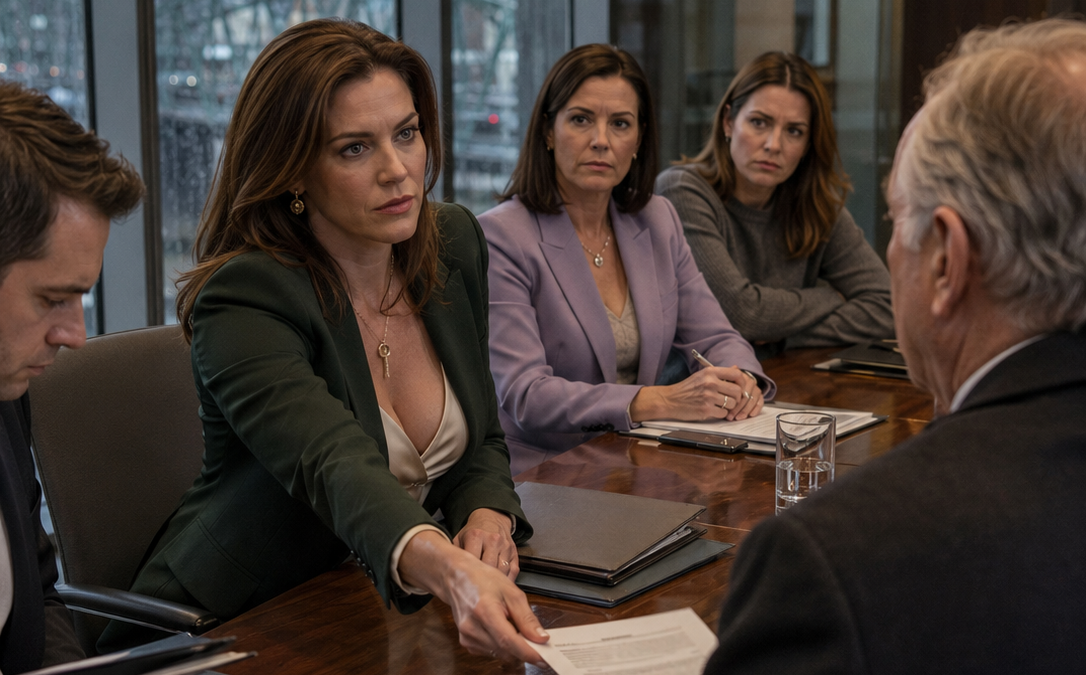
For the first time, Gerald had no immediate answer.
A memory moved through me then: my ten-year-old self at the breakfast table, cereal softening, my mother twisting her apron, my father explaining my removal like a bank procedure. I had imagined confronting him for years. In those fantasies, I shouted. He cried. The room broke open. Real life was quieter and far more satisfying.
I opened my purse and removed a photocopy of the placement consent form. Gerald’s signature sat at the bottom.
“This,” I said, placing it on the table, “is the day you forfeited any claim to being the person I owe.”
He stared at the paper.
His lawyer said nothing.
“I am willing to pay directly for structured help,” I continued. “Counseling. Financial planning. A monitored debt program if you qualify. Nothing goes to you personally. Nothing touches Walter’s estate. Any future contact begins with accountability, not access.”
Gerald laughed once, bitter and small. “So you’re offering charity.”
“No,” I said. “I’m offering the kind of help you refused to give a child.”
The silence that followed was the first honest thing he brought into the room.
He stood abruptly, chair scraping back. His lawyer touched his arm, but Gerald pulled away.
“You always were difficult,” he said.
There it was. The father I remembered. Not pleading. Not grieving. Cornered and reaching for blame.
I picked up Walter’s silver key pendant and held it between my fingers.
“And you always mistook quiet for weakness.”
I left before he did.
Outside, Portland rain had started again, soft and steady. Nicole walked beside me beneath the same umbrella because neither of us had remembered to bring two.
“How do you feel?” she asked.
I thought about it.
“Lighter,” I said.
And I did.
A week later, an email arrived from Marcus.
The subject line was simple: Harper.
I almost deleted it.
Instead, I opened it while standing at the kitchen counter, coffee cooling beside my laptop.
Harper,
I don’t know if you want to hear from me. I would understand if you don’t. I saw your name in the article and then heard Dad had contacted you. I’m sorry. Not in the easy way people say it when too much time has passed, but in the real way. I was twelve when they sent you away. Old enough to know it was wrong, too scared to say so. I have carried that longer than I admitted. You deserved a brother who protected you. I wasn’t one then. I’m sorry.
Marcus
I read it three times.
Then I printed it, folded it, and placed it beside Walter’s letter.
Not every broken thing deserves rebuilding. Some ruins are dangerous to enter. But sometimes, behind one cracked door, there is a room still worth looking into.
Marcus and I met for coffee at a diner off Hawthorne, the kind with chrome edges, sticky menus, and waitresses who refill your cup without asking. He looked older, of course. We both did. His hair was shorter than I remembered, his shoulders broader, his eyes carrying the same caution I felt.
He stood when I approached.
“Harper.”
“Marcus.”
There was no hug. We were not there yet.
We sat across from each other in a red vinyl booth while rainwater dripped from our coats. For a few minutes, we talked like strangers who shared a last name once. Work. Neighborhoods. Weather. The waitress brought coffee. Marcus stirred his even though he drank it black.
Finally, he said, “I remember the breakfast.”
I looked at him.
His eyes shone, but he did not look away. “I remember Dad saying you were leaving. I remember Mom standing at the stove. I remember Bradley kicking me under the table when I started to say something.”
“What were you going to say?”
“I don’t know.” He swallowed. “Maybe nothing useful. But I should have tried.”
I wrapped both hands around my mug. “You were a child.”
“So were you.”
That sentence opened something, not forgiveness exactly, but recognition. We had both been children in a house arranged around Gerald’s needs. I was the one removed. Marcus was one of the ones left behind. Different damage. Same architect.
We began cautiously after that. Coffee once a month. Then dinner with Nicole and his wife, Jamie. Then a phone call on my birthday that made me cry after hanging up. He told me about Bradley, who was not ready. Tyler, who wanted nothing to do with any Whitfield history. Diane, who had asked about me once through Marcus and then said she hoped I was well.
I did not ask to see her.
Not then.
Maybe not ever.
Walter’s money could have become a wall around me. For a while, that was tempting. I could have bought a house no one knew about, taken fewer meetings, let accountants turn grief into quiet growth. But Walter’s last request stayed with me.
Build belonging.
So I did.
The foundation began as sketches on Walter’s old desk. I named it Pierce House Family Futures, because the first safe home I had known deserved to keep opening doors. The initial project was twenty units of affordable housing in Portland for young adults aging out of foster care. Not a shelter. Not a temporary bed with fluorescent lights and rules posted in plastic sleeves. Homes. Studio and one-bedroom apartments with real kitchens, good windows, built-in shelves, and a courtyard where people could sit without being told to move along.
Downstairs, we planned a community center with counseling rooms, legal aid offices, job coaching, a teaching kitchen, laundry facilities, and a small library. I insisted on a front desk that looked welcoming instead of institutional. I insisted on hallways wide enough for light. I insisted every apartment door have a real peephole, a secure lock, and a small shelf inside for keys.
Keys mattered.
Rachel Simmons joined the advisory board after retiring from county work. Dr. Karen Ellis agreed to consult on trauma-informed design. Nicole handled communications because she had long ago appointed herself the person who made sure I did not disappear in rooms full of donors. Marcus volunteered with construction coordination, showing up in work boots and saying little unless asked. Even Mrs. Alvarez from Walter’s street donated recipe cards for the teaching kitchen.
At the groundbreaking, I carried Walter’s letter in my coat pocket.
At the ribbon cutting eighteen months later, the building stood beneath a bright September sky, brick and warm wood, glass catching the morning light. Young people toured the apartments with cautious faces I recognized too well. Some tried to act unimpressed. Some touched the countertops lightly. One young woman stood in the doorway of a studio and asked three times if the room was really hers.
I had to step outside for a minute.
Rachel found me near the courtyard, wiping my eyes with the heel of my hand.
“You built it,” she said.
“We built it.”
She smiled. “Walter would hate how much attention he’s getting today.”
“He would pretend to hate it,” I said.
Then I touched the silver key pendant at my throat and walked back inside.
The speech was short because I do not trust long speeches from people with microphones. I stood before donors, city officials, former foster youth, neighbors, friends, and the small family I had gathered through choice, repair, and time.
“I was once a child who packed one suitcase because adults decided I no longer fit inside their home,” I said. “For years, I believed belonging was something other people could withdraw when I disappointed them. Then one man opened a door, left a room unpainted, and let me choose the color. He taught me that family is not proven by blood. It is proven by who stays, who shows up, and who makes room when it would be easier not to.”
In the front row, Marcus lowered his head.
Nicole cried openly because Nicole had never respected subtlety.
Rachel smiled through tears.
I held up the ceremonial key to the building, silver and bright in the sun.
“This key is not just for a door,” I said. “It is a promise. No one who walks through here is extra weight. No one is a line item. No one has to become perfect to deserve a place to sleep, study, heal, and begin.”
The applause came slowly at first, then rose around the courtyard like weather.
After the ceremony, a young man named Luis approached me. He had just turned nineteen and would be moving into the third-floor corner unit. He wore a clean white shirt and kept smoothing the front as if nervous hands needed a job.
“Ms. Pierce?” he said.
“Harper is fine.”
He nodded, then looked toward the building. “They said I can paint one wall.”
“Yes.”
“Any color?”
“Any color that lets you sleep.”
The words left my mouth before I realized they were Walter’s.
Luis looked at me, confused by the emotion on my face.
I smiled. “That’s what someone told me once.”
That evening, after everyone left, I walked the building alone. The hallways smelled faintly of fresh paint and new wood. Light pooled near the windows. In one apartment, someone had already placed a plant on the sill. In another, a young woman had taped a photo above the tiny kitchen table. Keys turned. Doors closed softly. Lives began without asking permission from people who had failed them.
I stood in the courtyard until dusk and let the building settle around me.
For years, I thought the story of my life was the breakfast table. Gerald’s voice. Diane’s silence. One suitcase. A brick building downtown. A narrow cot smelling of bleach. I thought everything after that was repair.
But Walter had been right. You can build something that outlives the wound.
Gerald tried once more.
A letter came through Elise’s office six months after the ribbon cutting. He had entered a financial counseling program but refused the rest of the structured help. His note was three pages long and contained more explanation than apology. My mother had been overwhelmed. He had been under pressure. Times were different. He had thought I would be better off. He had always cared.
At the bottom, in shaky handwriting, he wrote, I hope someday you remember I am still your father.
I sat with the letter for a long time.
Then I wrote back one sentence.
I remember exactly who raised me.
I did not send more.
I did not need to.
The house Walter left me remains mine. I kept his chair by the window, his books on the shelves, his old gardening gloves near the back door longer than was practical. The sage green bedroom is still upstairs. Sometimes visiting foundation fellows stay there when life gets complicated and they need a quiet night away from everything. The paint has faded a little, but I have never changed it.
On the wall near the front door hangs a small framed copy of Walter’s letter, not the whole thing, just one line.
You were never my charity. You were my daughter.
Below it, on a row of hooks, are keys.
House keys. Office keys. Foundation keys. Spare keys for people who have earned trust slowly and honestly. Every time I hang one there, I think of the girl who once packed a suitcase under her father’s supervision and believed belonging could be revoked by morning.
I wish I could tell her the truth.
Not all families are born at breakfast tables.
Some are built in painted rooms.
Some in diner booths.
Some in therapy offices, college dorms, construction sites, conference rooms, hospital beds, courthouse hallways, and community courtyards where a nineteen-year-old asks if he can choose the color of his wall.
Some families begin with blood and end in silence.
Others begin with a stranger opening a door and saying, “You should choose the color.”
I lost one family because they could not see my worth.
I found another because one man did.
And with the key he left behind, I built doors wide enough for others to walk through.
THE END








