I ordered the cheapest coffee on the menu and a side of toast because I needed somewhere to sit that would not ask me what my plan was.
This time, he moved.
My room looked wrong. Not ransacked, not touched enough to accuse anyone of cruelty, but subtly disturbed. Drawers not fully closed. The jewelry box shifted. My notebook missing from the desk. The closet door open.
I opened the dresser.
Most of my clothes were there.
My winter boots sat by the window instead of in the closet.
The framed photo of Owen was face down on the nightstand.
I picked it up and held it for a moment.
In the picture, Owen was smiling, one arm around me, his eyes crinkled at the corners. Behind us was the old Christmas tree from my childhood, the one my grandmother decorated with wooden ornaments. I ran my thumb over the frame.
“Thank you,” I whispered.
Vanessa appeared in the doorway.
“You’re being dramatic.”
I turned.
She looked elegant, rested, and faintly irritated, as if my boundaries were an inconvenience to her morning.
“You always do this,” she said. “You make everything into some huge thing.”
I looked at her carefully.
“You watched them put me out on Christmas Eve.”
Her chin lifted.
“You’re an adult.”
“So are you.”
Her eyes narrowed.
“What’s that supposed to mean?”
“It means adults don’t lean on counters smirking while someone else gets thrown out into the cold.”
For once, Vanessa had no immediate reply.
Downstairs, my mother called my name.
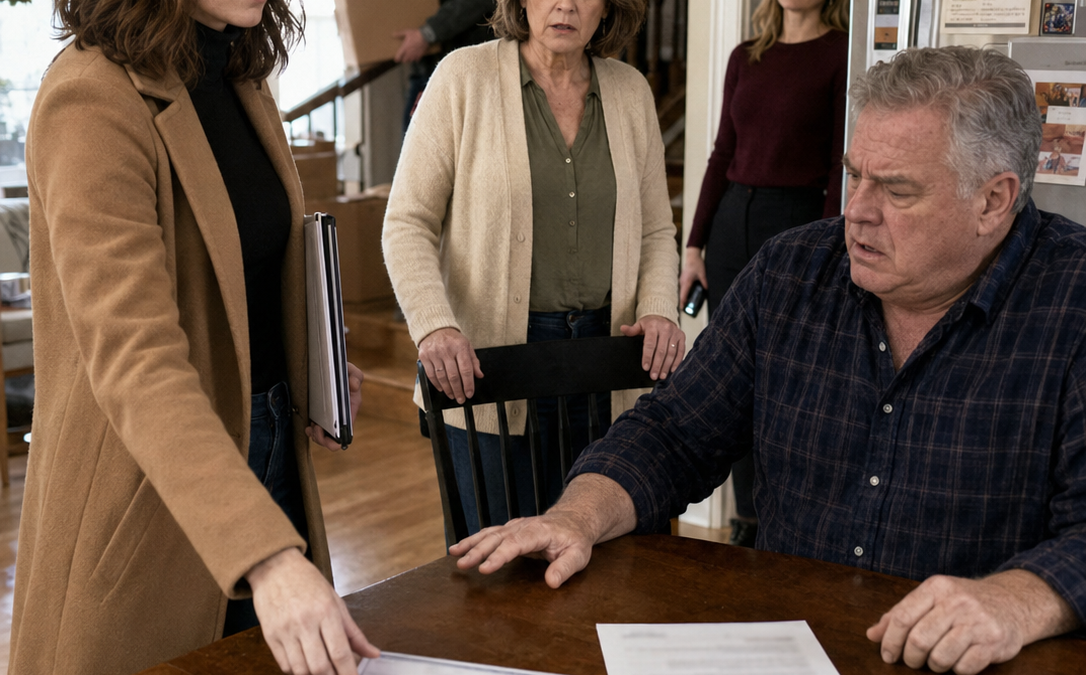
When I entered the kitchen, she stood beside the table where the bill had been. My father sat in the same chair, arms crossed, but the posture looked less powerful now. The paper lay between them.
“You asked for this,” he said.
“I did.”
He pushed it across the table.
I took it, folded it once, and placed it in my folder.
Then I pulled out a cashier’s check.
The exact amount.
$4,218.63.
My mother stared at it.
My father’s eyes flicked to the bank logo.
Vanessa stepped closer.
“What is that?”
“Payment,” I said.
My father’s face changed.
“Where did you get that?”
I slid the check across the table.
“You presented a bill. I’m paying it.”
“That’s not what this was about.”
“I know.”
The room went quiet.
My mother looked at me then, really looked, perhaps for the first time since Christmas Eve. Her mouth softened, but I no longer trusted softness that arrived after consequences.
“Rachel,” she said, “we were trying to make you stand on your own.”
“No,” I said. “You were trying to make me feel small enough to accept whatever story you told about me.”
My father’s hand moved toward the check but stopped.
I opened my folder and placed another paper on the table.
It was a printed copy of Owen’s handwritten note.
For when you really need it, Rach.
Don’t use it early.
You’ll know.
My father went very still.
There it was.
The moment the room shifted.
Not loud. Not cinematic in the way people imagine. No one stood. No one cried out. The refrigerator hummed. The furnace clicked on. A car passed outside, tires crunching over salted pavement.
But my father’s face told me everything.
He knew the note.
Or he knew enough.
“You went to the bank,” I said quietly.
His eyes lifted.
My mother looked at him. “Frank?”
I kept my voice even.
“The bank has a record of your inquiry after Grandpa died. You asked about the account. They turned you away.”
Vanessa’s face changed first.
She looked at my father, startled, then at me.
“What account?”
My father said nothing.
My mother gripped the back of a chair.
“Frank, what is she talking about?”
He looked smaller by the second.
I did not give them the amount. I did not owe them the number. The number was not the point. The point was that Owen had seen me accurately when the people in that kitchen had not. He had spent years building a door for me to walk through when theirs closed.
“I don’t know what you thought would happen,” I said. “Maybe you thought I knew and was hiding it. Maybe you thought if I felt guilty enough, I’d hand something over. Maybe you were angry because Grandpa protected me in a way you couldn’t control. I don’t really need the explanation.”
“Rachel,” my father said, but the authority was gone from his voice.
“No,” I said. “You gave me your explanation on Christmas Eve.”
My mother’s eyes filled now.
Too late.
“I didn’t know,” she whispered.
I looked at her.
“You knew enough to let him block the stairs.”
That ended whatever defense she might have tried to build.
The movers carried the last boxes downstairs. One of them asked if there was anything else. I checked my list. Laptop. Documents. Jewelry box. Quilt. Boots. Books. Photo. Savings notebook, found under a stack of old magazines in the closet.
Everything that mattered.
I picked up my folder.
“The check covers the amount you wrote,” I said. “Consider it paid in full.”
My father stared at it like it was something dangerous.
“Rachel, let’s talk.”
“We already did.”
“When?”
“When the lock turned.”
I walked to the front door.
This time, I opened it from the inside.
For one second, I paused on the porch. The Christmas wreath was still there, browning at the edges. The air was cold, but not unbearable. My car was parked at the curb behind the moving van. My whole life, or the start of it, was boxed and loaded.
Vanessa stood behind the screen door.
“You think money makes you better than us?”
I turned back.
“No,” I said. “But it showed me who thought I was nothing without it.”
She looked away first.
I drove to my apartment and unpacked until midnight.
The bed frame squeaked. The couch was too stiff. The coffee maker made a strange clicking sound before it brewed. The living room was full of boxes labeled in black marker, and the kitchen smelled like cardboard and takeout.
It was perfect.
Over the next few months, I built my life with the care of someone laying foundation after a storm.
I did not quit working immediately. That surprised Simone. It surprised Denise at the bank too. But I kept both jobs for a while, not because I needed every shift, but because I needed to remember that I could choose. I cut back slowly. I met with the financial adviser. I set up investments. I made a plan for school, because I had always wanted to finish the degree I paused years earlier when life got expensive and my family’s needs kept finding their way ahead of mine.
I bought a reliable car.
I paid off the small debt my breakup had left behind.
I gave Simone a check for the rent she refused to ask for during the nights I stayed with her. She cried and called me impossible. I told her people who open doors get to be thanked properly.
I never told my parents the amount.
They tried, of course.
My father called twice. My mother left a message saying she wanted to understand. Vanessa sent one text that began with I think we all said things we didn’t mean, which was such a dishonest sentence I deleted it before reading the rest.
Later, my father sent a letter.
Handwritten.
No apology at first. Just explanations. He said he had been worried about me. He said Owen had always been secretive. He said the bank inquiry was “a misunderstanding.” He said Christmas Eve had gotten out of hand.
I read it at my kitchen table, the new one, the small one by the window.
Then I took out a pen and wrote one sentence on a blank card.
The account was never the reason I left. The way you treated me was.
I mailed it without a return address.
Spring came slowly that year.
The maple tree outside my window opened tiny green leaves. I started walking in the mornings before work, past townhouses and coffee shops and a church sign that changed every week. My apartment became less empty. Books found shelves. Dishes found cabinets. Owen’s photo found a place on the wall above my desk, next to his note, framed in plain wood.
For when you really need it.
I used to think need meant financial need. Rent. Food. A place to sleep.
I understand now that Owen meant something larger.
Need can be the moment you finally see your life clearly. The moment love stops making excuses for people who do not protect you. The moment a locked door becomes proof, not punishment. The moment you stop trying to convince people you deserve room and simply go build a home where your name is already on the key.
That Christmas Eve, my parents thought they were sending me into the cold with almost nothing.
They did not know my grandfather had been walking beside me for seventeen years in the form of a card I had never used.
They did not know the bank would remember.
They did not know the bill they wrote to shame me would be the last thing they ever got to charge me for.
On the first Christmas in my own apartment, Simone came over with too many cookies and a lopsided wreath. We made coffee, burned the first batch of cinnamon rolls, and laughed until we had to open the window.
Later, after she left, I stood alone in the quiet living room. The tree I bought was small, only four feet tall, but the lights made the whole room warm. Outside, snow touched the parking lot in soft, harmless flakes.
My phone stayed silent.
No one called me desperate.
No one told me I could not do anything on my own.
I took Owen’s card from my wallet and placed it in a small box on my desk, next to the receipt for the cashier’s check and the folded expense list my father had written.
Paid in full.
That was what I wrote across the top.
Not because I owed them.
Because I didn’t anymore.
THE END








