“Honestly, it might be better if she stopped coming to these things altogether.”
Part 1 of 5:
Jessica’s voice slipped through the narrow gap in the dining room window just as I raised my hand toward the doorbell.
I stood motionless beneath my son’s covered porch, forty-five minutes late for Thanksgiving dinner, holding a warm pecan pie in a glass dish while cold November rain dripped from the edge of my wool coat. My sedan’s battery had failed outside a pharmacy, leaving me stranded until a young couple helped me with a jump start. I had called David twice to explain, but both calls went to voicemail.
Inside, someone laughed softly.
Jessica tapped her glass.
“She follows me around the kitchen asking if I need help, then she spends the whole evening questioning the kids. Did you finish your homework? Are you sleeping enough? It’s exhausting having to entertain her.”
The pie felt heavier in my hands.
I waited for David to speak.
My son had always been slow to confront people. As a boy, he let other children cut in front of him at the community pool because he hated conflict. His father, Arthur, used to tell him that silence was still a decision, even when it felt like peace.
I waited for him to remember that.
Instead, I heard him sigh.
“It is quieter when she’s not here,” he said. “And she does ask the kids a lot of questions.”
More laughter followed.
Not loud. Not openly cruel.
Comfortable laughter.
The kind people share when they believe the person being discussed is too far away to hear them.
My fingers tightened around the oven mitts. The pie had been cooling when my car failed, but heat still pressed through the glass dish against my palms. I looked through the narrow window beside the front door and saw the dining room I had helped furnish.
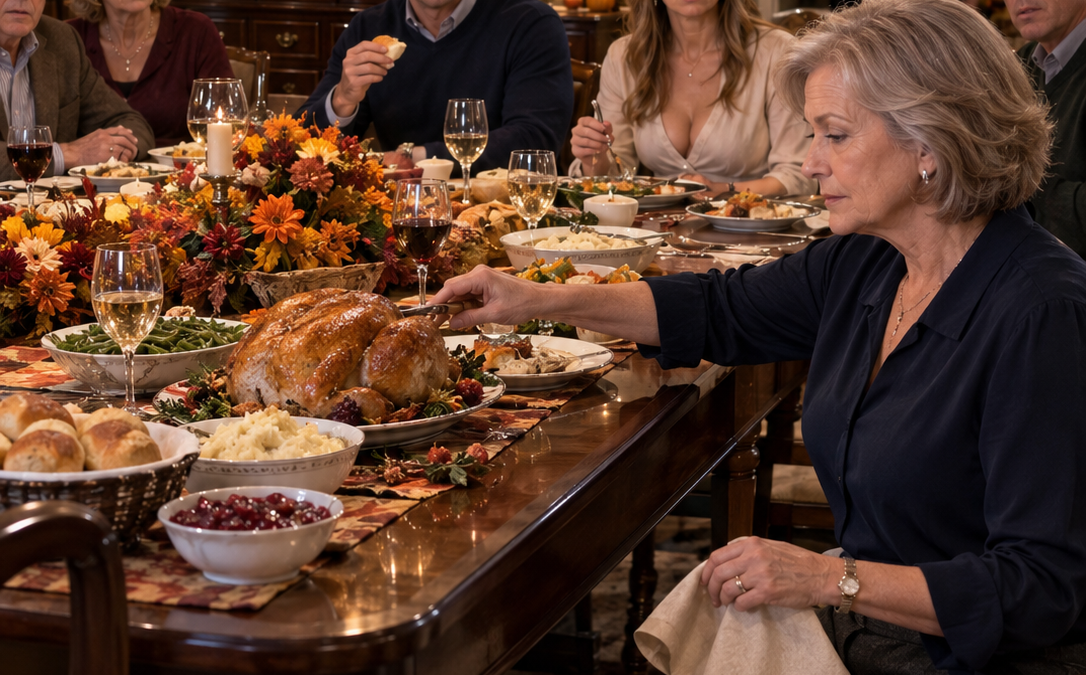
Eight people sat around the long mahogany table.
David was at the head, wearing the navy sweater I had given him the previous Christmas. Jessica sat beside him in a cream blouse, one hand around a wineglass. Her parents, Richard and Elaine, occupied the chairs near the china cabinet. My grandchildren, Lily and Noah, sat between them, distracted by the rolls and cranberry sauce. Two of Jessica’s friends completed the table.
My place at the far end remained empty.
A folded linen napkin rested on the plate.
For a moment, I considered returning to my car.
I could have driven back to my townhouse, put the pie in the refrigerator, made tea, and told everyone the battery had failed again. They would have accepted the explanation because it required nothing from them.
That was how I had handled disappointment for most of my life.
Quietly.
Neatly.
Without making anyone uncomfortable.
But at sixty-eight, after thirty years of marriage and ten years of widowhood, I had finally begun to understand that silence did not always preserve dignity. Sometimes it simply protected people from the consequences of how they treated you.
I shifted the pie to one hand and opened my purse.
The spare key David had given me six years earlier rested in the side pocket. I inserted it into the lock, turned it slowly, and stepped inside.
The foyer smelled of roasted turkey, cinnamon, and the expensive candle Jessica burned whenever guests came over. Wet leaves clung to my shoes. The grandfather clock in the hallway marked the seconds as I removed my coat and hung it beside the family jackets.
No one heard me until I reached the dining room.
Jessica was still smiling when I entered.
Her face changed first.
Then David saw me.
The conversation ended so quickly that the soft instrumental music playing from the kitchen suddenly seemed loud.
“Mom,” David said.
I smiled.
“I’m glad you started without me.”
The pie dish trembled slightly in my hands, but my voice did not.
Lily pushed back her chair.
“Grandma!”
She began to stand, but Jessica placed a hand on her shoulder.
“Let Grandma put her things down first.”
I walked to the sideboard and set the pecan pie between the silver serving tray and the crystal wineglasses I had purchased for their fifth anniversary.
Then I turned toward the table.
“I won’t stay long,” I said. “I just wanted to let everyone know that I’m putting the house on the market Monday morning.”
Jessica’s smile disappeared.
David stared at me with a piece of dinner roll still in his hand.
Elaine looked from her daughter to me as though she had missed the opening scene of a play.
Richard cleared his throat.
“I’m sorry, Carol. Did you say you’re selling this house?”
“Yes.”
I pulled out the empty chair at the end of the table and sat down.
The chair made a soft sound against the hardwood floor. I unfolded the cloth napkin and placed it across my lap.
Jessica gave a strained laugh.
“What a strange joke to make on Thanksgiving.”
“It isn’t a joke.”
I reached for the turkey platter.
“Sandra Bell will be here at ten on Monday morning to take listing photographs. I’d appreciate it if the kitchen counters were cleared before she arrives. Clutter tends to make rooms look smaller.”
No one moved.
The clock in the hallway continued ticking.
David placed the roll on his plate.
“Mom, what are you talking about?”
“I’m talking about the house.”
“You can’t just sell it.”
“I can.”
“We live here.”
“Yes.”
“The children go to school here.”
“I know.”
“We have a life here.”
I placed a modest slice of turkey on my plate.
“You do live here, David. But I own the property.”
Jessica’s fork touched her plate with a sharp metallic sound.
“You gave us this house.”
“No, I didn’t.”
Her eyes widened.
“You told us it was our home.”
“I told you that you could make a home here.”
“That is the same thing.”
“It is not legally or financially the same thing.”
I took a bite of turkey. It was dry, but chewing gave me a few seconds to steady myself.
Six years earlier, after Arthur died, David and Jessica had been living in a cramped two-bedroom rental near the highway. Lily was still a toddler, and Jessica was expecting Noah. Their landlord had announced a rent increase they could not afford.
At the same time, I was trying to decide what to do with the life insurance payment Arthur had carefully arranged.
I did not need a large home. I had already moved into a modest townhouse with a small patio and a maple tree outside the kitchen window. David, however, needed space.
Or so I believed.
I found the colonial house after three weekends of searching. Four bedrooms, a fenced yard, a finished basement, and a good elementary school nearby. I purchased it outright and put the deed in my name.
David and Jessica could live there without rent.
The agreement was simple. They would cover utilities and property taxes. I would remain the owner, and if the arrangement ever stopped working for either side, we would discuss it honestly.
For the first year, they sent me photographs of the children playing in the yard. Jessica invited me to dinner every Sunday. David called just to say thank you.
Gradually, gratitude became familiarity.
Familiarity became expectation.
When the heating system failed, I paid for the replacement.
When Jessica said their old sedan was unreliable for driving the children, I bought a safe family SUV and registered it in my name.
When they struggled with unexpected expenses, I opened a joint emergency account and deposited money into it.
The account was supposed to cover medical copays, home repairs, and true emergencies.
Over time, emergencies began to include salon appointments, boutique purchases, elaborate birthday decorations, and weekend retreats.
I noticed.
I said nothing.
I told myself that questioning the spending would make my generosity feel conditional.
Instead, my silence taught them that it had no limits.
Jessica sat straighter in her chair.
“The deed may be in your name, but you bought the house for David.”
“I bought the house so my son and his family would have stability.”
“Exactly.”
“Stability is not ownership.”
She turned to David.
“Are you going to let her talk to us like this?”
David rubbed his forehead.
“Mom, come on. You heard part of a conversation.”
“I heard enough.”
“It was a joke.”
“You both sounded very sincere.”
Jessica’s face flushed.
“We were frustrated.”
“About what?”
“You’re always here.”
I looked at her.
“I come for Sunday dinner twice a month. I pick up the children when you ask. I attend birthdays, school performances, and holidays.”
“That’s what I mean. There’s no space.”
David leaned forward.
“Mom, she doesn’t mean it the way it sounds.”
“Then perhaps one of you can explain how it was meant.”
Neither answered.
Lily looked between the adults.
“Grandma, are you mad?”
I softened my voice.
“No, sweetheart.”
Jessica quickly spoke.
“Lily, take Noah upstairs and show him the new game your grandfather brought.”
“But we’re eating.”
“Please.”
The children hesitated before leaving the table. Lily glanced back at me from the doorway. I smiled so she would not carry the weight of the room upstairs.
When their footsteps faded, Jessica folded her arms.
“You’re really going to disrupt the children’s lives because of one private conversation?”
“I am not selling the house because of one sentence.”
“Then why?”
“Because the sentence confirmed a pattern I have been refusing to name.”
“What pattern?”
“The eye rolls when I speak. The family photographs taken after I leave the room. The babysitting requests that arrive as instructions rather than questions. The purchases from an emergency account that none of you considered mine, though I funded every dollar.”
Elaine shifted uncomfortably.
“Jessica,” she said softly, “what emergency account?”
Jessica did not look at her mother.
“It’s just a family account.”
“It is my account,” I said. “I added David and Jessica as authorized users.”
David’s expression tightened.
“Mom, don’t bring finances into this in front of everyone.”
“Finances are already in the room. We are sitting inside one of them.”
Richard placed his napkin beside his plate.
“Perhaps this should be discussed privately.”
“You’re right,” I said. “The timing is awkward.”
Jessica released a breath, believing I was backing down.
Then I continued.
“But since I have apparently made family gatherings exhausting, I won’t stay for dessert.”
I pushed my chair away from the table.
Before standing, I looked toward Jessica.
“I need the keys to the SUV.”
Her face went blank.
“What?”
“The SUV is registered to me.”
“We need that car.”
“David has a car.”
“The children have soccer tomorrow.”
“Then David can drive them.”
Jessica looked at my son.
“Say something.”
David stared at his plate.
“Mom, the car was a gift.”
“No. The car was something I purchased for family use while I was supporting this arrangement. The title and insurance remain in my name.”
“You can’t walk into our house on Thanksgiving and take our car.”
I stood slowly.
“This is my house, and the vehicle is mine.”
“I’m not giving you the keys.”
Her voice had changed.
The polished hostess was gone. In her place was a woman who had become so accustomed to control that a calm boundary felt like an attack.
I reached into my coat pocket and removed my phone.
“I have the master key fob in my purse. The dealership application allows me to deactivate the spare. I can do that now, or you can hand me the keys and avoid the inconvenience.”
Jessica stared at me.
I held out my hand.
Neither of us looked away.
David finally spoke.
“Just give her the keys, Jess.”
She turned on him.
“You’re seriously going to sit there and let her do this?”
“It’s her car.”
“She bought it for us.”
“She also owns it.”
Jessica’s parents remained silent. Elaine studied her green beans. Richard looked toward the window.
Jessica reached into the pocket of her cardigan, removed the heavy key ring, and placed it on the table near the gravy boat.
She did not slam it.
That would have looked uncontrolled in front of her guests.
Instead, she set it down with deliberate care.
The metal still made a satisfying sound against the wood.
“Thank you,” I said.
I dropped the keys into my purse.
David looked small in his chair.
Not because I had raised my voice or embarrassed him. I had done neither.
He looked small because he had been given several opportunities to act with courage and had chosen comfort each time.
The realization hurt more than Jessica’s words.
I had spent decades protecting my son from discomfort. When he forgot a bill, I handled it. When his first job ended, I helped with rent. When he and Jessica struggled, I purchased a home.
I believed I was helping him become stable.
Perhaps I had only made it easier for him to avoid becoming strong.
“Happy Thanksgiving,” I said.
I kissed my fingertips and touched them lightly to the air in the direction of the staircase, a silent message for the grandchildren.
Then I walked out.
The rain had stopped.
Cold air moved through the bare trees, and drops of water fell from the branches onto the driveway. The SUV sat beside David’s compact sedan, clean and polished beneath the exterior lights.
For a moment, I considered taking it immediately.
Instead, I walked to my own car.
The sedan started on the first attempt. I placed my hands on the steering wheel and waited for the trembling to pass.
My phone began vibrating before I reached the end of the street.
David.
I let it ring.
A message appeared.
Mom, please don’t do anything tonight. We can talk tomorrow.
A second followed.
Jessica is upset. The kids are confused.
Nothing about what I had heard.
Nothing about his agreement with Jessica.
Nothing resembling an apology.
Only a request that I remain calm enough to preserve their comfort.
I drove home.
My townhouse felt unusually peaceful when I entered. The lamp beside my favorite chair cast a warm circle across the living room. Arthur’s photograph sat on the mantel, his expression patient and amused.
I placed the SUV keys beside it.
“Well,” I said to the photograph, “I finally stopped fixing something.”
The pecan pie remained at David’s house, untouched.
I made tea and ate two crackers for dinner.
At ten-thirty, I called Sandra Bell.
Sandra and I had met years earlier through the library fundraising committee. She was practical, discreet, and one of the best real estate agents in the area.
“Carol,” she said, “is everything all right?”
“No.”
I explained the property arrangement and the dinner.
She listened without interruption.
When I finished, she said, “Are you certain you want to sell, or do you want them to understand that you could?”
The distinction mattered.
“I want to sell.”
“Then we do it carefully.”
“I already told them Monday at ten.”
Sandra laughed softly.
“Nothing like a deadline.”
“I may have been feeling decisive.”
“Good. Decisive is useful. I’ll bring the camera.”
After we ended the call, I contacted Linda Cho, an attorney who had helped with Arthur’s estate. The occupancy agreement allowed me to end the rent-free arrangement with thirty days’ written notice. Linda said she would prepare the document over the weekend.
I did not want to remove anyone overnight.
I wanted clarity, not cruelty.
Thirty days would be enough time for two employed adults to find a rental.
At midnight, I turned off my phone.
I slept without dreaming.
The next morning, sunlight entered through the kitchen blinds in narrow gold lines. I brewed Earl Grey tea and sat at the small table by the window.
Forty-two messages waited on my phone.
David’s messages shifted from apology to panic.
Mom, I’m sorry you heard that.
Jess didn’t mean it.
Please don’t sell the house.
Rents are unbelievable right now.
Think about Lily and Noah.
Call me before you make this worse.
Jessica sent two messages.
You misunderstood a private conversation.
This reaction is completely out of proportion.
I read them once.
Then I opened my laptop.
The emergency account showed a balance of $14,850.
I reviewed the recent transactions.
Two hundred dollars at a hair salon.
One hundred fifty-eight dollars at a boutique.
Seventy-four dollars at an upscale café.
A three-hundred-dollar hotel deposit in a neighboring city.
None appeared connected to a family emergency.
For years, I had looked away because I did not want to become the older mother who monitored every purchase.
But generosity without accountability had become permission.
I transferred the remaining balance into my private savings account.
Then I removed David and Jessica as authorized users and closed the joint account.
The entire process took six minutes.
I expected guilt to follow.
Instead, I felt calm.
I had confused financial support with closeness for so long that withdrawing the money felt like losing the relationship.
The truth was harder.
The relationship had already been shrinking. I had simply been paying not to notice.
Part 2 of 5: The morning after Thanksgiving, David and Jessica appeared at my townhouse demanding to know why their debit card no longer worked. I explained that I had closed my own account—the one they had been using for household expenses. When Jessica protested that I had not warned them, I reminded her that they were the ones who had asked for distance.
Then she finally said aloud the threat that had controlled me for years without ever needing to be spoken. If I sold the house, she said, I would no longer see Lily and Noah. No visits, no birthdays, no school events.
I expected panic. Instead, I felt grief followed by an unexpected clarity. I had spent years tolerating disrespect because I believed financial support protected my relationship with the children. Jessica’s threat proved the opposite. Compliance had never guaranteed access; it had merely postponed the day she would use access as leverage.
“I love them deeply,” I told her. “But I will not exchange free housing and financial support for permission to be their grandmother.”
David looked at his wife and quietly said, “We started this.”
That was the first time his silence stopped working in her favor.
I gave them formal notice that they had thirty days to leave the house. Jessica could not believe I would actually sell what she still called “our home.” I corrected her. It was my property, and the listing process would begin Monday.
When Sandra, my realtor, arrived for photographs, we found the house deliberately left in chaos. Toys, laundry, dishes, and food covered nearly every room. Jessica apparently believed that if the property photographed badly, I might abandon the sale.
I called an emergency cleaning service.
Within hours, the mess was gone.
David watched the cleaners work and finally admitted something larger than the Thanksgiving insult. After Arthur died, he had convinced himself that paying their expenses gave me purpose. He knew I could afford it, so he never asked whether I wanted the role.
Then Jessica came downstairs.
When she saw the photographers, she demanded to know what I wanted from them.
“I wanted respect,” I said. “I no longer intend to negotiate for it.”
The house was photographed that afternoon.
The listing went live the next day.
And for the first time, the arrangement our family had hidden behind appearances became visible to everyone.
Part 3 of 5: Once the for-sale sign appeared in the yard, neighbors began asking questions. People who had always assumed David and Jessica owned the colonial discovered that my name was on the public record. Jessica initially told people they were voluntarily downsizing, but the story became harder to maintain once reality started imposing a deadline.
David began searching for rentals. The first apartment lacked the kitchen island Jessica wanted. The second was farther from school. The third had older carpet but fit their budget. Eventually preference gave way to responsibility, and they signed a lease on a clean three-bedroom apartment fifteen minutes away.
Lily called one evening from David’s phone.
“Are you mad at us?”
“Never at you.”
She asked whether another family would live in the old house and whether she could still visit me. I told her I would always want her there, though her parents controlled the schedule.
“I miss you,” she said.
Afterward, I cried for the first time since Thanksgiving. Not because I regretted the sale, but because boundaries can be necessary and still hurt.
The house received four offers within two weeks. I accepted one from a family relocating from Chicago. David and Jessica moved out before the deadline and left a box on the kitchen counter containing photographs of the grandchildren, some of Arthur’s tools, and an old family portrait. Beneath everything was a short note from David apologizing for allowing the house to become a place where I felt unwelcome.
It did not restore trust.
But the apology was specific.
That mattered.
After closing, the proceeds went into a retirement trust with no family access, emergency debit cards, or vague promises that my savings existed to rescue anyone who became uncomfortable. I sold the SUV too. David bought a used minivan, Jessica began comparing grocery prices, and David took extra consulting work.
They were not poor.
They were simply paying for their own lives.
Then I finally booked the European river cruise Arthur and I had postponed for years.
The journey began in Budapest. On the first evening, I stood on the upper deck watching lights move across the Danube and expected loneliness to overwhelm me.
Instead, I thought of Arthur and whispered, “You would have loved this.”
A woman named Ruth overheard me.
“So would my husband,” she said.
We became friends before dinner.
For three weeks, we toured cities, drank coffee in small squares, got lost in Vienna, and laughed about it. I bought new luggage, ordered dessert without checking the price, and sent postcards to Lily and Noah.
I did not send money home.
Nothing collapsed.
That realization changed me as much as the sale itself.
My family could survive without my bank account.
And I could survive without constantly being needed.
Part 4 of 5: Before the cruise, David invited me to their apartment for Christmas Eve. I agreed to come for one hour—to bring presents and read to the children, but not stay for dinner. Jessica had offered to apologize, and I wanted to hear what she said without pretending one conversation could restore everything.
The apartment was smaller than the colonial but beautifully decorated. Lily ran straight into my arms, and Noah showed me a drawing of the old house. When the children went to choose a book, Jessica approached me.
She apologized for the Thanksgiving comments and, more importantly, for using the children as leverage. She admitted that she had interpreted my financial boundaries as an attempt to control them.
“I stopped giving money when I realized it had become the only part of me you valued.”
She said she did not expect immediate forgiveness.
“Good.”
The answer hurt her, but she accepted it.
I told her rebuilding trust would require ordinary behavior: allowing the children to love me without using access as pressure, respecting invitations, paying their own expenses, and speaking decently even while frustrated.
At five o’clock, Noah begged me to stay for dinner. For a moment, Jessica looked ready to encourage him.
Then she stopped herself.
“We’ll see Grandma another day,” she said.
That choice mattered more than another apology.
Over the following months, evidence accumulated slowly. David called without asking for money. Jessica sent photographs without attaching favors. They invited me to a school concert and did not expect me to buy dinner afterward. When the minivan needed repairs, David told me he had picked up extra work and would handle it himself.
My first instinct was to secretly pay the bill.
Then I realized that would disrespect the independence he was finally building.
A year after the disastrous Thanksgiving, they invited me again. This time Jessica personally told me she wanted me there but would understand if I declined.
I went.
Their apartment was crowded, the tables were folding tables, and the dishes did not match. Yet the room felt more honest than the expensive colonial ever had.
Before dinner, Jessica stood and acknowledged what happened the previous year. She said she had treated generosity like entitlement and my presence like an inconvenience. David admitted that agreeing with her merely to avoid conflict had caused more damage than the conflict itself.
Then Jessica said something I had waited years to hear.
“Carol is welcome here because she is family, not because of what she owns or pays for.”
Lily reached beneath the table and took my hand.
No one asked about the proceeds from the house.
No one mentioned the old emergency account.
At the end of the evening, David told me he had begun repaying part of the fourteen thousand dollars they had spent from that account—not because I legally demanded it, but because repayment acknowledged that the money had been mine.
I agreed on one condition: half of whatever he repaid would go into professionally controlled education accounts for Lily and Noah.
David laughed.
“That sounds like you.”
This time, generosity was mine to choose.
Part 5 of 5: Over time, David learned to disagree without disappearing into silence, and Jessica learned that an apology did not buy immediate comfort. I learned something less flattering about myself too: much of my generosity had been fueled by fear. Money kept me useful, and usefulness felt safer than asking whether I was genuinely valued. Selling the house forced all of us to answer that question without money holding the family together.
Two years later, David and Jessica were saving toward a modest townhouse with a realistic budget, maintenance costs, insurance, and an emergency fund already accounted for. When they showed me the spreadsheet, David made one thing clear before I could ask: “I’m not asking you to contribute. I only want your opinion.” Their plan was imperfect but theirs, and that gave it more dignity than the polished dependence they once mistook for success.
Near my front door now sits a framed photograph from one of our later Thanksgivings. Everyone is in it, including me. On the back Jessica wrote only, “Thank you for coming.” Not thank you for paying or helping—just coming. The colonial belongs to another family, the emergency account is gone, and the SUV was sold long ago. What remains is simpler: I no longer finance my own erasure, and when I arrive for Thanksgiving, someone opens the door because they genuinely made room for me.
THE END








