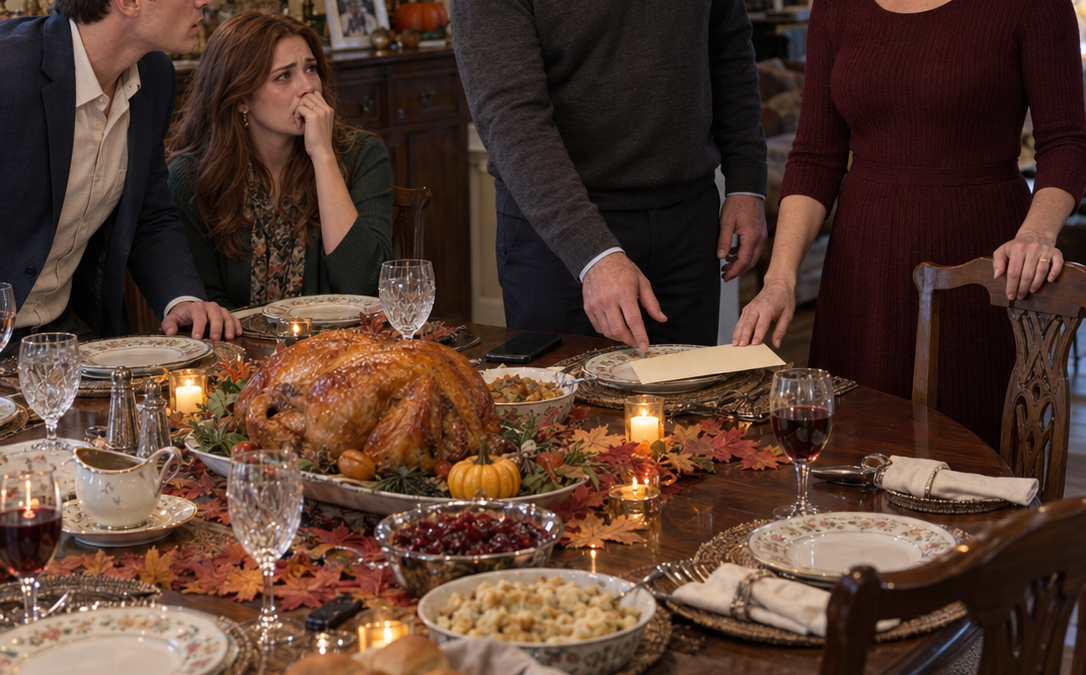
At thanksgiving dinner, my husband stood up like he had rehearsed the moment and said, “I’m selling the house. Cheryl needs a bigger place, and I’ve decided to start over with her.”
PART 1:
The envelope was already in my purse when my husband announced he was selling our house.
That is the part he never understood. Russell thought Thanksgiving dinner was the beginning of his story, the moment he would stand at the head of the table, clear his throat, and explain to his wife and children that he had chosen a new life and expected the old one to step aside politely. He thought he was walking into an announcement.
I had been carrying the ending for three weeks.
It was cream-colored, thick, sealed, and tucked into the inside pocket of my handbag beneath a tube of lipstick and the keys to the house he no longer owned.
The cranberry sauce was still bubbling on the stove when his phone buzzed for the seventh time that morning. I remember the sound because it did not belong in my kitchen. Thanksgiving had its own music: the oven fan humming, my daughter Meredith laughing from the dining room, my son Forest asking where I kept the extra serving spoons, the dull thump of my own heartbeat as I lifted a twenty-pound turkey out of the roasting pan and tried not to drop it on the floor.
Russell’s phone cut through all of that.
A hard little vibration against the polished dining table.
I looked through the kitchen doorway just in time to see him glance down. His face changed before he could stop it. A small private smile moved across his mouth, the kind of smile I remembered from a younger marriage, from restaurant booths and late-night drives and the first time he saw me in the blue dress I wore on our honeymoon.
That smile had not been mine for a long time.
“Honey,” I called, keeping my voice even, “could you give me a hand with the turkey?”
He did not look up.
“In a minute.”
His thumbs were already moving.
I stood there with oven mitts on both hands, feeling the heat of the pan through the fabric and a familiar ache opening in my lower back. I was forty-eight, not twenty-five. I had hosted twenty-four Thanksgivings in that house, raised two children between those walls, painted bedrooms, refinished the porch, paid bills, planned school mornings, waited up through teenage curfews, and kept every holiday alive even when the marriage beneath it began to thin like old cloth.
Russell could not be bothered to help me lift the turkey.
I managed it myself.
When the roasting pan landed on the counter, a little juice sloshed over the side and hissed against the hot metal. I stood still for one second, breathing in rosemary, sage, and butter, reminding myself that the children were home and the day could still be saved.
Forest had arrived from Chicago the night before, looking older than twenty-seven in the way young professionals look when the city has started taking pieces from them. He wore a new blazer and tried to hide the stress around his eyes. Meredith came in that morning from grad school with wine, flowers, and a bright scarf wrapped around her neck, bringing the whole house back to life the moment she stepped through the door.
For a while, it almost worked.
They sat at the dining room table with my grandmother’s china and the centerpiece I had spent two hours building from little pumpkins, autumn leaves, and flickering battery candles. They teased each other about old family stories. Forest stole a piece of turkey before we sat down. Meredith raised her glass and said, “To Mom, for another Thanksgiving miracle.”
I smiled because it was easy to smile at them.
Then Russell’s phone buzzed again.
He grabbed it too quickly.
Meredith noticed.
“Everything okay, Dad?”
“Fine.”
His voice was clipped. His leg began bouncing beneath the table, a fast, nervous rhythm that made the floor tremble under my chair. I knew that bounce. I knew every one of Russell’s little tells. The throat clear before bad news. The way his eyes refused to land on mine when he was hiding something. The way he straightened his shoulders before turning a decision into a performance.
He did all three.
The dining room cooled around me.
“Actually,” Russell said.
He pushed his chair back. The legs scraped harshly against the hardwood, slicing through the last of the laughter. Forest’s fork paused halfway to his mouth. Meredith lowered her wine glass. I felt the envelope in my purse from across the house as if it had begun to breathe.
Russell stood at the head of the table.
He did not look at me. He looked somewhere just above my shoulder, addressing an invisible board of directors.
“I have something to tell everyone.”
I heard the false brightness in his voice and knew he had practiced.
“Russell,” I said quietly, “whatever it is, can it wait until after pie?”
He ignored me.
“I’m selling the house.”
The words did not explode. They simply landed, heavy and final, in the middle of the Thanksgiving table. For one strange second, I noticed ordinary things more sharply than I noticed my own pain: the shine of gravy on his plate, the tiny flame inside the fake candle near Meredith’s elbow, the red cranberry sauce cooling in my mother’s silver bowl.
Then Forest’s fork slipped from his fingers and clattered against his plate.
“What?” Meredith whispered.
Russell kept going, because men like Russell do not stop once the speech begins. They fear silence more than cruelty.
“Cheryl and her kids need more space. Her apartment is too small, and the kids are getting older. I found a place in Westfield. Good schools. Big yard. It makes sense.”
Cheryl.
The name moved through the room like a match dropped onto dry paper.
Not a woman from work. Not a stranger. Not some late-life mistake I could file under ordinary betrayal.
Cheryl Peters was my stepsister.
The girl I had taken under my wing when my father remarried. The young woman with sad eyes who had once stood in my kitchen and told me she had never felt like she belonged anywhere. The woman I helped after her own short marriage collapsed. The woman whose children had slept in my guest rooms for two months while she cried into my towels and drank coffee at my counter.
I had called her my sister.
She had called me lucky.
Across the table, Meredith made a small sound.
“Aunt Cheryl?”
Russell looked irritated. “She’s not your aunt.”
That sentence hurt Meredith more than the first one had. I saw it on her face. He was not just leaving. He was rewriting the family while sitting at the table I had set.
Forest stood halfway out of his chair.
“Dad, are you serious?”
Russell finally looked at me. His expression hardened, bracing for the storm he believed he deserved. He wanted me to cry. He wanted me to shout. He wanted an emotional scene he could later describe as proof that I was impossible to live with.
I almost gave it to him.
For twenty-four years, I had carried the weight of being reasonable. I had softened my words, managed his moods, protected the children from tension, explained away late nights, accepted half answers, and turned my own discomfort into patience because families are supposed to survive hard seasons.
But a season is not the same thing as a life sentence.
I placed my napkin beside my plate.
The room watched me.
I stood, walked to the entryway, and opened my purse on the small mahogany table where we kept the mail. My fingers touched the worn leather lining, the car keys, the lipstick, the folded grocery receipt, and then the envelope.
It was exactly where I had left it.
For three weeks, I had moved it from one purse to another, waiting for the moment I would know when to use it. I had imagined a quiet conversation after the holidays. I had imagined Russell signing divorce papers in a lawyer’s office. I had even imagined never needing to hand it to him at all.
But life has a way of choosing the right theater.
I returned to the table.
Russell’s mouth twitched with nervous confusion when I placed the envelope beside his plate, right on top of the gravy stain left by his fork.
“Since we’re all making announcements,” I said.
My voice was quiet.
That made it stronger.
He stared at the envelope.
“What is that?”
I sat down and picked up my knife and fork.
“Open it.”
He did not.
His fingers hovered over it like the paper might burn him. Forest was standing now, his face pale with anger. Meredith had tears on her cheeks, one hand pressed against her mouth. The turkey, the candles, the centerpiece, all the beautiful things I had prepared sat around us like witnesses.
Russell picked up the envelope, then slid it into the inside pocket of his jacket.
“Later,” he said.
Forest’s voice turned cold. “No. Now.”
Russell reached for his water glass. “This isn’t the time.”
I laughed softly.
It was not a happy sound.
“You chose the time.”
His phone buzzed again.
Everyone turned toward it.
The screen lit up against the table.
Cheryl.
Russell’s hand shot out and flipped the phone over, but not fast enough. Meredith saw. Forest saw. I saw. For a moment, no one moved.
“Answer it,” I said.
His face flushed.
“It’s work.”
“On Thanksgiving?” Meredith’s voice broke. “Does Cheryl work with you now too?”
Russell pressed decline.
The phone buzzed again.
This time, he stood and left the dining room, shoulders stiff, phone already at his ear. We could still hear Cheryl’s sharp, demanding voice through the hallway, though not every word. We did not need every word.
The children and I sat at the table in the wreckage of dinner.
Then Forest pushed back his chair.
“I’m done.”
“Forest,” I said.
He looked at me, and whatever he saw in my face made him soften.
“I’m not leaving you,” he said. “I’m leaving this table.”
He went upstairs. Meredith followed a few minutes later after squeezing my hand so tightly it hurt.
That night, I slept alone in the bed Russell and I had shared for more than two decades, though sleep is not the right word. I lay there watching the ceiling fan turn and let myself remember the whole ugly story from the beginning.
PART FINAL:
It had started, as these things often do, with small kindnesses I mistook for harmless.
Cheryl calling Russell to help with a flat tire. Cheryl asking Russell to look over her lease. Cheryl bringing her children over because “Uncle Russell makes them feel safe.” Cheryl complimenting my marriage while inching closer to the center of it. Russell looking pleased by her neediness. Me feeling proud that my husband was helpful, generous, patient.
Then came the credit card statement.
It arrived on a rainy Tuesday, tucked between catalogs and a grocery flyer. The address window caught my eye because it listed Russell Davidson and Cheryl Peters on the same account. I opened it with shaking hands and found a domestic life I had not agreed to finance: groceries near Cheryl’s apartment, children’s furniture, clothing stores, a patio set, a restaurant Russell claimed he hated when I suggested it for our anniversary.
When I confronted him, he had an answer ready.
“Her ex is making things hard,” he said. “I’m helping her credit. It’s temporary.”
I wanted to believe him.
So I did.
The final proof came from Meredith, who called one Saturday from a park near her apartment.
“Mom,” she said casually, “I just saw Dad with Aunt Cheryl and the kids. I almost said hi, but it seemed kind of private.”
Russell had told me he was in Denver for a work retreat.
After I hung up, I sat in the living room until the daylight faded and finally admitted what my body had known for months.
My husband was not just helping Cheryl.
He was building another household.
The following Monday, I hired Clayton Richards, a divorce attorney with a calm voice and a reputation for making careless men regret unread documents. I brought him bank statements, credit card bills, screenshots, phone records, and every small proof I had gathered while pretending I was still deciding what to do.
He read everything without interruption.
When he finished, he said, “Your husband thinks he controls the assets.”
“He put the house in his name years ago,” I said.
Clayton smiled.
“Then we let him keep thinking that.”
The papers Russell signed two weeks later looked boring on purpose. Estate planning updates. Family trust language. Asset protection. Future inheritance security for the children. Clayton’s team made the packet dense enough that a man watching football would look for the yellow tabs and nothing else.
I handed it to Russell in the den.
“Clayton says these protect the kids,” I told him.
Russell barely looked away from the game.
“Show me where to sign.”
He signed away the house with less attention than he gave a third-down replay.
The next morning, I filed the deed at the county clerk’s office. The stamp came down with a sound that echoed through the quiet room.
The house became mine.
Three months later, at Thanksgiving, I placed proof of that fact beside his turkey.
The week after dinner was unbearable for him and strangely peaceful for me. Russell moved through the house like a man afraid of floorboards. He patted his jacket pocket constantly, checking for the envelope. I made coffee. I watered plants. I answered Meredith’s calls and told Forest I was fine. I watched Russell discover that silence can be louder than any argument.
Finally, on Thursday morning, he appeared in the kitchen while I was making pancakes.
He looked terrible.
His hair was messy, his eyes bloodshot, and the cream envelope was crushed in his fist.
“What is this, Brenda?”
I flipped a pancake.
“Open it.”
The paper ripped.
Then came the silence.
I turned around with the spatula still in my hand.
Russell stood by the counter staring at the quitclaim deed, his mouth slightly open, his face drained of color.
“You transferred the house.”
“I did.”
“When?”
“Three months ago.”
His eyes lifted to mine, wild and furious.
“You set me up.”
“I protected myself.”
“The house,” he said, almost to himself. “Cheryl is expecting the house. We already looked at furniture. We have plans.”
“Cheryl is expecting something that was never yours to give.”
His phone rang.
We both looked.
Cheryl.
He answered with a trembling hand.
“Hey, babe.”
Her voice carried from across the kitchen, bright and impatient.
“Russell, thank God. I’ve been thinking about the timeline. The kids are excited about the bedrooms, and I found the perfect sectional for the Westfield house. When will the paperwork be ready?”
Russell looked at me like a man standing on a bridge that had already burned from both ends.
“There’s been a complication,” he said.
The sweetness left her voice immediately.
“What kind of complication?”
Russell swallowed.
“The house isn’t technically in my name anymore.”
The silence on the phone was sharp.
Then Cheryl said, “What do you mean it isn’t in your name?”
I poured syrup over my pancakes.
Russell whispered, “Brenda transferred the deed.”
I could hear Cheryl breathing.
Then she said the sentence that ended whatever love story Russell thought he had built.
“You promised me a house you don’t even own?”
The line went dead.
Russell stared at the phone, hollowed out.
I took one bite of pancake.
It was perfect.
He moved out a week later.
Forest and Meredith stayed with me through the worst of it, not as children choosing sides, but as adults recognizing which parent had been abandoned at the table. The divorce moved forward on my terms. I painted the bedroom a soft blue. I turned Russell’s dark office into a reading room filled with plants. I started waking up without waiting for a phone to buzz.
For a few months, I thought the story was ending.
Then Meredith called me in April.
“Mom,” she said, her voice tight. “Dad and Cheryl are back together.”
I closed my eyes.
“Of course they are.”
“That’s not the worst part.”
I sat down at the kitchen island.
Meredith hesitated.
“She agreed to marry him. But she told him they need to start trying for a baby right away.”
A cold stillness moved through me.
A baby.
Not love.
Not forgiveness.
A strategy.
A week later, I learned why. I was in the pharmacy aisle at the grocery store when I heard Cheryl’s voice around the corner, low and sharp on the phone. She was talking about custody, relocation, and proving a stable new family unit. A new marriage. A planned child. A clean picture for a judge.
My hand tightened on the cart handle.
For years, I had carried a private sadness Russell had placed on me. After Meredith was born, we had tried for another child. I blamed myself through tests, appointments, and quiet monthly grief. Only much later, in a rare moment of guilty honesty, Russell admitted he had been tested too and never told me the results.
The issue had not been mine.
He had let me carry it anyway.
Now Cheryl was building her next plan on the one secret Russell had kept from everyone.
The next morning, I called Clayton.
“I need to amend discovery,” I said.
“For what?”
“Russell’s old medical records.”
Clayton paused.
Then he said, “Tell me what I’m looking for.”
The subpoena was signed within a week.
The timing was almost poetic.
Russell and Cheryl scheduled a small June wedding at a banquet hall, with her custody hearing set for the following Monday. She planned to walk into court as a newly married woman with a future family story polished and ready.
That Saturday afternoon, I was in my garden planting roses when Meredith called.
She had gone to the wedding out of curiosity and loyalty and perhaps a little inherited nerve.
“Mom,” she said, trying not to laugh and failing. “The courier came.”
“What courier?”
“The one Clayton sent. He delivered the medical file to Cheryl in the bridal suite.”
I sat on the garden bench.
Meredith lowered her voice.
“She opened it right there. I watched her face change. First she was annoyed, then confused, then furious. She ripped off her veil and left before Dad even got to the room.”
I looked down at the dirt under my fingernails.
“Did she say anything?”
“She left the envelope on the vanity,” Meredith said. “Dad walked in ten minutes later and just stood there staring at it.”
I closed my eyes and lifted my face to the warm afternoon sun.
Russell had promised another woman a house he did not own and a future he had not been honest enough to offer.
Both promises collapsed under paperwork.
That evening, Forest and Meredith came over. We sat on the front porch with a bottle of champagne I had been saving for something I could not name. The sun went down behind the maple trees, painting the lawn gold, and for the first time in a long time, the house felt like it belonged entirely to us.
Two years later, an engagement invitation arrived for Forest and Sarah, a brilliant architect who made my son laugh like he was ten years old again.
At the party, Russell came too.
He called first and asked if I would be uncomfortable.
“Our children are adults,” I told him. “They can decide what kind of relationship they want with you.”
He arrived at the old country club in a suit that looked too big. He was thinner, grayer, quieter. I watched from the terrace as Forest spoke with him. Meredith joined them. There was no warm family embrace, no instant forgiveness, no perfect ending wrapped in ribbon.
But there was honesty.
That was more than we had once had.
Clayton found me outside with two glasses of champagne.
“How are you holding up?” he asked.
I looked through the windows at my children laughing inside, at Russell standing near the edge of the room, at the life I had rebuilt from one envelope and the courage to let a man read what he signed.
“I’m good,” I said.
And I meant it.
The woman at that Thanksgiving table had been afraid of losing her home, her marriage, and the story she had spent twenty-four years protecting.
The woman on that terrace understood the truth.
Sometimes the house is not the thing you save.
Sometimes it is the place where you finally save yourself.
THE END
If you came here from Facebook because this story pulled you in, please go back to the Facebook post, tap like, and comment exactly “Well told” to support the storyteller. That small action means more than it seems and helps give the writer the motivation to keep bringing more stories like this to readers.








