At 14, She Was Abandoned in the Frozen Wilderness—Then Her Secret Clay Stove Helped Her Outsmart Every Hunter
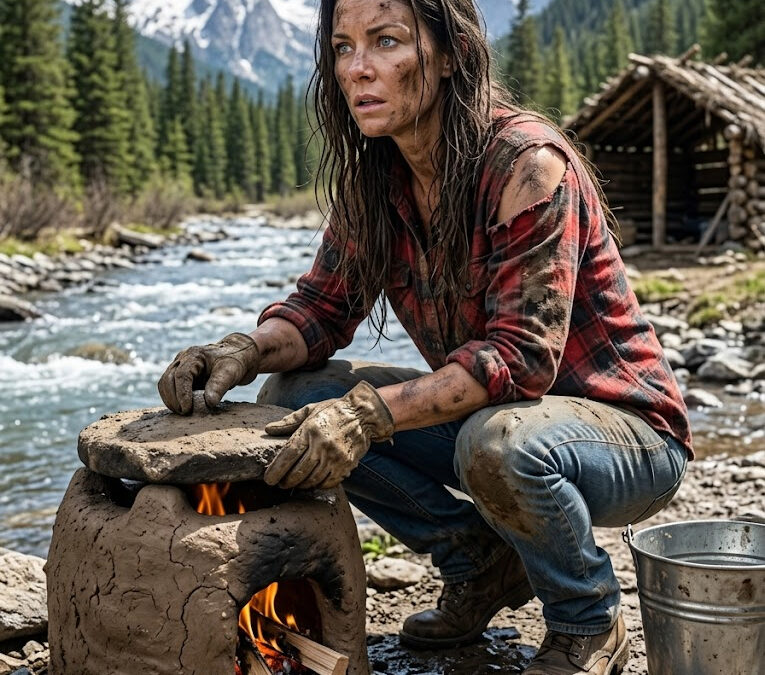
Part 1
The first hound came so close that Sydney Sullivan could hear the wet pull of air through its nose.
She lay beneath a mound of frozen pine needles, her cheek pressed against black earth, her lungs locked tight inside her chest. Three feet away, the brindled animal clawed at the ground and whined. Its breath drifted through the leaves in pale clouds.
Above her, Garrison Croft’s boots stopped.
Sydney could see only the cracked leather toes through a narrow gap in the forest debris. She could hear the faint metal click of the rifle hanging against his body.
“Find her,” Croft whispered.
The dog lowered its snout again.
Beneath Sydney’s ribs, hidden under several inches of soil and river clay, a fire burned without smoke. Heat radiated through a flat stone and into her freezing body. It was the only reason she was still alive.
Five minutes earlier, she had covered the stone with dirt and buried herself beside it. Now the warmth that had saved her threatened to expose her.
The dog stepped closer.
Sydney wrapped one hand around the small folding knife inside her sleeve. Her father had given it to her for her thirteenth birthday. The handle was worn smooth from use. It was the only thing her uncle had failed to take from her.
The hound scratched beside the stove’s concealed air tunnel. A puff of hot ash shot upward.
The dog sneezed violently and jerked back.
Croft cursed and pulled its leash. “What is it?”
The hound shook its head, its nose coated in gray dust. The ash drifted over the ground, covering the scent of the girl lying inches away.
Croft stood over Sydney for several more seconds.
Then his radio crackled.
“Did you find her?” William Prescott demanded through the speaker.
Croft looked around the silent grove. There were no footprints, no shelter, no smoke, and no sign that anyone could have survived the twelve-degree night.
“The dogs lost the trail near the river,” he answered. “She’s done. Without fire, she froze before sunrise.”
Sydney closed her eyes.
Her uncle laughed softly over the radio.
“Then let’s go home and start grieving.”
The men moved away. The hounds resisted at first, whining and glancing back toward the hemlock grove, but Croft dragged them into the trees.
Sydney remained buried long after their footsteps disappeared.
She had learned patience from her father. He used to tell her that the wilderness punished people who acted before they understood what was happening.
Listen first, he would say. The mountain is always telling you something.
Three months earlier, her father’s voice had vanished from the world.
A plane carrying both of her parents had crashed in the mountains outside Seattle. Investigators called it mechanical failure. William, her mother’s older brother, had taken Sydney into his home and promised to care for her.
He had also taken control of the Sullivan family trust.
Her parents’ estate was worth millions. Timberland, mineral leases, investment accounts, and property had been placed in trust until Sydney turned eighteen. As her legal guardian, William controlled everything in the meantime.
He had spent three months pretending to be a grieving uncle.
Then he invited her on an elk-hunting trip in northern Idaho.
“It’s what your father would have wanted,” he had said.
Sydney should have recognized the lie in his smile.
William drove her into the Selkirk Mountains during the final week of October. Frost covered the logging roads. The sky hung low and white above the peaks. At the trailhead, a man named Garrison Croft waited beside a stack of military-style equipment.
Croft did not look like a hunting guide. He wore tactical clothing and carried a suppressed rifle. He watched Sydney with the detached interest of someone measuring a target.
They hiked seven miles into roadless wilderness. William forced Sydney to carry the heaviest pack. By nightfall, exhaustion dragged her into sleep.
She awoke to the quiet movement of her tent zipper.
Her boots were gone. So were her coat, sleeping bag cover, food, compass, and survival equipment.
Outside, William and Croft spoke beside the dying fire.
“At this temperature, she won’t make it until morning,” William said. “Once she’s legally declared dead, the trust transfers to me.”
“And if she runs?” Croft asked.
“Follow her. Make sure she never reaches a road.”
Sydney lay motionless as the truth settled over her.
Her parents’ crash had not been an accident.
William had killed them.
Now he intended to let the wilderness kill her.
For one terrible moment, panic erased every lesson she had ever learned. Then her father’s voice returned inside her memory.
Breathe. Assess. Act.
Sydney touched the knife pinned inside the hem of her jeans.
She slipped through the rear of the tent while the men’s backs were turned. She did not run toward the trail. Croft would expect that. Instead, barefoot and dressed only in jeans and a flannel shirt, she moved deeper into the mountains.
Ten minutes later, William discovered she was gone.
“Let her run,” Croft called through the trees. “The cold will catch her for us.”
Sydney heard him.
And she kept moving.
Part 2
The first forty-eight hours nearly killed her.
The forest tore at Sydney from every direction. Sharp shale sliced her feet. Dead branches clawed her arms. Steep ravines forced her to crawl through mud and freezing water.
By the end of the first day, blood darkened the ground behind her.
She knew the trail would lead Croft directly to her. Near a creek, she stepped into the water and followed it downstream until the cold became unbearable. Then she climbed onto a fallen log and crossed to the opposite bank without leaving prints in the mud.
She wrapped her feet with thick lichen and strips torn from her shirt. The makeshift coverings looked ridiculous, but they protected her skin from the worst of the frozen ground.
Hunger came slowly.
Cold came all at once.
On the second evening, the temperature dropped into the teens. Sydney’s body shook so violently that her teeth hurt. She found shelter beneath the exposed roots of a fallen cedar, but the wind pushed through every opening.
After midnight, the shaking stopped.
That frightened her more than the pain had.
Her father had taught her that a freezing person sometimes felt warm just before death. The body stopped fighting. The mind became slow and peaceful.
Sydney felt that peace reaching for her.
She wanted to close her eyes.
Instead, she bit the inside of her lip until she tasted blood.
“Pain is clarity,” she whispered.
In the distance, hounds began to bay.
Croft was tracking her.
A normal campfire would reveal her position. Smoke would rise through the trees. The smell of burning wood would carry across the ravine. The dogs would find her before she could move.
She needed heat without smoke.
Near the creek, Sydney found a bank of heavy gray clay.
An idea formed.
Her father had once shown her how soldiers, hunters, and Indigenous scouts built concealed fires beneath the ground. A narrow air tunnel fed oxygen into a larger chamber. The fire burned hotter and cleaner than an open flame.
Sydney dropped to her knees and began digging.
Her hands were numb, and her fingers barely moved. She used a flat piece of slate as a shovel. The first hole was narrow at the top and wide below, shaped like a buried jug. A second angled tunnel connected to its base.
Loose soil collapsed repeatedly.
Sydney solved the problem with clay.
She lined both chambers with thick layers from the riverbank, pressing and smoothing the wet material against the walls. She chose dense granite stones for the rim, avoiding porous rocks that might explode under heat.
Then came the hardest part.
She had no matches.
Sydney scraped dry birch bark into fine curls. She crushed a piece of fungus into powder and protected the bundle beneath her shirt. Holding her carbon-steel knife against a shard of quartz, she struck them together.
Nothing happened.
She struck again.
A spark flashed and vanished.
Her hands trembled so badly that the knife slipped twice.
“Come on,” she pleaded.
Another spark landed in the fungus.
A thread of smoke appeared.
Sydney lowered her face and breathed gently over it. The ember glowed red. She added birch curls, then pine needles, then the smallest dry twigs she could find.
A flame opened like a tiny orange flower.
She lowered it carefully into the clay chamber.
The underground fire drew oxygen through the tunnel. Flames intensified, baking the wet clay into a hard ceramic shell. Sydney placed a flat slate stone across the main opening, leaving only a narrow gap.
No smoke rose.
Heat spread through the stone.
Sydney curled over it, pressing her chest and stomach against the warmth. Feeling returned to her hands in painful waves. Her feet throbbed. Tears filled her eyes, not from weakness but from relief.
The stove became her hidden heart beneath the forest floor.
She slept in short intervals, waking to feed thin sticks into the chamber. Above her, wind tore through the trees. Snow began to fall.
Before dawn, the hounds arrived.
Sydney concealed the stove, buried herself, and waited while Croft stood over her.
After he left, she remained hidden for three hours.
When she finally rose, frost coated her eyelashes. Her lips were cracked, and her fingers were swollen, but she was alive.
Sydney uncovered the slate. Red embers still glowed below.
She stared toward the ridge where her uncle had disappeared.
Until that moment, she had thought only about escape.
Now something inside her changed.
William would tell the sheriff that she wandered away in grief. Croft would support his story. Snow would bury the evidence. Her uncle would inherit everything her parents had built.
Unless Sydney stopped him.
She added wood to the fire and watched the flames strengthen.
William had brought her into the wilderness because he believed it belonged to him.
He was wrong.
Part 3
Sydney remained near the concealed stove for two more days.
She built a low shelter from spruce branches and layered it with moss. She trapped a squirrel beneath a granite deadfall and cooked the meat on the heated slate. It was tough and nearly tasteless, but the protein restored enough strength for her to think clearly.
Her feet were badly damaged. Several toes had lost sensation. She cleaned the cuts with boiled creek water and wrapped them in dry moss.
On the fourth afternoon, she discovered an abandoned hunter’s cache beneath a rocky ledge. Most of it had rotted, but a strip of old hide remained usable. She cut it into pieces and made crude shoes.
The next morning, Sydney began following Croft.
His trail was easier to read than he would have believed. He walked with confidence and weight, breaking twigs and grinding mud beneath his boots. The dogs left claw marks near water crossings.
Sydney moved slowly, stopping whenever the forest fell silent.
By dusk, she saw smoke through the trees.
William and Croft had relocated to an abandoned trapper’s cabin near an old logging road. Their pickup truck stood beside a rusted shed. The hounds were chained inside the outbuilding.
Sydney crawled through brush until she could see through a dirty window.
William paced beside a table, holding a satellite phone. His face looked gray with fear.
“We have to report her missing tomorrow,” he said. “Sheriff Wheeler is expecting us. If search and rescue finds her body before the snow covers it, they may ask questions.”
Croft sat beside a wood stove, cleaning his rifle.
“She froze,” he replied. “You cry for the cameras. I confirm she wandered away. You get the trust. I get my money.”
“What if she reached a road?”
Croft smiled without humor. “Then we would already be surrounded by deputies.”
Sydney watched her uncle press both hands against the table.
He did not look like a grieving man.
He looked like a coward waiting for someone else to solve his problem.
Sydney backed away from the window and crawled toward the truck.
She could not allow them to leave.
Beneath the vehicle, she found the exposed rubber fuel line. Cutting the tires would be obvious. Croft might repair them or use the radio immediately.
The fuel line was different.
Sydney sawed through it with her knife. Gasoline poured into the dirt beneath the truck. She worked quickly, keeping her face turned away from the fumes.
Then she opened the toolbox in the truck bed.
Her belongings were inside.
Sydney pulled on her insulated boots and heavy parka. Warmth surrounded her like her father’s arms. She found energy bars, gloves, a scarf, and a small emergency radio.
She took everything she could carry.
As she closed the toolbox, the cabin door opened.
Croft stepped onto the porch with a cigarette between his lips.
Sydney slipped behind a Douglas fir.
The man stared directly toward her hiding place. For several seconds, the red tip of his cigarette glowed in the darkness.
Then one of the dogs barked.
Croft turned toward the shed.
Sydney remained still until he went inside.
That night, she began to break them.
Using a branch, she scraped the metal wall of the shed. The sound resembled the claws of a bear.
The hounds erupted.
Croft stormed outside with his rifle and flashlight. Sydney lay flat in the mud while the beam swept inches above her head.
Finding nothing, he cursed the dogs and returned to the cabin.
Ten minutes later, Sydney threw stones onto the tin roof.
The metallic crash sent William stumbling onto the porch.
“Who’s there?” he shouted.
Only the wind answered.
Croft scanned the trees. His confidence was fading.
“It’s deadwood,” he said, though his rifle remained raised.
Sydney moved farther uphill and turned on the emergency radio. She found the frequency used by mountain rescue teams and county dispatchers. Then she held the microphone near a narrow crevice where the wind produced a low, unnatural moan.
The sound poured through the cabin’s radio.
William began shouting.
Croft shut the equipment off, but the silence that followed was worse.
Neither man slept.
From the ridge, Sydney watched their lanterns move from window to window until dawn.
She wanted them frightened.
Frightened people spoke carelessly.
Frightened people blamed each other.
And frightened people confessed.
Part 4
Morning arrived bright and cruel.
The storm had passed, leaving the mountains buried beneath a thin sheet of snow. Sunlight struck the frozen branches and filled the clearing with blinding white glare.
William discovered the fuel line first.
“We’re stranded!” he screamed.
He kicked the truck hard enough to hurt himself, then turned on Croft.
“You said you secured the camp!”
Croft crouched beside the severed hose. He touched the cut with two fingers and studied it.
“This wasn’t an animal.”
William stopped moving.
Croft rose slowly, rifle in hand. His eyes traveled across the tree line.
“Someone is here.”
“The girl?” William gave a high, nervous laugh. “She was barefoot. She’s dead.”
“Then maybe she told someone before we left.”
Croft advanced on him.
Sydney lay behind a fallen log on the ridge above them. The radio rested in her gloved hands. She had selected an emergency dispatch frequency used throughout Bonner County.
She pressed the transmit button.
Below, Croft grabbed William by the front of his jacket.
“If deputies are playing games with us, I’m not going to prison for you,” he snarled. “You hired me to kill her. You paid me to leave her in the mountains so you could steal the trust.”
William shoved him away.
“You need me.”
“I don’t need anyone.”
“You think I’m taking the blame?” William screamed. “I planned everything. I arranged the plane crash. I paid the mechanic in Seattle. Without me, you wouldn’t have known where to find her.”
Sydney’s thumb trembled against the radio.
She kept the button pressed.
Every word traveled through the mountain repeater network.
Croft stared at William.
“You idiot.”
William’s face collapsed as he understood what he had said.
Croft looked toward the cabin.
The emergency radio on the table was still switched on.
He began running.
Sydney released the transmission button and moved into the trees.
She did not know whether anyone had heard. Mountain signals were unreliable. Storm damage could have affected the repeaters. The men might regain control before help arrived.
She needed distance from them, but she also needed to remain near the logging road where rescuers would search.
Croft entered the forest with his rifle.
He found her tracks within minutes.
“Sydney!” he called. “I know you can hear me.”
She climbed a steep slope, keeping dense trunks between them.
“Your uncle is finished,” Croft shouted. “You and I can make a deal.”
Sydney said nothing.
A gunshot shattered the morning.
The bullet struck a tree to her left, sending bark across her shoulder.
She dropped behind a boulder.
Croft was no longer trying to hide the murder.
He moved uphill, following her prints.
Sydney studied the terrain. A rotting cedar lay across a narrow section of the slope. Beneath it, the ground fell sharply toward the logging road.
She climbed into the lower branches of a spruce tree beside the cedar and waited.
Croft appeared two minutes later.
He was breathing hard. The rifle moved from side to side as he searched.
Sydney tossed a stone into the brush behind him.
Croft spun and fired.
The moment he turned, she dropped from the branch.
Her boots struck the soft snow directly in front of him.
Croft stumbled backward, shocked by the sudden appearance of the girl he believed had frozen to death days earlier.
Sydney stood with the folding knife in her hand. Clay darkened her face. Ash stained her coat.
For the first time, Croft looked afraid of her.
“You,” he whispered.
He raised his rifle.
“Drop it!”
The command thundered through the trees.
Croft froze.
An armed deputy stood behind him, partially concealed by a pine trunk. Two more officers moved into position from the logging road.
“Put the rifle down,” the deputy ordered. “Now.”
Croft glanced toward the ravine.
There was nowhere to run.
The rifle fell from his hands.
Deputies forced him to the ground and cuffed his wrists.
Farther down the slope, William tried to flee in the opposite direction. He made it less than fifty yards before Sheriff Daryl Wheeler intercepted him near the disabled truck.
William sank to his knees.
By the time Sydney reached the clearing, her uncle was sobbing.
“I didn’t mean it,” he told the sheriff. “You don’t understand. Croft threatened me.”
Sheriff Wheeler looked toward Sydney.
The girl he had expected to find dead walked out of the forest under her own power.
For several seconds, no one spoke.
Part 5
Sheriff Wheeler removed his coat and placed it around Sydney’s shoulders.
She tried to tell him she already had a parka, but the words came out weak and broken. Now that the danger was ending, exhaustion flooded through her.
A paramedic guided her toward a rescue vehicle.
Sydney stopped beside William.
His hands were cuffed behind his back. Snow clung to the knees of his expensive hunting pants. He looked older than he had five days earlier.
“Sydney,” he said.
She waited.
“I loved your mother.”
The lie was almost insulting.
Sydney looked at him without anger. Her fury had burned too hot for too long. What remained was cold certainty.
“You killed her.”
William lowered his eyes.
Sheriff Wheeler led Sydney away.
Inside the rescue vehicle, paramedics removed the hide wrappings from her feet. Several wounds were infected, and the tips of two toes showed early frostbite. Her hands were cut and swollen. She was dehydrated, underfed, and dangerously exhausted.
Yet she was alive.
The emergency transmission had reached dispatch clearly.
At first, the dispatcher believed it was an accidental open channel. Then she heard Croft accuse William of hiring him to kill Sydney. When William confessed to arranging the plane crash, the call was recorded and immediately forwarded to investigators.
Search teams used the radio signal to narrow the location. Officers reached the cabin while a helicopter searched the surrounding forest.
William and Croft were taken into custody.
The investigation expanded rapidly.
The mechanic William claimed to have paid was arrested in Washington. Financial records showed money moving from shell accounts connected to William. Investigators discovered messages between him and Croft, along with searches about hypothermia, missing-person declarations, and trust inheritance laws.
The crash that killed Sydney’s parents was reopened as a homicide case.
Weeks later, Sydney sat in a hospital room in Spokane while an attorney explained the charges. William faced conspiracy, murder, attempted murder, fraud, and theft. Croft faced many of the same charges, along with illegal weapons violations.
Neither man would control the Sullivan trust again.
Sydney barely listened.
Her attention remained fixed on the window. Beyond the glass, winter clouds gathered over the distant mountains.
She had nightmares about the hounds.
Sometimes she woke believing she was buried beneath pine needles. Sometimes she could smell ash or hear Croft’s boots above her head.
Recovery did not happen quickly.
She underwent treatment for frostbite and physical therapy for the damage to her feet. She met with counselors who understood trauma. She moved in with an older couple who had been close friends of her parents.
The hardest part was not surviving the mountains.
The hardest part was returning to ordinary life.
At school, people stared. Reporters waited outside. Strangers called her a hero. Television programs wanted interviews. Outdoor companies offered money for sponsorships.
Sydney rejected almost all of it.
She did not feel heroic.
She remembered crying while trying to make sparks. She remembered wanting to sleep in the snow. She remembered gripping her knife beneath the leaves and wondering whether she would have the courage to use it.
Survival, she learned, did not feel brave while it was happening.
It felt desperate.
The following spring, Sheriff Wheeler drove her back into the Selkirks.
The criminal cases were still moving through court, but Sydney had asked to return. The sheriff initially refused. Her therapist advised caution. Eventually, they agreed that confronting the place might help her reclaim it.
Snow remained on the highest slopes, but the ravines were green again. Water rushed through the tributary where Sydney had found the clay.
She led the sheriff beneath the drooping hemlocks.
At first, she thought the stove was gone.
Then she found the flat slate beneath a layer of wet leaves.
Sydney knelt and cleared the ground.
The clay chamber had cracked during winter, but much of it remained intact. Black soot stained the baked walls. Tiny pieces of charcoal rested at the bottom.
Sheriff Wheeler crouched beside her.
“This kept you alive?”
Sydney nodded.
He examined the air tunnel and the carefully lined interior.
“You built this with a pocketknife?”
“And a piece of slate.”
He shook his head slowly. “The entire county was looking for a body.”
Sydney touched the cold edge of the stone.
“They were looking for the girl my uncle thought I was.”
“And who was that?”
“Someone helpless.”
The sheriff sat back on his heels.
“And who are you?”
Sydney considered the question.
She looked toward the creek, the steep ridge, and the endless dark timber beyond it. The wilderness had almost killed her. It had also hidden her, warmed her, fed her, and given her the space to defeat two dangerous men.
“My father taught me that the forest doesn’t care who you are,” she said. “It only cares what you do next.”
She placed the slate over the chamber again.
William Prescott was later convicted of arranging the deaths of Sydney’s parents and attempting to murder Sydney for her inheritance. Garrison Croft accepted a plea agreement after agreeing to testify about the plane sabotage and the wilderness plot. Both men received sentences that ensured they would spend most, if not all, of their remaining lives in prison.
The Sullivan trust was placed under independent management until Sydney became an adult.
Years later, she used part of the estate to establish a wilderness education program for young people who had experienced loss. The program taught navigation, emergency shelter building, fire safety, first aid, and the mental discipline required to remain calm under pressure.
Sydney personally demonstrated how to build a concealed clay stove.
She never described it as a weapon.
She called it a lesson in hope.
During one class, a frightened twelve-year-old struggled to ignite a bundle of birch bark. After several failed attempts, the child threw down the striker.
“I can’t do it,” she said.
Sydney knelt beside her.
The mountains rose around them, silent and immense.
“Yes, you can,” Sydney replied. “You don’t need a big fire. You only need one spark that refuses to go out.”
Together, they tried again.
A tiny ember appeared.
Sydney shielded it from the wind with both hands. The child leaned closer and blew gently.
The ember brightened, caught the bark, and became a flame.
For a moment, Sydney saw herself at fourteen, freezing beside a riverbank with killers searching the mountains behind her.
Then the memory passed.
She watched the young girl smile as warmth spread across her face.
Sydney had entered the Selkirks as an orphan whose family had been stolen from her. She had returned as someone who understood that survival was more than staying alive.
It was refusing to let cruelty decide what happened next.
Deep beneath the hemlock trees, the remains of her first hidden stove still rested in the earth. Rain filled its cracks. Roots grew around its walls. Seasons buried it deeper each year.
But Sydney never forgot the fire that had burned inside it.
Nor the fire that had burned inside her.
The men who hunted her had believed the wilderness would erase their crime.
Instead, it revealed exactly who they were.
And it revealed exactly who Sydney Sullivan could become.
THE END








