After the hospital sent me home, i stopped outside my son’s door and heard him say, “she’s not that fragile. just find somewhere for her.” i didn’t knock. i didn’t beg. i drove back to my quiet house and changed everything before they even knew i was gone.
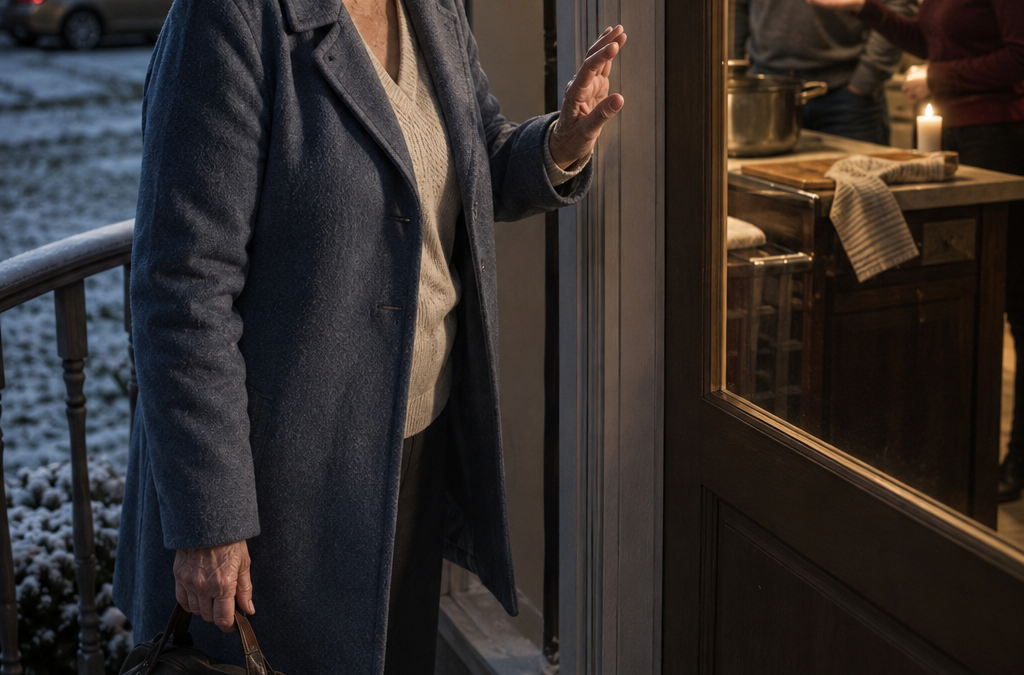
Daniel came that evening.
He did not ring at first. He sat in his car at the curb for nearly twenty minutes. I watched him through the front window the way I had once watched for his school bus. Then he came up the walk slowly, hands in his jacket pockets, shoulders rounded against the cold.
When he finally knocked, it was soft.
I let him in.
He looked older than I remembered. Or maybe I had stopped seeing him clearly somewhere along the road.
“Mom,” he said. “I got the papers.”
“I know.”
“The trust. The will. The bank account. I don’t understand.”
“After everything?” I asked.
He flinched.
“Yes,” he said. “After everything.”
“Exactly that.”
He stood by the chair Ray used to sit in and looked toward the mantel, where family photos still lined the wood. Hannah at six with missing front teeth. Caroline on her wedding day. Daniel in his Little League uniform. Ray holding a fish too small to brag about and bragging anyway.
“You’re doing all this over one night,” Daniel said. “Over one thing Vanessa said when she was stressed.”
Here is where the old me would have melted. I would have reached for him. I would have said, Oh honey, no, of course not. Sit down. Let me explain. I would have softened the truth until he could swallow it without discomfort.
I did not.
“Daniel,” I said gently, “the porch was the last page. Not the book.”
He looked at me then.
“The book was every holiday you put me in the draft. Every birthday that came as a gift card at bedtime. Every time someone in your house decided what I could do, where I should sit, what I should give, and you found something fascinating on your phone. I gave you the roof you sleep under, and you could not give me a couch for one cold night when I came home from the hospital.”
His eyes filled.
“We’re still family.”
“No,” I said.
I said it with no heat at all, which is how I knew I meant it.
“I was your family. You stopped being mine one small silence at a time.”
He sat down hard in Ray’s chair. I let him. The chair did not belong to grief anymore. It was just a chair.
“I don’t know how to fix it,” he said after a while.
“You can’t. Not the way you mean.”
He looked up, and for one moment I saw the boy from the thunderstorm. Lost. Afraid. Wanting me to make the room safe.
I wanted to reach for him.
Love does not vanish just because trust does. That would be easier. It stays, but it changes shape. Sometimes it becomes a candle you no longer carry into the wind.
“You can start telling the truth in your own house,” I said. “For Hannah’s sake, if not for mine.”
He covered his face with both hands.
“I didn’t know she heard all of it,” he whispered.
“She hears more than you think.”
“She came home crying.”
“She came here cold.”
That landed.
He looked toward the door as if seeing the distance for the first time.
I walked him out without anger. I did not slam the door behind him. I closed it softly. There is something final about a soft door. It says you are no longer trying to be heard through it.
After he left, I went to the hallway and took down a photograph that had hung there for thirty years. Daniel at eight, gap-toothed and asleep against my shoulder during a thunderstorm, one fist curled into my sweater. I held it for a long time. Then I placed it face down on the table.
Not in anger.
In mourning.
The boy in that picture had been real. The man who had grown from him was real too. People can be both. That is one of the hardest truths a mother has to learn. Gone deserves to be grieved, even when it continues walking around in the body of someone you still know.
I made Ray’s lentil soup that night. The steam fogged my glasses until I could not tell what was steam and what wasn’t, and I decided not to find out.
The weeks after were quiet.
The quiet was the whole gift.
The phone rang less once everyone understood there was nothing left to manage. Caroline called from Oregon and cried when I told her the full story. Not because of the will. Not because of the money. Because she knew how long I had been making myself small and how far away she had been while it happened.
“Mom,” she said, “I’m proud of you. I’m so sorry it took this.”
“I’m not sorry anymore,” I told her.
And I meant it.
Hannah kept coming openly now. At first, there were arguments at home. I know that. I saw the shadows under her eyes. But something had shifted in Daniel after our conversation. He did not become brave overnight. Men who have practiced silence for years do not suddenly become trumpets. But he began, slowly, to stop pretending he did not hear.
One Saturday, Hannah put her head down on my floured counter and cried when I told her the trust would help carry her through school.
“I don’t want Dad to hate me,” she said.
“He won’t.”
“Mom will.”
“Your mother is afraid,” I said. “That is not the same as being right.”
Hannah lifted her head. Flour marked one cheek.
“How do you know the difference?”
I thought of Vanessa in my living room. Daniel in Ray’s chair. My own hand hovering over my purse in Diane’s office, ready to retreat from my own life.
“Right makes room for other people to breathe,” I said. “Fear asks everyone else to get smaller.”
She wrote that down in the margins of her chemistry notes.
In the spring, I sold the house.
Not because anyone forced me. Not because Vanessa hinted at it. Not because Daniel needed money. I sold it because Ray’s note had finally released me from the idea that a roof is only sacred if you stay under it forever. The house had protected me. Now it could protect someone else.
The young couple who bought it were expecting their first child. The woman cried in the kitchen when she saw the morning light. Her husband asked whether the maple tree was healthy enough for a tire swing someday. I told him Ray had hung one there once, and yes, it would hold.
On my last day, I walked through every room alone.
The kitchen where I had underlined my sentence. The spare room where I found the watercolors. The hallway where Daniel’s photograph had hung. The porch steps Ray built. The living room where I had learned the difference between loneliness and freedom.
I thanked the walls.
Then I let them go.
With part of what the house brought, I bought a small, bright apartment near the water. Ground floor. East-facing. Wide windows. No stairs. The kind of place Vanessa would have called impractical because it had more light than storage. Every morning, sunlight pours across the floor like something poured on purpose.
The overnight bag, the one I carried up Daniel’s steps and carried back down again, stayed zipped by my front door for months. It became a kind of headstone. A reminder of the woman who had almost knocked.
Then, one June morning, I unpacked it.
I washed the nightgowns. Put the paperback on a shelf. Threw away the old toothbrush. Folded the bag flat.
A week later, I packed it again.
Not because I had nowhere to go.
Because I did.
I followed the coast that summer, town by town, just like Ray had told me to. My hip was still stiff in the mornings, but I learned which motels had easy parking and which diners kept coffee hot without rushing you. I ate dinner alone at little windows overlooking harbors and did not feel lonely. There is all the difference in the world between being alone and being unwanted. I finally knew which one I was.
I painted the ocean badly and then better. I painted gray waves, green waves, lobster boats, gulls, salt marshes, children with red buckets, old men in caps, one crooked lighthouse that looked drunk until Hannah told me it had personality.
I sent her a postcard from every town.
Wish you were here, I wrote on the first.
Someday you will be, I wrote on the second.
By the fifth postcard, she had started taping them above her desk.
Daniel called sometimes. Not often. Not smoothly. He did not ask about the will again. That was something. He asked about my hip. He asked where I was. Once, after a long silence, he said, “I should have opened the door.”
I sat on a motel balcony with the ocean moving black under moonlight and let the sentence sit between us.
“Yes,” I said. “You should have.”
“I’m sorry, Mom.”
“I know.”
Forgiveness is not a key that opens every room. Sometimes it is only a window cracked enough to let air in. I do not know what Daniel and I will become. I know only that I no longer purchase closeness with silence.
Vanessa has not come to my apartment. She sends holiday cards signed in careful handwriting, as if manners might build a bridge where truth has not. I read them. I set them aside. I do not answer every one.
Hannah visits every Saturday when school allows. Now she knocks once and lets herself in because she has a key. The door opens to her. Always.
She is applying to colleges with strong engineering programs. Vanessa wanted business. Daniel said she should choose what she wants. Hannah called me after he said it, whispering from the backyard like she had just witnessed a small miracle.
“Grandma,” she said, “he actually said it.”
“Good,” I told her. “Let him practice.”
My apartment walls are full of watercolors now. Some mine. Some Hannah’s. One small framed note from Ray hangs by the window, the paper soft with age.
Make sure somebody takes care of you, even if it has to be you.
People like to say families fall apart in dramatic moments. I do not believe that anymore. Families fall apart in drafts by kitchen doors, in unanswered sentences, in chairs placed too far from the table, in small monthly transfers no one thinks an old woman will notice. And sometimes, if you are lucky, if you are tired enough, if there is still one clean page left in a grocery notebook, you can begin putting yourself back together in equally small ways.
A canceled card.
A new signature.
A revoked document.
A granddaughter’s key.
A door closed softly.
A bag packed for your own reasons.
I used to think calm meant surrender. I know better now. Calm is not weakness. Calm is what arrives after the last plea has left your body. It is the sound a woman makes when she is finally finished asking to be kept warm and remembers she owns matches.
No one decides where I lay my head anymore.
Not my son.
Not his wife.
Not the long polite years that taught me to make myself easy to overlook.
I sleep where I choose now, under my own roof by my own water. The door is mine to open, and it opens every Saturday for the girl who knocked when no one else would.
And sometimes, late in the evening, when the apartment is full of sea light and the kettle begins to sing, I think back to that porch. The cold rail under my hand. Vanessa’s voice through the door. Daniel’s silence. My overnight bag pulling at my sore side.
I think about the woman standing there, waiting to be invited into a warmth she helped build.
I wish I could go back and put my arm around her.
I would tell her not to knock.
I would tell her the cold is honest.
I would tell her to turn around, go home, open the file box, find the clean page, and write the sentence that will save her.
I am not someone you keep in the cold.
THE END








