HOA President FINED Me $500 and BANNED My “Ugly” Snowplow After I’d Cleared Their Mountain Road Free for 30 Years—So I Obeyed. Days Later, a Blizzard Buried Their Luxury Homes, Their “Eco-Friendly” Contractor Crashed, and Residents Came Begging. But When the HOA Sued Me for Refusing to Help, One Financial Record Exposed Who Their $85,000 Snow Contract Really Went To—and Destroyed the Association From the Inside.
Part 3
The Leviathan had never looked elegant.
That morning, elegance would have been a liability.
Vance let the Kenworth idle while air pressure built in the braking system. The old Detroit diesel shook the barn walls with a deep mechanical pulse.
Robert stood several yards away, watching.
For the first time since Vance had known him, the lawyer wasn’t trying to explain anything.
“Where are their trucks?” Vance asked.
“Second hairpin and just above it.”
“Anyone hurt?”
“No.”
“Drivers still inside?”
“One is. The other walked down.”
“Good.”
Vance lowered the V-plow.
“Then we clear to the first truck and stop.”
Robert frowned.
“You’re not going all the way up?”
“Not until those trucks are moved.”
“We need the road open.”
“And I need fifteen feet of road where they’re sitting.”
Robert nodded slowly.
That was the first useful conversation the HOA had had about snow all winter.
Vance rolled onto Grand Heights Boulevard.
The storm had buried most of the pavement.
He ran the first pass slowly, keeping the blade high enough to avoid hidden debris. On the second pass, he dropped to the surface and peeled away the packed layer beneath.
The Kenworth climbed steadily.
Not quickly.
Steadily mattered more.
Chains bit into the grade.
The V-plow split the snow and sent it rolling toward both shoulders.
Behind him appeared the first clean strip of dark pavement Grand Heights had seen since the storm began.
Residents came to their windows.
Some filmed.
Some waved.
Vance ignored them.
At the second hairpin, the first EcoClear truck sat diagonally across the road with its rear wheels buried in the outside snowbank.
Its driver climbed down.
He looked about twenty-five.
Embarrassed.
Cold.
“You Mitchell?”
“Yes.”
“I’m sorry.”
That surprised Vance.
“For what?”
“We shouldn’t have been up here without chains.”
Vance nodded.
“Now we can solve something.”
They rigged a recovery strap to the truck’s designated tow point.
Vance did not ram it.
Did not shove it over an embankment.
Did not turn a difficult situation into an insurance investigation.
He used the Kenworth exactly the way heavy equipment should be used.
Slowly.
With rigging.
With somebody watching the wheels.
The Unimog came free after twelve minutes.
They pulled it into a turnout.
The second truck had slid against the inside rock wall. It needed a commercial wrecker, but enough room remained to open one lane.
By midday, Vance had cleared a route to the ridge.
An ambulance came first.
Then a utility crew.
Then propane delivery.
Then two county emergency vehicles assisting residents whose medical equipment depended on electricity.
Nobody complained about diesel smoke.
Nobody complained about sand.
Nobody complained that the snowbanks looked dirty.
When survival enters the room, aesthetics tends to leave quietly.
Beatrice Thorne was waiting near the clubhouse when Vance reached the top.
She wore a black ski jacket and looked exhausted.
Vance stopped the Kenworth but left the engine running.
She approached the cab.
“Mr. Mitchell.”
“Mrs. Thorne.”
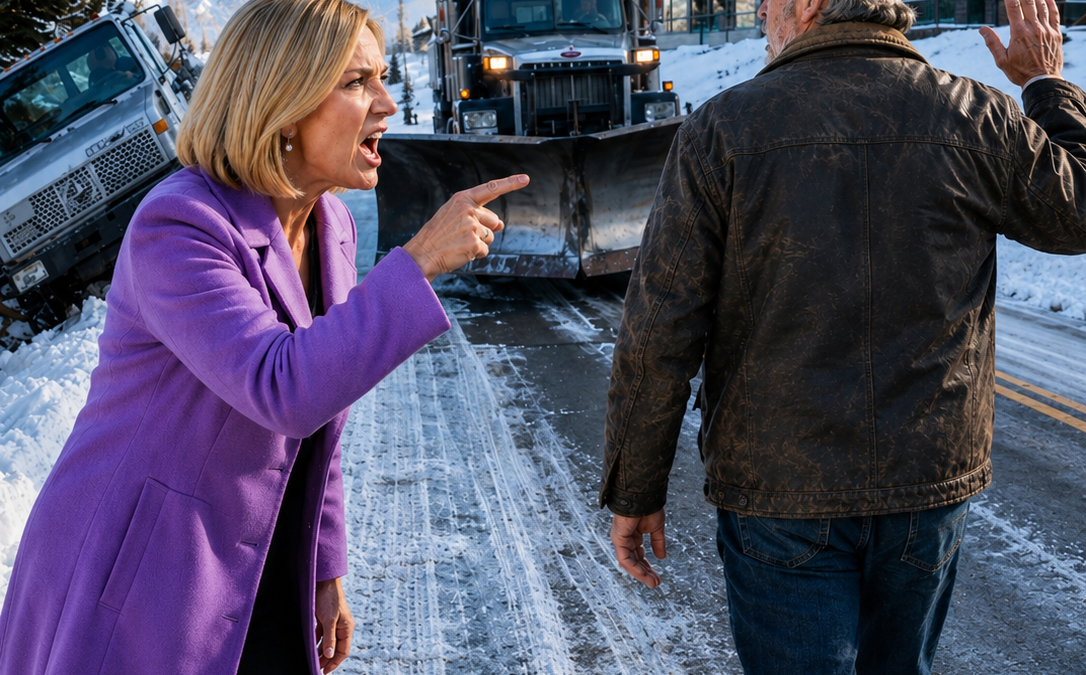
“I suppose you’re expecting an apology.”
“I wasn’t.”
That seemed to unsettle her.
“The board overreacted.”
“You signed it.”
“I relied on the snow contractor.”
“You hired them.”
Her face tightened.
“We were trying to modernize.”
Vance looked at the road behind her.
Residents were helping utility workers move extension cables from a temporary generator.
“Modern isn’t the same as prepared.”
Beatrice crossed her arms.
“You’ve made your point.”
“No.”
Vance shook his head.
“The storm made it.”
Then he shifted into gear.
“Mine was just the truck.”
The ridge remained partially without power for another day.
By Monday afternoon, the storm had passed.
Then came the bills.
EcoClear’s contract.
Recovery costs.
Emergency propane delivery.
Road damage where one of the trucks had slid into a drainage structure.
Temporary generator rental.
And the cost of hiring Vance for the remaining winter.
Because after what happened, the residents wanted one thing from their snow plan.
Reliability.
An emergency board meeting was scheduled for the following Thursday.
Vance wasn’t planning to attend.
Then Robert called.
“You should come.”
“Why?”
“Because there’s something you don’t know.”
That got his attention.
The meeting began at seven.
Nearly every chair in the clubhouse was occupied.
Beatrice sat at the center of the board table.
Robert sat two seats away with several folders in front of him.
Vance took a chair near the back.
Beatrice opened with prepared remarks.
She described the storm as “an unprecedented weather event.”
She praised the community response.
She thanked emergency services.
Then she said:
“Although some operational challenges occurred, the board remains confident that the move toward environmentally responsible snow management was appropriate.”
Someone laughed.
Not loudly.
But enough.
Beatrice continued.
She explained that EcoClear had been selected because of its modern equipment, environmental practices, and competitive package.
Robert raised his hand.
“Before we go further, I need to correct that.”
Beatrice turned.
“Correct what?”
“The competitive part.”
The room went quiet.
Robert opened a folder.
“I reviewed the procurement file this week.”
Beatrice’s expression changed almost imperceptibly.
“There were no competing bids.”
She leaned toward the microphone.
“The board had authority to make an emergency seasonal selection.”
“In September?”
Robert asked.
Several residents shifted in their chairs.
Beatrice looked at him.
Robert continued.
“EcoClear received an eighty-two-thousand-dollar seasonal contract without competitive bidding.”
A man in the front row said, “Eighty-two?”
Another resident asked, “For one road?”
Robert held up a hand.
“That isn’t the part that concerns me most.”
Beatrice’s voice sharpened.
“Robert.”
He ignored her.
“The company’s registered managing member is Tyler Thorne.”
The room became completely still.
Vance remembered the young man who had appeared at his door during the storm.
Same last name.
He had noticed it.
He hadn’t asked.
Now he knew why it mattered.
Robert looked directly at Beatrice.
“Tyler Thorne is your nephew.”
People began speaking at once.
Beatrice raised her voice.
“There was nothing improper about that arrangement.”
Robert waited.
Then:
“Did you disclose the relationship before the vote?”
No answer.
“Did you recuse yourself?”
Beatrice looked toward the other board members.
One woman shook her head.
Robert continued.
“Did Tyler’s company provide proof of prior steep-grade mountain road experience?”
Beatrice said, “They provided insurance and equipment specifications.”
“That wasn’t my question.”
For a moment, Vance almost smiled.
The tone sounded familiar.
Beatrice had spent months talking to him that way.
Now the board was doing it to her.
Robert placed another document on the table.
“The contract also came from the infrastructure reserve.”
That created a different reaction.
People understood family favoritism.
But every homeowner understood reserves.
“How much?” someone asked.
“Eighty-two thousand.”
“What was the reserve for?”
“Retaining walls, drainage, and major road repair.”
A woman near the aisle stood.
“So you used our road-repair money to hire your nephew’s snow company?”
Beatrice’s face flushed.
“He owns a legitimate business.”
“No one said he doesn’t.”
Robert’s voice remained calm.
“The problem is process.”
That sentence did more damage than shouting could have.
Beatrice had spent years presenting herself as the guardian of standards.
Now her own standards were the problem.
Vance sat quietly.
This wasn’t his fight anymore.
The board voted that night to open an independent financial review.
Beatrice’s authority to approve vendors was suspended pending the results.
Two weeks later, the review found no evidence that she had stolen money personally.
That mattered.
Rumors had already become uglier than the facts.
What the audit did find was simpler and still serious.
She had pushed through a related-party contract without proper disclosure.
She had skipped the bidding requirements.
She had used restricted reserve funds for operating expenses without the membership approval required by the association documents.
And she had fined Vance under a bylaw that did not apply to his ranch.
That last finding came from the HOA attorney.
The 1996 easement granted Grand Heights residents access across Mitchell land.
It did not make Vance a member of the HOA.
It did not incorporate his ranch into the subdivision.
And it gave the HOA no general regulatory authority over his equipment.
The $500 fine had never been enforceable.
Vance received a refund check by certified mail.
He deposited it.
No ceremony.
No photograph.
The bigger argument involved the easement itself.
For years, everyone had casually allowed contractors, delivery trucks, utility crews, and maintenance vehicles to use the road.
The original deed language was narrower than modern practice.
Rather than weaponize that ambiguity, Vance and the residents did something Beatrice had never tried.
They negotiated.
A new easement amendment was drafted.
Emergency services received explicit access.
Utilities and deliveries were protected.
Commercial maintenance contractors could use the road when authorized by the community and landowner.
Snow operations received their own section.
The HOA could hire anyone it wanted.
But whoever took responsibility for plowing had authority to determine equipment, treatment materials, timing, chains, sanding, and closure thresholds based on actual road conditions.
There would be no aesthetic standards for active snow removal.
Vance insisted on that sentence.
Robert laughed when he read it.
“Seasonal visual harmony?”
“Something like that.”
The amendment also made one thing clear.
Vance was not obligated to plow.
If the community wanted his services, they would pay.
Not because he was angry.
Because free labor had helped everyone forget that the labor had value.
They negotiated a seasonal retainer plus per-storm charges.
Reasonable numbers.
No extortion.
No absurd penalties.
No desperation contracts signed while people froze.
A business arrangement.
That changed things.
For the first time in thirty years, Vance kept proper plowing logs for Grand Heights.
Time out.
Time back.
Snowfall.
Temperature.
Material used.
Equipment condition.
Residents began receiving monthly winter reports.
Most never read them.
That was fine.
The important thing was that someone did.
Beatrice resigned as president before spring.
She remained in Grand Heights for another year.
Vance saw her twice.
The first time was at the hardware store.
Same plumbing aisle.
She stopped beside him.
He expected another lecture.
Instead, she said:
“I owe you an apology.”
Vance looked at her.
She continued.
“I thought because we were paying for the road, the board controlled everything connected to it.”
“You weren’t paying me.”
“No.”
“And you didn’t own the ground.”
“No.”
She looked embarrassed.
“I should have read the easement.”
“Yes.”
That was all.
No dramatic reconciliation.
No speech.
Sometimes an apology is only useful when it finally becomes accurate.
The second time Vance saw her was the next winter.
A storm had dropped fourteen inches overnight.
At 4:30 a.m., he was halfway through the first pass when he noticed headlights behind him.
Beatrice’s SUV waited at a safe distance.
When he reached the turnout, she rolled down her window.
“Hospital shift,” she said. “My neighbor’s daughter.”
Vance nodded.
“I’ll have the lower grade open in fifteen.”
“Thank you.”
She started to roll the window up.
Then stopped.
“And Vance?”
“Yes?”
“The dirty snowbanks look beautiful.”
He laughed.
That winter passed without incident.
Then another.
The Kenworth kept working.
Some residents still hated the noise.
Some still complained about grit near their driveways.
One emailed the board asking why the snowbanks couldn’t be “more evenly sculpted.”
Robert forwarded that one to Vance.
Vance printed it and taped it inside the Kenworth cab.
Not because he was angry.
Because it made him laugh every time he climbed in at four in the morning.
By the third year, Grand Heights had changed.
Not dramatically.
The homes were still expensive.
The entrance sign was still timber and stone.
People still cared about landscaping.
They still held wine weekends and architectural committee meetings.
But the road had become something different in their minds.
Not scenery.
Infrastructure.
A retaining wall was inspected before cracks became dangerous.
Drainage culverts were cleaned before winter.
The association installed a weather station near the clubhouse.
A road-condition camera went up at the steepest hairpin.
Every October, Vance attended one board meeting.
He brought no presentation.
He stood in front of the room and gave them the same five-minute briefing.
Chains.
Sand.
Closures.
Emergency contacts.
Turnaround points.
No parking during storms.
The first year, people asked twenty questions.
By the third, they asked three.
They were learning.
One October evening, Robert stayed behind after everyone else left.
“You know what’s funny?”
“What?”
“We thought the snowplow was the primitive part.”
Vance zipped his coat.
“And?”
“The primitive part was assuming money could replace local knowledge.”
Vance considered that.
“Money can buy good equipment.”
“Apparently not judgment.”
“Sometimes it can buy that too.”
Robert smiled.
“If you know who to hire.”
Outside, the temperature was dropping.
The peaks already carried the first white line of the coming winter.
Vance drove home through the lower gate.
The easement crossed his ranch exactly where it always had.
Same granite.
Same pines.
Same climb.
A century earlier, his grandfather had traveled that slope behind horses.
His father had driven it in an old International truck.
Now million-dollar homes stood on the ridge.
Technology changed.
People changed.
Weather did not care.
That was the lesson Beatrice had missed.
Snow was never decoration.
A mountain road was never merely part of a view.
And the old yellow Kenworth had never been ugly because Vance lacked taste.
It was ugly because every part of it had been chosen to solve a problem more important than appearance.
The next storm arrived in December.
Vance woke at 3:45.
Coffee.
Boots.
Canvas coat.
He walked to the barn and switched on the lights.
The Leviathan waited beneath them.
Yellow paint.
Scarred blade.
Heavy chains.
Old steel.
No branding consultant would have approved it.
Vance climbed into the cab.
The Detroit diesel fired.
Across the ridge, porch lights began appearing one at a time as residents prepared for work.
Vance dropped the blade.
Then he headed toward Grand Heights.
Nobody had to beg.
Nobody had to threaten.
Nobody had to explain property values.
They had finally done the simplest thing.
They had asked the man who understood the mountain how to clear the road.
And then they let him do his job.
The end
Disclaimer: This content is entirely AI-generated for fictional and entertainment purposes only. Any resemblance to actual persons, living or dead, events, or locations is purely coincidental, and the creator assumes no liability for any interpretation of this content.








