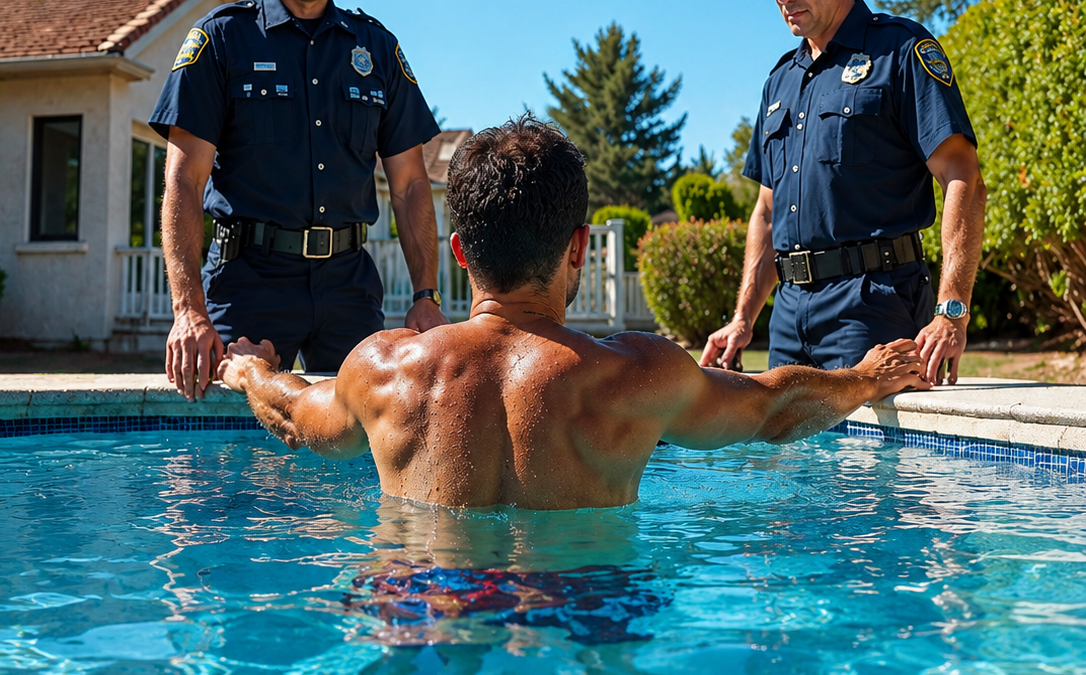
The HOA Karen called the police, banned me from my own backyard pool, and claimed my property belonged to the neighborhood — all so her kids could swim whenever they wanted. She thought her “board power” would scare me into silence. But when officers arrived, the HOA president showed up, looked at the pool, and revealed the one truth Karen never expected: she wasn’t on the board, and she had been trespassing the entire time.
Part 3
That night, I did not use the pool.
I sat at my kitchen table instead, still wearing the same T-shirt, with an ice pack against my shoulder and a stack of closing documents spread in front of me.
I knew the pool belonged to me.
I had known that all day.
But there is something unsettling about having someone challenge reality with enough confidence that police officers end up standing in your backyard.
So I checked everything.
Property survey.
HOA declaration.
Original approval for construction of the pool.
Fence permit.
Insurance documents.
Every page said the same thing.
Private property.
The pool was entirely inside my lot.
The HOA maintained a separate recreational facility three blocks away.
Nothing about my backyard had ever been common property.
I called an attorney Monday morning.
Her name was Rachel Kim, and she had handled a property dispute for one of my coworkers.
I expected her to tell me I was overreacting.
Instead, after hearing what happened, she said, “Send me everything.”
“Even the HOA paperwork?”
“Especially that.”
I emailed her the documents.
Then I contacted the officer handling the case and learned that several neighbors had already offered their recordings.
That surprised me.
I had always thought of my neighborhood as friendly but distant.
People waved.
People borrowed ladders.
People discussed lawns.
We were not exactly sharing Thanksgiving dinner.
Yet within twenty-four hours, four households had submitted camera footage.
One recording captured Karen standing outside my fence before the children entered.
Another showed her pointing toward the gap beneath it.
That mattered.
Her original explanation—that the kids had wandered into my yard without her noticing—was becoming difficult to maintain.
A third video captured almost the entire confrontation.
Her claim about being an HOA board member.
Her threat to ban me from my own pool.
Her phone call.
And finally the moment she shoved and slapped me while police were standing there.
Rachel watched that clip in her office.
When it ended, she removed her glasses.
“Well.”
“That bad?”
“For her?”
She gave me a look.
“Very.”
But the videos revealed something else.
Karen had not simply followed her children after noticing them in my yard.
She had brought towels.
Pool toys.
Sunscreen.
Drinks.
She had planned their visit.
That changed how I felt about what happened.
At first, I had tried to convince myself this was an exhausted mother making a terrible decision on a hot afternoon.
I had even felt sorry for her.
Taking care of three young children alone could not have been easy.
But this was not a spontaneous mistake.
She had deliberately taught her children that my fence did not matter.
That my answer did not matter.
That if they wanted something badly enough, another person’s property became negotiable.
Bill came by two evenings later.
He brought an envelope.
Inside was a letter from the HOA board formally confirming that my pool and backyard were private property.
“We’re sending her one too,” he said.
“What for?”
“Her records.”
I laughed.
Bill did not.
“I’m serious. This has gone on longer than you know.”
We sat on my patio.
For the first time, he told me the history.
Karen had moved into the neighborhood six years earlier.
At first, she was enthusiastic.
She attended meetings.
Organized block parties.
Volunteered for landscaping days.
Then she began telling people she represented the board.
She would warn neighbors about garbage cans, decorations, parking, even things the HOA had no rules against.
Whenever anyone complained, she claimed she had only been “helping.”
Bill admitted the board should have confronted her more firmly.
Instead, because most incidents seemed petty, they kept trying to smooth things over.
Then he said, “That was our mistake.”
“What was?”
“We kept solving the immediate argument instead of dealing with the behavior.”
That stayed with me.
It was easy to see why.
Nobody wanted a war over a garbage can.
Nobody wanted to spend a Tuesday night meeting debating whether Karen had improperly criticized someone’s garden gnome.
So everybody absorbed a little inconvenience.
Then another.
And another.
Until one Saturday, she was standing beside my private pool telling police I had assaulted her.
A week later, the HOA called a special meeting.
I almost skipped it.
Rachel advised me to attend but say very little.
“Let other people talk,” she said.
That turned out to be excellent advice.
The clubhouse was packed.
Bill opened the meeting by explaining that the board wanted to clarify the limits of HOA authority after “a serious recent incident.”
He did not say Karen’s name.
He did not need to.
Then residents started raising their hands.
A retired man named George said Karen once threatened to fine him because his granddaughter parked a pickup in his driveway overnight.
A woman across the street said Karen ordered her to remove birthday balloons from her mailbox.
Another neighbor said Karen had walked into his backyard without permission to inspect a shed.
Someone else said her children routinely cut through private yards because Karen told them “the whole subdivision belongs to everyone.”
I sat there listening.
My pool had not created the problem.
My pool had simply exposed it.
Bill proposed several policy changes.
Only named board officers would be allowed to issue official compliance notices.
Every notice would include a contact number for verification.
Residents were explicitly forbidden from representing themselves as board agents.
Most importantly, HOA rules could only be enforced on property actually covered by the governing documents.
That last one seemed obvious.
Apparently, obvious things sometimes need to be written down after somebody decides they are optional.
The measures passed unanimously.
Karen was not there.
Her attorney had apparently told her attending would be unwise.
For the next several weeks, life became quieter.
Then the court proceedings began.
I had never been inside a courtroom except for jury duty.
I expected something dramatic.
It was mostly paperwork, waiting, and people speaking carefully.
Karen’s defense initially argued that the confrontation resulted from confusion over the property boundary.
Rachel did not represent the prosecution, but she helped me understand what was happening and protected my interests.
The prosecutor had photographs of the fence.
Property records.
Bill’s statement.
Police body-camera footage.
Neighbor security videos.
And, most damaging of all, the recording showing Karen shove me after officers had already ordered everyone to remain separated.
The property confusion argument did not survive long.
Karen’s lawyer shifted toward remorse.
She claimed she had been overwhelmed.
She said she feared for her children.
She said she had misunderstood my tone.
Some of those things might even have been true.
People rarely behave badly for only one reason.
But being stressed did not make my backyard public.
Being overwhelmed did not make her a board member.
And fear did not explain calling police with a false version of events before any physical confrontation occurred.
During one hearing, Karen looked directly at me.
“I’m sorry.”
I nodded.
That was all.
I had imagined that moment many times.
In some versions, I made a speech.
In others, I ignored her.
When it actually happened, I felt almost nothing.
Maybe because I had finally understood that an apology and forgiveness were not the same thing as erasing consequences.
The case concluded much faster than I expected.
Karen accepted responsibility for the physical confrontation and trespass-related conduct as part of a negotiated resolution rather than dragging everyone through a lengthy trial.
The court imposed penalties, mandated anger-management counseling, and issued an order requiring her to stay off my property.
The exact legal consequences mattered less to me than that final sentence.
Stay off his property.
Clear.
Simple.
No megaphone required.
Afterward, I walked outside with Bill.
He looked relieved.
“I should’ve done more sooner.”
“You didn’t send her kids into my pool.”
“No. But leadership isn’t just dealing with problems once they become impossible to ignore.”
That was probably true.
I had learned something similar.
Boundaries are easier to defend before someone becomes comfortable crossing them.
For years, several neighbors had laughed off Karen’s behavior.
I probably would have too if the first incident had been something small.
Maybe that was how people like her gained confidence.
Not because everyone agreed with them.
Because everyone else was too tired to argue.
Summer was nearly over before I finally felt comfortable using the pool again.
The first Saturday after the court order, I went outside early.
The neighborhood was quiet.
I checked the fence automatically.
The gap Karen’s children had crawled beneath was gone.
I had reinforced the bottom with additional boards and installed a self-closing gate latch.
Technically, the fence had already met code.
I upgraded it anyway.
Not because I wanted to make my yard look like a prison.
Because children do not always understand adult disputes, and water does not care whose fault an accident is.
That was one thing I never blamed the kids for.
They had behaved badly, yes.
But children learn the rules adults teach them.
Karen had told them they were entitled to enter.
They believed their mother.
Months later, I occasionally saw them outside with their grandmother.
They never came near my fence.
Once, the oldest boy saw me taking out the trash.
He looked embarrassed.
“Sorry about the pool.”
I stopped.
“You don’t need to carry all of that.”
He looked surprised.
“But don’t come into somebody’s yard without asking.”
He nodded.
“I know.”
“Good.”
That was enough.
Karen changed too, though perhaps not in the dramatic way people expect.
She did not become wonderfully pleasant.
She did not arrive with homemade cookies and a heartfelt speech.
Mostly, she became quiet.
She stopped patrolling the neighborhood.
Stopped confronting people.
Stopped pretending to represent the HOA.
When she walked outside, she stayed on her property.
Honestly, that was all anyone wanted.
Bill remained HOA president for another year before deciding not to run again.
At his final meeting, he made a joke about retiring before somebody tried to nationalize another backyard pool.
People laughed.
Then he became serious.
“An HOA should protect shared responsibilities,” he said. “It should never give people an excuse to control things that don’t belong to them.”
I wrote that down later.
Because despite everything, I still did not hate the HOA.
That surprised some people.
The association had approved the original pool.
It maintained common landscaping.
It kept the community pool clean.
It negotiated trash collection.
The problem had never been the existence of rules.
The problem was one person pretending the rules gave her unlimited authority.
There is a difference between community and ownership.
Good neighbors understand it.
A community means helping when somebody’s pipe bursts.
Watching a house when someone travels.
Taking in packages.
Calling a parent when a child wanders into the street.
It does not mean every fence becomes optional.
It does not mean another person’s yard becomes yours because you would enjoy using it.
And it definitely does not mean banning a homeowner from his own swimming pool.
The following summer, I hosted a neighborhood cookout.
That would have been unimaginable a year earlier.
Bill came.
George brought hamburgers.
The woman across the street brought enough potato salad to feed a high school football team.
Children played in the yard.
A few people swam.
But everyone asked first.
That small detail meant more to me than I expected.
Late in the afternoon, I sat near the pool while sunlight moved across the water.
For once, there were no sirens.
No shouting.
No audience gathering at the fence.
Just neighbors talking and kids laughing.
Someone asked whether I regretted buying the house.
I looked around.
“No.”
And I meant it.
One terrible neighbor had nearly convinced me that privacy required isolation.
She was wrong.
The best community I found was not one where everybody could take whatever they wanted.
It was one where people respected each other enough to ask.
The pool was still mine.
The fence still mattered.
And somehow, once everyone understood that, sharing the space became easier rather than harder.
I had spent months thinking the lesson of that Saturday was that I needed stronger locks, stronger fences, and stronger legal protection.
Those things helped.
But the deeper lesson was simpler.
You can be generous without surrendering your boundaries.
You can understand someone’s difficulties without accepting their behavior.
And when somebody confidently tells you that what belongs to you actually belongs to them, you do not have to scream louder.
Sometimes you only need the truth, good records, and enough patience to let their own actions reveal exactly who they are.
That summer afternoon, I lowered myself into the water and floated beneath a cloudless sky.
Three blocks away, the actual community pool was full of families.
Mine was quiet again.
Exactly the way I wanted it.
The end
Disclaimer: This content is entirely AI-generated for fictional and entertainment purposes only. Any resemblance to actual persons, living or dead, events, or locations is purely coincidental, and the creator assumes no liability for any interpretation of this content.








