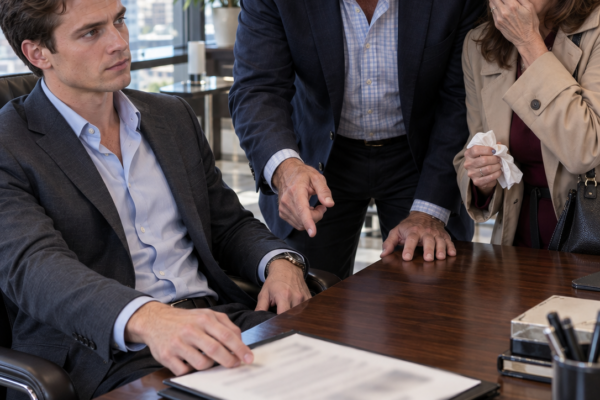
STH-I held out my hand to greet the new ceo, but the chairman looked straight at me and said, “I don’t think we need to pretend we’re equals here,” and as the boardroom fell silent and every camera kept rolling, I glanced at my watch and replied, “That decision just cost this deal $2.1 billion.”

The Handshake That Cost $2.1 Billion
I held out my hand to greet the new ceo, but the chairman looked straight at me and said, “I don’t think we need to pretend we’re equals here,” and as the boardroom fell silent and every camera kept rolling, I glanced at my watch and replied, “That decision just cost this deal $2.1 billion.”
For several seconds, nobody moved.
The cameras mounted along the back wall continued blinking red.
A white bouquet of lilies and eucalyptus rested awkwardly beneath my left arm. My right hand was still suspended between me and Cameron Foster, the forty-one-year-old executive who had been hired to rescue Norfolk Industrial Group from the worst financial crisis in its seventy-year history.
Cameron’s eyes moved from my hand to Bradley Worthington.
Bradley was chairman of the board.
Sixty-two years old. Silver hair. Charcoal suit. Burgundy tie. The kind of expensive watch designed to be recognized from across a conference table.
He had inherited enough shares to control nearly every meaningful board vote, and he wore that inheritance with the effortless certainty of a man who had spent his entire adult life entering rooms where chairs were already waiting for him.
Now he leaned back at the head of a twenty-foot walnut table and looked at me as though I were an employee who had forgotten where to stand.
“I beg your pardon?” one of the directors said.
Bradley barely glanced toward him.
He kept his eyes on me.
“This is an executive transition meeting,” he said. “Everyone here has a role. Let’s not make it more complicated than it is.”
I lowered my hand.
Not quickly.
Not because Bradley had ordered it.
I lowered it because I had learned a long time ago that people reveal the most when they think your dignity depends on their permission.
Cameron looked like he wanted to speak.
He didn’t.
That mattered too.
I placed the flowers on the credenza behind me.
Then I walked toward the only empty chair at the far end of the table.
Bradley’s communications director, a woman named Allison Grant, stood beside the camera controls with one hand hovering over a switch.
“Do you want us to pause the webcast?” she asked.
Bradley gave a dismissive flick of his fingers.
“No. We’re already behind schedule.”
I took my seat.
“No,” I said quietly. “Please keep recording.”
That made several people look at me.
Bradley smiled.
It wasn’t a warm smile.
“Good. Then let’s begin.”
He turned toward the wall display.
Behind him appeared the blue-and-silver logo of Norfolk Industrial Group, followed by the words Leadership Transition and Capital Restructuring.
Underneath was a number.
$2.1 billion.
Bradley began speaking.
He talked about stability.
Growth.
Modernization.
A renewed commitment to employees.
A stronger future.
All the polished phrases companies use when they need people to forget how close they came to running out of cash.
I listened for exactly forty-six seconds.
Then I interrupted.
“Before you continue, Bradley, there’s something the board needs clarified.”
His shoulders stiffened.
“We’re not taking comments from event support during this portion.”
A director near the middle of the table slowly removed his glasses.
Dennis Coleman, the chief financial officer, looked at me.
Then at Bradley.
Cameron’s face had gone very still.
I checked my watch.
“That decision just cost this deal $2.1 billion.”
Nobody laughed.
That was the interesting part.
If everyone truly believed I was support staff, somebody would have laughed.
Instead, Dennis opened the thick financing binder in front of him.
A director named Margaret Ellis whispered, “Who is he?”
Bradley heard her.
His confidence flickered.
Only for a second.
Then he straightened.
“Allison, perhaps someone can escort Mr…”
He stopped.
He didn’t know my name.
That told me almost everything I needed to know.
Dennis did.
“Marcus Sheffard,” he said.
Bradley looked toward him.
Dennis’s expression had changed.
“Managing partner of Patriot Ridge Capital.”
The room seemed to contract.
Bradley’s eyes came back to me.
This time he actually saw me.
Not the bouquet.
Not the plain navy suit I’d bought four years earlier.
Not the chair at the end of the table.
Me.
“You’re Marcus Sheffard?”
“I am.”
The chairman’s face did something subtle.
It rearranged itself.
People who have lived on status become very skilled at changing expressions without admitting why.
“I’m afraid there has been a misunderstanding.”
“No,” I said. “I think everybody understood perfectly.”
I reached into the leather portfolio beside my chair and removed one document.
Twenty-three pages.
The financing commitment Bradley had signed eleven days earlier.
I opened it to page eighteen.
A yellow tab protruded from the edge.
Bradley stared at it.
Dennis was already turning to the same page in his binder.
“The conduct provision,” he said.
Nobody spoke.
I watched Bradley’s eyes narrow.
He remembered.
Maybe not the language.
But the page.
Six months of negotiations.
More than three thousand pages of diligence reports.
Meetings in Norfolk, Richmond, Charlotte, New York.
Operational audits.
Debt restructuring plans.
Plant inspections.
Employee-retention studies.
And one paragraph Bradley had spent less than ten seconds reading.
That paragraph was now the most valuable piece of paper in the building.
My name is Marcus Sheffard.
I was fifty-three years old that morning.
For seventeen years, I had been managing partner of Patriot Ridge Capital, an investment firm headquartered four blocks from where we were sitting.
We weren’t famous.
That was intentional.
Our clients didn’t hire us to become personalities.
They hired us to deploy capital into companies that built real things.
Factories.
Commercial ship-repair yards.
Industrial equipment businesses.
Construction suppliers.
Logistics companies.
Infrastructure firms.
Businesses where bad management could not be hidden forever behind a clever presentation.
I hadn’t always worked in finance.
For the first twenty-five years of my adult life, the nicest room I entered most mornings was a job-site trailer.
My father, Frank Sheffard, had been a construction supervisor.
Not an executive.
Not an owner.
A supervisor.
He carried a metal lunchbox until the handle finally broke and drove the same Ford pickup for seventeen years because, as he liked to say, “A truck doesn’t become useless because somebody invented cup holders.”
When I was twelve, he started taking me to weekend job sites.
By fourteen, I could read basic blueprints.
By sixteen, I could tell whether a concrete crew was rushing a pour just by watching how they moved.
My father believed work had a rhythm.
Good work looked boring.
Measured.
Patient.
Bad work always seemed to be in a hurry.
“Watch the foundation,” he told me once while we sat eating sandwiches on an unfinished staircase. “Everybody notices paint. Nobody compliments footings. But you can put a million dollars of glass on a bad foundation and you’ve still got a bad building.”
I didn’t understand how many things that sentence would eventually apply to.
At twenty, I was working on a twelve-story office project near downtown Norfolk.
One afternoon, I noticed that a concrete section poured the previous day was curing incorrectly.
The surface didn’t look right.
I told the floor supervisor.
He waved me away.
“Schedule’s tight.”
“It needs checking.”
“It passed inspection.”
“Nobody tested this section.”
He stared at me.
“You carrying a clipboard now?”
“No.”
“Then keep tying rebar.”
That evening, I told Dad.
He listened without interrupting.
Then he asked, “What do you think you should do?”
“I already told the supervisor.”
“That’s what he should do. What should you do?”
I didn’t know.
Dad wiped mustard from his thumb with a napkin.
“Once you see the problem, you own your response to it.”
The next morning, we returned early.
Dad inspected the area himself.
He made two calls.
By noon, independent testing had confirmed the section didn’t meet specification.
It had to be redone.
The contractor lost time.
Money.
The supervisor lost his position.
I spent the entire day expecting to lose mine too.
Instead, the general contractor called me into his trailer.
Bill Morrison was sixty, smoked cigars he never lit, and had eyebrows that looked permanently disappointed.
“You saw it?”
“Yes, sir.”
“You told your supervisor?”
“Yes.”
“He told you to shut up?”
“Basically.”
Bill leaned back.
“Why didn’t you?”
I thought about Dad.
“Because the building doesn’t know who outranks who.”
Bill stared at me.
Then he smiled.
“That’s a good answer.”
Two weeks later, I was promoted to crew chief.
That lesson stayed with me.
Titles matter.
Authority matters.
But reality doesn’t care about either.
A weak beam does not become strong because a vice president approved it.
A bad contract does not improve because a chairman calls it strategic.
And a person does not become decent simply because everybody around him is paid to nod.
My father never became wealthy.
He never wanted much.
A paid-off house.
Sunday breakfast with my mother.
A fishing boat that started when he turned the key.
He measured success by whether people trusted him when he said a job was safe.
Then, in the spring of 1997, a commercial renovation project suffered a preventable site failure after cheaper connection hardware had been approved to save money.
My father went to work that morning.
He never came home.
I will not describe that day.
I don’t need to.
The details that stayed with me were quieter.
His lunchbox sitting on the kitchen counter because my mother had washed it the night before.
His boots by the garage door.
A voicemail from a project manager who kept saying, “We’re so sorry,” as if repetition could turn language into repair.
Weeks later, investigators traced the failure back to a purchasing decision.
The difference between the specified hardware and what had actually been used amounted to less than fifteen dollars per connection.
That was what broke something in me.
Not only grief.
Understanding.
Somebody had looked at a spreadsheet.
Somebody had found a cheaper number.
Somebody else had approved it.
Several people had likely noticed.
And every one of them had convinced himself the decision belonged to somebody higher up.
At Dad’s memorial service, the room was filled with electricians, carpenters, operators, engineers, estimators, foremen, and supervisors.
People who had worked with him twenty years earlier came.
One man drove six hours.
Another stood beside my mother and cried so hard he couldn’t speak.
My father left no company.
No trust fund.
No building with his name on it.
He left credibility.
Standing there, I made myself a promise.
I was going to learn who made the financial decisions behind the job sites.
Not just how buildings stood.
Why companies chose one material over another.
Why schedules became unrealistic.
Why good crews were pressured into bad work.
Why some executives protected quality and others treated it as a cost center.
I enrolled at Old Dominion University.
Finance during the day.
Construction work at night and on weekends.
I was older than most students.
More tired than all of them.
Professors talked about leverage while I spent evenings worrying whether a subcontractor had enough cash to make Friday payroll.
Classmates studied operational risk from case studies.
I watched it happen on actual sites.
It took six years to finish my undergraduate degree.
Two more for an MBA.
By the time I graduated, I understood something few finance people around me seemed to grasp.
Businesses did not fail only because of numbers.
Numbers were usually the final symptom.
They failed because somebody important stopped listening.
In 2005, I met Wade Cooper.
Wade worked in commercial lending.
Where I understood operations, he understood capital structure.
We met over coffee.
Then lunch.
Then six months of arguments written on legal pads.
In 2007, we opened Patriot Ridge Capital in two rented rooms above a hardware store on Granby Street.
Our timing was terrible.
A year later, credit markets froze and construction companies began folding.
That nearly ended us.
It also created our future.
We bought our first distressed industrial maintenance company for a fraction of what its equipment alone was worth.
The company wasn’t failing because its workers were bad.
They were excellent.
Its managers were drowning in debt they didn’t understand.
We restructured the financing.
Promoted people from inside.
Cut three unnecessary executive positions.
Kept every technician.
Eighteen months later, the company was profitable.
Then we did it again.
And again.
By 2015, Patriot Ridge managed close to a billion dollars.
By the year Bradley Worthington entered our office, we managed several times that.
But the rule never changed.
Before writing a check, we walked the floor.
We talked to people whose names weren’t in investor decks.
Maintenance supervisors.
Shipping clerks.
Foremen.
Payroll managers.
Receptionists.
People knew things.
Executives often knew how the company wanted to be described.
Employees knew how it actually worked.
Our most important contract provision came after a deal in Raleigh nearly embarrassed us badly.
We had invested in a metal fabrication company led by an impressive CEO.
Great resume.
Strong numbers.
Polished presentations.
Three months after closing, a recording from an employee meeting surfaced.
Nothing illegal.
Nothing sensational.
Just an executive speaking to experienced workers as though they were replaceable pieces of equipment.
Within weeks, several of the company’s best people resigned.
Customers noticed delays.
Quality complaints increased.
Recruiting costs rose.
Revenue followed.
Wade and I spent a year fixing a problem that had not appeared on any financial statement during diligence.
After that, we wrote the conduct-integrity provision.
The language was simple.
If documented behavior by senior leadership during negotiations materially damaged company reputation, employee confidence, or the credibility of incoming management, Patriot Ridge could withdraw its pending capital commitment without penalty.
Clients hated the clause.
Lawyers called it subjective.
I refused to remove it.
“Why care so much about one stupid comment?” Wade asked me once while playing devil’s advocate.
“Because stupid comments aren’t usually alone.”
He knew what I meant.
The sentence is rarely the real problem.
The sentence is the window.
Years later, Norfolk Industrial Group came to us.
The company had been part of the Hampton Roads business community for generations.
It repaired commercial vessels.
Manufactured specialized industrial equipment.
Owned fabrication facilities.
Supplied port operators and logistics companies along the East Coast.
The underlying businesses were good.
The capital structure was not.
For five years, the previous management team had acquired companies simply because acquisitions made investor presentations look ambitious.
A software company.
A component manufacturer.
A regional construction firm.
A warehouse automation business.
Some were profitable.
None fit together.
Debt climbed.
Interest expenses swallowed cash.
Suppliers shortened payment terms.
Banks became nervous.
By the time Bradley Worthington contacted Patriot Ridge, Norfolk Industrial Group needed a recapitalization large enough to make most investors leave the room.
Two point one billion dollars.
Wade read the number and whistled.
“That’s a lot of zeros to put behind people we don’t know.”
“So we get to know them.”
For four months, our teams lived inside the company.
The core business impressed me.
Eight hundred skilled employees worked at the main Norfolk-area facility.
Many had been there fifteen years or more.
The equipment was maintained.
Safety records were strong.
Backlog was solid.
Customers liked the crews.
The company was not broken.
Its leadership was.
Bradley Worthington was the clearest example.
His grandfather had built a fortune in commercial shipping and waterfront real estate.
Bradley inherited shares, money, and the chairmanship.
He had attended excellent schools.
He spoke beautifully about capital discipline.
He had never made payroll from his own money.
Never managed a production line.
Never stood in front of a hundred employees and explained why cash flow required delaying an expansion.
The first time he visited Patriot Ridge, he entered our conference room ten minutes late without apology.
“Gentlemen,” he said, although one of our senior analysts, Rebecca Shaw, was sitting beside me.
Rebecca looked at him.
I noticed.
So did Wade.
Bradley didn’t.
Warning number one.
Twenty minutes later, I explained the integrity clause.
He barely glanced at it.
“Standard reputational language.”
“It’s not standard.”
“Our lawyers will handle it.”
“Bradley.”
He finally looked up.
“If your lawyers remove that clause, there is no deal.”
He smiled.
“Understood.”
He did not understand.
That became clear over the next several months.
Every time we suggested governance changes, he acted personally offended.
Two independent directors?
Unnecessary.
Monthly reporting?
Micromanagement.
Outside operational review?
An insult to the existing team.
A new chief executive with real turnaround authority?
That one caused three weeks of arguments.
Eventually, his board overruled him.
Cameron Foster became their choice.
Cameron was forty-one.
He had spent his career in industrial operations and restructuring.
He had helped stabilize two heavily leveraged manufacturing companies.
References described him using words I trust.
Practical.
Prepared.
Calm.
No one called him visionary.
That made me like him more.
During my interview with Cameron, I asked a question I used with almost every senior executive.
“What do you do when the numbers and the people tell you different stories?”
He thought before answering.
“Find out which numbers are late.”
I smiled.
“What does that mean?”
“People usually experience the problem before accounting measures it.”
Good answer.
I supported his appointment.
The recapitalization agreement was finalized the following month.
Patriot Ridge would lead a $2.1 billion financing package through our funds and co-investment partners.
The money would arrive in stages.
Debt reduction first.
Working capital second.
Growth capital only after governance milestones were achieved.
Bradley’s powers as chairman would become limited.
Cameron would run the company.
Two independent directors would join the board.
And the conduct-integrity clause remained exactly as I had written it.
Bradley signed.
I watched him.
He spent roughly ten seconds on page eighteen.
Eleven days later, I entered his boardroom carrying flowers.
The flowers were not my idea.
Investor relations had arranged them for the CEO announcement and asked that I bring them upstairs because the delivery arrived as I checked in.
I almost refused.
Then I thought it was funny.
A fifty-three-year-old man controlling a $2.1 billion commitment walking into a boardroom holding white lilies while nobody had bothered to tell the chairman who he was.
The moment I entered, Bradley looked directly at the flowers.
“Perfect timing,” he said. “Set those over there.”
Not Marcus.
Not Mr. Sheffard.
Not welcome.
He pointed at the credenza.
I should have corrected him immediately.
Instead, I walked toward Cameron.
Cameron looked up.
I shifted the flowers and extended my hand.
“Congratulations. I’m Marcus.”
His expression brightened with recognition.
He began standing.
Bradley turned.
Saw us.
And said the sentence that changed everything.
“I don’t think we need to pretend we’re equals here.”
Cameron stopped halfway out of his chair.
Nobody breathed.
Bradley continued.
“This room works because everyone understands their position.”
His smile was almost pleasant.
That made it worse.
He had not lost his temper.
He was demonstrating hierarchy.
For the cameras.
For Cameron.
For the board.
For every employee watching the internal webcast.
He believed he was teaching the room who belonged where.
Cameron’s eyes met mine.
He could have taken my hand.
Bradley had not physically stopped him.
Cameron had just been introduced as the man who would run a company employing thousands of people.
He had an opportunity to define his leadership before his first official sentence as CEO.
He looked down.
That disappointed me almost as much as Bradley’s comment.
Fear explains silence.
It does not make silence meaningless.
So I lowered my hand.
Sat down.
And gave the room a chance to show me what it would do next.
Bradley began the presentation.
When I interrupted, he dismissed me again.
This time Dennis Coleman corrected him.
“Capital controller,” Dennis said.
Bradley frowned.
“What?”
Dennis turned his binder around and pointed to the financing authorization page.
“Mr. Sheffard is the funding authority.”
The room changed.
Directors started looking at the seating chart.
One actually picked up his phone, probably searching my name.
Bradley stared.
“You control the commitment?”
“I’m authorized to approve each funding stage or withdraw the commitment according to its terms.”
He gave a short laugh.
“Over a misunderstanding?”
“Was it a misunderstanding?”
His expression tightened.
“I thought you were part of the event staff.”
“Would that make the comment acceptable?”
Nobody moved.
That question stayed in the room longer than anything else I said that morning.
Bradley looked toward the cameras.
For the first time, he seemed aware of them.
“Let’s not turn this into theater.”
“I agree.”
I slid page eighteen down the table.
Dennis read the clause aloud.
Documented conduct by senior leadership that materially damages the credibility of the company or incoming leadership during the pre-closing period constitutes grounds for immediate withdrawal of the capital commitment.
Bradley leaned back.
“You’re claiming that sentence applies because I didn’t shake someone’s hand?”
“No.”
He looked relieved too soon.
“I’m saying it applies because the chairman publicly demonstrated, on a company-sponsored employee broadcast, that he believes respect depends on perceived status.”
His relief disappeared.
“And your incoming CEO watched it happen.”
Every eye moved toward Cameron.
Cameron swallowed.
Bradley turned on him.
“Tell him this is ridiculous.”
That was Cameron’s second chance.
He stared at the table.
Then at me.
Finally, he said, “I should have shaken his hand.”
Bradley’s face darkened.
“Cameron.”
“No.”
Cameron’s voice became steadier.
“I should have stood up and shaken his hand.”
Bradley leaned toward him.
“You are not going to undermine this company on your first morning.”
Cameron’s mouth tightened.
“That’s exactly what I’m trying not to do.”
For the first time, I saw the CEO our diligence team had described.
Late.
But present.
Bradley stood.
“Enough.”
I remained seated.
“Bradley, sit down.”
The room froze again.
He stared at me.
Nobody spoke to him that way.
Not publicly.
Probably not privately.
“I’m chairman of this board.”
“And I am the authorized representative of the capital keeping this restructuring alive.”
His face flushed.
“You think money allows you to order me around?”
“No.”
I looked at the contract.
“The agreement you signed does.”
Dennis closed his eyes for half a second.
A man who understood exactly where the morning was headed.
Bradley slowly sat.
I collected the contract.
“I’m requesting a ten-minute recess.”
Margaret Ellis, one of the independent-minded directors, spoke before Bradley could.
“Granted.”
He turned toward her.
“You don’t have authority to grant anything.”
She stared back.
“Then consider it a personal request.”
Chairs moved.
Phones came out.
People stepped into the hallway.
I walked to an alcove near the elevators.
Through the windows, Norfolk spread below me.
Glass towers.
The river.
Warehouses.
Cranes.
The kinds of places where people spent actual days making the money people in boardrooms discussed.
My phone rang before I could call.
Wade.
“I just watched it.”
Of course he had.
Patriot Ridge’s deal team had access to the webcast.
“What do you think?”
There was silence.
Then Wade said, “Your dad would hate him.”
I smiled despite myself.
“That wasn’t what I asked.”
“You’ve already decided.”
“Probably.”
“Do you want me to argue?”
“Please.”
Wade exhaled.
“Two point one billion is a lot of capital to pull because one chairman showed bad judgment.”
“He showed culture.”
“Maybe.”
“On camera.”
“Yes.”
“During a meeting designed to reassure employees.”
“Yes.”
“While introducing a CEO he already resents.”
“Yes.”
Wade paused.
“There’s my argument.”
“That’s not an argument.”
“I know.”
I looked down at my watch.
“Execute the withdrawal.”
“Full commitment?”
“Full.”
“Effective immediately?”
“Yes.”
“You understand some of the co-investors may never come back.”
“I do.”
“And the company could enter restructuring.”
“I know.”
Wade became quiet.
“Marcus.”
“Yeah?”
“Are you doing this because of your father?”
The question irritated me.
Which meant it deserved an answer.
I looked through the window.
“No.”
“Sure?”
“If it were about Dad, I’d have walked after the first diligence meeting.”
“Fair.”
“This is about whether we trust leadership with our investors’ money.”
“Then say it once.”
I did.
“I don’t.”
“Good enough.”
He hung up.
The withdrawal notice was sent seven minutes later.
When I returned to the boardroom, Bradley was already speaking as though nothing had happened.
Slide four showed projected cash runway after closing.
Twenty-six months.
A strong number.
A meaningless number.
The funding beneath it no longer existed.
Phones began vibrating around the table.
One.
Then another.
Dennis’s screen lit.
He read the email.
His face emptied.
Bradley continued talking.
Dennis raised a hand.
“Bradley.”
“After the slide.”
“Now.”
The chairman turned.
Dennis looked toward the directors.
“The Patriot Ridge commitment has been withdrawn in full.”
Silence.
Not dramatic silence.
Working silence.
The kind where minds calculate.
Payroll.
Debt maturities.
Vendor obligations.
Covenants.
Cash on hand.
Bradley stared at him.
“That’s impossible.”
Dennis turned his laptop.
“The notice is effective immediately under Section 14.3.”
Bradley looked at me.
“You can’t do this.”
“I just did.”
“We have a signed agreement.”
“With an exit provision.”
“Over a handshake.”
“No.”
My voice stayed level.
“Over leadership behavior.”
He stood again.
“This is personal.”
“Sit down, Bradley.”
This time Margaret said it.
He turned.
She had opened her board binder.
Another director, Harold Nguyen, was reading the governance section.
Self-preservation had entered the room.
Boardrooms rarely explode.
They calculate.
That is colder.
And more final.
Bradley looked from face to face and began realizing that the people who had laughed at his jokes an hour earlier were now evaluating whether their own positions could survive being associated with him.
“We can fix this,” Cameron said.
Bradley pointed at him.
“You stay out of this.”
Cameron did not lower his eyes.
“No.”
Bradley blinked.
Cameron stood.
“I’m the incoming CEO.”
“Not anymore if I say so.”
Margaret closed her binder.
“That isn’t solely your decision.”
Another shift.
Small.
Permanent.
Bradley sat.
His authority hadn’t disappeared.
But everyone had seen the edge of it.
Dennis spent the next twenty minutes explaining the financial consequences.
Without Patriot Ridge’s commitment, Norfolk Industrial Group had fewer than five months of comfortable liquidity.
Two credit facilities were due for renewal.
One major supplier had requested improved payment terms.
The existing lenders had expected Patriot Ridge’s capital to reduce leverage.
The assumption was embedded in nearly every forward-looking financial plan.
Bradley had not merely lost a deal.
He had removed the bridge everyone was already walking across.
Finally, he looked at me.
“What do you want?”
There it was.
The question powerful people ask after discovering someone else has leverage.
“What would it take to restore the financing?”
I thought about that.
Not long.
“Nothing today.”
His eyebrows lifted.
“You won’t negotiate?”
“Not while you’re chairman.”
His face hardened.
“So this is a demand for my resignation.”
“No.”
I closed my portfolio.
“It’s a statement of our risk assessment.”
“Same thing.”
“Not remotely.”
I stood.
“Your board can keep you. That’s their right.”
I looked around the table.
“We can keep our capital. That’s ours.”
I picked up my coat.
Bradley said, “You are going to destroy thousands of jobs because your feelings got hurt.”
That stopped me.
I turned.
“No.”
My voice stayed quiet.
“This company reached the edge because your board spent years approving debt-heavy decisions without enough challenge.”
Bradley’s mouth tightened.
“Patriot Ridge offered a path back on the condition that leadership demonstrate accountability.”
I nodded toward the cameras.
“You had one morning to show employees the culture was changing.”
Then I looked at Cameron.
“Instead, everybody watching learned the chairman still thinks respect flows downward only.”
Bradley said nothing.
“I didn’t create your problem.”
I picked up the flowers from the credenza.
“You showed me it wasn’t fixed.”
I carried the lilies out.
That detail became the photograph newspapers used later.
Not my face.
Not Bradley’s.
One of the communications cameras captured me walking out of the boardroom holding white flowers while half the directors stared after me.
By lunchtime, the webcast had been removed from the employee portal.
Too late.
Hundreds of people had watched it live.
Clips circulated inside the company.
By two in the afternoon, several business reporters knew Patriot Ridge had withdrawn.
By four, Norfolk Industrial Group issued a statement saying the board was reviewing “recent events affecting the company’s pending recapitalization.”
Bradley’s name appeared nowhere.
That told me his board had begun acting.
At 5:20, Margaret called.
“He’s been placed on temporary leave.”
I sat in my office on Granby Street, looking at a framed photograph of Dad standing beside a concrete mixer in 1994.
“Unanimous?”
“No.”
“How many opposed?”
“Bradley.”
I almost laughed.
“Cameron?”
“Appointment under review.”
“He shouldn’t lose the job because he froze for three seconds.”
Margaret was quiet.
“He failed a leadership test.”
“Yes.”
“So why defend him?”
“I’m not.”
I looked at Dad’s photograph.
“I’m saying people can fail a test and still learn.”
“Bradley?”
“No.”
She understood.
Two days later, Cameron came to see me.
No cameras.
No communications team.
No board members.
He stood in our reception area wearing a blue suit and carrying nothing.
My assistant showed him into my office.
He didn’t sit.
“I’m sorry.”
I looked at him.
“For what?”
“You know.”
“I want to hear it.”
He swallowed.
“I saw what Bradley was doing.”
I waited.
“I knew it was wrong.”
“Yes.”
“And I was afraid if I contradicted him in front of the board before I’d even officially started, he’d find a way to remove me.”
“Reasonable fear.”
Cameron looked surprised.
“You think so?”
“Of course.”
He sat slowly.
“Then why does it feel so bad?”
“Because fear explains your choice. It doesn’t make the choice right.”
He looked toward the window.
“My father ran a hardware store. I spent my entire career telling myself I wasn’t impressed by people like Bradley.”
“Then he spoke and you obeyed.”
Cameron nodded.
“Yeah.”
Silence settled between us.
Finally, he said, “Can the financing be restored if Bradley resigns?”
“No.”
His eyes returned to mine.
“Why?”
“Because restoring it immediately would teach the board the wrong lesson.”
“Which is?”
“That contracts are negotiable after consequences become inconvenient.”
Cameron leaned back.
“So the company is finished.”
“I didn’t say that.”
“What are you saying?”
“Norfolk Industrial Group still has good businesses.”
“Without your capital—”
“There are other forms of restructuring.”
He understood.
More painful forms.
Asset sales.
Debt negotiations.
A court-supervised reorganization if necessary.
New ownership.
Smaller company.
Less ego.
“People are going to lose jobs.”
“Some probably will.”
His jaw tightened.
“Doesn’t that bother you?”
“More than Bradley losing his chair.”
I leaned forward.
“But pretending the old deal is still safe because consequences are uncomfortable would be the exact kind of decision my father spent his life warning me about.”
Cameron nodded.
He stood.
At the door, he stopped.
Then turned.
“I should have shaken your hand.”
“Yes.”
“I knew it before your arm came down.”
“Good.”
“That somehow makes it worse.”
“It should.”
He gave a tired half-smile.
“You’re not very comforting.”
“I’m an investor.”
“I thought those were the same thing.”
“That’s your third mistake.”
He laughed.
Then he left.
The next six months were ugly.
Not cinematic.
Corporate trouble rarely is.
It arrives in calendars and conference calls.
Norfolk Industrial Group renegotiated debt.
Sold three noncore businesses.
Canceled an expensive headquarters renovation.
Reduced executive bonuses.
Paused expansion projects.
Bradley resigned permanently from the board.
His official statement said he wanted “to prevent personal distraction from interfering with the company’s future.”
Nobody believed that sentence, but it gave him a dignified exit.
The core industrial operations entered a formal restructuring process.
A regional manufacturing group eventually bought the healthiest facilities.
Most of the skilled production workforce kept their jobs.
Not all.
That part stayed with me.
Every investment decision has people beneath the numbers.
Anybody who tells you otherwise has never walked a factory floor after layoffs.
Patriot Ridge did not profit from Norfolk’s collapse.
We lost almost eighteen months of diligence expenses.
Several co-investors were furious.
One limited partner called me personally.
“You blew up a billion-dollar opportunity because a rich man was rude to you.”
“Two point one billion.”
“That’s not helping.”
“I wasn’t trying to.”
“Was the company financially sound?”
“The core operations were.”
“Then why walk?”
“Because the governance wasn’t.”
“Governance doesn’t make widgets.”
“No.”
I looked out my office window.
“It decides whether good people are allowed to make them properly.”
He canceled one future commitment to our fund.
That hurt.
Capital is trust.
Losing it always hurts.
Two years later, the same investor returned.
Not because he suddenly admired my principles.
Because Patriot Ridge’s portfolio had survived a downturn better than comparable firms.
Culture had become numbers.
Retention became productivity.
Productivity became margin.
Margin became return.
Eventually the spreadsheet caught up.
Dad would have enjoyed that.
A year after the boardroom meeting, Cameron Foster called me.
He was running a smaller industrial equipment manufacturer in South Carolina.
Privately owned.
Six hundred employees.
Modest debt.
Good backlog.
“I’m in Norfolk next week,” he said. “Can I buy you lunch?”
“Depends.”
“On?”
“Whether you’re still afraid of handshakes.”
He laughed.
“I deserve that.”
We met at a diner near the airport.
Nothing fancy.
Vinyl booths.
Coffee that arrived before we ordered.
Cameron looked different.
Less polished.
Better.
His company had gone through a difficult year.
Supply problems.
A major customer delay.
A production bottleneck.
He talked about all three without pretending they were opportunities in disguise.
That alone impressed me.
Then he told me about an incident on his plant floor.
A maintenance technician had challenged one of Cameron’s cost-cutting plans during an employee meeting.
“What did you do?” I asked.
“My first instinct?”
“Yes.”
“Defend myself.”
“And?”
“I remembered you.”
“That’s unfortunate.”
He smiled.
“I asked him to explain.”
The technician showed Cameron that delaying preventive maintenance would save money in the quarter and cost several times more over two years.
Cameron reversed the decision.
“Did the employee enjoy proving the CEO wrong?”
“Far too much.”
“Good.”
He reached into his briefcase.
A business plan.
“We’re expanding.”
I raised an eyebrow.
“Are you pitching me?”
“Yes.”
“You know I’m difficult.”
“I was hoping you’d matured.”
“Meeting over.”
He laughed.
Then his expression turned serious.
“Marcus.”
“Yeah?”
“Before we start.”
He extended his hand across the table.
I looked at it.
Then at him.
One year earlier, fear had kept that hand at his side.
Now no chairman was watching.
No camera was recording.
No deal existed yet.
Nothing to perform for.
I shook it.
“Now we can talk.”
Patriot Ridge eventually invested $ eighty million in Cameron’s company.
Not because he apologized.
Apologies are not due diligence.
We invested because the company was healthy, management was accountable, employees stayed, and Cameron had demonstrated the ability to hear information he didn’t enjoy hearing.
Three years later, that investment became one of the best in our fund.
Bradley Worthington never called me.
Not once.
I heard from people who knew him that he continued telling the story differently.
According to one version, Patriot Ridge had become politically sensitive.
According to another, I had been looking for an excuse to take control.
A third version blamed Cameron.
People protect their self-image the way companies protect trademarks.
I stopped caring.
The only time I saw Bradley again was at a business charity dinner in Virginia Beach.
Hundreds of people.
Round tables.
White tablecloths.
He stood near the bar speaking to three men.
I walked past.
Our eyes met.
For half a second, I thought he might look away.
Instead, he stepped toward me.
“Marcus.”
“Bradley.”
There was a pause.
He looked older.
Not broken.
Not ruined.
Just smaller without a boardroom built around him.
“I’ve thought about that morning.”
“I imagine you have.”
“I should have known who you were.”
I studied him.
There it was.
Still.
After all that time.
“You still don’t understand.”
His brow tightened.
“What?”
“The problem wasn’t that you didn’t know who I was.”
People nearby had gone quiet enough to listen without appearing to.
I lowered my voice.
“The problem was that you thought it mattered.”
Bradley stared at me.
For once, he had no immediate answer.
I nodded.
“Have a good evening.”
Then I walked away.
Years have passed since that boardroom morning.
Patriot Ridge has grown.
Wade complains that this means we now attend too many meetings.
He’s right.
I work fewer hours than I used to.
Not few enough, according to my daughter.
Dad’s photograph still sits behind my desk.
Frank Sheffard in work boots.
Hard hat pushed back.
Coffee cup in one hand.
Not smiling because he hated cameras.
Every major investment committee meeting, I look at that photograph at least once.
Not for luck.
For calibration.
Finance has a way of making numbers feel more real than people.
Billions become cells in spreadsheets.
Debt becomes ratios.
Payroll becomes an expense line.
A plant becomes an asset.
Then you walk the floor.
You see someone’s lunch bag beside a machine.
A photograph of a kid taped inside a locker.
A birthday card on a supervisor’s desk.
A woman in shipping who has worked there twenty-seven years and knows three customers better than the sales department does.
Then the numbers become human again.
That is why the handshake mattered.
Not because Bradley embarrassed me.
I’ve been underestimated before.
Any man who spends twenty-five years in work boots before entering finance develops a thick enough skin for that.
The handshake mattered because everyone was watching.
Bradley was introducing a new leader to thousands of employees while demonstrating the exact opposite of the culture the restructuring was supposed to create.
And Cameron was watching too.
So were the directors.
So were we.
The $2.1 billion did not disappear because one man’s manners disappointed me.
It disappeared because a ten-second interaction confirmed six months of concern about whether the people at the top had actually changed.
That is the thing people often misunderstand about power.
They think power is the ability to make somebody else uncomfortable.
To make them wait.
To make them stand.
To decide whose hand deserves yours.
That is insecurity wearing an expensive suit.
Real power is quieter.
It is knowing what you control.
Knowing what you don’t.
Reading the document before you sign it.
Listening when someone without a title tells you the foundation is wrong.
Giving respect before you know whether the person standing in front of you can do anything for you.
My father taught me that without ever entering a boardroom.
Once, when I was seventeen, I watched him greet a new laborer on a job site.
The kid arrived late.
Cheap boots.
No experience.
Clearly terrified.
Dad put down his clipboard and shook his hand.
“Frank.”
The kid blinked.
“I know who you are, sir.”
Dad said, “Good. Now I know who you are.”
That was it.
I hadn’t remembered that moment in decades.
Not until Bradley refused mine.
Sometimes a life lesson waits quietly in your memory until the exact day you need it.
The morning after Patriot Ridge withdrew the Norfolk commitment, I drove to the cemetery before work.
I don’t go often.
Dad wouldn’t have liked people visiting a stone instead of getting on with their day.
Still, I went.
Cold morning.
Brown grass.
Traffic humming beyond the trees.
I stood beside his marker with my hands in my coat pockets.
“I pulled a deal yesterday,” I said.
No answer.
“Big one.”
Wind moved through the branches.
“Two point one billion.”
I almost heard him.
You bragging or confessing?
“Not sure.”
I looked down at the stone.
“I think it was right.”
A maintenance truck moved slowly along the cemetery road.
“I hope it was.”
That was the truth.
People like to imagine decisive leaders never doubt themselves.
Nonsense.
Only reckless people never doubt.
The goal is not certainty.
The goal is to do enough work that doubt does not paralyze responsibility.
I stood there another minute.
Then I remembered the twenty-year-old kid on the construction site asking Dad what we should do about bad concrete.
Once you see the problem, you own your response to it.
“All right,” I said.
Then I went to work.
That sentence still sits on a small card inside my desk drawer.
Not framed.
Not displayed.
Just written in my handwriting.
Once you see the problem, you own your response to it.
Beside it is another piece of paper.
Page eighteen of the Norfolk Industrial Group financing agreement.
Bradley Worthington’s signature appears at the bottom.
I keep that page for the same reason I keep Dad’s sentence.
One reminds me what character looks like.
The other reminds me what happens when people assume character is optional.
The strangest detail is that the flowers survived the whole meeting.
I had carried them back downstairs without realizing it.
Our receptionist found me standing in the lobby afterward still holding the bouquet.
“Nice flowers,” she said.
I looked down.
“I forgot I had them.”
“For anyone?”
“They were supposed to welcome a new CEO.”
She tilted her head.
“Did he like them?”
“It’s complicated.”
She took the bouquet.
“I’ll put them in water.”
For a week, those white lilies sat on the reception desk at Patriot Ridge Capital.
Clients walked past them.
Employees commented on them.
Nobody knew they had been sitting six feet away when a $2.1 billion agreement disappeared.
I liked that.
Important moments rarely look important from the outside.
Sometimes they look like paper.
Sometimes a blinking camera.
Sometimes a quiet man checking his watch.
Sometimes an unshaken hand.
And sometimes the person a room decides is least important turns out to be the one person whose signature everyone needed.
I never enjoyed what happened to Norfolk Industrial Group.
That distinction matters.
Consequences are not entertainment.
Workers spent months wondering what would happen to their jobs.
Suppliers worried about invoices.
Families worried about health coverage.
Good managers had to repair damage they did not create.
Bradley paid a reputational price, but thousands of other people carried uncertainty too.
That is why I reject the version of the story where Marcus Sheffard walked into a boardroom, got offended, and destroyed a company.
No.
The company arrived at that boardroom carrying years of weak governance, excessive debt, and a chairman who had mistaken inheritance for judgment.
I simply refused to put $2.1 billion underneath it once he proved the foundation had not changed.
There is a difference between causing a crack and refusing to cover one with paint.
Dad taught me that too.
The last time I saw Cameron, we were touring his expanded plant.
Three new production lines.
Clean floor.
Good maintenance records.
Operators who greeted him by first name.
We stopped beside a machine where an older technician was explaining a calibration problem to a young engineer.
Cameron listened for a moment.
Then introduced me.
“This is Marcus.”
The technician wiped his hand on a shop rag.
Before I could move, he extended it.
“Good to meet you.”
I shook it.
Cameron smiled.
No cameras.
No billion-dollar deal.
No audience.
Just three people standing beside a machine.
That was better.
As we walked away, Cameron said, “You know, this entire relationship started because I didn’t shake your hand.”
“No.”
He looked at me.
“It started because you eventually understood why you should have.”
He considered that.
“Fair.”
Then he opened the door to the next production area and held it for an employee pushing a cart.
Small gesture.
Maybe meaningless.
Maybe not.
That’s the thing about foundations.
You almost never know which ordinary decision will eventually carry the most weight.