He Hired Her as a Housekeeper and Cook—But She Transformed His Struggling Grain Farm Into the Most Successful Operation in the Region.
Part 1
The letter was not long, and it did not promise much.
It had been folded twice, and the paper had worn so thin along the second crease that it split in Eliza Mercer’s hands when she opened it at the counter of the land office in Moose Jaw.
The clerk behind the counter pretended not to watch her. Eliza pretended not to notice him pretending.
Seeking a capable woman for work at a grain operation north of the Qu’Appelle Valley. Must be willing to work. Accommodation provided. Wage discussed upon arrival. Respond to Box 14, Lumsden.
That was all.
No description of the house. No mention of the condition of the farm. No explanation of why a grain farmer was advertising for a woman through a land office rather than asking one of the families in his district.
Eliza read the advertisement twice, fitted the torn halves together, and placed them inside the pocket of her coat.
She had been in Moose Jaw for eleven days. Before that, she had spent nearly a month in Winnipeg. Before Winnipeg, there had been another town, one she never named when strangers asked where she had come from.
She owned a carpetbag with a broken clasp, two dresses, one good coat, a small notebook, and forty-one dollars.
She was not desperate. She knew what desperation felt like. Desperation was hunger sharpened into panic. It was accepting danger because there seemed to be no other choice. This was different.
This was simply the next road available to her.
She wrote her reply that afternoon.
Three days later, she stepped off the train at Lumsden and found a red-eared boy waiting beside a wagon. He looked about fourteen and wore an expression so serious that it seemed borrowed from a much older man.
“You Miss Mercer?” he asked.
“I am.”
He took her carpetbag without introducing himself, placed it in the wagon, and secured it beneath a canvas sheet. Eliza appreciated that he did not comment on the cord holding the bag shut.
They traveled north in silence.
The road climbed out of the valley, and the land opened around them. Eliza watched the fields with more attention than she gave the boy. She had grown up on prairie land farther east, near the edge of the Canadian Shield, and she knew how to read country like this.
The grass was thin along the draws. The roadside soil was pale, cracked, and loose beneath the wagon wheels. It was not the harmless dryness of a single warm spring.
The land had been thirsty for years.
“How long has the operation been running?” she finally asked.
The boy glanced at her. “My uncle’s had it twelve years.”
“And the yields?”
He turned his attention back to the horses. “Not good.”
Eliza nodded.
The farm stood on a low rise above a shallow brown creek. There was a two-story house, a barn leaning slightly away from the wind, two granaries, and a machine shed with rust running down its roof like dried blood.
An old yellow dog emerged from beneath the porch. It moved carefully, as if every joint required negotiation.
A man came out of the barn and crossed the yard toward them.
Eliza had expected someone older. Neville Stroud appeared to be in his mid-forties, broad through the shoulders, with dark hair beginning to gray near his temples. He carried himself with the stillness of a man who had been exhausted for so long that weariness had become part of his posture.
He wiped his hands on his trousers and studied her.
“You’re the woman who wrote.”
“I am.”
“Long way to come.”
“Lumsden isn’t far.”
“I meant from wherever you started.”
Eliza met his eyes. “I’m here now.”
Neville considered her answer, then nodded.
“Neville Stroud.”
“Eliza Mercer.”
He repeated her name carefully.
“Supper hasn’t been started,” he said.
Eliza looked toward the house. “Then I’ll start it.”
The kitchen was large, cold, and neglected. It was not filthy. Neville Stroud was clearly not a filthy man. But the room carried the disorder of someone trying to manage too many responsibilities alone. Mud had dried across the floor. A blackened pot sat beside the stove. A calendar from two years earlier still hung open to March.
Eliza found flour, dried peas, salt pork, onions, and a heel of hard cheese. By six o’clock, soup simmered on the stove and a pan of biscuits rested beneath a clean cloth.
The boy came in first. Eliza had learned his name when Neville shouted for him from the barn.
Quinn.
He washed at the outdoor pump and sat at the table without speaking. Neville entered several minutes later, paused at the sight of the food, and looked at Eliza.
“You didn’t have to make all this.”
“I know.”
He waited.
“Did you want to eat tonight?” she asked.
For the first time, the hardness around his eyes shifted. He almost smiled.
They ate while the wind pressed against the walls.
Quinn finished two bowls of soup and four biscuits. He barely looked up, though once he studied the biscuit in his hand as if surprised that something so good had appeared in that house.
After supper, Eliza washed the dishes. Neville stood in the doorway.
“I should explain the work.”
“Tomorrow.”
His eyebrows rose.
“I want to look around first,” she said.
“Most people ask what they’re getting into before they start examining the place.”
“I looked on the way in. Tomorrow I’ll have questions.”
Neville remained in the doorway for another moment. Then he nodded and left her alone.
Before sunrise, Eliza pulled on her boots and walked the property. The old yellow dog followed at a respectful distance.
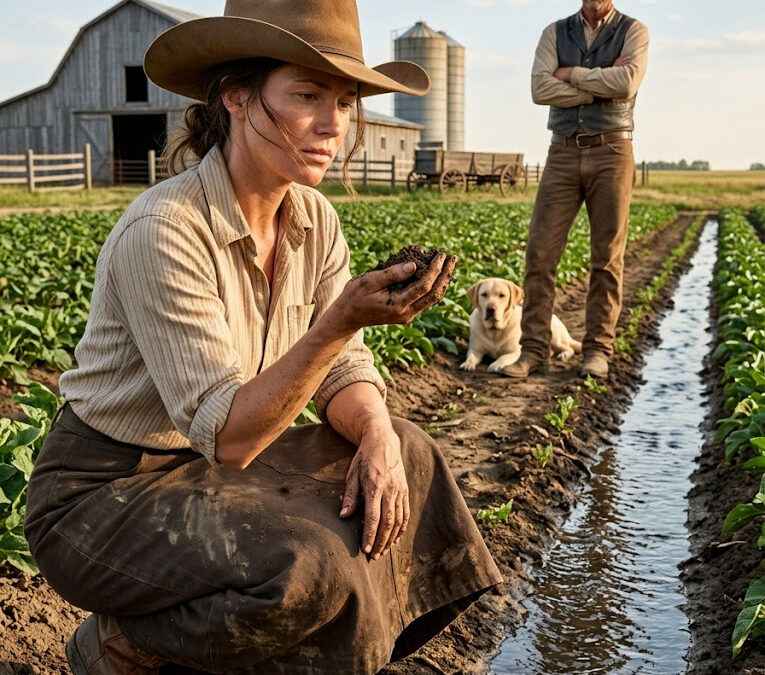
The wheat stubble from the previous year remained standing in patches. The soil near the creek was light and sandy, but farther west it became dark and heavy. She crouched, lifted a handful, and rubbed it between her palms.
Beneath the damaged surface, the soil still had structure.
The land itself was not the main problem.
She followed the creek.
The present channel was narrow and pushed too far east. In the grass, she could see the ridge of an older bank where the water had once traveled toward the lower field.
Eliza continued upstream until she found the obstruction.
A beaver dam had formed at a bend nearly a quarter mile away. It had been there for years. Mud and vegetation had hardened above it, redirecting the current and starving the best field on Neville Stroud’s property.
She stood beside the blocked channel while the morning light spread across the prairie.
Her father had once told her that land always revealed what it needed, but only to those willing to become quiet enough to hear it.
Eliza had learned to be very quiet.
By the time she returned to the house, she already knew why the farm was failing.
Part 2
Neville had hired two men for the previous spring’s seeding, but only one had stayed through the summer.
Louis Ouellette was a quiet French Canadian mechanic with a heavy mustache and the guarded expression of a man who trusted machinery more than people. Eliza found him inside the machine shed examining a binder that had thrown its chain.
He watched her approach but did not greet her.
Eliza looked over the machine.
“The sprocket is worn.”
Ouellette’s gaze shifted toward the broken mechanism. “The chain came off.”
“Because the sprocket is worn. Replace the chain alone and it will happen again.”
For the first time, he looked directly at her.
“Yes,” he said.
“Do you have a replacement?”
“No.”
“Nearest implement dealer?”
“Regina or Moose Jaw.”
Eliza opened her notebook. “What else needs parts?”
Ouellette studied her for several seconds before moving toward the rear of the shed. He showed her a cracked bearing, a damaged belt, two rusted blades, and a cultivator wheel that had been repaired so many times that the welds resembled scars.
She wrote everything down.
“How long have you worked here?” she asked.
“Since April.”
“Will you stay?”
He considered the question.
“Depends on the season.”
Eliza closed her notebook. It was the kind of answer she respected: practical, honest, and free from promises made for appearance’s sake.
That evening, she placed three pages of notes on the kitchen table.
Neville looked at them as though he had expected a conversation and discovered he was about to face an examination.
“When did the lower field stop receiving water?” Eliza asked.
“Three years ago. Maybe four.”
“Did anyone investigate upstream?”
“I walked part of it once. Thought there might be beaver.”
“There is. A dam has redirected the creek away from the old channel. If it’s opened carefully, the water should return to the lower field.”
Neville leaned back in his chair. “You found that this morning?”
“I found what was visible.”
He looked toward the window, where the last of the evening light lay across the yard.
“That field hasn’t produced properly in six years.”
“It’s your best soil. That’s why losing the water hurt you more there than anywhere else.”
Quinn sat near the stove, repairing a leather strap. He kept his eyes on his work, but Eliza knew he was listening.
“The binder needs a new sprocket,” she continued. “Not another patched chain. The east granary floor has moisture damage. If you store grain there without treating it, you’ll lose part of the harvest to mold.”
Neville’s attention returned to her.
“What did you do before coming here?”
“Farm work.”
“That’s not what I asked.”
Eliza folded her hands on the table. “I grew up on my father’s farm near Canora.”
“You left?”
“Yes.”
He waited, perhaps expecting more. When she offered nothing, he did not ask why.
Some histories did not belong to an employment arrangement.
“The binder part,” Neville said. “I can go to Moose Jaw Thursday.”
“Go Wednesday. You’re already late.”
That almost-smile appeared again.
Two days later, Eliza and Ouellette opened the beaver dam.
They worked beneath a gray sky, removing branches and hardened mud slowly enough to prevent the sudden release from destroying the lower bank. The old channel remained dry at first. Then a thin brown stream slipped into it.
The water moved hesitantly, touching the abandoned course as though searching its memory.
By afternoon, the creek was flowing steadily toward the lower field.
Eliza stood on the bank and watched the water spread through the channel.
Quinn came down from the barn and stopped beside her.
“Uncle Neville said it couldn’t be fixed.”
“He didn’t say that.”
Quinn frowned. “He said he didn’t know how.”
“That’s different.”
“Is it?”
“Considerably.”
Quinn thought about her answer. Then he nodded with the same slow seriousness as his uncle and returned to the barn.
June was dry. July was worse.
The upper fields faded beneath the heat, but the lower field held moisture. When Eliza pressed her heel into the earth, the soil yielded beneath the crust. The wheat remained upright, its color strong.
The roots were growing downward.
She explained this to Neville one evening after Quinn had gone to bed. Their conversations after supper had become a habit. It was not intimacy, at least not in the ordinary sense. It was the closeness of two people studying the same difficult problem from opposite sides.
“The surface is dry,” Eliza said, “but the plants aren’t showing stress. That means the roots are going deep.”
Neville turned his coffee cup slowly. “My father grew wheat for thirty years. Never once heard him speak about roots.”
“Did his yields rise or fall over those thirty years?”
Neville paused. “They fell.”
“Then perhaps he should have spoken about roots.”
A coyote called beyond the granaries. The old dog answered once from beneath the porch.
Neville looked toward the dark window.
“Ouellette says you know more about land than most men he has worked with.”
“That was generous.”
“He isn’t generous. That’s why I believed him.”
Eliza lowered her eyes to her cup.
She had spent years being underestimated, ignored, or treated as useful only when someone needed labor done without complaint. Being seen accurately should have felt satisfying.
Instead, it left her strangely exposed.
Still, it was not an unwelcome feeling.
Part 3
By midsummer, Eliza’s duties no longer resembled the work Neville had advertised.
She still prepared meals and kept the house orderly, but she also treated the granary floors, reorganized the seed records, negotiated with the implement dealer, and created a maintenance schedule for every machine on the property.
In August, she discovered the north fence had drifted nearly eighteen inches from its proper survey line.
The neighboring property belonged to Cecile Fournier, a widow who managed a small cattle operation with the help of two sons who worked seasonally on the railway. Neville’s opinion of Cecile seemed complicated, and Cecile’s opinion of Neville was likely the same.
“I’ll speak with her,” Neville said.
“No,” Eliza replied. “I will.”
He stared at her. “Why?”
“Because you already sound angry, and nothing has happened yet.”
“I’m not angry.”
“You will be by the time you reach her porch.”
Neville opened his mouth, reconsidered, and handed Eliza the survey papers.
Cecile Fournier answered her door wearing work clothes and an apron dusted with flour. Her gray-streaked hair had been pinned carelessly behind her head.
“You’re from the Stroud place,” she said.
“I am.”
“I heard Neville hired someone.”
“He did.”
Cecile examined her from boots to bonnet, then stepped aside. “Come in.”
They spoke for nearly an hour.
Cecile had not known the fence had shifted. Spring flooding and years of frost had moved several posts, and both properties had gradually treated the damaged line as the true boundary. Once Eliza showed her the survey, Cecile acknowledged the problem without argument.
They discussed more than the fence. The road between their properties needed grading before autumn. Both farms required access to the creek if the drought continued. Cecile’s cattle could graze part of Neville’s clover field after cutting, while Neville might borrow her heavier wagon during harvest.
By the time Eliza left, the boundary dispute had become a cooperative agreement.
Walking home, she thought about how easily the conversation could have become a feud. One accusation, one insult, one demand made with too much pride, and two neighboring farms might have spent years fighting over eighteen inches of ground.
Her mother had once told her that a fence was only as useful as the relationship on either side of it.
Eliza had found the statement foolish when she was young.
Now she understood.
The harvest was not large. No single season could undo years of exhausted soil, misdirected water, and failing equipment.
But the lower field produced more grain than it had in six years.
Neville sat at the kitchen table with the figures before him, adding the total twice before speaking.
“This can’t be right.”
“It is.”
He checked the column again. “That field nearly doubled last year’s yield.”
“It will improve again if the water continues and you rest the north quarter.”
“I can’t leave a quarter unplanted.”
“Seed it with clover. Cut it for feed. You’ll lose grain income for a season, but the soil will recover.”
“A season?”
“Three years would be better.”
Neville looked up sharply. “Three years?”
“You’ve taken from that ground for twelve. Give something back.”
He rubbed a hand across his jaw. “You’re planning three years ahead.”
“Someone has to.”
The words settled between them.
Until that moment, Eliza had not admitted even to herself that she imagined remaining long enough to see the plan completed.
Ouellette left in September, heading west to join a threshing crew. Before climbing onto the wagon, he shook Neville’s hand. Then he turned to Eliza.
“The binder runs well,” he said.
“It does.”
“The new schedule will keep it running.”
“If people follow it.”
Ouellette’s mustache shifted slightly. It might have been a smile.
“You will make them follow it.”
Then he left.
That evening, Neville placed the farm ledger on the table.
“I put that advertisement in the paper because I needed someone to cook and manage the house,” he said.
Eliza waited.
“I want you to understand that I know the difference between what I hired you to do and what you’ve done.”
“What have I done?”
“You saved the operation.”
He said it without drama. That made the words feel heavier.
Eliza looked down at the ledger. “The farm was salvageable.”
“I didn’t know that.”
“You were too close to it.”
“Perhaps.”
“The land only needed someone to look at it properly.”
Neville’s gaze remained on her. “Yes. It did.”
During the winter, he gave her full control of the farm accounts and seed purchasing. By spring, he consulted her before making any decision involving the land.
The arrangement changed without ceremony. There was no contract, announcement, or formal title. Eliza simply became the person who understood how the farm worked.
She hired a nineteen-year-old man named Abel Turner for seeding. Abel came from a large family near Weyburn and possessed the rare combination of strength, curiosity, and willingness to admit what he did not know.
Quinn turned fifteen and began taking on a grown man’s workload without complaint.
Eliza noticed how he examined the soil after rain, how he watched the direction water traveled across the yard, and how he could detect a machine’s trouble by listening to it.
“He should learn field records and land surveys,” she told Neville.
“He’s never shown much interest.”
“He didn’t know it was interesting.”
So Eliza taught him.
In the evenings, she showed Quinn how to measure acreage, track yields, judge moisture, and compare one field’s performance with another. He learned quickly.
Serious boys often did, once someone treated their questions seriously.
Part 4
The farm changed slowly enough that people nearby did not notice at first.
The north quarter returned to clover. The lower field grew stronger each season. Neville repaired the barn roof and replaced the worst section of the granary floor. Cecile Fournier’s sons helped grade the shared road, and Neville allowed her cattle to graze the cut clover after harvest.
By the third summer, the Stroud operation was producing more grain with fewer acres under wheat than it had when every field had been planted.
Other farmers began stopping by.
Some came to ask Neville about the restored creek. Others wanted to know where he had purchased seed or why one quarter had been taken out of grain production.
Neville answered honestly.
“Eliza planned it.”
Many of the men glanced toward the house when he said her name. A few looked amused. Some assumed he was being polite.
Then they saw the field records.
One farmer named Harold Ames arrived after losing nearly a third of his crop to poor drainage. Eliza walked his east field, identified a blocked runoff channel, and advised him to cut a shallow diversion before the next heavy rain.
He followed her instructions. The following spring, he returned with a sack of coffee and placed it on the Stroud kitchen table.
“My wife said I shouldn’t come empty-handed,” he told Eliza.
Neville watched from the doorway.
After Ames left, he said, “You’re becoming expensive.”
“It was coffee.”
“Good coffee.”
“Then perhaps you should ruin more neighbors’ drainage.”
Neville laughed.
It was the first time Eliza heard the sound clearly. It surprised both of them.
Years of strain had made him quiet, but success did not make him boastful. Instead, it restored parts of him that hardship had buried. He began sleeping later than four in the morning. He repaired the porch steps. He bought Quinn a proper winter coat before the boy’s sleeves became too short.
He also began leaving books beside Eliza’s place at the table: agricultural reports, soil studies, catalogs from American machinery companies, and once, a collection of essays about prairie settlement.
He never asked whether she wanted them. He simply noticed what she read.
Eliza never asked why he had remained unmarried or why Quinn had come to live with him after the death of the boy’s mother. Neville never asked what had driven Eliza west with forty-one dollars and a carpetbag tied shut with cord.
Their silence about the past was not coldness.
It was respect.
Almost two years after her arrival, a journalist from the Regina Leader came through the valley to write about changing agricultural methods in the territories.
His name was Charles Pembroke. He wore a city suit inappropriate for dust and carried a small notebook he opened before anyone had invited him to sit down.
He interviewed Neville on the porch while Eliza worked on the accounts inside.
“How did you turn the operation around?” Pembroke asked.
“Better attention to the land,” Neville replied.
“New machinery?”
“Some repairs.”
“Improved seed?”
“Partly.”
The journalist waited, clearly hoping for a simple explanation.
Neville looked through the open doorway toward Eliza.
“Mostly good advice from someone who knows what she’s doing.”
Pembroke’s pencil stopped.
“And where did you find this adviser?”
“She answered an advertisement.”
“What position did you advertise?”
Neville hesitated.
“To cook and keep the house.”
The journalist smiled as though he had found an amusing detail. “And she did that as well?”
“She did everything.”
Pembroke wrote something down, though Eliza suspected it was not what Neville had meant.
The article appeared three weeks later.
Most of it praised a large farm to the north that had imported expensive American machinery. The Stroud place received two sentences.
Neville Stroud’s modest recovery was attributed to careful management and a fortunate season.
Neville brought the newspaper inside and placed it on the kitchen table.
“Fortunate season,” he said.
Eliza read the line.
She took the pencil from behind her ear and wrote in the margin: Restored waterway. Rebuilt soil. North quarter rested. Fence reset. Equipment repaired. Fournier agreement. Accurate field records.
Then she tore the strip from the newspaper and placed it inside the farm ledger.
Neville watched without speaking.
Quinn entered from the yard, read the article, and then read Eliza’s handwritten correction.
“They got it wrong,” he said.
“Newspapers often do.”
“Doesn’t that bother you?”
Eliza thought of her father kneeling in a field with soil between his fingers. She thought of water returning to an abandoned channel, and of wheat roots reaching quietly beneath a dry surface.
“The land knows,” she said. “That’s enough.”
Quinn considered this for a long moment.
Then he nodded and went back to work.
Part 5
The newspaper article was forgotten by nearly everyone except Quinn.
He preserved the clipping between the pages of his own field notebook. Years later, when the ink had faded and the paper had become brittle, he could still remember exactly where Eliza had been sitting when she wrote her correction in the margin.
The following spring brought rain at the right time.
The clover on the north quarter stood thick and green. When Neville finally returned that land to grain, the wheat grew higher and stronger than anything on the surrounding farms.
At harvest, the figures exceeded even Eliza’s projections.
Word traveled beyond the valley.
Farmers came from Lumsden, Regina, and districts farther north to inspect the restored waterway, examine the field records, and ask how a failing operation had become one of the most reliable producers in the region.
Some still directed their questions to Neville.
He redirected every one of them.
“Ask Eliza.”
At first, a few men resisted. Then she began explaining the relationship between soil exhaustion, water access, crop rotation, and root depth. Their expressions changed.
She did not speak to impress them. She spoke because the evidence was in the fields, and she had no reason to soften facts for men who had arrived asking for answers.
By autumn, Neville replaced the old sign near the road.
For twelve years, it had read Stroud Grain Farm.
The new sign read Stroud-Mercer Agricultural Farm.
Eliza stood in the yard staring at it.
“You spelled my name correctly,” she said.
“I’ve had practice.”
“You didn’t ask me.”
“I thought you might say no.”
“I might still.”
Neville placed his hands in his coat pockets. “Will you?”
The wind moved through the stubble. Quinn was repairing a gate near the barn but had become suspiciously still.
Eliza looked from the sign to the fields.
She had arrived believing the farm was merely the next place she would work. She had expected to cook, clean, save money, and eventually move on before anyone asked too many questions.
Instead, she had restored a creek, rebuilt exhausted soil, and taught a boy how to understand land. She had found a neighboring woman she trusted, a farmhand who respected her judgment, and a man who never demanded explanations she was not ready to give.
Most importantly, she had found work that did not require her to become smaller.
“No,” she said at last. “I won’t say no.”
Quinn resumed hammering as if he had not been listening.
That winter, Eliza finally told Neville why she had left her father’s farm.
Her father had died after two failed harvests. The land passed to Eliza’s older brother, who believed a woman had no authority over planting decisions. He rejected her warnings, borrowed against the property, and lost nearly everything.
When Eliza objected, he told her she was welcome to remain as long as she stayed in the kitchen and left farming to men.
She packed her belongings the next morning.
Neville listened without interruption.
When she finished, he looked toward the stove.
“Your brother was a fool.”
“That is a simple description.”
“Simple can still be accurate.”
She smiled.
Several months later, Neville asked her to marry him.
He did not arrange flowers, prepare a speech, or wait for a romantic sunset. He asked while they were standing beside the lower field discussing seed prices.
“If we marry,” Eliza said, “the farm remains half mine.”
“It’s already half yours.”
“On paper.”
“I’ll have the papers prepared.”
“And Quinn continues his studies.”
“He will.”
“And I make the final decision on rotation.”
Neville frowned. “Final?”
“You may appeal.”
“To whom?”
“To me.”
He looked at her for a moment, then laughed.
They married in Cecile Fournier’s parlor with Quinn and Abel as witnesses. Ouellette returned from the west for the ceremony and gave them a new set of machine tools.
There was no newspaper announcement.
Eliza did not need one.
Over the next decade, the farm became known throughout the district not because it owned the largest machines or planted the greatest acreage, but because it produced steadily through difficult seasons.
Eliza introduced crop rotation before most nearby farms accepted it. She kept detailed rainfall records and built small diversion channels to prevent erosion. She negotiated cooperative equipment purchases with neighboring families and created an agreement allowing smaller farms to share machinery rather than sink themselves into debt.
Quinn eventually attended an agricultural college in Manitoba. He returned with new ideas, but he never treated education as proof that he understood more than the people who had taught him.
On his first evening home, he walked the lower field with Eliza.
“The instructors talk about soil as if it’s a formula,” he said.
“It can be measured.”
“But not entirely.”
“No.”
He crouched and lifted a handful of earth.
“You still have to listen.”
Eliza looked toward the creek, flowing in the channel she had restored years before.
“Yes,” she said. “You still have to listen.”
When Quinn later took over much of the operation, he kept the old farm ledger in the office. Inside its cover remained the strip of newspaper margin on which Eliza had recorded the truth behind the supposed fortunate season.
Visitors often noticed it framed above his desk.
Restored waterway. Rebuilt soil. North quarter rested. Fence reset. Equipment repaired. Fournier agreement. Accurate field records.
Beneath the list, Quinn eventually added one sentence of his own.
The land did not fail us. We had failed to pay attention.
Eliza never became famous. Her name did not appear in agricultural journals, and the journalist who had described the farm’s recovery as fortunate never returned to correct his article.
But across the valley, farmers began rotating crops. They opened old waterways, repaired drainage channels, kept better records, and stopped treating every exhausted field as if it could be forced back to health through harder plowing.
The change spread quietly, one farm at a time.
Years after Eliza first arrived with forty-one dollars and a broken carpetbag, she stood beside Neville on the rise above the creek. The granaries were full. The barn roof was new. Quinn’s children were racing through the yard while the descendants of the old yellow dog slept beneath the porch.
Neville looked over the fields.
“When you came here, I thought I was hiring someone to make supper.”
“You needed supper.”
“I needed considerably more than supper.”
Eliza smiled. “You didn’t know how to ask.”
“No.”
Below them, the creek followed its old course through the lower field, steady and clear.
The farm had not been rescued by luck or by a fortunate season. It had been rescued by observation, patience, and the courage to change what generations of men had insisted must remain the same.
Neville had given Eliza a room, a wage, and a place at his table.
She had given the land another future.
And although the newspapers never understood what had happened on that low prairie rise, the wheat rose gold every summer, the water continued running, and the soil remembered the woman who had listened.
THE END








