The HOA slapped a foreclosure notice on my million-dollar cabin over fake violations, planning to seize my land for their new clubhouse. What they never checked was my career—or the fact that I had personally underwritten the $50 million insurance policy keeping their entire subdivision financially alive.
IF YOU CAME FROM FACEBOOK, HERE’S THE NEXT PART OF THE STORY, ENJOY !!
Part 3
The emergency meeting was held in the Crestview clubhouse.
The irony was not lost on me.
Crestview already had a clubhouse.
Small.
Underwhelming.
Nothing like the renderings Briley had been circulating for a future “community lodge.”
But it had chairs.
A projector.
And enough room for more than two hundred angry homeowners.
David sat beside me.
I had no intention of speaking first.
The board had created this.
The board needed to explain it.
Briley sat in the center.
No pastel tracksuit.
Dark blazer.
Attorney on one side.
Association manager on the other.
The board treasurer, Elaine Foster, opened the meeting.
“We are here to discuss pending litigation involving the Powell parcel and associated insurance matters.”
A man in the second row called out:
“Associated insurance matters?”
Elaine continued.
“The association’s D&O carrier has issued a reservation of rights.”
People started whispering.
Briley reached for the microphone.
“This is standard litigation procedure.”
David leaned toward me.
“She’s not completely wrong.”
“I know.”
That was important.
A reservation-of-rights letter is not a denial.
It is not a policy cancellation.
It does not mean every homeowner loses a mortgage.
It means the insurer is defending while preserving the right to dispute coverage later.
That was already enough.
Board members had spent months behaving as though the HOA’s legal budget and insurance made their decisions risk-free.
Now they were learning that insurance has boundaries too.
Elaine projected the title report.
My parcel outlined in blue.
Crestview in green.
No overlap.
Then the recorded access easement.
Permanent right-of-way benefiting my property.
No covenant language.
No annexation language.
No HOA control.
A homeowner raised her hand.
“Then why were we fining him?”
Briley answered.
“Our counsel believed the access arrangement created a basis for community enforcement.”
David opened his folder.
“That is not what counsel wrote.”
The room became quiet.
He put the email on the screen.
OWNERSHIP THEORY IS UNCERTAIN. DO NOT RECORD LIEN AGAINST POWELL PARCEL WITHOUT CONFIRMING COVENANT APPLICABILITY.
Then Briley’s reply.
IF WE WAIT, HE’LL NEVER SELL. PROCEED WITH ENFORCEMENT PRESSURE.
Nobody spoke for several seconds.
Briley’s attorney stood.
“These communications are being presented without full context.”
David nodded.
“Then provide the full thread.”
That was the advantage of documents.
You can argue interpretation.
You cannot make the sentence disappear.
The full chain went up.
The attorney had warned that the parcel appeared outside Crestview.
He recommended a title opinion before filing anything.
Briley asked whether continued fines could “create leverage.”
He replied that fines without covenant authority might be unenforceable.
Two weeks later, the lien was filed anyway.
A woman near the aisle stood.
“You told us this man owed the HOA twenty-eight thousand dollars.”
Briley looked toward her.
“The board relied on legal advice.”
The homeowner pointed at the screen.
“The legal advice says the opposite.”
That was when the room changed from confused to angry.
Elaine moved to the next exhibit.
Capital planning.
The new clubhouse concept.
Site alternatives.
Option A sat inside Crestview.
Smaller.
Complicated drainage.
Option B was my property.
Three acres.
Highest elevation.
Best view.
Largest usable footprint.
Beside Option B:
ACQUISITION STRATEGY REQUIRED.
Then a later note.
ENFORCEMENT DISPUTE MAY IMPROVE NEGOTIATING POSITION.
The room erupted.
Briley grabbed the microphone.
“That was a consultant’s comment.”
Elaine answered.
“It appears in the board packet.”
“Not authored by me.”
“But you received it.”
The attorney whispered something to her.
Briley stopped talking.
For eight months, she had treated my cabin as a compliance issue.
Paint.
Driveway.
Firewood.
Truck.
Grass.
Now her own residents were reading documents suggesting those violations had been useful because they increased pressure on a property owner whose land the HOA wanted.
That was a much harder story to explain.
Then came the insurance issue.
Crestview’s broker joined by video.
He was careful.
Professional.
No drama.
“The master policies remain in force.”
Several people exhaled.
Then he continued.
“However, the pending claim has created a material governance issue. The D&O carrier has reserved rights regarding certain allegations and is requesting additional documentation.”
A homeowner asked:
“Can they refuse to pay?”
“For some claims or damages, possibly. That determination has not been made.”
“Can board members be personally exposed?”
“Depending on findings, applicable law, indemnification provisions, and policy exclusions, potentially.”
That word did more than any threat I could have made.
Potentially.
Briley looked smaller.
The board members looked at one another.
For years, they had operated collectively.
Now each had to consider an individual question.
What did I know?
When did I know it?
What did I approve?
The treasurer had already hired personal counsel.
Two other directors did the same that week.
The insurer appointed separate counsel for certain board members because their interests might not align.
Again, normal.
Expensive.
Complicated.
Exactly the kind of thing people should think about before using an HOA as leverage in a land dispute.
Then David stood.
He did not demand millions.
He did not threaten anyone’s pension.
He gave the board a settlement proposal.
First:
Record a full release of the lien.
Second:
Dismiss every claimed fine and fee against my property.
Third:
Record an acknowledgment that my parcel is not subject to Crestview’s declaration.
Fourth:
Reimburse documented legal and title-clearing costs.
Fifth:
Adopt a board resolution prohibiting enforcement activity against nonmember parcels without a written title opinion.
Sixth:
Pay an agreed settlement for the wrongful lien and interference with my property rights.
No clubhouse transfer.
No public humiliation clause.
No demand that Briley move.
The treasurer read the list.
A homeowner asked:
“If we do this, does the insurance issue go away?”
The broker answered.
“The claim can resolve. The carrier still completes its internal review.”
That was honest.
Nobody could simply call Chicago and erase history.
The board requested a recess.
David and I went outside.
Cold mountain air.
Dark firs.
Crestview’s streetlights stretched behind us.
“You think they accept?” I asked.
“Yes.”
“All of it?”
“Not the first number.”
I smiled.
“Good.”
“Why good?”
“If they accepted the first number immediately, we asked for too little.”
He laughed.
Forty minutes later, we returned.
The board had agreed to the nonfinancial terms.
Settlement amount remained open.
More importantly, Elaine made a motion.
Suspend Briley Rivera as HOA president pending completion of the governance review.
Seconded.
Four votes yes.
One abstention.
Briley did not vote.
She sat very still.
Nobody cheered.
I was glad.
I did not need an arena.
Three weeks later, we settled.
Less than the five-million-dollar fantasy number Briley later claimed I had threatened.
Much less.
Enough to cover my legal expenses, title work, and damages from the wrongful lien.
The lien release was recorded the same day.
David emailed me the stamped copy.
I printed it.
Put it beside my original deed.
Then the insurance carrier completed its review.
Its conclusions were confidential between the insurer and insured, but some consequences became obvious.
Crestview renewed coverage under stricter risk-management requirements.
The board had to improve litigation reporting.
Certain governance controls were added.
The D&O program changed at renewal.
Premiums rose.
Not catastrophically.
But noticeably.
The association also changed legal firms.
Briley resigned from the board before the internal review finished.
She sold her house the following spring.
I heard Florida.
Could be true.
Could be neighborhood mythology.
I never checked.
What mattered happened on my side of the stone wall.
Nothing.
That was the victory.
Nobody painted my cabin gray.
The gravel driveway stayed gravel.
My firewood stayed stacked beside the shed.
The stone chimney remained.
My old Ford still sat outside.
The HOA never sent another violation letter.
The developer’s clubhouse idea moved to a smaller parcel already owned by Crestview.
It cost them more to redesign.
The views weren’t as good.
That was their problem.
The most interesting conversation happened months later.
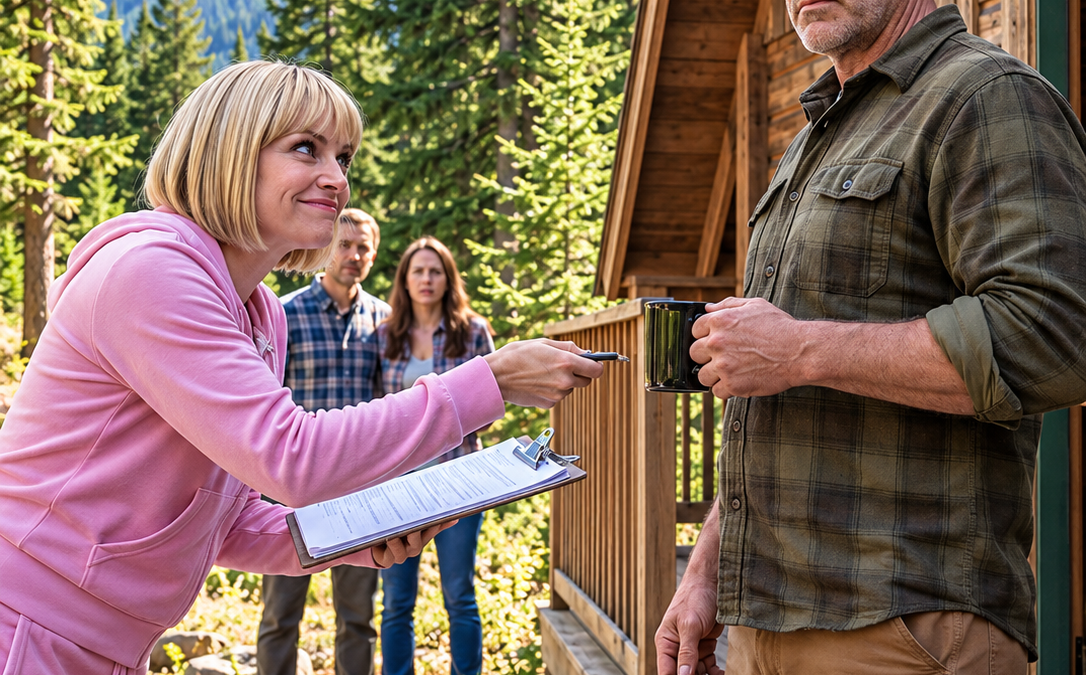
Elaine came to my cabin.
She stopped at the bottom of the porch.
“May I come up?”
That alone told me Crestview had changed.
“Sure.”
I poured coffee.
We sat outside.
She looked toward the subdivision.
“I owe you an apology.”
“You didn’t file the lien.”
“I voted to continue enforcement.”
“Why?”
She took a while.
“Because Briley kept saying counsel had confirmed it.”
“Did you read the title opinion?”
“There wasn’t one.”
“I know.”
She nodded.
“That’s why I’m apologizing.”
We sat quietly.
Then she asked something I had expected for months.
“Did you know the insurance issue would frighten the board?”
“Yes.”
“Did you use that?”
I considered the question.
“Yes.”
She looked at me.
I continued.
“But I didn’t control the carrier.”
“I know.”
“I disclosed my prior connection.”
“I know.”
“I didn’t ask them to cancel coverage.”
“I know.”
“Then what are you asking?”
She looked toward the trees.
“Whether you enjoyed it.”
That took longer to answer.
“No.”
She seemed surprised.
“I enjoyed watching the lien disappear.”
“That’s different?”
“Completely.”
I had spent a career watching companies learn the difference between insured risk and reckless behavior.
Insurance works because uncertainty can be priced.
A warehouse may burn.
A storm may hit.
A director may make a negligent decision.
Those are risks.
What insurers dislike is somebody receiving a clear warning, ignoring it, and then expecting the policy to absorb every consequence.
That was never a magic lever.
It was simply the point where Briley’s decisions stopped being somebody else’s abstract problem.
She had wanted collective power.
HOA money.
HOA lawyers.
HOA letterhead.
HOA insurance.
Then the documents forced everyone involved to ask whether the collective should protect a decision made for an improper purpose.
Once that question existed, her leverage collapsed.
Elaine finished her coffee.
Before leaving, she said:
“We changed the board policy.”
“How?”
“Any lien now requires independent verification that the parcel is subject to the declaration.”
“That wasn’t already required?”
She gave me a look.
“Apparently it needed to be written down.”
Fair.
The cabin returned to being quiet.
Almost.
Crestview remained next door.
Children played.
Dogs barked.
Lawn crews arrived every Thursday.
I could hear the pool construction when the wind came from the east.
But nobody crossed the stone wall.
That mattered.
One morning, I found another cream-colored envelope in my mailbox.
For half a second, my stomach tightened.
Old reflex.
Then I opened it.
Crestview Meadows.
No violation.
No fine.
A notice informing adjacent property owners that the HOA would be resurfacing part of the shared access road and asking whether temporary construction traffic would inconvenience me.
At the bottom:
PLEASE CONTACT MANAGEMENT IF YOU HAVE CONCERNS.
I laughed.
Then called.
We coordinated the work in five minutes.
That was what competent governance looked like.
Not weakness.
Not surrender.
Just authority staying inside its actual boundary.
I still consult occasionally.
Young underwriters ask me about large residential associations.
I tell them something I learned long before Crestview.
Policies do not govern people.
Documents do.
Policies define how financial consequences may be shared after something goes wrong.
They do not turn a bad decision into a good one.
They do not create property rights.
And they certainly do not transform an HOA president’s ambition into an easement.
Briley’s biggest mistake was not choosing the wrong shade of brown to complain about.
It was believing every institution around her existed to enforce whatever she decided.
The HOA.
The lawyer.
The insurer.
The lender.
The county.
Once each institution looked at its own documents instead of her confidence, the story became much simpler.
My deed said what I owned.
The plat said where Crestview ended.
The easement said what road access I had.
The declaration said which parcels belonged to the HOA.
None of them said Briley Rivera could take my cabin.
That should have ended the dispute before it started.
In the end, it did.
It just took eight months, a wrongful lien, several attorneys, and one very uncomfortable insurance review for everybody to read the paperwork that had been sitting there from the beginning.
I still keep the foreclosure notice.
Blue tape and all.
It sits in the same folder as the recorded lien release.
Sometimes I show both to younger clients.
The first document tried to make something true by asserting it confidently.
The second corrected the public record.
Only one of them survived.
The cabin is still cedar.
The chimney still smokes in winter.
My driveway is still gravel.
And when I sit on the porch with coffee, Crestview Meadows is visible through the trees.
Close enough to hear.
Far enough to remain exactly what it always should have been.
Somebody else’s HOA.
The end
Disclaimer: This content is entirely AI-generated for fictional and entertainment purposes only. Any resemblance to actual persons, living or dead, events, or locations is purely coincidental, and the creator assumes no liability for any interpretation of this content.