They Said the Orchard Was Beyond Saving—Until She Turned the Animals Loose
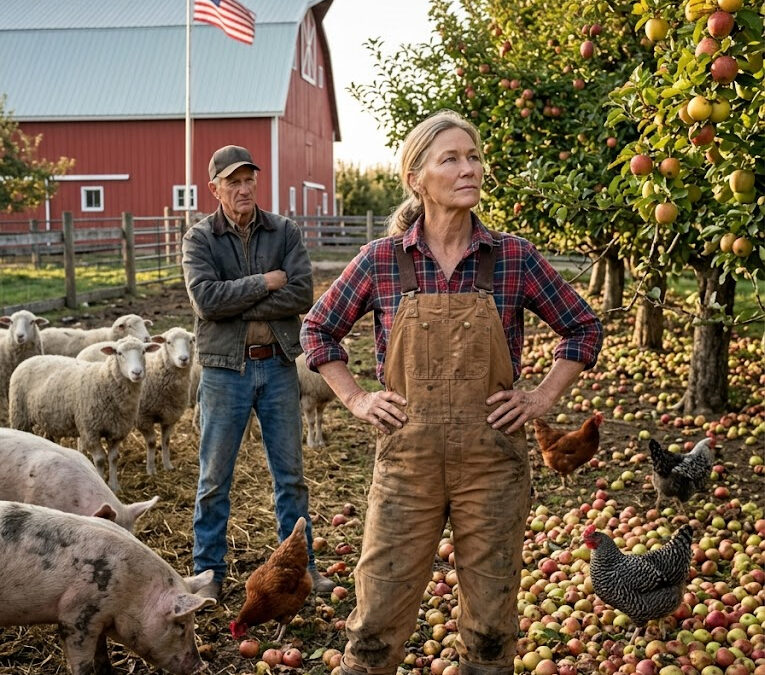
Part 1: The Orchard Everyone Had Abandoned
On a freezing morning in early March, Laura Bennett turned off a narrow two-lane highway in western Michigan and drove toward an apple orchard that looked as though it had been forgotten by the world. The wooden sign at the entrance hung from a single rusted chain, swinging whenever the wind pushed across the empty fields. Weeds had swallowed most of the gravel driveway, and the tires of her pickup sank into mud as she moved slowly toward the old packing shed.
Forty-eight acres of apple trees stretched across the property. Some rows were still visible, but others had disappeared beneath waist-high grass, thorny bushes, and fallen branches. Apples from the previous season lay rotting beneath the trees, darkened by snow and rain. The irrigation pipes had split during winter. Several trees leaned at unnatural angles, and many had not been pruned in years.
The packing shed was even worse. A hole in the roof allowed daylight to fall across dusty wooden crates. Old labels bearing the Whitaker family name were peeling from the walls. Mouse droppings covered the corners, rainwater had stained the floor, and one side of the building had begun to sag.
The orchard consultant who walked beside Laura did not try to soften his opinion.
“You would be better off removing most of these trees,” he told her. “Clear the ground, repair the drainage, replace the irrigation, and replant from the beginning.”
Laura stared down a long row of neglected apple trees. “How much would that cost?”
When he named the figure, she almost laughed. It was more money than she could borrow and far more than she had left after selling her house.
The consultant looked at the ruined shed, the weeds, and the cracked pipes. “This place has been out of production for eight years. Sometimes starting over is cheaper than trying to save what is already gone.”
That was what everyone saw when they looked at the property: a failed orchard, exhausted soil, broken equipment, and decades of work waiting to be undone.
Laura saw something else.
She looked at the grass growing beneath the trees and imagined sheep grazing there. She looked at the insects moving through the fallen fruit and imagined chickens scratching through the rows. She saw damaged apples that could feed pigs, branches that could become wood chips, leaves that could become compost, and manure that could return fertility to the soil.
Most people saw waste because the pieces were scattered and disconnected. Laura saw a system waiting to be rebuilt.
For fourteen years, she had managed food-waste collection routes in Detroit. Before sunrise, she would study lists from restaurants, grocery stores, bakeries, breweries, juice companies, and commercial kitchens. She knew where six bins of vegetable trimmings needed to be collected, which grocery store had bruised produce, and which brewery had hundreds of pounds of wet grain that would spoil if it was not moved quickly.
Some of that material became compost or animal feed. Too much of it went to landfills simply because transportation, timing, storage, or regulations made reuse inconvenient. Laura had watched perfectly edible apples discarded because they were too small. She had seen pumpkins thrown away after Halloween and bread destroyed because the packaging had been damaged.
Over time, she had begun to believe that waste was often nothing more than a useful resource trapped in the wrong place.
Then her father died.
He had worked as a mechanic his entire life and had always dreamed of buying a few acres of land. There was never enough money. There was always another bill, another repair, or another reason to wait.
While cleaning out his garage after the funeral, Laura found an old coffee can filled with bolts, washers, screws, springs, and small pieces of metal. A strip of masking tape was attached to the side. In her father’s handwriting were four words.
Nothing useful gets wasted.
Laura sat on the cold garage floor holding the can against her chest. Six months later, she resigned from her job.
Her friends assumed she needed time to grieve. Her brother believed she would become a consultant. Her former supervisor told her she could return when she was ready to be practical again.
Instead, Laura studied pasture rotation, composting, soil biology, livestock nutrition, orchard management, and silvopasture, a system that combined trees, forage, and animals on the same land. She visited farms across Michigan, Wisconsin, Indiana, and Ohio. She asked questions that exposed how little she knew and filled notebook after notebook with answers.
When she found the abandoned Whitaker orchard listed for sale, she drove there the next morning.
She purchased it for $214,000 using most of her savings, a small agricultural loan, and the money from selling her suburban home. She had very little left to repair the property, and she could not afford to erase the orchard and begin again.
So she chose another path.
On her first official morning as the owner of Second Ground Orchard, Laura backed a rented livestock trailer beside the packing shed. Sixteen sheep stepped uncertainly into the muddy grass. Behind them came sixty laying hens in transport crates and four young pigs that complained loudly from the trailer.
The man who delivered the animals looked across the ruined orchard.
“You sure this is where you want them?”
Laura closed the trailer gate and listened to the sheep calling to one another beneath the old apple trees.
“Yes,” she said. “This is exactly where they belong.”
At the local feed store, people began talking before the end of the week. Why would anyone bring sheep into an orchard? Would the pigs destroy the land? How would chickens survive when raccoons and foxes were already common in the area?
One man watched Laura load fencing supplies and shook his head.
“You bought a dead orchard,” he said, “and now you’re turning it into an expensive petting zoo.”
Laura smiled, lifted another fence post into her truck, and drove away.
She knew every animal had a job. She simply had to prove it before the money ran out.
Part 2: A Plan Meets Reality
Laura’s plan looked organized in her notebooks. The sheep would graze the grass beneath mature trees, reducing mowing and returning manure to the soil. The chickens would follow several days later, scratching through manure, eating insects, and spreading organic material. The pigs would remain in controlled areas, where they could eat selected fallen fruit, vegetables, and approved food byproducts.
The manure, leaves, bedding, spoiled hay, wood chips, and damaged produce would become compost. The compost would feed the orchard. The orchard would produce apples. The animals would also produce eggs, lamb, and pork.
On paper, every part supported another.
During the first week, the sheep destroyed Laura’s confidence.
The portable electric fencing worked in dry conditions, but melting snow and fallen branches repeatedly interrupted the current. One large ewe discovered that her thick wool protected her from the wire. She pushed beneath the fence, and the others followed.
Laura spent three afternoons chasing sheep through rows of neglected apple trees. Each time she moved toward them, they scattered. By sunset, she was muddy, exhausted, and furious.
The chickens presented another problem. Laura converted an old trailer into a temporary mobile coop, but she underestimated the determination of local predators. One night, a raccoon climbed through a weak section near the roof and killed five hens.
Laura found the birds at dawn.
For several minutes, she stood silently beside the coop, blaming herself. Then she removed the dead hens, reinforced every opening with hardware cloth, installed an automatic door, and added solar-powered lights. She began moving the coop more often and checking it after dark.
The orchard required even greater attention. Laura learned that mature apple trees could survive short periods of sheep grazing, but only if the animals were moved before they became hungry enough to chew the bark. Young trees needed guards. Low branches needed protection. Grazing time depended on the condition of the grass, the number of sheep, and the size of each temporary paddock.
Nature did not manage itself merely because Laura wanted it to.
She divided the property into smaller sections with portable fencing. The sheep remained in each paddock for one or two days before moving. Several days later, chickens followed in mobile shelters. In thin areas, Laura planted mixtures of clover, ryegrass, chicory, and other forage crops.
The pigs were placed away from the tree trunks. Laura collected fallen apples and brought them to the feeding area. She also negotiated an agreement with a nearby grocery store for bruised vegetables that met safety requirements.
Her most important partnership came from a small craft brewery ten miles away. Twice each week, the brewery produced wet spent grain after making beer. It was heavy, spoiled quickly, and cost the brewery money to remove.
Laura provided sealed containers and followed a strict pickup schedule. The grain became one ingredient in the pigs’ diet, mixed with balanced feed and other approved foods.
She knew the arrangement could become dangerous if handled carelessly. Pigs could not live on random leftovers, and spoiled grain could make them sick. Laura weighed every delivery, recorded each feeding, rejected anything moldy, and adjusted the pickup schedule according to the weather.
The logistics experience people had considered useless suddenly became her greatest strength.
Laura created spreadsheets for feed costs, grazing days, egg production, veterinary expenses, labor hours, compost temperatures, restaurant orders, fencing repairs, and orchard maintenance. She tracked nearly everything because she understood that the difference between a resource and a burden was often timing.
By May, Second Ground Orchard no longer looked abandoned. It still looked rough, but it looked alive.
The grass in the first rotational sections was shorter. Chickens moved through the rows in their repaired shelter. The pigs consumed stored apples, bruised vegetables, and carefully measured brewery grain. Laura cleared a sunny area beside the packing shed and planted pumpkins, winter squash, herbs, and vegetables.
She purchased finished compost from another farm because her own piles were not ready. A circular system, she realized, did not become self-sufficient immediately. In the beginning, fertility, equipment, and knowledge still had to come from outside.
The first product Laura sold was not an apple. It was an egg.
She washed and packed twenty-eight dozen eggs and took them to a Saturday farmers market. The label on the cartons read Second Ground Orchard. Beneath the name were the words Animals, Trees, and Soil Working Together.
Laura expected curiosity but prepared herself to bring half the cartons home.
She sold every one before noon.
The following week, several customers returned. One woman told her the yolks were darker than the eggs she usually bought. A restaurant owner asked whether Laura could provide twenty dozen each week by summer.
For the first time since purchasing the orchard, money came back through the gate.
It was not enough to cover the loan, repairs, feed, or insurance. It was not even close. But it proved that one part of the system could begin supporting another.
Laura drove home from the farmers market with empty crates and allowed herself to believe the orchard might survive.
Then June arrived.
Three days of heavy rain turned the ground into mud. A large branch fell across the electric fence during the night and shut down the current. Nine sheep escaped into a block containing younger apple trees.
By the time Laura found them, several trunks had been stripped of bark. Two trees were damaged so badly that they later died.
Laura stood in the rain staring at the wounds. Those trees represented years of growth, and she had failed to protect them.
That same week, a container of brewery grain fermented in the warm weather. Laura smelled the sour odor before feeding it and rejected the entire load, but replacing it increased her costs. An irrigation contractor then discovered more broken underground lines than expected. The repair estimate was nearly twice her budget.
Before Laura could adjust, a pest specialist found serious codling moth activity in one northern block.
Each problem revealed another problem waiting beneath it.
At night, Laura lay awake calculating expenses. Her savings were disappearing. Egg sales covered only a fraction of the bills, and the orchard had not yet produced a commercial crop.
For the first time, she wondered whether everyone had been right.
Part 3: The Price of Refusing to Quit
Laura’s father had restored an old motorcycle over many years. After his death, it became the one possession she could not imagine selling. She had kept it beneath a cover, telling herself she would ride it when the farm became less demanding.
The farm never became less demanding.
In late June, Laura rolled the motorcycle into the sunlight and photographed it for sale. When the buyer arrived, she explained every repair her father had made. After he drove away, she stood beside the empty space in the shed and cried.
The money paid for irrigation repairs, stronger fencing, fence alarms, and guards for every young tree.
Laura also returned to Detroit on weekends to perform consulting work. She helped two restaurants reorganize waste collection, recycling, and purchasing systems. During the week, she worked in the orchard. On Friday evenings, she drove east. On Sunday nights, she returned to the farm and slept for a few hours before beginning again.
People in town heard about the escaped sheep, damaged trees, and irrigation costs. The man from the feed store told someone that the petting zoo was already falling apart.
Laura did not argue with him.
She studied the failures.
The weak fencing had not proved that sheep did not belong in an orchard. It proved that her fencing system needed improvement. The spoiled grain did not prove that brewery byproducts were useless. It proved that summer required faster collection and shaded storage. The damaged trees did not prove grazing was impossible. It proved that every vulnerable trunk needed protection.
Laura installed a voltage alarm that sent a warning to her phone whenever the fence lost power. She added permanent perimeter fencing around the most sensitive orchard blocks. She created a shaded storage area for brewery grain and reduced the interval between pickups during warm weather.
She placed guards around every young tree and removed low branches from areas where sheep grazed. She added pheromone traps for codling moths, removed damaged fruit, pruned diseased wood, and moved the chickens strategically through blocks where insects might survive in fallen apples.
Laura never claimed the animals could solve every problem. They could not repair irrigation lines or cure diseased trees. They could not replace careful pruning, veterinary care, balanced nutrition, or pest monitoring.
But they could reduce mowing, cycle nutrients, convert selected byproducts into valuable products, and become part of a larger management strategy.
By late July, small signs of improvement began appearing.
Laura pushed a soil probe beneath a row that had been grazed twice, followed by chickens, seeded with clover, and given a light application of compost. The probe sank deeper than it had in March. The surface soil was darker and remained moist longer after rain.
In an untreated block nearby, the ground had already begun to dry and crack.
The difference was not dramatic. No television camera would have noticed it. Laura noticed.
The vegetation changed as well. Rotated sections had shorter grass, more clover, and less dead material. The sheep reduced the number of hours Laura spent mowing. The chickens broke apart manure piles and scattered organic matter.
The pigs consumed thousands of pounds of fallen apples, pumpkins, vegetables, and brewery byproducts that might otherwise have been discarded. Behind the packing shed, compost piles began heating properly.
Laura built them from sheep manure, chicken bedding, leaves, wood chips, spoiled hay, rejected produce, and orchard prunings. Steam rose from the piles on cool mornings. To anyone passing on the road, they looked like heaps of debris.
To Laura, they were the heart of the system.
In August, customers from the farmers market began asking whether they could visit the orchard. Laura scheduled one tour for a Saturday morning and expected ten people.
Thirty-eight arrived.
Families walked between the trees while Laura explained how the sheep moved from one paddock to another. Children watched the flock enter fresh grass. Adults asked questions about food waste, soil, pesticides, animal care, and composting.
At the end of the tour, Laura arranged eggs, herbs, early pumpkins, and jars of apple-scrap vinegar on a folding table. Everything sold.
Two families asked whether she offered subscriptions.
Laura said no, then changed her mind before they reached their cars.
That night, she created the Second Ground Harvest Club. Members would receive a rotating selection of eggs, vegetables, herbs, vinegar, pumpkins, and seasonal products every other week. Pork and lamb shares could later be purchased separately.
Twenty-five families joined within the first month.
The subscription money was not enormous, but it was predictable. For a farm struggling with irregular expenses and seasonal sales, predictable income felt almost miraculous.
Still, the orchard faced one final test.
It had to produce apples.
In September, Laura entered the healthiest surviving blocks with empty crates. The first apples she picked were scarred and smaller than supermarket fruit. Some showed insect damage. Some were suitable only for processing.
But many were good.
She cut one open with her pocketknife and studied the pale flesh. Then she tasted it. The apple was crisp, sharp, and sweet.
Laura leaned against the tree and closed her eyes.
For eight years, no commercial harvest had left the property. Now, crate after crate began filling inside the repaired packing shed.
The best apples went into bags for the farmers market and boxes for two local stores. Smaller fruit went to a cider maker. Damaged apples became vinegar or pig feed. Cider pulp returned to the compost piles or was used in limited quantities as an approved feed ingredient.
For the first time in nearly a decade, trucks left the orchard carrying food instead of broken equipment and debris.
Part 4: The Man Who Thought the Trees Were Finished
One afternoon during harvest, an old sedan stopped beside the packing shed. Thomas Whitaker, the orchard’s former owner, stepped out slowly and reached for a cane.
He was seventy-six years old. Laura had met him only twice during the purchase, and both times he had appeared eager to leave the property behind.
Now he stood beside the repaired shed and stared across the rows.
Laura walked toward him. “I didn’t know you were coming.”
“Neither did I,” Thomas said. “I was driving nearby.”
They both knew that was not entirely true.
Laura invited him to walk through the orchard. Thomas moved slowly, pausing often. Beneath the mature trees, sheep grazed inside a temporary paddock. Farther behind them, chickens scratched through the grass beside a mobile shelter.
Workers carried apple crates into the packing shed. The roof had been repaired, the floor cleaned, and the old Whitaker labels preserved on one interior wall.
Thomas stopped beside a bin of apples. He picked one up and turned it in his hand, examining the skin as though reading a message written there.
“I thought these trees were finished,” he said.
Laura looked down the row. “So did everyone else.”
Thomas raised the apple and took a bite. He chewed slowly. Then he smiled.
The expression lasted only a few seconds, but it meant more to Laura than the first farmers market sale. She had not erased the orchard’s history. She had connected its past to something new.
Two weeks later, a regional newspaper published a story about Second Ground Orchard. The headline described a former logistics manager using animals to restore abandoned farmland. The article brought more visitors, more subscription requests, and several skeptical farmers who wanted to see whether the system truly worked.
Laura answered their questions honestly. Some trees had died. The soil was still recovering. The fencing had been expensive. Predators remained a threat. The animals required daily care, proper nutrition, and constant attention.
Nothing was effortless.
By the end of the first year, the orchard was home to thirty-one sheep, one hundred eighty laying hens, and eight pigs. Nearly forty acres were being managed as orchard and pasture.
The farm had sold eggs, herbs, vegetables, pumpkins, apples, vinegar, pork shares, and a limited number of lamb shares. It supplied two restaurants, two small stores, one cider producer, and fifty-four subscription members.
More than eighteen thousand pounds of apples, produce, brewery grain, bedding, leaves, and other approved organic materials had been redirected into animal feed or composting systems.
Laura’s first-year gross revenue rose slightly above eighty-six thousand dollars.
On paper, the number looked impressive. In reality, repairs, fencing, feed, livestock purchases, insurance, veterinary bills, market fees, fuel, loan payments, and irrigation costs consumed most of it.
The margin was thin.
Laura was not rich. She still drove an aging pickup. She lived in a small room she had repaired inside the farmhouse, and she continued accepting occasional consulting work.
But the orchard remained open.
It had produced food, revenue, compost, and healthier soil. Customers were returning. The largest startup costs would not need to be repeated every year. The trees had survived another season, and many were stronger than they had been in spring.
Exactly 365 days after Laura arrived with the first trailer of animals, she stood inside the packing shed before sunrise.
Crates of stored apples lined one wall. Cartons of eggs waited for restaurant delivery. Jars of vinegar stood beside boxes of squash, herbs, and customer orders. Through the repaired doorway, she could see sheep moving beneath the trees.
The shed no longer smelled of rot and rainwater. It smelled of apples, straw, wood, and cold soil.
Laura placed her father’s coffee can on a shelf above the workbench. The strip of masking tape had begun to curl, but the words remained visible.
Nothing useful gets wasted.
She looked around the building and understood that her father’s sentence had become more than a memory. It had become the structure of the farm.
Part 5: What the Orchard Became
The man from the feed store returned in February. He walked into Second Ground Orchard with his hands in his coat pockets and studied the permanent fencing around the young trees.
Laura recognized him immediately.
He did not apologize for calling the farm a petting zoo. Instead, he pointed toward the voltage monitor.
“What kind of fence alarm are you using?”
Laura explained the system. He asked several more questions, then mentioned a walnut grove behind his house. Grass and insects had become difficult to manage there.
“Think chickens would help?” he asked.
“They might,” Laura said, “if you move them carefully and protect them at night.”
That spring, he bought twenty hens.
Laura never considered the moment a victory over him. She had learned too much during the previous year to enjoy proving people wrong. Every time she became confident, the orchard reminded her how quickly weather, animals, pests, or machinery could expose another weakness.
Sheep still escaped occasionally. Chickens became sick. A fox tested the perimeter. Feed prices changed. Some cover crops failed. Certain vegetables did poorly in the orchard’s heavy soil. One compost pile became too wet, while another lacked enough nitrogen to heat properly.
Some ideas worked beautifully. Others were abandoned.
The farm was not a flawless model of nature repairing itself. It was a living system that required observation, correction, patience, and humility.
The central idea, however, remained strong.
The grass beneath the trees was not merely a maintenance problem. It was forage. The sheep were not simply animals producing lamb. They were mowers, fertilizer spreaders, and part of the farm’s income.
The chickens were not only egg producers. They disturbed insect habitat, scattered manure, and helped clean the orchard floor.
The pigs were not garbage disposals. They were living animals with nutritional needs that could responsibly convert selected byproducts into food and fertility.
Damaged apples were not worthless. Leaves were not worthless. Manure, bedding, branches, and wood chips were not worthless. Their value depended on whether Laura placed them where they could become useful again.
She did not rescue the orchard with a miracle chemical, an enormous machine, or a single perfect crop. She changed the relationships between the pieces.
Grass became sheep feed. Fallen apples became pork. Insects became chicken feed. Manure became compost. Compost became soil. Soil became fruit.
The fruit began the cycle again.
During the second spring, Laura walked to the highest point of the property before sunrise. From there, she could see most of the forty-eight acres. The rows were cleaner than they had been the previous year. Clover grew between the trees. Mobile shelters stood near the eastern block, and new fencing protected the youngest trunks.
The packing shed roof shone with frost. Smoke-like steam rose from a compost pile behind it.
Laura remembered her first morning at the property. She remembered the hanging sign, the rotting apples, the broken pipes, and the consultant telling her that starting over would be easier.
Perhaps he had been correct. Removing everything might have been easier if she had possessed enough money.
But easier was not the same as better.
She had preserved mature trees that still had fruit to give. She had honored the family that planted them. She had created several sources of income instead of depending entirely on one crop. She had built partnerships with a brewery, a grocery store, restaurants, markets, and families.
Most importantly, she had stopped asking what could be removed from the land and started asking what each part could become.
That question had changed the orchard.
It had also changed Laura.
When she left Detroit, she believed her greatest challenge would be learning how to farm. Instead, she learned how to continue after failure. She learned that confidence was less important than careful attention. She learned that ideal systems existed only in notebooks and that real systems became stronger by surviving mistakes.
She had lost trees, money, sleep, and the motorcycle her father had restored. She had stood in mud wondering whether she had destroyed her future.
Yet each failure had forced her to understand the land more deeply.
One evening, after the last customers left a spring tour, Laura sat on the steps of the packing shed. Sheep grazed beyond the fence. Chickens settled inside their shelter. The pigs moved through fresh bedding, and the apple trees carried the first pale blossoms of the season.
A young girl who had remained behind with her parents approached Laura.
“Were the trees really dead?” she asked.
Laura looked across the orchard.
“No,” she said. “But they were waiting for someone to believe they could still be useful.”
The girl considered the answer, then ran back toward her family.
Laura stayed on the steps until the light faded.
Everyone had said the orchard was finished. They had seen its broken buildings, overgrown rows, diseased branches, and exhausted soil. They had measured its value according to what it could produce immediately.
Laura had measured it according to what could be connected.
She understood now that broken systems were rarely repaired by saving one isolated part. They changed when someone rebuilt the relationships between the parts.
The animals had not performed a miracle. They had worked, eaten, moved, scratched, fertilized, and transformed resources that had once been ignored.
Laura had done the same.
She had taken everything people dismissed as unrelated, including her logistics career, her father’s lessons, discarded food, neglected land, old trees, and beginner questions, and placed them inside one living system.
A year earlier, the orchard had been a symbol of failure.
Now, trucks carried food away from it. Families visited it. Restaurants depended on it. Animals lived beneath the trees, and compost warmed the cold ground.
The orchard had not returned to what it once was.
It had become something entirely new.
And above the workbench inside the repaired packing shed, an old coffee can continued to remind Laura why she had begun.
Nothing useful gets wasted.
THE END








