She Was 19, Homeless, And Had Only $10 Left — What She Found Hidden Beneath Her Rusted Houseboat Left the Entire Bayou in Tears
PART 3
The money sat in that bank account for exactly one week before June made her decision.
She wasn’t going to spend it on an apartment somewhere clean and safe and far away from the bayou.
She wasn’t going to buy a car, or a plane ticket out of Louisiana, or disappear into some easier version of a life.
She was going to save the boat.
Tilden’s boat.
“You sure about that?”
Walker asked her one evening, the two of them sitting on the dock with paper cups of coffee going cold in their hands.
“You could do a lot with that money, cher.
Start fresh somewhere.”
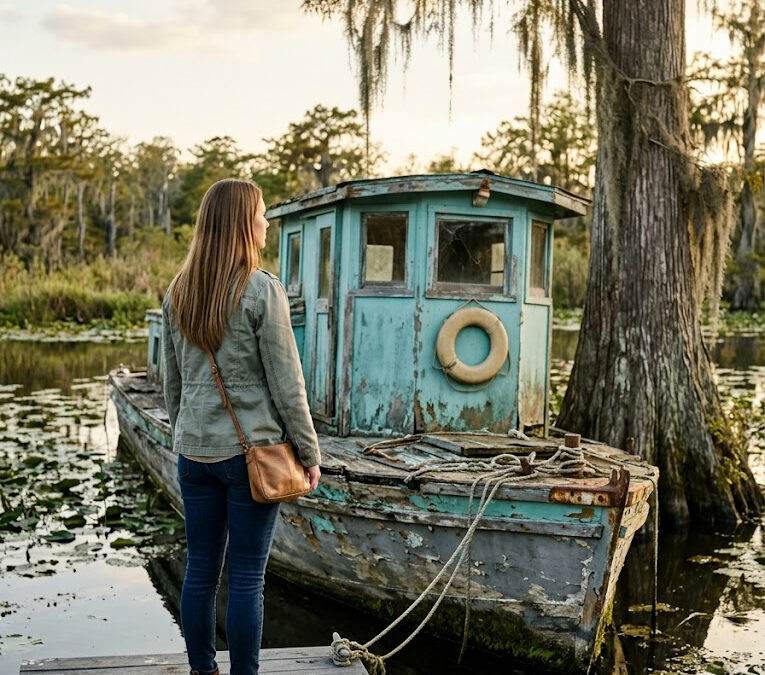
June looked out at the water, at the cypress knees standing like patient old men in the shallows, at the boat listing gently at the end of the dock — rusted, broken, and somehow, impossibly, hers.
“I think I already did start fresh,” she said quietly.
“Right here.”
So the work began.
They hauled the houseboat out of the water using an old winch system Walker had built years before, sliding it up onto heavy wooden blocks in the yard behind his shop.
Out of the water, in full daylight, the hull looked even worse than June had feared — pitted with rust along the entire waterline, two old patch jobs barely holding beneath it, done in a hurry decades ago by hands that clearly hadn’t cared the way June now did.
She sanded the whole hull down to bare metal herself, hour after hour, a power sander screaming in her hands until her shoulders ached so badly she could barely lift her arms at night.
Her ears rang even through the foam plugs.
Rust dust coated her skin, her hair, the inside of her nose.
But day by day, the bare steel emerged underneath — dull silver in the morning light, warming to bronze by afternoon.
Walker taught her to mix marine epoxy “like peanut butter and jelly — thick enough to stay where you put it.”
He showed her how to feather the patches so they melted seamlessly into the surrounding steel.
She did the worst section, the bow, first.
When she got that right, she did the rest exactly the same way.
Two coats of gray epoxy primer.
Three coats of deep, midnight-blue marine enamel — a color the paint mixer in town picked out for her without her even asking.
“I know exactly what color you want,” he’d said.
“Hold on.”
When June stepped back after that first coat dried, she understood immediately why he’d chosen it.
It was the color of water at night.
The color of sleep without nightmares.
The color of finally, finally feeling safe.
The cabin came next — gutted down to its steel bones, rebuilt board by board with cedar and marine plywood.
New wiring, color-coded the way Thad had taught her years ago in Mississippi.
A solar panel on the roof feeding a battery bank tucked beneath the bunk.
A freshwater tank.
A small composting toilet behind a curtain.
Bookshelves built into every spare inch of wall, because June intended to fill this boat with stories the way Tilden had once filled it with silence.
She kept his footlocker.
Cleaned the brass corners until they gleamed.
Oiled the leather straps soft again.
She placed it beneath her new bed, where she’d see it first thing every morning — his letter, the folded flag, and one empty 1979 canvas bag tucked safely inside, a quiet reminder of exactly where everything had started.
Slowly, the bayou began to claim her as one of its own.
A woman named Adelaide, who’d run the local Cajun restaurant for thirty years and had been Tilden’s only real friend, started showing up every Friday with gumbo in Mason jars, refusing every dollar June tried to hand her.
“You eat that tonight, cher.
You’re too thin.”
A crawfisherman named Buddy taught her to set traps along the muddy bank, baited with chicken necks, checked at first light before the herons could steal the catch.
And one quiet Sunday afternoon, an old retired tugboat captain named Pelham walked down to the dock, stood staring at the newly painted hull for a long, long moment, and finally said:
“He’d be happy.
Tilden always said this boat had more in her than people gave her credit for.”
He paused, eyes still on the water.
“Same way he felt about himself, I expect.”
Pelham kept coming back after that.
He didn’t talk much.
But sitting on the dock beside June, he told her, piece by piece, about the war Tilden never spoke of.
About the woman he’d loved before Vietnam who never waited for him to come home.
About a dog named Dauphin who’d lived on that very boat for fourteen years and was buried in the cypress grove just behind the marina.
June wrote every piece of it down in a small notebook she kept in the drawer beneath her bed — building, fragment by fragment, a portrait of a man she had never once met in life, but somehow now understood better than she’d ever understood her own father.
Within a year, June wasn’t just living on Tilden’s boat — she was working full-time in Walker’s shop, rebuilding outboard engines with her own two hands, tracing wiring faults with nothing but a flashlight and a multimeter.
Customers began asking for her by name.
“The young woman at Walker’s place.
She knows her stuff.”
One evening in late May, almost exactly a year after she’d bought the boat, June sat alone on the deck and watched the sun sink behind the cypress trees.
The water lay flat and still, mirroring the sky so perfectly it looked as though her boat were floating in open air.
A heron stood motionless in the shallows nearby, watching her the way only solitary creatures watch one another.
She thought about Tilden Boudreaux — a man who came home from a war he never discussed, bought a $400 boat, and spent forty quiet years folding silver coins and worn bills into canvas bags labeled by year, building a record of his life one deposit at a time.
A man with no family left to leave anything to — who left it anyway, because some part of him refused to let his whole story vanish into nothing.
She thought of her mother, who’d saved crayon drawings of boats in a kitchen drawer, recognizing something in her daughter long before June recognized it in herself.
She thought of her father, who had simply stopped, ember by ember, the year her mother died.
And she thought of herself — 19 years old, homeless, standing in a bus station with a coffee can and $1,128 to her name, following a pull she could never quite explain.
That pull had led her here.
To this deck.
This water.
This dark blue hull and cedar cabin and an old empty canvas bag tucked safely beneath her bed.
Some of us are born into the place we’re meant to be.
Others have to go out and build it themselves — a boat on a bayou, a house on a hill, a life stitched together from nothing but $10 and a stubborn kind of hope.
June Prescott was 19 years old, homeless, with only ten dollars left in the world.
She spent every last cent of it on a rusted, sinking houseboat nobody else wanted.
It was, without question, the best $10 she ever spent in her life.
THE END








