He Found a Hidden Door Under an Abandoned Railroad Bridge — What Was Inside Left Him Speechless
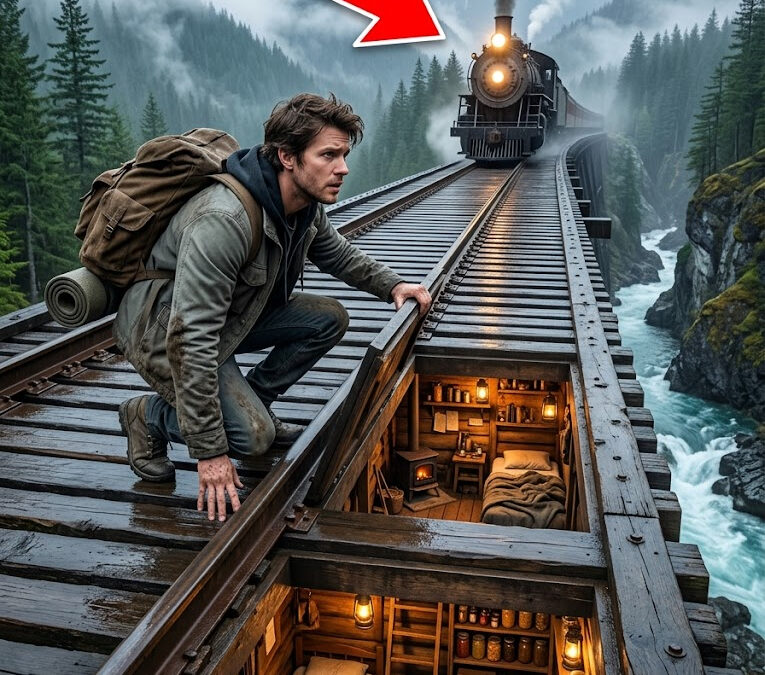
PART 3
The next morning, he followed that map straight into the mountains — and what he found at the end of it would break his heart wide open.
He slept in the chair that night.
Not a decision, really — more a surrender.
He’d sat down to close his eyes for a few minutes and woke to gray morning light pressing through the narrow window, the candle long dead in its jar, the storm gone entirely, leaving behind that particular silence mountains carry after weather — the quiet of a place still assessing the damage.
He was stiff, cold, but warmer than he’d been in days.
That alone felt like a small miracle.
He stood at the window and looked down properly for the first time.
The river ran pale green in the early light, threading between dark boulders sixty, seventy feet below.
Dense spruce climbed the far canyon wall — old growth, untouched for decades.
He opened his notebook to the map he’d copied the night before and traced the dotted trail with his fingertip.
Not far on paper, he thought.
But paper never accounts for terrain.
Still — he wanted to know what those two letters meant.
D.C.
He spent the morning trying to be useful, because that was how he’d learned to deal with wanting something he couldn’t have yet.
He inventoried the cans properly this time, cataloged the tools, cleared a bird’s nest from the stove flue, tested the draw of the fire until the smoke rose clean through the hidden chimney channel.
Small jobs.
Comprehensible jobs.
But by midmorning, the light through the window had sharpened into something he couldn’t ignore anymore.
He climbed the ladder, map in hand.
The bridge felt different in daylight — the planking gray and split, gaps showing straight down to the river far below.
He kept his weight on the ties and made his way to the eastern end of the trestle, where a footpath dropped away into the brush.
Not a game trail.
Too deliberate.
Packed by years of repeated human footsteps, not the random wandering of deer.
Someone walked this path many, many times, he thought, and followed it down.
The trail switchbacked through spruce before leveling along the riverbank, where the water ran wide and shallow over a gravel bar.
He matched the bend in the river to the map, found the dotted line running north, and followed it.
Twenty minutes later, the trail bent inland and climbed a low shelf.
The trees thinned.
Light poured in.
And then he stopped dead, because there was a clearing that shouldn’t exist.
The spruce had been cut back decades ago.
The stumps had rotted flat, nearly swallowed by moss — but the clearing remained.
Tall grass hid something structured beneath it.
He stepped closer and understood.
Raised garden beds.
Twelve of them, in two neat rows, built from logs long since silvered and half-sunk into the earth.
Overgrown, but unmistakable.
South-facing, to catch every scrap of light the narrow canyon offered.
Someone farmed here, he realized, his chest tightening in a way he didn’t fully understand yet.
Someone lived a whole life out here that nobody ever knew about.
He moved through the rows slowly, the soil in the beds still dark and rich beneath the neglect.
And at the far edge of the clearing, half-swallowed by brush and a birch tree growing up through its corner — the small square from the map.
A cache shed.
Roof collapsed on one side.
Walls still standing, built from flat stone and clay mortar.
The door — a single hand-forged plank — was swollen shut.
He put his shoulder into it and it gave with a groan.
Shelves lined two walls.
A rusted hand cultivator hung from a nail.
Two ceramic crocks, sealed in wax-dipped cloth.
And on the highest shelf — a small tin box with a hasp latch.
He reached for the box first.
Then stopped himself.
The crocks are sealed.
They held.
That deserves respect too.
He lifted one down — heavy, liquid shifting inside — and worked his thumbnail gently under the wax-crusted cloth.
It flaked away in pieces.
Beneath it, dark amber, thick — plum jam, he guessed, still holding its color, still sweet, only lightly crystallized at the top.
He tasted it carefully off his fingertip.
Still food.
After all these years.
Still food.
The second crock had failed — mold across the surface.
He set it aside gently, almost apologetically, like it deserved better than what time had done to it.
Then he took down the tin box.
The latch gave easily under his thumb.
Inside, wrapped in brittle oilcloth, was a small bundle — a dozen hand-labeled seed packets in careful penciled cursive.
Plum tomato.
Pole bean.
Winter squash.
Sweet corn.
Dill.
Calendula.
And beneath them, folded twice, a single sheet of paper.
He unfolded it standing right there in the doorway, morning light falling gray and even across the page.
It wasn’t a letter, exactly.
More like a final inventory left for someone who hadn’t arrived yet.
It described what had been built and where.
It noted the stove damper ran stiff in cold weather and needed a second hand to seat it properly.
It mentioned the south garden bed drained poorly in spring and needed its drainage channel extended another four feet toward the slope.
It noted the wall near the river window sometimes wept moisture in heavy rain and needed its clay-and-sand pack refreshed every few years.
Practical.
Careful.
The handwriting of a man who loved this place enough to leave it perfect instructions.
And then, at the very bottom, pressed harder into the page than everything above it — like it had cost something to write:
“If you found this, you were looking.
That’s enough.”
He stood there for a long moment, the paper trembling slightly in his hands, the seed packets laid out on the oilcloth beside him like something left in trust — like a gift someone had wrapped decades ago and simply waited to be opened.
He thought about it.
Really thought about it.
He had been looking.
Not for this exactly — he hadn’t known this existed an hour before he found it.
But he’d followed a dead railroad line when any sane person would’ve turned back at the first washed-out grade.
He’d stayed on a collapsing trestle when a storm screamed at him to leave.
He’d climbed down into total darkness without one single reason to believe there was anything down there worth finding.
That counts for something, he thought.
Maybe it counts for everything.
He folded the letter carefully along its original creases and set it back on the shelf, behind the jam jar, exactly where he’d found it.
Not hidden.
Just returned to where it lived.
The rest of the day moved slowly, and gratefully so.
He spread the seed packets out and catalogued what he recognized and guessed at what he didn’t.
He pried up the boards near the drainage channel and dug the extra four feet the note asked for, cutting until the slope ran clean and the standing water drained away exactly the way it was supposed to.
He repacked the weeping wall with fresh clay and river sand, pressing it in with his palm, layer over layer, the same way the old repair had been done.
Slow work.
Patient work.
The kind that never announces itself but holds everything together, quietly, for years.
By late afternoon he sat on the stone ledge outside the shed, eating the last of his canned food, watching the light change over the river far below.
A pair of birds crossed the canyon in one long gliding arc and vanished into the trees on the far side.
He thought about the man who built all of this.
Whoever he was — whatever he was running from, or toward, or protecting — he had understood something most people never learn in an entire lifetime:
A place only becomes yours through the work you put into it.
Not through ownership.
Not through paperwork.
Through the stove you season by hand.
The wall you repack.
The four feet of drainage ditch you dig because someone before you, a stranger you’ll never meet, once wrote down that it needed doing — and trusted that someday, someone would care enough to finish it.
He was 19 years old, sitting on a mountain ledge with a shed full of seeds, a stove that drew clean, a window that looked out over a river no map remembered, and a list of things still left to do.
He reached for his notebook on the ledge beside him.
Opened it to a fresh page.
And began writing his own inventory.
THE END








