My Daughter-in-Law Had Security Ask Me to Leave My Grandson’s Birthday Party, Not Knowing the House Was Still Mine
PART 1:
My daughter-in-law called for someone to remove me from my grandson’s birthday party, saying, “She wasn’t invited into my house.” I didn’t argue, cry, or ruin the cake cutting in front of the guests. I simply picked up my purse, kissed my grandson on the forehead, and walked out quietly. But what she didn’t know was that my name was still on one document she had never bothered to read. Within forty-eight hours, she was the one packing boxes. By then, my phone was full of missed calls…
The cake had not even been cut yet when Vanessa decided I had become inconvenient.
I was standing in the marble foyer with my purse tucked under one arm and a wrapped telescope gift resting beside my shoes. Silver star balloons floated above the staircase. Children were running through the living room with paper planets taped to their shirts, and somewhere beyond the French doors, a woman dressed like an astronaut was leading Ethan’s friends toward the terrace.
My grandson saw me before anyone else did.
“Grammy!” he called, his little face painted blue around one cheek, his paper cup of punch tilting dangerously in his hand.
For one second, the whole room softened.
Then Vanessa stepped in front of him.
She wore a cream silk dress, her blonde hair pulled tight, her smile arranged for guests. She placed one hand lightly on Ethan’s shoulder, not enough to seem harsh, just enough to stop him from running to me.
“Helen,” she said. “You came.”
“I said I would.”
Her eyes moved to the gift box. “I also said not to bring anything oversized.”
“It’s a telescope,” I said. “He asked me about Saturn.”
Ethan’s eyes lit up. “The rings?”
“Yes, sweetheart.”
Vanessa’s smile thinned.
Behind her, my son Marcus stood near the hallway with his hands in his pockets. He looked tired, handsome, careful. He had Charles’s eyes and none of Charles’s courage in that moment.
“Mom,” he said quietly, “maybe we should talk in the library.”
The library was the room I had loved most when I bought that house. Walnut shelves, tall windows, a stone fireplace, the kind of quiet Charles would have filled with old books and jazz on Sunday mornings. Eleven years earlier, I had paid cash for that seven-bedroom house in Cherry Creek because Marcus and Vanessa had a baby on the way and a townhouse too small for a stroller, much less a childhood.
I had told Marcus clearly, in my attorney’s office, “The house stays in my name. You can live there as long as we remain family in more than words.”
He cried then.
He called me the best mother in the world.
Vanessa kissed my cheek and left lipstick on my skin. I wiped it off in the car.
Now she stood in that same house as if generosity had expired into ownership.
Inside the library, she closed the door before Ethan could follow.
“This isn’t working,” she said.
I looked at Marcus. “What isn’t?”
“The dynamic,” Vanessa said, before he could answer. “Ethan is getting older. He needs consistency.”
“He needs his grandmother?”
“He has a grandmother. My mother is here every day.”
That sentence sat between us longer than it should have.
Cordelia, Vanessa’s mother, had been at the party before I arrived. She had opened the front door to me with that polished society smile and looked at the telescope like I had brought a folding chair to a black-tie dinner. She had never liked me. Not really. I was useful to the family, but not decorative enough for her taste.
Marcus looked out the library window at the snow along the boxwoods.
“Mom,” he said, “Vanessa and I think visits should be more structured.”
“Structured,” I repeated.
“Major holidays,” Vanessa said. “Shorter visits. Supervised if necessary.”
I felt something cold move through my chest, but my voice stayed even. “You want to supervise me with my grandson?”
“We want boundaries.”
“And the birthday party?”
Vanessa folded her hands. “We told him you couldn’t make it.”
The room became very clear after that. The telescope box near my feet. The polished desk. The little scratch on the wood from when Ethan pushed a toy truck across it at age three. Marcus’s reflection in the window, not turning around.
“You told him I wasn’t coming,” I said.
“For his sake,” she replied.
I looked at my son. “Did you agree to that?”
He did not answer.
That was answer enough.
The thing about being seventy is that people mistake age for confusion. They think a quiet woman in pearls, carrying a birthday gift, can be managed with soft phrases and polite exclusion. They forget that I had sat through estate meetings, hospital rooms, school admissions offices, closing tables, tax appointments, and boardrooms beside my late husband Charles. They forget that silence does not mean empty.
Sometimes silence is simply a locked drawer.
Vanessa took a breath, as if moving to the next item on a list. “There is also the house.”
I looked at her then.
“The house?”
“Marcus and I have lived here for eleven years. Ethan has grown up here. It is our primary residence in every meaningful sense.”
“In every meaningful sense,” I said slowly.
She lifted her chin. “It’s time the paperwork reflected reality.”
Marcus finally turned from the window. His eyes were wet, but he still did not come toward me.
“Mom,” he said, “please don’t make this ugly.”
I almost smiled.
Ugly had already entered the room. It had come dressed in silk and used the word boundaries.
I reached for the telescope box.
“I’m going to give Ethan his gift,” I said. “I’ll stay ten minutes, then leave.”
Vanessa stepped between me and the door. “No. We need you to leave now.”
“Before he sees me?”
“He already saw you,” Marcus whispered.
Vanessa shot him a look, then turned back to me. “Before this gets harder for him.”
“For him,” I said.
“Yes.”
I rested my hand on the doorknob. “Vanessa, do you know whose name is on the deed?”
She gave a small laugh. Not loud. Not wild. Just confident enough to tell me she had been rehearsing for this.
“Helen, please. After eleven years, no one is going to pretend this isn’t our home.”
“Our home,” I repeated.
“We’ve built a life here.”
“With whose foundation?”
Her face tightened.
Marcus said, “Mom.”
I looked at him one last time. “Is this what you want?”
He swallowed. “I just want peace.”
The birthday music outside the library door sounded distant and too cheerful. A child laughed. Someone called for plates. The cake was coming soon. Ethan would be waiting for me to appear again, probably asking why grown-ups always needed to talk in other rooms.
I opened the door.
The foyer had gone quieter than before. A few guests looked over, then looked away too quickly. Cordelia stood near the console table, pretending to adjust white flowers. Two attendants in dark suits waited by the front entrance, uncomfortable but ready.
Vanessa walked out behind me and said, clearly enough for the nearest guests to hear, “She wasn’t invited into my house.”
That was when Ethan slipped past the astronaut entertainer and ran toward me.
“Grammy, don’t go.”
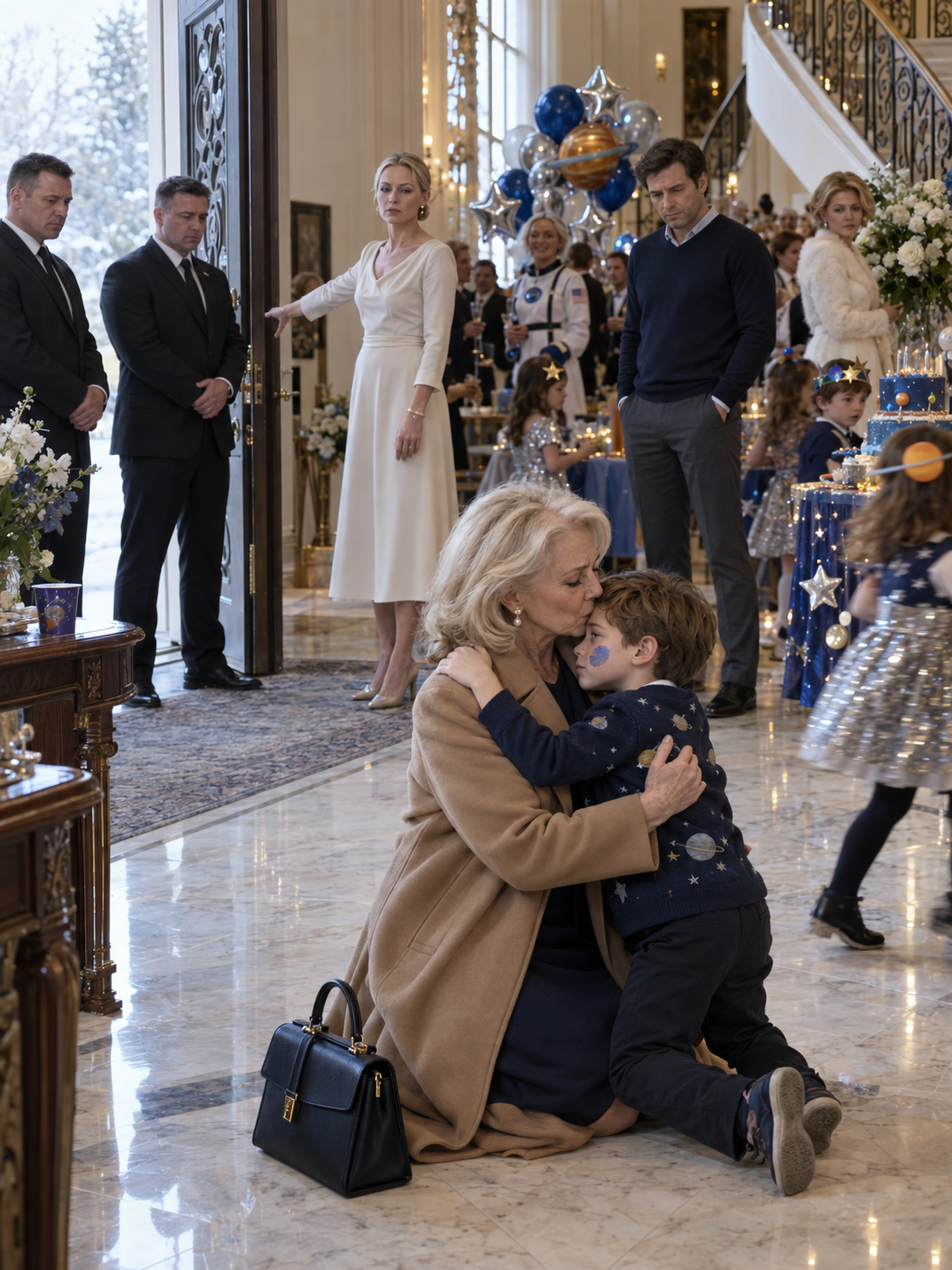
I knelt before anyone could stop him. My knees touched the marble floor I had chosen with Charles from a builder’s sample board. Ethan threw his arms around my neck, and I held him as tightly as I could without frightening him.
“I love you more than all the stars,” I whispered.
“Are you mad at me?”
“No, baby. Never.”
“Then why are you leaving?”
I kissed his forehead, right where the blue paint had smudged near his hairline. “Because sometimes grown-ups need to remember what belongs to whom.”
He did not understand.
Vanessa did.
Her eyes sharpened, but she said nothing with all those guests watching.
I picked up my purse, left the telescope beside the entry table, and walked down the front steps without looking back.
I did not drive home.
I drove straight to Gerald Winthrop’s house. Gerald had been our attorney for twenty-six years, and he opened his front door in a golf sweater with a coffee stain near the cuff. He took one look at my face and stepped aside.
“What happened?”
I sat at his kitchen table and told him everything. Not with tears. Not yet. I told him about the birthday party, the library, Ethan’s face, Vanessa’s words, Marcus’s silence, and the house she had just called hers.
When I finished, Gerald opened a yellow legal pad.
“How much do you want to correct?” he asked.
“All of it.”
He nodded slowly, then pulled one thick folder from his office cabinet.
On the tab was the Cherry Creek address.
Inside was the document Vanessa had never bothered to read.
Gerald placed it on the table, turned it toward me, and tapped the first page with his pen.
“Then Monday morning,” he said, “we start here.”
PART FINAL:
There was a telescope in my hands when Vanessa told the uniformed security attendants I did not belong in the house I had bought.
They stood in the marble foyer with their radios clipped to their belts, looking uncomfortable in the way decent people look when they are asked to carry out someone else’s private cruelty. Behind them, children were laughing under silver balloons shaped like stars. A hired entertainer dressed like an astronaut was leading a group of seven-year-olds through the living room, and somewhere near the back terrace, my grandson Ethan was waiting for the grandmother he had been told was not coming.
Vanessa stood between me and the staircase, one manicured hand lifted toward the front door, the other resting lightly against my son Marcus’s arm.
“She is not invited to stay,” she said, her voice smooth enough for company. “Please make sure she leaves the property.”
My son did not correct her.
That was the part that emptied the room of air.
Marcus stood behind his wife with his arms crossed over his navy cashmere sweater, his face pale, his mouth pressed into a line I recognized from childhood. He had worn that same expression at nine years old when he broke a neighbor’s window and hoped silence would keep the truth from finding him. Only now he was forty-three, a father himself, and the woman he had chosen was asking strangers to remove his mother from a birthday party held under a roof I owned free and clear.
I looked at him.
“Marcus,” I said quietly, “is this what you want?”
His eyes moved toward mine, then dropped to the marble floor.
“Mom,” he said, almost too softly to hear over the party music, “please don’t make this harder.”
I had carried him for months, raised him through fevers and homework and heartbreak, sat beside him in emergency rooms, waited up for him after bad dates, paid for schools, cars, counseling, apartments, mistakes, restarts, and every version of the man he thought he had become. I had loved him after my husband Charles passed because love was all I knew how to do when the house became too quiet.
And there he was, asking me not to make things harder.
I almost laughed.
Not because anything was funny, but because sometimes grief becomes so precise that the body does not know whether to cry or make a sound no one understands.
I looked down at the telescope box in my arms. It was wrapped in deep blue paper patterned with tiny gold constellations. Ethan had become fascinated with space that winter. The last afternoon I had been allowed to spend with him, he sat cross-legged on my condo floor with a library book open across his knees, tracing Saturn’s rings with one finger and asking if people could see them without being astronauts.
“If you have the right telescope,” I told him.
He looked up at me with those wide Ashford eyes and said, “Then I want to see them with you, Grammy.”
I had spent three months planning that gift. Not because it was expensive, though it was. Not because I wanted to outshine the other presents, though Vanessa would have accused me of that no matter what I brought. I bought it because my grandson had asked me to share the sky with him.
Now the gift sat between us like evidence of a love Vanessa had spent years trying to manage, limit, and quietly remove.
“Helen,” Vanessa said, with a controlled smile that did not reach her eyes, “this is Ethan’s day. Please don’t turn it into something unpleasant.”
The security attendants shifted their weight. One looked at the telescope, then at me, then away. Guests had started to notice. A woman in a cream coat paused near the entry table. Cordelia, Vanessa’s mother, pretended to adjust a vase of white flowers while watching every second from the corner of her eye.
I did not raise my voice.
I did not explain who paid for the marble floor beneath our feet, or the roof over our heads, or the French doors leading to the terrace, or the private school tuition Vanessa bragged about to other mothers as if the check came from her own account. I did not tell the security attendants that the deed had my name on it, that the property taxes had been paid from my trust every year, that the Cherry Creek mansion Vanessa called “our home” had never legally belonged to Marcus or to her.
I simply nodded.
“Of course,” I said.
And then I walked out of my own house with my grandson’s unopened birthday gift still in my arms.
My name is Helen Ashford. I am seventy years old. I live in Denver, in a condo with a view of the mountains and a small balcony where I drink coffee every morning in a robe Charles bought me on our thirtieth anniversary. Charles was the kind of man people underestimated once and never twice. He built a real estate portfolio from nothing but instinct, discipline, and a refusal to confuse kindness with weakness. By the time he passed, he had made sure I would never need to ask anyone’s permission to live with dignity.
But the greater inheritance he left me was not money.
It was backbone.
He used to say, “Helen, the checkbook is not the power. The ability to close it is.”
For years, I forgot that.
I forgot it because I was a mother, and mothers are trained by love to keep opening doors even after people stop knocking. I forgot it because Marcus was my only child, my miracle after years of private heartbreak and whispered prayers I no longer had the strength to repeat. I forgot it because when Charles was alive, he always stood beside me, and after he was gone, I mistook giving for staying connected.
Marcus married Vanessa Prescott seven years before Charles passed. I met her twice before the wedding. She was beautiful in the clean, polished way that photographs well: pale blonde hair, perfect posture, eyes that measured a room before her smile arrived. Her mother, Cordelia, wore diamonds to brunch and once told me my pearls were “so classic they were almost charming.”
I smiled at that.
Charles squeezed my hand under the table, and later in the car he said, “That woman thinks manners are jewelry.”
“Which woman?” I asked.
“Both of them.”
I laughed then.
I wish I had listened harder.
After Charles passed, Marcus and Vanessa had Ethan. They were living in a cramped townhouse in Aurora, and Vanessa began dropping comments the way some people drop crumbs for birds.
“Ethan would love a yard.”
“It’s so hard raising a child without space.”
“Cherry Creek has such wonderful schools.”
“It must be nice to have a real home, not just a place you’re making do with.”
I knew what she wanted before she asked. Maybe she knew that too. Maybe that was why she never asked directly.
So I bought them a house.
Not a house. A seven-bedroom stone mansion in Cherry Creek with a circular driveway, a library lined with walnut shelves, a terrace facing a landscaped lawn, and a kitchen Vanessa said would “work for now” until she could modernize it. I paid cash. Three point four million dollars. I kept the deed in my name. I told Marcus clearly, in my attorney Gerald’s office, that he and his family could live there as long as we remained family in more than name.
He cried when I told him.
He hugged me with both arms and said, “Mom, I don’t deserve you.”
“No,” Charles would have said if he had been there. “You don’t. Earn it.”
But Charles was gone, and I was tired of grief, so I kissed my son’s cheek and said, “Just make a good life there.”
For eleven years, I paid for everything quietly. Property taxes. Landscaping. Insurance. The new roof after a spring hailstorm. The kitchen renovation Vanessa insisted on because the original marble was “a little too 2010.” I paid Ethan’s preschool tuition, then his elementary school tuition. I funded his swim lessons, his cello tutor, his summer science camp, and the trust I established the week he was born. By his seventh birthday, that trust held six hundred thousand dollars, protected for his education and future.
I did not do it for thanks.
I did it because that is what I thought family meant.
Slowly, though, I became a visitor in the life I was funding.
Vanessa would cancel Sunday lunch because Ethan “wasn’t feeling well,” then post photos that afternoon of him at the zoo with Cordelia. I would drop off a birthday gift and find a note taped to the front door saying they had gone to Vail for the weekend. The first Thanksgiving after Charles died, I hosted at my condo and set a place for all of them. Marcus came alone, stayed through dessert, and left early because Vanessa had a migraine.
By the third year, even Marcus stopped coming.
I spent Thanksgiving alone in 2022 with a Cornish hen I roasted because a whole turkey felt like an accusation. I watched a parade rerun on television and told myself it was fine. I told myself young families were busy. I told myself Ethan was little and Vanessa was stressed and Marcus was trying to keep peace.
A person can survive a long time on explanations that are almost true.
Ethan was the reason I kept trying. My grandson was bright, gentle, and curious in the way children are before adults begin teaching them which questions are inconvenient. He wrote me letters in careful block print. He ran to me when he saw me, arms wide, shouting “Grammy!” like the word itself had wings. When he was four, he told me I smelled like cookies and Sunday. I kept that sentence inside my chest like a locket.
Vanessa knew he loved me.
That was what made her careful.
She never cut me off all at once. She narrowed the hallway inch by inch. Fewer visits. Shorter calls. More rules. Gifts had to be approved. Outings had to be discussed. Sleepovers became “too disruptive.” Holidays became “complicated.” By the time Ethan’s seventh birthday arrived, I had not been alone with him in nearly five months.
The invitation came by text message three days before the party.
Ethan’s birthday will be Saturday, 2–5. Space theme. Please do not bring anything oversized. We have a specific setup planned.
No warmth. No “hope you can come.” No “he’ll be excited to see you.” Just instructions.
I replied, I’ll be there at two.
I did not mention the telescope.
That Saturday afternoon was cold for Denver, the kind of bright winter day when the snow on the lawn looks polished and the sky seems too blue to be real. I drove my dark green Range Rover up the circular driveway at one-fifty. I sat for a moment with my hands on the steering wheel, looking at the stone facade Charles and I had chosen from the builder’s renderings. I remembered him standing beside me with the plans spread across our dining table, tapping the library with one finger.
“Our grandson will read in there someday,” he said.
He never met Ethan. But he had imagined him.
I carried the telescope up the front steps.
Cordelia opened the door.
She was dressed in winter white, her face smooth and tight with the sort of careful maintenance she treated as a moral accomplishment. Her eyes landed on the large wrapped box, and the corners of her mouth lowered.
“Helen,” she said. “You’re early.”
“I’m on time.”
“Vanessa mentioned not to bring anything big.”
“It’s a telescope for Ethan.”
Her sigh was soft but theatrical, like she had been asked to tolerate a public inconvenience. “Well. The décor is very specific.”
She stepped aside at last.
I entered my own foyer. The marble gleamed under the chandelier Charles and I found at an estate sale in Charleston. The console table against the wall had belonged to my mother. On it sat a silver bowl filled with wrapped candies Vanessa had chosen to match the party colors. Not one photograph of Charles remained in sight. Not one of me. Not one trace that the house had ever belonged to anyone before Vanessa decided it reflected her taste.
The party was already in motion. Children ran through the rooms with silver star stickers on their shirts. Adults in cashmere and tailored coats held champagne flutes near the terrace doors. A balloon arch curved over the living room entrance. A woman dressed as an astronaut knelt beside a group of children, handing out plastic planets from a basket.
I recognized almost no one.
This was Vanessa’s world. Her friends. Her mothers from school. Her donors and decorators and women who spoke in polished tones about ski weekends and waitlists. They stood in the house my money had bought and looked through me as if I were part of the staff.
Then I saw Ethan.
He was near the back terrace, his face painted like a blue alien, laughing with another boy. My heart lifted so suddenly it almost hurt. I began walking toward him.
Vanessa appeared in front of me before I reached the rug.
She wore a cream silk dress, her blonde hair pulled into a severe knot, her smile sharp enough to cut paper.
“Helen,” she said, taking the telescope box from my hands before I could protest. “You made it. Wonderful. I need to speak with you for one second.”
“I’d like to say hello to Ethan first.”
“It will only take a moment.”
She turned and walked toward the library with my grandson’s gift in her arms.
I followed her.
That is the part I still think about. I followed because some foolish, aching part of me still believed she might surprise me with kindness. At seventy years old, after a lifetime of reading people, after eleven years of being pushed to the edge of my own family, I still hoped.
Marcus was in the library waiting.
He stood by the window with his hands in his pockets, looking out at the snow along the boxwoods. He did not turn when I came in.
Vanessa closed the door.
“Helen,” she said, placing the telescope box on the floor beside the desk, “this has been coming for a long time.”
I looked from her to my son.
“What has?”
She folded her hands in front of her. “We don’t want you here.”
Five words.
That was all.
My knees did not weaken. My breath did not catch. Instead, a cold calm moved down my spine, one vertebra at a time. I understood then that I had been waiting for that sentence for more than a decade. The shock was not that she said it. The shock was that some hidden part of me felt relieved.
At least the lie was over.
“Marcus,” I said, “is this how you feel?”
He kept looking out the window.
“Mom,” he said, “Vanessa and I have talked. Ethan needs consistency.”
“Consistency.”
“He’s getting older,” Vanessa said smoothly. “The dynamic is confusing for him. My mother is part of his daily life. She’s here. She helps. Then you come in with extravagant gifts and promises of trips, and it undermines what we’re trying to build.”
“What are you trying to build?”
“A stable family structure.”
I almost asked her whether stability included excluding the woman paying for the structure.
But I waited.
Vanessa took a breath. “Going forward, we think visits should be limited to major holidays. Supervised, of course. And there is another issue we need to settle.”
I knew before she said it.
“The house,” she continued. “After eleven years, it needs to be in our name.”
I looked at her.
“Say that again.”
She lifted her chin. “This is our primary residence. We have raised our son here. We have maintained it emotionally, socially, practically. The deed should reflect reality.”
“I pay for the maintenance.”
“You pay bills,” she snapped, then immediately smoothed her voice. “I live the life of the home. There is a difference.”
I turned to Marcus. “Son.”
He finally looked at me.
His eyes were wet, but he did not move toward me.
“Mom,” he whispered, “please don’t make a scene. Not today. Not for Ethan.”
Something inside me went very quiet.
“I will not make a scene,” I said. “I will give my grandson his gift, spend ten minutes with him, and leave.”
“That won’t work,” Vanessa said. “We told Ethan you couldn’t make it.”
I stared at her.
“You told him I wasn’t coming?”
“For his sake.”
The room became almost painfully clear. The bookshelves. The snow beyond the window. The telescope box on the floor. Marcus’s hand gripping his own wrist. Vanessa’s pale lipstick. A small scratch on the library desk from when Ethan had pushed a toy car across it at age three.
I picked up the telescope.
Vanessa’s voice hardened. “If you refuse to leave, I will have security escort you out. You are not welcome in this house.”
I stopped with my hand on the doorknob.
“Vanessa,” I said quietly, “do you know whose name is on the deed?”
She gave a short laugh.
“Please. After eleven years, no one is going to pretend this isn’t our home.”
I looked at Marcus. “Is this what you want?”
He looked at the carpet.
“I just want peace.”
I nodded once.
Then I opened the library door.
The walk through the foyer felt longer than it should have. Cordelia pretended to rearrange napkins on the entry table. Two security attendants appeared near the front door, summoned by someone while we were still in the library. Guests turned their heads, then looked away in that polite, eager way people do when they want to witness something without being caught watching.
I reached the front door before Ethan saw me.
“Grammy?”
His small voice stopped me.
I turned.
He stood at the edge of the living room with his face paint smudged near one cheek, holding a paper cup of juice. Confusion filled his eyes. Then hope. Then fear that matched nothing a child should feel at his own birthday party.
“Why are you leaving?”
I knelt on the marble floor, still holding the telescope. He ran into my arms. I held him tightly enough to memorize him all over again: the smell of frosting, face paint, and little-boy shampoo; the warmth of his cheek against mine; the way his fingers curled into my coat.
“Sweetheart,” I whispered, “Grammy has to go.”
“But you just got here.”
“I know.”
“Did I do something?”
The question nearly broke me.
“No. Never. You are the best thing in all of this.”
I touched the telescope box. “This is for you. When you look at Saturn’s rings, I want you to remember that I saw them with you in my heart, even if I wasn’t standing beside you yet.”
He nodded, though I knew he did not fully understand.
“I love you more than all the stars you’re going to find,” I said.
“I love you too, Grammy.”
I stood before my grief could become a scene Vanessa would enjoy.
Then I walked out.
I did not go home.
I drove straight to Gerald Winthrop’s house. Gerald had been our attorney for twenty-six years, a tall, careful man with silver hair and the weary patience of someone who had seen too many families confuse money with loyalty. He opened the door in a golf sweater, took one look at my face, and stepped aside without asking questions.
“What do you need?” he said.
I sat at his kitchen table. He poured coffee I did not drink. Then I told him everything in order.
When I finished, Gerald set down his pen.
“How much of this do you want to unwind?”
“All of it.”
He studied me for a long moment. “Helen.”
“All of it,” I repeated.
He opened a yellow legal pad and began writing.
The Cherry Creek house was mine. Ethan’s trust was mine to protect. The education account could be redirected so funds went directly to his school, not through his parents. The family line of credit I had guaranteed could be withdrawn under the terms Gerald had warned me never to sign casually. Marcus’s business rented office space from a building I owned at a rate so low I had nearly forgotten it was charity. Vanessa’s mother’s foundation depended every year on a pledge from my charitable trust.
It was astonishing, hearing my own life read back to me as leverage I had been too lonely to use.
Gerald stopped writing and looked at me.
“What about Ethan?”
My answer came immediately.
“Ethan loses nothing. Not one dollar. Not one opportunity. Not one Saturday if we can help it.”
Gerald nodded.
“The trust will be amended so no parent can access principal,” I said. “Education payments go directly to the institution. If anyone challenges that, their residual interest is gone. And I want my access to Ethan protected by every appropriate family petition available.”
Gerald wrote for a long time.
Then he looked up.
“Monday morning?”
“Monday morning.”
I went home after that. I made myself a turkey sandwich and sat at my kitchen island in the quiet. I still did not cry. Not yet. Tears would come later, when there was room for them. That night, there was only work.
Monday began at nine.
By noon, my phone had fourteen missed calls from Marcus, six from Vanessa, and three from Cordelia. By five, the number had nearly doubled. I watched each call light the screen and disappear. Vanessa left messages that began with outrage and ended with pleading. Cordelia’s voice was crisp, then strained, then sharp. Marcus left one message at eight-seventeen that was mostly silence.
Then, very softly, he said, “Mom, please.”
I did not call back.
On Friday, Marcus came to my condo.
He looked thinner in just six days. He sat on my couch with his elbows on his knees, staring at the floor. For the first time in years, he looked less like a man protected by comfort and more like my son.
“Mom,” he said, “the house, the accounts, Ethan’s school, Vanessa’s mother. You’re undoing everything.”
“No,” I said. “I am correcting a ledger.”
He looked up.
“That is not the same thing.”
His eyes filled. “We have nowhere to go.”
“You have three weeks.”
“Ethan—”
“Ethan is protected.”
“Vanessa says you’re trying to take him from us.”
“I am making sure no one takes him from me.”
He covered his face with both hands.
I let the silence sit between us. There had been a time when I would have crossed the room, touched his shoulder, made everything softer. But softness had taught him that consequences were temporary things other people absorbed.
“Marcus,” I said, “do you remember what you said in the library?”
He did not answer.
“You said you wanted peace.”
He swallowed.
“I am giving you peace. The peace of a life that is actually yours.”
He looked at me then, and something in his face cracked.
“You have lived in my house,” I said. “Driven cars I helped provide. Sent your son to schools I funded. Built your business partly on space I gave you below its value. And while you accepted all of that, you let your wife treat me like an inconvenience in a home I opened for you.”
“Mom—”
“I am not finished loving you,” I said. “But I am finished financing your disrespect.”
That was when he cried.
Not the polite tears of a man trying to be forgiven. The broken, boyish crying I remembered from when he was eight and fell from the oak tree behind our old house. My instinct was to go to him. Every part of me wanted to. I loved him so much in that moment it hurt in my bones.
But I stayed where I was.
“Love without respect,” I said softly, “is not love. It is dependence dressed up nicely.”
Six months passed.
Marcus and Vanessa moved into a two-bedroom rental in Englewood. Their marriage did not survive the move. I will not pretend I celebrated. A broken home is still a broken home, even when it was built on arrogance. Marcus found work that had nothing to do with my buildings, my contacts, or my checkbook. For the first time in his adult life, he earned a living that was entirely his.
The foundation Cordelia chaired quietly dissolved. The Cherry Creek house was sold in August to a young doctor and her husband, who had twin girls and walked through the library whispering about where to put the piano. I did not feel sadness when I signed the final paperwork. The house had stopped being mine long before the sale. Letting it go felt less like loss than clearing a room after a long illness.
Ethan’s trust remained untouched.
And my access to him was protected.
Every Saturday, he comes to my condo or I pick him up for pancakes, bookstores, museum afternoons, or evenings with the telescope. We have used it fourteen times. He has seen Saturn’s rings. He has seen the craters of the moon. He has seen Jupiter with four bright points lined beside it like tiny pearls.
The first time he saw Saturn, he stepped back from the eyepiece and whispered, “It’s real.”
“Yes,” I said. “It is.”
He looked at me. “Did Grandpa Charles see it?”
I looked up at the winter sky.
“Your grandfather saw a lot of things before the rest of us did.”
Marcus and I have dinner once a week now. Not in the mansion. Not with champagne flutes or staged flowers or Vanessa’s curated guest lists. We meet at a small restaurant near my condo where the waitress knows Ethan likes extra whipped cream on hot chocolate. We talk about his job. We talk about school pickups. Sometimes we talk about Charles. Sometimes we sit quietly, and the quiet is not hostile anymore.
Last month, Marcus handed me a folded piece of paper across the table.
His apology was handwritten.
Not a text. Not a rushed sentence at the end of a phone call. A letter. Three pages. He wrote about the library, the birthday party, the way he let silence become agreement. He wrote that he had confused comfort with success and access with love. He wrote that he was ashamed.
I read it twice.
Then I folded it and placed it in my purse.
“I forgive you,” I said.
He cried again, but differently that time. So did I.
Forgiveness is not forgetting. I know that now. Forgiveness is the door I chose to open after I changed the locks.
I am seventy years old. I live alone in a beautiful condo with a mountain view, and I am no longer afraid of silence. I have a grandson who calls me every Thursday to tell me what he learned in science class. I have a son who calls on Sunday mornings just to hear my voice. I have boundaries where guilt used to live.
And I have learned, late but clearly, that kindness is not a contract requiring you to keep feeding the people who mistake your generosity for weakness.
Vanessa thought calling security would remove me from the house.
She never understood that I had been holding the keys all along.
THE END
If you came here from Facebook because this story pulled you in, please go back to the Facebook post, tap like, and comment exactly “Well told” to support the storyteller. That small action means more than it seems and helps give the writer the motivation to keep bringing more stories like this to readers.








