My Brother Said It Right To My Face, “We’re Family!” After Deciding My Beach House Would Be The Perfect Wedding Gift For Him. So I Replied, “That Sounds Less Convincing Every Time You Say It.”
PART 1:
“I’m not asking to hold the wedding there,” Mark said. “I’m asking you to give us the house.”
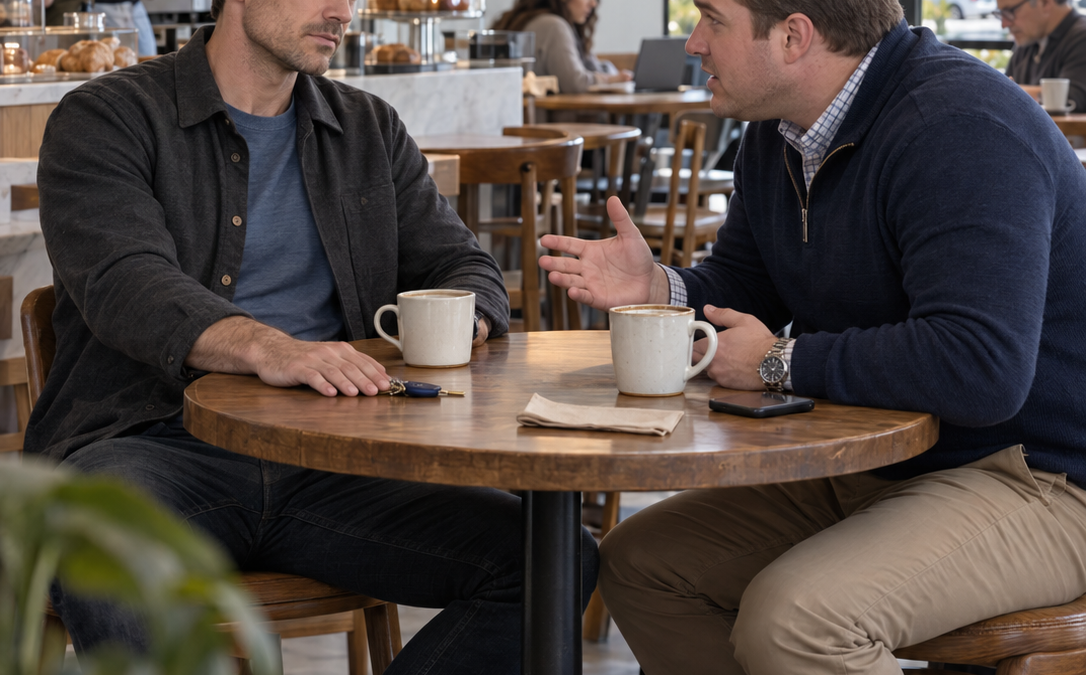
The brass key lay between our coffee cups on the small café table, catching the pale Santa Barbara sunlight every time someone opened the front door.
For several seconds, I thought I had misunderstood him.
Mark had spent most of the meeting talking about wedding costs. He and Michelle wanted a ceremony near the ocean, but every venue they liked charged more than two public-service salaries could comfortably support. I had already planned to offer ten thousand dollars toward the wedding. If they needed more for the right venue, I was prepared to discuss it.
I had not expected my brother to ask for the deed to a house worth nearly $1.8 million.
“You want me to transfer the property to you?” I asked.
Mark kept his eyes on mine, but his thumb continued rubbing the edge of his phone case.
“To Michelle and me. Yes.”
“As a wedding gift.”
“Exactly.”
The espresso machine hissed behind the counter. A barista called out someone’s name. At the table beside us, two women leaned over a laptop and debated paint colors as though nothing in the room had changed.
I studied my brother’s face.
Mark was thirty-three, three years younger than me, with the same brown eyes our father had and the same habit of pressing his lips together when he expected resistance. He wore the navy quarter-zip Michelle had given him for Christmas and the watch Mom had bought him when he graduated from college.
He looked nervous.
He also looked prepared.
“How long have you been thinking about this?” I asked.
“It came up while we were planning.”
“With Michelle?”
“We’ve talked about our future.”
“That wasn’t my question.”
His fingers stopped moving.
“Michelle and I need stability, Brandon. You know what the housing market is like. We both have good jobs, but good jobs don’t mean much when a starter home costs more than we’ll make in ten years.”
Mark taught eighth-grade history in Ventura. Michelle worked as a social worker for a nonprofit serving families in transition. They were both intelligent, hardworking people doing work that mattered.
They also earned together what some of my colleagues spent renovating kitchens.
I understood the frustration. I did not understand the conclusion.
“The house isn’t a starter home,” I said.
“I know.”
“It’s a three-bedroom property overlooking the ocean in Santa Barbara County.”
“I know what it is.”
“The annual taxes, insurance, maintenance, and utilities aren’t small. Even if I transferred it free and clear, how would you carry the costs?”
“We’d figure it out.”
“That isn’t a plan.”
“Neither is renting forever.”
I leaned back and looked through the window toward the palm-lined street. The morning marine layer had started to lift, revealing a thin strip of blue sky beyond the rooftops.
Two years earlier, I had bought the house after the software company I worked for went public. I had joined the company when it consisted of fourteen people sharing a converted warehouse and pretending the leaking roof was part of the startup experience. For six years, I worked through weekends, canceled vacations, lived in a one-bedroom apartment with unreliable plumbing, and invested most of what I earned.
The public offering did not make me unimaginably wealthy. It gave me options.
The beach house was the first major thing I bought simply because I loved it.
It had peeling paint, rotted deck boards, fogged windows, and a kitchen trapped in the late 1980s. Jessica and I spent months fixing it. I replaced the deck one board at a time while she stripped old wallpaper from the guest room. We painted cabinets, repaired screens, planted rosemary and lavender along the walkway, and learned which plumbing problems required a professional.
On weekends, we drank coffee on the deck and watched the ocean turn silver beneath the morning fog.
It was where Jessica and I had first spoken seriously about marriage.
It was where we had discussed children.
It was not a spare object waiting to be assigned.
“You said I could afford another one,” I said.
Mark’s shoulders rose slightly.
“You could.”
“No. I could survive giving this one away. That isn’t the same thing.”
“You have investments. Retirement accounts. Stock. You make more in a year than I’ll make in five.”
“Most of my net worth isn’t cash sitting in a checking account.”
“But you have choices.”
“So do you.”
His expression changed.
The nervousness disappeared, replaced by something harder.
“There it is.”
“There what is?”
“The lecture.”
“I’m not lecturing you.”
“You always do this. You turn everything into a spreadsheet and explain why the numbers make you right.”
“The number in this case is $1.8 million.”
“It isn’t about the number.”
“You are asking me to give you a $1.8 million house.”
“I’m asking my brother to help me start my marriage with some security.”
“I offered to help with the wedding.”
“That’s not the same.”
“No, it isn’t.”
He glanced at the brass key.
I had placed it on the table when I took my wallet from my pocket. It was attached to a dark blue leather fob Jessica had given me after we finished the renovation. One side carried a tiny stamped image of a wave. The other held the date we first spent a night there without a single repair tool in sight.
Mark looked at the key as if it had already become part of the negotiation.
“You could buy another place,” he said again. “Maybe not tomorrow, but eventually. Michelle and I may never get this opportunity.”
“You’re describing my home as your opportunity.”
“We’re family, Brandon.”
I covered the key with my palm.
“That sounds less convincing every time you say it.”
The color rose along his neck.
“That’s a cruel thing to say.”
“What you’re asking is not reasonable.”
“It’s unreasonable because you don’t need anything from anyone.”
“That isn’t true.”
“You’ve always been the one who got everything right. Good grades. Computer science degree. Startup job. Investments. Even when the company went public, everyone acted like it proved you were some kind of genius.”
“I worked for what I have.”
“And I didn’t?”
“I never said that.”
“You didn’t have to. Mom and Dad said it every time they compared us.”
The mention of our parents changed the air between us.
Dad had passed away five years earlier after a brief illness. Mom followed two years later. Mark and I had stood together through both losses, handling hospital forms, funeral arrangements, and the quiet dismantling of the home where we grew up.
For a while, grief made us close in the way childhood once had.
Then life resumed, and the closeness became something we referred to more often than we practiced.
“Mom and Dad aren’t part of this conversation,” I said.
“They’re the reason we’re having it.”
“How?”
“They supported you more.”
“That is not the same as owing you my house.”
“They paid for your test preparation. Dad never missed your science fairs. They understood your career. When I said I wanted to teach, Mom asked how I planned to support a family.”
I remembered that conversation.
Mom had not intended to be cruel. She had been practical to the point of carelessness, and Mark had heard judgment where she believed she was offering concern.
He continued before I could answer.
“You were the easy kid. You got praise for existing. I got advice about how to be more like you.”
“I didn’t control that.”
“No. You just benefited.”
The words were quiet, which made them land harder.
Mark reached for his coffee but did not drink.
“The house could balance some of that out,” he said.
I stared at him.
“You think a property transfer can balance our childhood.”
“I think family should support each other’s dreams.”
“I offered ten thousand dollars.”
He gave a short, humorless laugh.
“That’s what our relationship is worth to you?”
“It’s a generous wedding gift.”
“To you, it’s pocket change.”
“No, Mark. It’s ten thousand dollars.”
He pushed his chair back.
“I shouldn’t be surprised.”
“Don’t do this.”
“Do what? Tell the truth?”
“You asked me for more than half of everything I’ve built and expected me to thank you for the opportunity.”
“You’ve always chosen money over family.”
“That is not true.”
“Mom said it.”
My chest tightened.
“Mom never said that.”
“She said she worried success would change you.”
“She said that after I missed Thanksgiving because the company was six weeks from running out of money.”
“And look at you now.”
He stood and slipped his phone into his jacket.
“I hope you think about what actually matters.”
I kept my hand over the key.
“I am.”
He left his coffee unfinished and walked out.
My phone began lighting up before I reached my car.
Aunt Patricia sent the first message.
Mark told me what happened. I cannot believe you would deny your own brother one small gesture when you have so much.
One small gesture.
I read the words twice while standing beneath a jacaranda tree outside the café.
Cousin Nathan followed.
Money really did change you.
Then a message appeared in the family group chat from someone I had not spoken to in months.
Family should always come before property.
By the time I merged onto Highway 101, Mark’s version of the conversation had already traveled farther than the truth.
I drove north instead of returning to Los Angeles.
The ocean appeared and disappeared beside the freeway, blue between the breaks in the hills. I kept hearing Mark’s voice.
You always choose money over family.
The accusation should have been easy to dismiss. The request was outrageous. The math was obvious. The beach house represented more than half my total net worth, and much of the rest was tied up in retirement accounts and long-term investments.
But guilt does not care whether an argument is reasonable.
It only needs a familiar wound.
I remembered Mark at nine years old, dividing his peanut butter sandwich because I had forgotten my lunch. I remembered him sitting beside me on the floor of our childhood bedroom, correcting my college essays until two in the morning. I remembered the day after Dad’s funeral, when Mark drove to my apartment with groceries because he knew I had not eaten.
He had been my first friend.
For much of our lives, he had also been my best one.
The beach house sat above a narrow road a few miles outside Santa Barbara, pale cedar siding softened by salt and weather. When I pulled into the driveway, the porch light was already on.
Jessica’s car was parked beside the rosemary hedge.
I found her in the kitchen, barefoot, wearing faded jeans and one of my old college sweatshirts. A half-finished glass of wine rested beside a bowl of lemons from the tree near the back fence.
She looked up from her laptop.
“You’re early.”
Then she saw my face.
“What happened?”
I placed the beach-house key on the kitchen island.
It made a small metallic click.
“Mark wants the house.”
“For the wedding?”
“As the wedding gift.”
Jessica remained completely still.
“The house itself?”
“The deed. Free and clear.”
She slowly closed the laptop.
“What did you say?”
“Not enough, apparently.”
I told her about the café. Mark’s reasoning. The comparison to our childhood. The messages from the family. The accusation involving our mother.
Jessica listened without interrupting, but the muscles along her jaw tightened.
When I finished, she crossed both arms over her chest.
“That is not a wedding request.”
“I know.”
“That is a demand for your future.”
“He and Michelle may never be able to buy a home here.”
“That does not make this one theirs.”
“I offered to help with the wedding.”
“How much?”
“Up to ten thousand.”
“And he called you selfish.”
I looked toward the windows.
Beyond the glass, evening had begun to settle over the water. The deck boards I had replaced glowed amber beneath the porch lights. Jessica and I had sanded each one before sealing them, arguing good-naturedly over whether the stain looked too red.
“He isn’t a bad person,” I said.
“I did not say he was.”
“He’s a teacher. He gives everything to his students. He was there when our parents died.”
“Both things can be true. He can have done good things and still be wrong now.”
“He grew up feeling second place.”
“And you grew up feeling responsible for making that better.”
The answer came too quickly.
“I was the older brother.”
“You were three years older, not his parent.”
I turned toward her.
“You don’t understand what it was like.”
“No, I don’t. I was an only child. But I understand what it looks like when people keep volunteering something that belongs to you.”
She reopened her laptop, then hesitated.
“There’s something I need to show you.”
“What?”
“I have been keeping track.”
“Of what?”
She turned the screen toward me.
A simple spreadsheet filled the display.
Dates.
Names.
Amounts.
Reasons.
Aunt Patricia’s car repair: three thousand dollars.
Cousin Nathan’s investment opportunity: five thousand.
Uncle David’s medical bills: eight thousand.
Mark’s school laptop: two thousand.
Mark’s car down payment: seven thousand.
Several smaller loans to relatives, totaling nearly fifteen thousand.
I stared at the screen.
“Why do you have this?”
“Because you kept saying each one was the last emergency.”
“They needed help.”
“Some of them did.”
“Uncle David had medical bills.”
“I know. I did not tell you not to help him. I started the list because you never remember what people owe you, and they never seem to remember either.”
She scrolled downward.
“Forty thousand dollars in two years, Brandon. Not including dinners, flights, gifts, or the times you covered group vacations because everyone promised to pay you later.”
My first instinct was to defend them.
Patricia’s transmission had failed the week she started a new job. Nathan had believed in his business idea. Mark needed the laptop for school.
Jessica saw the argument forming.
“I am not saying generosity is wrong,” she said. “I am saying the pattern matters.”
I looked at the names again.
“What pattern?”
“They ask. You hesitate. They remind you how much you make. You say yes. They thank you for about a week. Then the money becomes something you were supposed to give.”
“That isn’t fair.”
“To whom?”
I did not answer.
Jessica shut the computer and leaned her palms on the island.
“When you had your appendix removed last year, who visited?”
“You did.”
“Mark sent a text.”
“He had school.”
“When you got promoted?”
“You arranged the dinner.”
“Your family found out because I posted a photo.”
“That doesn’t mean they don’t care.”
“No. But when was the last time Mark called just to ask about your life?”
I opened my mouth.
A memory came to me of Mark calling in February. He needed advice about refinancing his car.
Before that, he had called about the laptop.
Before that, to ask whether I knew anyone who could help Michelle’s cousin find a job.
I searched farther back and found nothing.
Jessica’s anger softened when she saw my face.
“I did not want to show you the spreadsheet,” she said. “I was afraid you would think I was trying to turn you against them.”
“Were you?”
“No. I am trying to keep them from turning you against yourself.”
My phone lit up on the island.
Michelle’s name appeared on the screen.
Brandon, I need to tell you the truth.
Jessica looked at me.
I opened the message.
I am so sorry. I knew Mark wanted to ask whether we could hold the ceremony at the beach house. I did not know he planned to ask you to transfer ownership. I would never have agreed to that conversation. Can we talk?
A second message followed with a screenshot of a text exchange between her and Mark.
Michelle: Maybe Brandon would let us have the ceremony there if we covered the cleanup.
Mark: I’ll talk to him. He owes us a real gesture after everything.
Michelle: I mean borrowing the venue. Nothing more.
Mark: Leave it to me.
I read the messages twice.
Jessica did not say I told you so.
She did not need to.
Mark had asked to meet alone because he knew exactly how far beyond reasonable he intended to go.
I called Michelle from the deck.
She answered immediately.
“Brandon, I’m so sorry.”
Her voice was strained, as if she had been crying.
“Did Mark tell you what happened?”
“Not at first. He came home angry and said you had chosen the house over him. I kept asking what he meant. Then he finally told me.”
“And?”
“I told him the request was far beyond anything we discussed.”
“You hoped I would say yes.”
There was a long pause.
“A small part of me did,” she admitted. “Not because I thought we deserved your home. Because for one second, I imagined what it would mean not to worry about rent or moving or whether we could ever have a child in a place with enough room.”
Her honesty made it harder to be angry with her.
“But that fantasy was never mine to turn into your obligation,” she continued. “Mark does not see the difference right now.”
“What does he see?”
“He thinks your success is evidence that the world compensated you for everything he did not get.”
I looked through the deck railing toward the darkening ocean.
“Has he always talked about me that way?”
“Not always. More since the engagement. The wedding has made him compare everything. Our income, your house, friends who own property, people who can afford big ceremonies. It is like the wedding became proof of whether he succeeded.”
“Did he tell you our parents favored me?”
“Yes.”
“Do you think they did?”
“I think he believes they did.”
That was not an answer, but it was probably the only honest one.
“What are you going to do?” I asked.
“I don’t know. I love him. But I need to understand whether this is pressure he can work through or how he truly thinks family should operate.”
After the call, Jessica joined me outside with two mugs of coffee.
The wind carried the smell of salt and damp wood.
“You still think you might give it to him,” she said.
I wrapped both hands around the mug.
“I keep thinking about what the house would mean to them.”
“What would losing it mean to you?”
The question settled between us.
I looked through the window into the kitchen we had rebuilt together. One cabinet door still sat slightly crooked because I had refused to admit the hinge needed replacing. Beside the stairs was a narrow wall where Jessica had once joked we could mark our children’s heights someday.
I had laughed at the time.
PART FINAL:
Later, after she went to sleep, I stood beside that wall for several minutes imagining it.
Mark was not asking for excess.
He was asking for a piece of my future.
The family pressure increased over the next several days.
Aunt Patricia left a voicemail saying our parents would be ashamed. Nathan posted a vague message about successful people forgetting who supported them before they were successful. Mark’s friend Jason shared a quote about wealth revealing character.
No one asked what the property cost to maintain.
No one asked whether Mark and Michelle could afford the taxes and insurance.
No one offered to contribute their own savings toward the wedding or a down payment.
They were generous with my money because generosity cost them nothing.
Jessica suggested I stop defending myself individually.
“Every explanation gives them another sentence to argue with,” she said.
“What am I supposed to say?”
“The truth.”
“That I won’t give him the house.”
“Yes.”
“That sounds cold.”
“It sounds clear.”
We practiced in the living room.
She sat across from me and pretended to be Mark.
“We’re family,” she said.
“I know.”
“Mom would want you to help.”
“I am willing to contribute ten thousand dollars toward the wedding. I will not transfer the beach house.”
“You can afford it.”
“I will not transfer the beach house.”
“So property matters more than your brother.”
“I love my brother. The house is not available.”
The first several times, I added apologies.
I explained tax consequences. My investment structure. The sentimental value. The renovations. The plans Jessica and I had made.
She stopped me each time.
“You are trying to prove you are allowed to own your own home.”
“It feels like I have to.”
“You do not.”
I invited Mark and Michelle to meet us at the beach house the following Saturday.
Mark almost refused when he learned Jessica would be present.
Michelle insisted.
They arrived shortly after noon. Mark parked near the road instead of pulling into the driveway. He entered the house without removing his jacket and remained standing near the kitchen island.
Michelle looked exhausted.
Jessica placed four mugs on the counter but no one touched them.
I had prepared a slim folder.
Inside was a written estimate of the annual property expenses, a copy of the recent appraisal, and a cashier’s check for ten thousand dollars made out to Mark and Michelle.
The brass house key rested beside the folder.
Mark looked at both.
“You brought paperwork.”
“I wanted everything to be clear.”
“Jessica’s idea?”
“My decision.”
He gave her a brief, hostile glance.
Jessica did not react.
I slid the folder toward him.
“I am not giving you the beach house. I am offering ten thousand dollars toward the wedding as my gift.”
Mark did not open the folder.
“Ten thousand.”
“Yes.”
“That is what you think our relationship is worth.”
“Our relationship does not have a purchase price.”
“You are the one putting a dollar amount on it.”
“You put a property deed on the table, Mark.”
Michelle closed her eyes.
Mark pointed toward the windows.
“You barely use this place during the week.”
“That does not make it abandoned.”
“You rent it out sometimes.”
“Occasionally.”
“So it is an investment.”
“It is also our home.”
“Your second home.”
I felt the practiced explanation gathering behind my teeth.
Jessica’s hand rested lightly against my back.
Not pushing.
Reminding.
“The house is not available,” I said.
Mark’s voice sharpened.
“Mom and Dad would be disgusted.”
“Do not bring them into this.”
“They are already in it.”
“No. Their mistakes are part of our history. They are not a lien against my property.”
His mouth opened, then closed.
Michelle looked at him.
“Mark, please.”
He turned toward her.
“You said the house would change our future.”
“I said owning a home would change our future. I did not say your brother owed us his.”
“You hoped he would say yes.”
“I also hoped you would ask to use the yard for one afternoon. Those are not the same thing.”
The room became very still.
Mark looked at the screenshot printed in the folder. The message where Michelle had clearly written, Nothing more.
“You shared our private conversation?”
“I needed Brandon to know I did not send you to ask for the deed.”
He stepped away from the island.
“So now everyone is against me.”
“No one is against you,” I said.
“That is easy for you to say. You have everything.”
“I do not have everything.”
“You have no idea what it is like to be compared to someone your entire life.”
“No. I know what it is like to be made responsible for the comparison.”
He stared at me.
I moved the folder slightly closer.
“The check is my gift. The house is my future. You do not get to confuse the two.”
Mark looked at the check but did not touch it.
His eyes moved to the brass key.
For a moment, I saw the boy who had shared his lunch with me. Then his face hardened again.
“You know what? Keep it.”
He turned toward the door.
“Mark,” Michelle said.
He paused but did not look back.
“I hope that house keeps you warm when you have no family left to visit it.”
Then he walked out.
Michelle remained in the kitchen.
The front door closed.
No one spoke for several seconds.
Finally, she looked at the check.
“I’m sorry.”
“You do not need to apologize for him.”
“I am not only apologizing for him. I let myself imagine the house too. I should have stopped this earlier.”
Jessica picked up one of the untouched mugs.
“What happens now?”
Michelle looked toward the driveway, where Mark was sitting in the car with both hands on the steering wheel.
“I find out whether he wants a marriage or an audience for the life he thinks he should have.”
The family group chat erupted that evening.
Patricia called my refusal a betrayal of our parents’ memory.
Nathan said I had allowed Jessica to control me.
Jason wrote that Mark deserved a brother who understood sacrifice.
I stared at the screen until anger replaced guilt.
Then I typed a single message.
Since everyone believes Mark deserves greater financial support, please share the amount you are personally willing to contribute toward his wedding or home purchase. I will match the first ten thousand dollars collectively offered by the family.
The chat went silent.
Patricia reacted with a thumbs-up symbol but entered no amount.
Nathan left the conversation.
No one volunteered a dollar.
Jessica looked over my shoulder.
“They were generous with your money,” she said. “Not their own.”
Three days later, Mark sent a family-wide email.
It was almost three thousand words long.
He described every childhood moment in which he believed our parents had chosen me.
The test-preparation course they paid for before my college entrance exams.
The old Honda they gave me at graduation while he received a watch three years later.
Dad attending my science fair after missing one of Mark’s soccer games.
Mom praising my first software internship while asking whether Mark’s teaching program would lead to stable work.
Some of his memories were selective.
Some were unfair.
Some were true.
I read the email alone at the dining table in our Los Angeles apartment. Jessica sat on the couch nearby but did not interrupt.
When I finished, I opened the storage box containing our parents’ photographs.
There was a picture of Dad beside my science-fair project, one hand proudly resting on my shoulder.
I found only one photograph of him at Mark’s soccer games.
There were five framed report cards of mine and none of Mark’s.
Mom had saved my college acceptance letter in a plastic sleeve. Mark’s teaching credential was folded into an ordinary envelope beneath old utility bills.
I felt something inside me shift.
Acknowledging Mark’s pain did not mean giving him the house.
But refusing the house did not require pretending our childhood had been perfectly fair.
I wrote him a letter by hand.
It took four drafts.
Mark,
I read your email more than once.
You are right that our parents were not always fair. They understood my interests more easily than yours. They praised achievements that looked familiar to them and sometimes treated your different path as a problem to solve. I did not create that, but I benefited from it. I am sorry for the times I dismissed your hurt because it made me uncomfortable.
Your pain is real.
The debt you assigned to me is not.
We are adults now. I cannot repair our childhood by giving you my present. I cannot prove I love you through increasingly larger transfers of money or property.
I am proud that you became a teacher. You chose work that matters, and you have changed lives in ways I never will. Your salary does not make you less successful than me. But your financial frustration is not mine to erase.
My offer of ten thousand dollars remains. It is a gift, not a measurement of our relationship. The beach house will remain mine.
I love you. I want my brother in my life. I do not want to purchase his presence with a deed.
Brandon
I placed the letter in an envelope and mailed it instead of sending a photograph or email.
The physical act mattered.
A letter could not be revised after delivery. It could not be argued with in real time. Mark would have to hold it, read it, and decide what kind of man answered.
He did not contact me.
Michelle called two weeks later.
“We postponed the wedding,” she said.
My stomach dropped.
“I did not want that.”
“I know. This is not punishment.”
“What happened?”
“Mark read your letter and sat in the kitchen for almost an hour. Then he took out the box where he keeps things from your parents.”
I imagined the same photographs spread across another table.
“He admitted he has been angry for years,” she continued. “Not only at you. At them. At himself. At the fact that he chose work he loves and still resents what it costs him.”
“Is he okay?”
“He is starting counseling. We are also seeing someone together.”
“I’m sorry.”
“Do not apologize. The wedding had become proof that we were successful. The venue, the photographs, the house—it was all carrying something a ceremony was never supposed to carry.”
“What about you?”
“I am angry. I am also hopeful. But hope does not mean I’m pretending this never happened.”
After we ended the call, I went to the beach house.
The envelope containing the ten-thousand-dollar check still rested inside the folder. Mark had left it untouched.
I locked the folder in the desk.
Over the next several months, the noise around the family faded.
Patricia and I stopped speaking after she sent another message suggesting I had dishonored my parents. Nathan contacted me once about a new investment and received a polite refusal.
Uncle David called unexpectedly.
“I have been thinking,” he said. “We all treated you like the family emergency fund.”
I did not know what to say.
“I’m sorry,” he continued. “You helped me when I truly needed it, but I never asked how you were afterward.”
“Thank you for saying that.”
“I’ll start repaying you next month.”
“You don’t have to strain yourself.”
“I know. I want to.”
His first check arrived six weeks later for one hundred dollars.
The amount was not important.
The fact that he remembered the debt without being chased was.
Jason removed his social-media post and sent me an apology.
“I heard one version,” he wrote. “I should have called you before judging.”
I accepted the apology but did not rush to restore the friendship.
Boundaries, I learned, were not one dramatic statement. They were dozens of small decisions made afterward.
Mark remained silent for nearly two months.
Then a plain envelope arrived at my office.
Inside was a money order for two hundred fifty dollars and a note.
Toward the car down payment. This does not fix anything. It is just the first payment.
There was no signature.
He did not need one.
I deposited the money and placed the note in the same drawer as his letter.
Another payment arrived the following month.
Then another.
He did not call to ask whether I had received them.
For the first time in years, Mark was sending something without expecting immediate emotional return.
Five months after the café meeting, he called.
“Can we talk?” he asked.
“About what?”
“Us.”
We met at a burger restaurant in Ventura that Dad used to take us to after Little League games. The booths had been replaced, but the menu still included the same milkshakes.
Mark was already seated when I arrived.
He looked tired but calmer. The constant tension I had stopped noticing in his shoulders was gone.
He stood.
“Thanks for coming.”
We ordered coffee instead of food.
For several minutes, he turned the paper wrapper from his straw into a tight spiral.
Finally, he looked at me.
“Asking for the beach house was wrong.”
I waited.
“It was more than wrong. It was entitled.”
“You were hurt.”
“I used being hurt as permission.”
The sentence sounded practiced, but not false.
He continued.
“I spent years telling myself you were successful because Mom and Dad chose you. Then I told myself I was better because I became a teacher instead of chasing money.”
“You do important work.”
“I know. But I used the importance of it to hide the fact that I was jealous.”
He looked toward the window.
“Every time you achieved something, I felt smaller. Instead of asking why, I made you responsible for making me feel larger.”
I traced a scratch in the tabletop with one finger.
“I should have noticed how differently they treated us.”
“Maybe. But you were a kid too.”
“You were there for me when they passed away.”
“I love you.”
The directness of it tightened my throat.
He looked back at me.
“The problem was I started measuring your love by what you gave me. The laptop. The car payment. The dinners. The wedding. Every time you helped, it felt good for a minute. Then it became evidence that you owed me more.”
“What changed?”
“Michelle moved in with her sister for three weeks.”
I had not known.
“She said she would not marry me until I understood the difference between building a life and trying to inherit one from someone who was still living it.”
“That sounds like Michelle.”
“She was right.”
He reached into his jacket and placed an envelope on the table.
Inside was the cashier’s check I had offered, still uncashed.
“We are not taking it.”
“You don’t have to refuse help to prove something.”
“I’m not refusing because I’m angry. I’m refusing because I need to know I can build something without using you as the foundation.”
He told me he had begun tutoring after school. Michelle had taken on freelance grant-writing projects. They had set a new wedding date for six months later and planned a ceremony with thirty guests at a rented beach club.
“It will be simple,” he said. “But it will be ours.”
I pushed the envelope back toward him.
“Keep the offer open. Use it later if you truly need it.”
He shook his head.
“No. Let me do this.”
I understood then that accepting his refusal was another kind of respect.
We talked for almost three hours.
Not only about the house.
We talked about Dad missing soccer games. Mom’s fear that teaching would not provide financial stability. The Honda I received at graduation, which I reminded Mark had been fifteen years old and smelled permanently of wet carpet.
He laughed for the first time.
“I still got a watch.”
“It was a nice watch.”
“It stopped working after six months.”
“I did not know that.”
“You never asked.”
The answer could have reopened the wound.
Instead, he smiled.
“Neither did Mom.”
We did not solve our childhood over coffee.
We changed the way we held it.
Before leaving, Mark said, “I don’t expect you to trust me immediately.”
“I don’t.”
He nodded.
“That’s fair.”
In the parking lot, we hugged.
It felt awkward at first. Then familiar.
Rebuilding our relationship happened slowly.
Mark began sending messages that did not contain requests.
A photograph of a student project.
A complaint about a faculty meeting.
A memory of Dad accidentally grilling hamburgers in the rain because he refused to cancel a barbecue.
Sometimes days passed before we spoke.
That was healthier than the old cycle of urgent calls followed by silence.
He continued making small payments toward the car down payment. I eventually told him the amount had been a gift, but he insisted on repaying half.
“I need the record to change,” he said.
The wedding took place eleven months after the café conversation.
It was held at a small beach club north of Ventura. White folding chairs faced the water. Michelle carried a bouquet of wildflowers made by one of her coworkers. Mark wore a navy suit he already owned.
Jessica and I arrived early.
When Mark saw us, his face brightened.
Not with relief that I had brought a check.
Simply because we were there.
The ceremony lasted twenty minutes. Mark’s vows were direct and unpolished.
“You taught me that building something together matters more than having something impressive,” he told Michelle. “You also taught me that love does not remove responsibility. It gives us the courage to accept it.”
At the reception, Mark stood with a glass in his hand.
The room quieted.
He looked at me.
“I need to say something about my brother.”
My shoulders tightened.
He noticed and gave a small, apologetic smile.
“Last year, I asked Brandon for something I had no right to ask for. When he said no, I made him the villain because I did not want to look at myself.”
Several guests glanced toward me. Most did not know the full story.
Mark continued.
“He was right to say no. I am grateful he cared enough not to buy peace between us.”
That was all.
No long speech.
No applause engineered for forgiveness.
Michelle took his hand. I nodded once.
Later, Mark found Jessica and me near the water.
He carried a small envelope.
“No financial request,” he said.
“Good opening.”
Inside was an old photograph.
Mark and I were children, sitting on the porch steps of our parents’ house. Dad stood behind us holding a garden hose. Mom’s handwritten date appeared along the bottom.
On the back, Mark had written:
For once, I wanted to give you something without asking for anything in return.
I looked up.
“Thank you.”
He glanced toward the inside pocket of my jacket.
“Also, your ring box is showing.”
Jessica looked at me.
I pressed my hand against the pocket.
Mark grinned.
“I did not tell anyone.”
Three weeks after the wedding, I proposed to Jessica at the beach house.
The morning fog had lifted by late afternoon, leaving the ocean bright and endless. I had planned a speech, but when we stepped onto the deck, I forgot most of it.
I told her the truth instead.
The house had once represented achievement to me. Then it became the thing my family nearly used to measure my love. She had helped me understand it was neither a trophy nor a debt.
It was a place where we had chosen each other repeatedly.
I opened the ring box.
Jessica said yes before I finished asking.
Mark was the first person we called.
His joy sounded genuine.
“Can I help with anything?” he asked.
Then he paused.
“Actually, let me rephrase that. Tell me what kind of help you want, if any.”
Jessica laughed.
“That is progress.”
Mark attended our wedding the following year as a groomsman because I asked him.
Michelle stood beside Jessica.
The beach house remained ours. Mark and Michelle visited occasionally, but they always called first. The first weekend they stayed after the reconciliation, Mark arrived with groceries and asked which room they should use.
He no longer walked through the door as though family meant ownership.
Two years after their wedding, Mark and Michelle bought a small condo.
It was not near the beach. The kitchen was narrow, and the balcony overlooked a parking lot rather than the ocean. They saved for the down payment themselves.
Mark sent me a photograph of the keys in his palm.
Built, not given, the message read.
I framed the photograph and placed it beside the old picture from our parents’ porch.
Some relationships did not survive the boundary.
Patricia remained distant. Nathan disappeared after I stopped funding his plans. I learned to accept that certain people missed my availability more than they missed me.
The relationships that remained changed shape.
Uncle David repaid part of what I had given him. Jason and I became cordial rather than close. Mark and I learned how to be brothers without keeping an invisible ledger between us.
The beach house still sits above the water.
Jessica and I bring our daughter there now. A line on the wall near the stairs marks her height each summer.
Sometimes Mark and Michelle visit with their son. The children run across the deck while we drink coffee and argue about who inherited Dad’s stubbornness.
The brass key still hangs from the dark blue leather fob.
I keep it in a ceramic bowl near the door.
It is no longer something I grip when I feel threatened.
It is simply the key to our home.
Mark once believed he needed that house to prove his life mattered. I once believed being a good brother meant giving until no one could accuse me of selfishness.
We were both wrong.
He needed the dignity of building his own future.
I needed the courage to protect mine.
Now, when Mark calls, I no longer glance at my banking app before answering.
I pick up the phone because my brother is on the other end.
Nothing requested.
Nothing owed.
Just family.
THE END
If you came here from Facebook because this story pulled you in, please go back to the Facebook post, tap like, and comment exactly “Well told” to support the storyteller. That small action means more than it seems and helps give the writer the motivation to keep bringing more stories like this to readers.








