Everyone Laughed When He Rescued a Dying Horse — 18 Years Later, 40 Trucks Rolled Onto His Farm
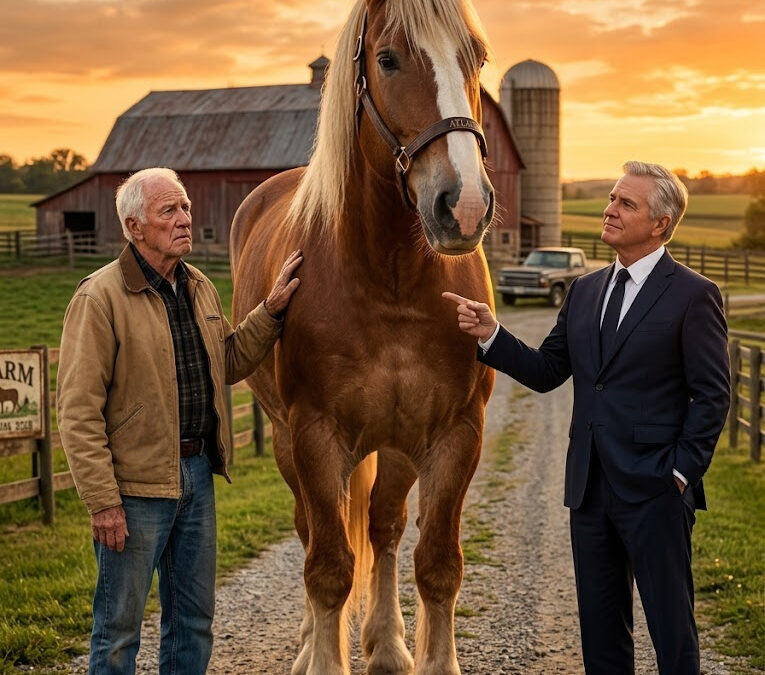
Part 1
Everyone in Millbrook thought Henry Lawson had finally lost his mind the day he bought Atlas.
It was October of 2006, the kind of cold Pennsylvania morning that made the fields look tired before winter had even begun. Mud clung to boot soles. Wind moved through the auction barns with the smell of wet straw, nervous animals, diesel fumes, and old wood. Farmers stood in groups with coffee cups in their hands, talking about milk prices, fuel bills, broken equipment, and the kind of debts nobody wanted to name out loud.
Henry knew those conversations too well.
His dairy bills were overdue. His hay wagon had a cracked axle. His old baler needed parts. And worst of all, the faded green tractor that had worked the Lawson farm for decades had died in the middle of harvest. The repair estimate was still folded in Henry’s coat pocket, though he had already read it so many times he could see the numbers whenever he closed his eyes.
He had come to the auction looking for used parts, not livestock. Maybe an old mower blade. Maybe a tire. Maybe something he could afford that would keep his farm breathing for one more season.
Then he saw the horse.
The Belgian draft gelding stood near the back of the sale barn, tied to a rusted rail as if even the auction workers had already decided he was not worth presenting properly. He was massive, or had been once. His shoulders were still wide, his legs thick as fence posts, his head noble despite the age that had settled over him. But his coat was dull and rough. His joints were swollen. One back leg trembled when he shifted his weight, and he moved with the slow caution of an animal that expected pain before every step.
A paper tag hung from his halter.
Atlas.
The auctioneer barely gave him a glance. “Old draft gelding,” he called. “Gentle enough. Not much use left from the look of him. Who’ll start me at five hundred?”
Nobody raised a hand.
The price dropped. Four hundred. Three hundred. Two hundred.
Still nothing.
Behind Henry, someone laughed. “That horse will eat more than he’s worth.”
Another man said, “Best thing for him is the rendering truck.”
Henry turned and looked at him. He did not speak. Henry was not a man who wasted words, especially when a look would do. Then he turned back to Atlas.
The old horse had lowered his head.
It was foolish to think an animal understood humiliation. Henry knew that. He had been around livestock his whole life. Still, something about Atlas’s stillness bothered him. It was not fear. It was not even sadness. It was patience. A deep, worn-down patience Henry recognized in his own bones.
The kind that came from years of work.
The kind that came from giving everything and still being asked for more.
The auctioneer sighed. “One hundred dollars. Anybody?”
Henry’s hand went up before his mind could stop it.
For one second, the auctioneer blinked as if he had not expected anyone to answer. Then the gavel came down.
“Sold.”
By the time Henry paid the fee, borrowed a trailer, and loaded Atlas with slow carefulness, half the sale barn had heard what happened. The joke spread before Henry even pulled out of the parking lot.
Henry Lawson, with a broken tractor and overdue bills, had bought himself a broken horse.
When he brought Atlas home, the Lawson farm sat under a gray sky, its red barn sagging in places, its fences leaning, its gravel drive cut with deep ruts from years of rain and hard use. The farm had belonged to his family for generations. His grandfather had milked cows there. His father had planted corn there. Henry had learned to drive a tractor in the lower field before he was tall enough to see over the steering wheel without sitting on a folded feed sack.
Every gate had a memory.
Every field held a voice.
And lately, every acre felt like a responsibility growing too heavy for his aging hands.
Henry led Atlas into the old horse stall that had not been used since his father was alive. The stall smelled of dust, old hay, and forgotten mornings. He cleaned it out, spread fresh straw, filled a bucket with water, and stood back while Atlas drank slowly.
Then Henry picked up a brush and began working the mud from the horse’s coat.
“You and me both, huh?” he said quietly. “Everybody thinks we’re past our usefulness.”
Atlas turned one ear toward him.
The next morning Henry called Dr. Elaine Porter, the county veterinarian who had known him for years. She examined Atlas in silence, running her hands along the old horse’s legs, checking his hooves, his teeth, his eyes, his ribs beneath the rough coat.
When she finished, her expression was gentle but honest.
“He’s old, Henry,” she said. “His joints are rough. He’s been overworked. He needs rest, medicine, hoof care, and better feed. It won’t be cheap.”
Henry looked toward the dead tractor near the machine shed. The money in his account was supposed to go toward repairs. Not enough to fix everything, but enough to start.
“How much?” he asked.
When she told him, he looked down at the barn floor for a long moment.
“Henry,” Dr. Porter said softly, “you may not get much work out of him.”
Henry looked at Atlas, standing quietly in fresh straw with tired eyes that had seen too much and expected too little.
“I know,” Henry said. “But maybe he’s earned a little kindness anyway.”
Part 2
The mocking began before the week was over.
At the feed store, men lowered their voices when Henry walked in, though not enough to hide their smiles. Earl Whitcomb, who farmed land two miles over and had opinions on everything, stopped by one afternoon just to lean on the stall door and stare at Atlas like Henry had dragged home a museum piece.
“You know, Henry,” Earl said, “we’re not living in 1920 anymore. You need horsepower under a hood, not in a barn.”
Henry kept brushing Atlas’s shoulder. “Maybe.”
“That horse won’t save your farm.”
Henry’s hand paused, but only for a second. “Maybe he doesn’t have to save it. Maybe he just needed somebody to save him.”
Earl shook his head, laughed under his breath, and left.
Henry said nothing more. He had learned long ago that people who mocked kindness rarely understood its cost. They thought soft-hearted meant weak. They thought mercy was something a man could afford only after all practical things were handled.
But Henry had buried his wife, Margaret, four years earlier, and grief had changed the way he measured value. Some mornings he still set out two coffee cups by habit before remembering she was gone. Some evenings he sat at the kitchen table listening to the house settle, missing the sound of her steps in the hallway, her humming near the sink, her hand resting on his shoulder when bills came due.
His daughters called from other states. They loved him, but they had their own children, their own mortgages, their own worries. Henry never told them how bad things were. He said the farm was fine. He said he was fine. He said what fathers say when they do not want their children carrying the weight they have carried all their lives.
So he carried it alone.
Winter came early that year.
A heavy storm rolled in just after Thanksgiving, dropping wet snow over the fields and turning the lower pasture into deep, sucking mud. The tractor still sat useless by the shed. The cows needed feed. Hay had to be moved to the lower barn. The lane was too soft for a truck, and Henry stood in the barn aisle one morning, staring from the wagon to Atlas and back again.
The horse had changed.
Not into the powerful animal he might have been in his prime, but into something steadier than Henry expected. He had gained weight. His coat had started to shine. His limp remained, yet it no longer seemed to own him. He moved slowly, carefully, but with purpose.
Henry looked at the old harness hanging from the wall.
It had belonged to his father. The leather was dry, stiff with age, but still strong underneath. Henry carried it down, oiled it, adjusted it, and worked it gently over Atlas’s broad back.
The old horse stood still.
Patient.
Ready.
Henry hitched him to the small flat wagon and took the lines in his hands. For a moment, the barn was so quiet he could hear the storm dripping from the roof.
Then Henry clicked his tongue and spoke the command his father had taught him more than fifty years before.
“Step up.”
Atlas leaned forward.
The wagon moved.
Not fast. Not smoothly. Not like a machine. But it moved.
Henry felt something rise in his chest that he had not felt in months.
Hope.
That winter, Atlas became part of the Lawson farm. He pulled hay where the truck could not go. He dragged fallen branches from the fence line. He hauled firewood. In spring, Henry used him in garden plots too narrow and soft for a tractor. People still joked, but the jokes lost some of their bite. It was harder to laugh at a useless horse while watching him do useful work.
And Atlas did his work with quiet dignity.
Around that time, a boy named Noah Bennett started coming by after school.
Noah was fourteen, thin and quiet, usually wearing the same faded blue jacket. His mother worked nights at a diner, and his father had left years before. He did not have the easy confidence of boys who had been told their whole lives they belonged somewhere. He stood at the edge of things, watching.
At first, he came because he liked the equipment. He would linger by the machine shed, studying engines, belts, hoses, and old tools with the focus of someone listening to a language he desperately wanted to learn.
Henry noticed.
“You planning to fix that tractor by staring at it?” he asked one afternoon.
Noah froze. “No, sir.”
“Then grab that grease gun. If you’re going to stand there, you might as well be useful.”
Noah came the next day.
And the next.
Henry gave him real work. Stacking feed bags. Cleaning stalls. Holding tools. Greasing fittings. Learning what parts were called and what they sounded like when they were failing. Noah had a gift with engines. He could listen to a motor cough and almost hear what was wrong inside it.
But he was drawn to Atlas too.
He watched how Henry treated the old horse. Henry never rushed him. Never yelled. Never acted as if age made Atlas worthless. If Atlas needed rest, Henry gave him rest. If the horse’s leg was stiff, Henry rubbed it down. If the work was too heavy, Henry changed the job.
One evening, after they had hauled hay from the lower barn, Noah stood quietly as Henry unhitched Atlas.
“Mr. Lawson,” he asked, “why did you buy him if everybody said he was no good?”
Henry loosened the harness and thought for a moment.
“Because people say that about a lot of things before they really look,” he said. “Old horses. Old farms. Poor kids. Tired men. Doesn’t mean they’re right.”
Noah did not answer.
But he remembered.
Part 3
For the next three years, Noah spent nearly every free afternoon on the Lawson farm.
Henry never made a speech about helping him. He never called it charity. He simply left work for the boy to do and made sure there was always something to learn. He taught Noah how to patch tires, sharpen blades, rebuild a carburetor, fix hydraulic leaks, and listen to a machine before taking it apart. He taught him how to read weather in the color of the sky and how to know when an animal was sick before it dropped.
He also taught him patience.
“When you work with something stronger than you,” Henry told him one evening while Atlas stood between them, “you don’t win by being cruel. You win by being steady.”
Noah carried that sentence like a tool in his pocket.
By the time he was seventeen, everyone in town knew the Bennett boy had talent. A vocational school in Ohio accepted him into an agricultural mechanics program, and for the first time in his life, Noah saw a road leading somewhere other than the tire shop or the edge of town.
Then the numbers arrived.
Tuition. Tools. Housing. Transportation.
His mother cried at their kitchen table because she wanted to help and could not. Noah told her it was fine. He said he could work full-time and try school later. He said it the way people say things when they are trying to make disappointment sound like a plan.
Henry heard about it through Dr. Porter.
Two days later, he sold three young calves he had planned to keep.
Then he called Noah to the barn.
Atlas was standing in his stall, older now, his muzzle grayer, but still calm, still watching everything with those deep brown eyes. Henry handed Noah an envelope.
Noah opened it and went still.
“Mr. Lawson,” he whispered, “I can’t take this.”
“Yes, you can.”
“This is too much.”
Henry shook his head. “Too much is letting a gift go to waste because you’re scared of needing help.”
Noah’s eyes filled, and he looked down because seventeen-year-old boys do not know what to do when gratitude breaks them open in front of another man.
“I’ll pay you back,” he said.
Henry smiled. “Don’t worry about paying me back. Just become the kind of man who knows when someone else needs a hand.”
Noah left for school that fall.
Atlas died two years later on a quiet spring morning. He lay in fresh straw, breathing slowly, while Henry sat beside him with one hand on the old horse’s neck. There was no panic in Atlas at the end. Only tiredness. Only peace. Henry stayed with him until the final breath left his great body.
He buried him beneath the big oak tree behind the barn.
The marker was simple, cut from a board Henry had sanded himself.
Atlas.
A good horse who pulled more than his share.
Years passed.
The world changed faster than Henry wanted it to. Farms grew larger. Small dairies disappeared. Land that had once held corn and pasture became subdivisions with identical houses and perfect lawns. Machines arrived with computers inside them, and repairs became more expensive than Henry could understand. Men who had once laughed about Atlas moved away, passed on, or sold their own farms to developers.
Henry kept going.
But every year took something from him. Strength from his hands. Speed from his steps. Money from the farm account. Hope from the corners of rooms where Margaret’s absence still lived.
By 2024, Henry Lawson was eighty-three years old. His hair was white. His shoulders had narrowed. His hands shook in the cold mornings. Still, he woke before sunrise, made black coffee, and walked to the barn because that was what a Lawson did.
The farm, however, was in real trouble.
The herd was smaller than it had ever been. The tractor had broken again, worse this time. The haybine needed parts. The barn roof leaked whenever rain came hard from the west. Feed costs climbed until Henry found himself standing in the supply store staring at totals that seemed almost cruel.
The bank letters started in January.
At first, Henry opened them.
Then he stacked them on the desk.
Then he stopped opening them at all.
He put them in the bottom drawer, where he did not have to look at them. But hidden paper does not erase debt. It only waits.
One evening in late March, Henry sat on the porch as the sun lowered behind the far pasture. The old oak tree behind the barn stood dark against the orange sky. Atlas lay beneath it. Margaret’s roses, long neglected, pushed through weeds near the porch rail.
Henry looked across the land his grandfather had bought and his father had protected.
“I tried,” he whispered.
The words hurt more than he expected.
He had never been afraid of work. He had never been ashamed of getting by with less. But losing the Lawson farm felt different. It was not just property. It was a line of people behind him, all trusting him to hold on.
And he was so tired.
Several states away, Noah Bennett had not forgotten him.
At thirty-two, Noah no longer looked like the quiet boy in the faded blue jacket. He had become broad-shouldered, steady-eyed, and strong in the way men become strong when they learn work before pride. After trade school, he had worked for dealerships, repair shops, and farm equipment companies. Then he built his own business restoring old agricultural machines and helping small farmers keep older equipment alive when new machines cost more than their land was worth.
He named the company Atlas Field Works.
Most people thought the name sounded powerful.
Only Noah knew what it really meant.
In his office, above his desk, hung an old photograph. Henry stood beside a massive Belgian draft horse, one hand resting on the horse’s neck. Next to them stood a skinny teenage boy trying not to smile too wide.
Noah looked at that photograph whenever business got hard.
One afternoon, while repairing a combine outside Columbus, he heard Henry’s name.
A farmer named Carl Jensen was talking about small dairies in Pennsylvania. “Shame about Lawson,” Carl said.
Noah looked up from the engine. “What about Henry Lawson?”
Carl shrugged. “Heard he’s about to lose the place. Bank’s after him. Equipment’s shot. Too proud to ask anybody for help.”
Noah went still.
For a moment, the shop noise faded.
That night, after everyone had gone home, Noah sat alone in his office and opened an old metal box in his desk drawer. Inside was the note Henry had written years earlier, folded along the same creases.
Noah,
Machines can be fixed, land can be worked, but a young man with a good heart should never be left standing at a locked gate. Go learn, then help somebody else.
Henry
Noah read it three times.
Then he picked up the phone.
Part 4
Noah did not call Henry.
He knew exactly what Henry would say. No. Don’t trouble yourself. I’ll manage. I’ve gotten by this long. Those were proud words, but Noah understood what lived underneath them. Fear. Shame. The old stubborn belief that needing help made a man smaller.
Henry had once seen through that lie for him.
Now Noah would do the same.
By morning, he had called former customers, mechanics, classmates, roofers, horse farmers, feed suppliers, attorneys, and people who still believed that small farms mattered. He told them about Henry Lawson. He told them about the old horse nobody wanted. He told them about the farmer who had saved a dying Belgian draft horse when he could barely afford to save himself. He told them about a poor boy who had been given work, dignity, and the chance to learn.
He did not have to ask twice.
Some people gave money. Some offered labor. Some offered equipment parts. A roofing crew said they could spare two days. A feed supplier promised hay and grain. A retired electrician agreed to fix the milk house wiring. Horse farmers offered teams and trailers. Mechanics from Noah’s company cleared their schedules.
Noah also contacted an attorney named Melissa Grant. Through the proper legal channels, they reviewed what could be done. Payments were arranged. The immediate foreclosure process was stopped. The bank did not care about sentiment, but it understood satisfied balances, signed documents, and money delivered on time.
A week later, Henry woke before sunrise as he always did.
The house was cold. He pulled on an old flannel shirt and his worn brown jacket, made coffee, and stepped onto the porch. The fields were gray in the first light. Fog lay low across the pasture. For a few minutes, the world was still.
Then he heard engines.
At first, he thought it was traffic on the county road. But the sound grew louder, closer, heavier. He set his coffee cup on the porch rail and stepped forward.
A long line of vehicles was turning onto his gravel road.
Pickup trucks. Service trucks. Flatbeds. Horse trailers. Feed trucks. Roofing trucks. More than Henry could count.
His stomach tightened.
The bank.
That was his first thought. They had come to take everything away.
By the time the first truck reached the gate, neighbors had begun stepping outside. Word traveled fast in Millbrook. People stood along fence lines and at the ends of driveways. Some thought developers had bought the land. Others thought the bank was clearing the property.
Henry walked down the porch steps slowly, his knees stiff, his hands cold, his heart pounding against his ribs.
The convoy stopped in the yard.
Doors opened.
Men and women stepped out wearing work boots, tool belts, barn jackets, and company shirts. Some unloaded ladders. Others opened trailers filled with lumber, hydraulic hoses, tractor tires, roofing panels, fence posts, and tool chests.
Then the ramp of one horse trailer dropped.
A massive Belgian draft horse stepped down, steam rising from its nostrils in the cold morning air.
Then another.
Then another.
Henry stared as if the past itself had come walking back into his yard.
A silver pickup pulled near the barn. The driver’s door opened, and a man stepped out wearing a dark work jacket with Atlas Field Works stitched over the pocket. He was tall, broad-shouldered, confident. For one confused second, Henry did not know him.
Then the man smiled.
And Henry saw the boy in the faded blue jacket.
“Noah?” he whispered.
Noah walked toward him. “Morning, Mr. Lawson.”
Henry’s mouth opened, but no words came out.
Noah stopped in front of him, and for a moment both men just stood there in the cold dawn. Then Henry reached for him. Noah hugged him hard, and the old farmer held on as if the years between them had collapsed in one breath.
Around them, workers grew quiet.
Neighbors stopped whispering.
Even the horses stood still.
When they finally stepped apart, Henry wiped his eyes with the back of his hand.
“What is all this?” he asked.
Noah looked toward the sagging barn roof, the leaning fences, the broken tractor, the fields Henry had spent his life trying to protect.
“This,” Noah said, “is a man getting paid back for something he told me not to pay back.”
Henry shook his head. “Noah, I don’t understand.”
Noah reached into his jacket and pulled out the old handwritten note. Henry recognized his own writing immediately, and his face changed.
“You told me to go learn,” Noah said. “Then you told me to help somebody else. I did. Now I’m helping you.”
For the next several days, the Lawson farm became the busiest place in the county.
Mechanics tore into the tractor and rebuilt what age and neglect had worn down. Roofers patched the barn before the next rain. Volunteers repaired fences, replaced rotten posts, cleared brush, and hauled scrap away. The feed supplier delivered hay and grain. The electrician fixed the wiring in the milk house. A crew cleaned out the old horse stalls and repaired the harness room Henry had not used in years.
The Belgian horses worked too.
They pulled logs from a fallen tree line. They dragged posts across ground too soft for trucks. They hauled old boards away from the barn. Every time one of those huge horses leaned into a harness, Henry saw Atlas again.
Atlas in the mud.
Atlas in the snow.
Atlas lowering his tired head in the auction barn while men laughed.
The horse nobody wanted had somehow come home in forty trucks.
Part 5
On the fourth morning, Noah drove Henry into town.
Henry protested from the passenger seat the entire way. “I need to be at the farm.”
“You’ve been at the farm for eighty-three years,” Noah said. “It can spare you for one hour.”
They stopped outside a small law office near the courthouse. Inside, Melissa Grant greeted them and led them into a conference room where several folders were arranged on the table.
Henry looked at Noah with suspicion. “What did you do?”
Noah smiled gently. “Read first.”
Henry put on his glasses and opened the first folder. At first the words blurred together.
Loan restructuring.
Emergency payment.
Foreclosure terminated.
Lien released.
Outstanding balance satisfied.
He read the page again. Then a third time. Finally, his hands began to tremble so badly that he had to set the paper down.
“No,” he whispered.
Noah sat across from him quietly.
Henry’s voice broke. “You paid the bank?”
“Not alone,” Noah said. “A lot of people helped. People you never met. Farmers you helped by helping me. Customers. Friends. Folks who still believe small farms matter.”
Henry covered his mouth with one hand.
For months, he had carried that fear alone. He had put letters in drawers. He had sat in the dark listening to the house creak, wondering how to tell his daughters that he had failed. He had looked at his grandfather’s fields and felt shame settle over him like frost.
And now, just like that, the heaviest part was gone.
Not the work. Farms always had work.
Not the problems. Farms always had problems.
But the threat that had been sitting on his chest every night had lifted.
The Lawson farm was safe.
Henry leaned forward, elbows on the table, and cried.
Noah did not rush him.
After a while, Henry looked up. “Why would you do all this?”
Noah’s eyes softened. “Because you bought a horse nobody wanted,” he said. “Because you gave a kid nobody noticed a place to belong. Because you taught me that old doesn’t mean useless, poor doesn’t mean hopeless, and broken doesn’t mean finished.”
Henry closed his eyes.
He saw Atlas standing in the auction barn. Atlas pulling hay through snow. Atlas resting beneath the oak tree. Atlas, who had arrived as a burden and left behind a legacy Henry had never understood until that moment.
When they returned to the farm, the yard was full of people. Neighbors who had once laughed stood quietly near the barn. Some looked ashamed. Some looked grateful simply to be witnessing something good.
Noah led Henry behind the barn to the old oak tree.
Atlas’s wooden marker had been cleaned and restored. Beside it stood a new sign.
Atlas Working Horse Foundation.
Henry stared at it.
Noah explained quietly. The foundation had already been created. Its mission was simple: help small farms survive by repairing old equipment, teaching young people agricultural mechanics, supporting working horse programs, and giving struggling farmers practical help before it was too late.
“The first training barn will be right here,” Noah said. “If you’ll allow it.”
Henry looked at him in disbelief. “Here?”
Noah nodded. “This farm taught me. It can teach others.”
Over the next year, the Lawson farm changed.
Not into something fancy. Not into a tourist attraction. Something better. It became a working place again.
Young people came on weekends to learn how to maintain tractors, mend fences, handle draft horses, and care for livestock. Retired farmers came to teach skills that were disappearing. Mechanics volunteered time. Local families donated tools. Horse owners brought teams to demonstrate old methods that still had value.
And Henry, who had thought his usefulness was nearly over, became a teacher.
His hands still shook. His steps were slow. His back ached in bad weather. But when he spoke, people listened.
One spring morning, Henry watched a teenage boy struggle to fit a harness over a Belgian mare. The boy grew frustrated, tugging too hard, his face red with embarrassment. Henry walked over slowly.
“Don’t fight her,” he said. “Work with her. Strong things don’t need your anger. They need your patience.”
Nearby, Noah smiled.
He had heard those words before.
That summer, during the foundation’s first public event, more than two hundred people came to the Lawson farm. Some were farmers. Some were students. Some were families who wanted to see the horses. The old barn had been repaired. The fences stood straight. The pastures were green again.
Noah asked Henry to say a few words beneath the oak tree.
Henry did not want to. He had never liked attention. But he looked at the crowd, then at the horses, then at Atlas’s marker, and finally stepped forward.
“I bought Atlas because I felt sorry for him,” Henry said. “That’s the truth. I didn’t have some big plan. I didn’t know he would help me through winter. I didn’t know he would teach Noah anything. I didn’t know his name would end up on a sign.”
The crowd was quiet.
“I just saw an old horse everybody had given up on,” Henry continued. “And I thought maybe he deserved better than that.”
His voice trembled.
“Turns out, that old horse gave me more than I ever gave him. He helped me work this land. He helped me teach a boy. And years later, he helped bring people back to this farm when I thought I was going to lose it.”
Henry looked at Noah.
“Sometimes we think the thing we’re saving is small. A horse. A kid. A broken machine. A tired neighbor. But we don’t know what that kindness might grow into. We don’t know who’s watching. We don’t know how far one good choice can travel.”
He looked across the fields his family had loved for more than a century.
“So if you see something the world has called useless, look again. If you see someone standing at a locked gate, open it if you can. And if you’re the one who feels old, tired, or forgotten, don’t believe for one second that your story is over.”
For a moment, nobody moved.
Then Noah began clapping.
Others joined.
Soon the whole crowd stood beneath the old oak tree, applauding an old farmer, a saved farm, and the memory of a draft horse nobody had wanted.
Henry looked down at Atlas’s marker as a soft breeze moved through the leaves above him.
For the first time in a long time, the farm did not feel like a burden he was carrying alone.
It felt alive.
Eighteen years earlier, Henry Lawson had walked into an auction barn with a broken tractor, overdue bills, and barely enough money to keep going. He could have done the practical thing. He could have walked away. Nobody would have blamed him.
Instead, he chose kindness when kindness cost him something.
He chose to see value where everyone else saw waste.
And because of that choice, a horse found dignity, a boy found a future, and a farm found its way back from the edge.
Maybe that is how the best miracles happen. Not all at once. Not with thunder or bright lights. But quietly, through ordinary people who decide that something broken is still worth saving.
A tired horse.
A struggling kid.
An old farm.
A life.
And somewhere down the road, years later, the kindness you thought nobody noticed may come rolling back toward you, bigger than anything you ever imagined.
THE END
Disclaimer: This story is fictional and created for entertainment purposes only. Any names, characters, places, or events are fictitious or used fictitiously. No real person or organization is intended to be portrayed.








