They Laughed When He Paid $700 for a Worn-Out Farm Dog… Then the Dog Became the Valley’s Last Hope.
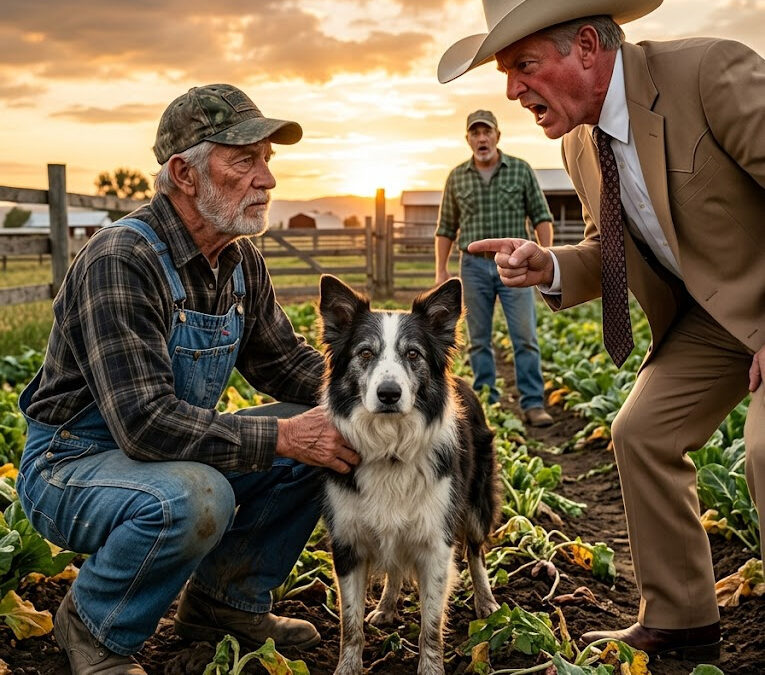
Part 1
With seven hundred dollars, a man could barely buy a decent used irrigation valve in California’s Central Valley, let alone a working farm dog worth trusting with livestock, crops, and long nights under a wide, empty sky. So when Daniel Reeves raised his weathered hand at the livestock auction and spent every dollar he had saved on a gray-faced Border Collie with a limp, the silence under the canvas tent lasted only long enough for people to understand what had happened.
Then the laughter came.
It started near the front row, where Harold Whitman stood with his polished boots planted in the dust and his white hat tipped back like he owned not only the land outside, but the air inside the tent too. Harold owned thousands of acres across the valley. Almond groves, tomato fields, storage sheds, packing contracts, equipment yards, wells, water rights, and just enough friends in county offices to make smaller farmers lower their voices when his truck rolled by
He looked at Daniel, then at the old dog sitting quietly beside the auction handler, and smiled.
“With seven hundred dollars,” Harold said loudly, “you couldn’t even buy a healthy puppy.”
The crowd laughed harder.
Daniel heard every word. At seventy-one, he had spent enough years being laughed at to know the sound in all its forms. There was friendly laughter, the kind that warmed a room. There was nervous laughter, the kind people used when they did not know what else to do. And then there was the kind that came from men like Harold Whitman, sharp and polished, meant to cut without leaving blood on the floor.
Daniel did not answer.
He only stepped forward and looked at the dog.
The Border Collie’s name was Scout. His ribs showed faintly through his coat. His muzzle had gone silver. One ear hung lower than the other, and his left hind leg dragged just enough to make people shake their heads before they even saw him move. When the auction handler had tugged the leash, Scout had not bounded forward, had not barked, had not tried to prove anything. He had simply walked a few slow steps, looked around with calm brown eyes, and sat down in the dust.
To everyone else, the dog looked finished.
To Daniel, he looked tired.
There was a difference, and Daniel knew it better than anyone.
He had been tired for years.
He had spent his life working land that belonged to other men before he ever owned a piece of his own. He had picked tomatoes until his fingers cracked, loaded hay until his shoulders burned, cleaned irrigation trenches in August heat, mended fences under winter rain, and driven tractors so old the steering wheels shook like they were trying to come apart in his hands. He had worked for men who called him dependable when they needed him and invisible when they did not.
His wife, Clara, had understood that kind of life. She had packed peaches in the summer and sewed clothes in the winter, saving coins in jars and smiling at Daniel across cheap kitchen tables as if love could stretch a dollar farther than arithmetic allowed. For many years, somehow, it did.
Then Clara got sick.
Hospitals took what the droughts had not. Bills came in envelopes so thick Daniel stopped opening them at the table. Clara apologized every time another charge arrived, as if being ill were a debt she had chosen. Daniel would hold her hand and tell her not to speak that way, but after she passed, the silence in the house became heavier than any debt collector’s notice.
Still, Daniel kept working.
People like him did not collapse loudly. They got up before sunrise. They fed animals. They checked pipes. They fixed what broke, even when what had broken was inside them.
Late in life, after decades of saving and borrowing and doing jobs younger men refused, Daniel finally bought a small piece of land on the edge of the valley. It was nothing like Harold Whitman’s empire. Just a few acres with tired soil, old fruit trees, a vegetable patch, a sagging barn, and a farmhouse that leaned slightly when strong wind came down from the hills.
But it was his.
Every morning, when Daniel stepped outside and saw sunlight reach across his own rows, he felt a peace he had waited a lifetime to earn.
Peace, however, did not fix a leaking pump. It did not replace rusted tools or pay property taxes. His knees hurt worse each season. His hands shook when he tightened bolts. His eyes tired before the work was done. He needed help, and he had always believed in good working dogs. A dog could notice what an old man missed. A dog could guard the chickens, alert him to coyotes, move sheep, and keep company when the house felt too empty.
So he went to the auction with seven hundred dollars folded in his pocket.
The young dogs sold first. Four thousand. Thirty-eight hundred. Five thousand for an Australian Shepherd with bright markings and a body full of spring. Daniel watched from the back, his hand resting over the money he already knew was not enough.
Then they brought out Scout.
“Older Border Collie,” the handler said, barely trying. “Former working dog. Unknown stamina. Minor limp. Sold as is.”
Bidding started low and stalled quickly. Two hundred. Three hundred. Six hundred.
The auctioneer called, “Six hundred once. Six hundred twice.”
Daniel raised his hand.
“Seven hundred.”
Heads turned. Harold twisted around and grinned.
“Well, I’ll be,” he said. “Old Daniel finally came to play.”
No one bid after that. Harold could have. He could have raised the price just to humiliate Daniel, but he wanted Daniel to win. He wanted everyone to watch the old farmer spend his last savings on an old dog nobody else wanted.
“Sold,” the auctioneer said. “Seven hundred dollars.”
That was when Harold made his joke, and the tent laughed.
Daniel clipped a rope leash to Scout’s collar and rested his cracked hand gently on the dog’s head.
“Come on, boy,” he said. “Let’s go home.”
Part 2
For the first few weeks, it seemed like the whole valley had been right.
Scout was kind, but he was slow. He followed Daniel from the barn to the orchard, from the orchard to the vegetable rows, from the rows back to the porch, always watching, always listening, but never with the quick, sharp bursts of energy Daniel remembered from good herding dogs. When Daniel borrowed a small flock of sheep from a neighbor to see what Scout could still do, the dog understood the work, but his body betrayed him. He circled too wide. He stopped too often. His limp grew worse when the ground was uneven.
Across the road, Mike Patterson leaned on his fence and watched with a look Daniel knew too well.
“Daniel,” Mike called, not cruelly, “I think that dog’s working days are behind him.”
Daniel wiped sweat from his forehead. Scout sat beside him, breathing hard but alert, his eyes still fixed on the sheep.
“Maybe,” Daniel said.
Then he looked down at the old dog and added quietly, “Mine probably are too, and I’m still here.”
He did not give up on Scout. He brushed burrs from the dog’s coat every evening. He fed him from the better scraps and sometimes went without meat himself so Scout could have something warm in his bowl. He learned the places where Scout preferred shade, the pace he could manage, the way his ears lifted when coyotes called from the dry wash beyond the fence.
But kindness did not improve the farm.
The south tomato row began failing first.
At the beginning, the signs were small enough that Daniel almost blamed the heat. A few leaves curled along the edges. A handful of stems developed faint dark marks near the base. Then young fruit trees near the lower irrigation channel began yellowing in a pattern Daniel did not like. He checked the soil moisture. He checked for common pests. He cleaned filters, flushed lines, dug around roots, and studied leaves beneath a magnifying glass Clara had once used for sewing.
Nothing gave him a clean answer.
The damage spread.
Neighbors noticed. Some shook their heads with pity. Others said Daniel had waited too long to retire. A few whispered that buying Scout had been the final poor decision of a man too proud to admit he was finished.
Harold Whitman, of course, enjoyed it.
One afternoon, Harold’s clean white pickup rolled slowly past Daniel’s fence while Daniel knelt in the dirt beside a dying row. Scout sat nearby, his nose lifted as if reading something carried by the wind.
“How’s that miracle dog working out?” Harold called.
Daniel did not rise.
“He’s doing fine,” he said.
Harold laughed. “Your crops don’t look fine.”
Then he drove away, leaving dust hanging in the air.
That night, Daniel sat at his kitchen table with unpaid bills spread before him. The old house creaked around him. Scout lay near the door, muzzle on his paws, watching Daniel with eyes too patient for the world that had discarded him.
For the first time in years, Daniel wondered if he had reached the end.
Not because Harold laughed. Daniel could survive laughter. He had survived worse. What frightened him was not knowing what was killing his plants. A farm could survive heat, bad prices, broken parts, and hard seasons. But it could not survive an invisible enemy moving beneath the soil while the farmer stood helpless above it.
Before sunrise the next morning, Daniel walked the rows again with Scout.
He expected to find more damage, and he did. But he also noticed something strange.
Scout kept stopping.
Not at the plants already yellow. Not at the wilted ones. Not even at the ones Daniel had marked as suspicious. Scout stopped at plants that looked nearly healthy. He would walk a few yards, lower his nose to the soil near the stem, breathe deeply, and sit.
At first, Daniel thought he was tired.
“Come on, boy,” he said softly.
Scout stood, moved down the row, sniffed another healthy-looking plant, and sat again.
Daniel frowned.
He had worked fields too long to ignore odd patterns. He tore a strip of red tape from his pocket and tied it loosely around the plant. Then he marked the next one Scout chose. By noon, twenty-three plants carried red tape. Most looked perfectly normal.
Two days later, the first marked plant began to yellow.
By the fourth day, twelve of them showed symptoms.
By the end of the week, nearly all had changed.
Daniel stood in the row with his notebook in hand and felt a chill pass through him despite the heat. He looked at Scout, who sat calmly beside another plant that still looked healthy.
“You knew,” Daniel whispered.
Scout only looked back at him.
For the next several days, Daniel tested him quietly. He walked Scout through different rows at different times. He marked every plant where Scout sat. He wrote dates, row numbers, plant positions, weather, soil conditions, and visible symptoms. He did not tell anyone. He had been laughed at enough for one season, and besides, he was not looking for applause. He was looking for truth.
Again and again, Scout found the problem before Daniel could see it.
Sometimes two days early.
Sometimes four.
Once, nearly a full week before the leaves showed signs.
Daniel had taken agricultural extension classes years earlier at a community college, back when he still believed he might become more than a hired hand. He had never earned a degree, but he remembered enough to know that stressed plants released odors. Infected plants changed chemically before they changed visibly. Humans could not smell those warnings.
But dogs could smell a world people never knew existed.
Daniel collected samples from the marked plants. He cut leaves, scooped soil from roots, labeled plastic bags, and placed everything carefully in an old cooler. Then, with Scout in the passenger seat of his battered truck, he drove nearly two hours to a university agricultural lab that sometimes helped small farms.
The receptionist looked surprised when the old man walked in carrying a cooler and a spiral notebook.
“What are we testing for?” she asked.
Daniel hesitated.
“I’m not completely sure,” he said. “But my dog is.”
Part 3
The receptionist stared at Daniel for a moment, polite enough not to laugh but not certain she had heard him correctly. Daniel understood. If a stranger had walked into his barn claiming an old dog had diagnosed a crop disease, he might have looked twice too.
So he opened the notebook.
He showed her the dates. The row numbers. The red tape markings. The plants that had appeared healthy when Scout sat beside them and then showed visible symptoms days later. His handwriting was uneven, but the records were careful. Daniel had never had much formal education, but he had spent his entire life noticing things that wealthier men paid consultants to notice for them.
A plant pathologist named Dr. Emily Carter came out after reviewing the notebook.
She was in her forties, serious-eyed, with the brisk manner of a person who had too many problems waiting and too little time for foolishness. She looked at Daniel, then at the cooler, then at Scout, who sat quietly beside Daniel’s boot.
“You’re saying your dog identified these plants before symptoms appeared?” she asked.
“I’m saying he sat at them,” Daniel replied. “And then they got sick.”
Dr. Carter studied him. Daniel did not sound excited. He did not sound like a man chasing attention or trying to sell a miracle. He sounded worried. That mattered.
“We can run tests,” she said. “It may take some time.”
“I’ll pay what I can,” Daniel said.
Dr. Carter glanced down at Scout, whose gray muzzle rested against Daniel’s leg.
“Let’s see what we find first.”
The call came three days later.
Daniel was fixing a cracked hose clamp behind the barn when the house phone rang. By the time he reached it, his shirt was wet with sweat and his hands were black with grease.
“Mr. Reeves?” Dr. Carter said. “The plants your dog marked tested positive.”
Daniel closed his eyes.
He had expected it, but hearing the words still made the floor feel unsteady beneath him.
“What is it?” he asked.
“Aggressive root and stem disease,” she said. “Not common in your area, at least not officially. It can move quietly through irrigation runoff, shared equipment, contaminated soil. By the time symptoms are visible, it may already be spreading.”
Daniel looked out the kitchen window toward the rows.
“How bad?”
There was a pause.
“If this is beyond your property,” Dr. Carter said, “it could be very serious.”
Within days, she arrived at Daniel’s farm with two specialists, testing kits, protective boot covers, flags, tablets, and the kind of focused concern that made Daniel’s stomach tighten. Scout watched them from the porch.
“Can we see him work?” Dr. Carter asked.
Daniel looked down at the dog. “You up for it, boy?”
Scout stood slowly.
There was nothing dramatic about the way he worked. He did not bark or run or perform for the strangers. He moved down the rows at his own pace, nose low, body calm, eyes steady. Every so often, he stopped, sniffed the soil near a plant, and sat.
Each time he sat, the team placed a flag.
Later tests confirmed what Daniel already feared. Scout was right far more often than chance could explain.
One of the younger researchers whispered, “That’s incredible.”
Daniel did not smile.
If Scout was right, then the problem was not just on his land.
The county agriculture office was contacted. More testing followed. Neighboring farms were checked. Early infection appeared in several places, especially near irrigation channels where runoff connected properties like veins. If Daniel had ignored Scout, the disease could have moved silently for months. By harvest, it might have damaged hundreds of acres. Maybe thousands. In a valley that supplied produce across the country, that kind of outbreak could have ruined contracts, bankrupted families, and swallowed small farms whole.
News moved fast after that.
First among farmers. Then through county offices. Then a local reporter heard about the old dog who could smell sick crops before people could see them. A regional agriculture magazine called. A television crew wanted footage. Daniel hated all of it. He had spent most of his life unseen, and invisibility had become a kind of shelter.
But Dr. Carter told him small farmers needed to hear the truth.
So Daniel went to the county meeting with Scout lying at his feet.
The room was full. Farmers leaned forward in their chairs. Officials took notes. People who had mocked Daniel avoided his eyes. Dr. Carter stood at the front and explained that Scout was not magic. He was likely detecting volatile organic compounds released by infected plants before symptoms appeared. His years as a working dog, his calm focus, and his unusually sensitive nose had made him notice what humans missed.
Daniel sat quietly, one hand resting on Scout’s head.
For once, no one laughed.
Near the back of the room, Harold Whitman watched with his arms crossed. At first, his face carried the same arrogance it always did. But as Dr. Carter explained the potential value of early detection, Harold’s expression changed.
He was no longer amused.
He was calculating.
After the meeting, Harold found Daniel in the parking lot.
“Daniel,” he said, suddenly warm. “That’s quite a dog you’ve got.”
Daniel opened the passenger door of his old truck. “He is.”
Harold smiled. “I’ll give you ten thousand dollars for him.”
Daniel looked at him.
Months earlier, Harold had called Scout a problem with fur. Now the same man stood under the afternoon sun offering more money than Daniel had seen at one time in years.
“No,” Daniel said.
Harold’s smile tightened. “Twenty-five thousand.”
“No.”
“Don’t be foolish,” Harold said, lowering his voice. “A dog like that needs real backing. Real facilities. I can put him to use.”
Daniel helped Scout into the truck.
“He’s already useful.”
Harold stepped closer. “You’re old. You’re tired. You don’t have the resources to handle what this could become.”
Daniel closed the truck door and met Harold’s eyes.
“You may be right about me being old,” he said. “But you’re wrong if you think that means I don’t know what I have.”
Then he drove away.
Part 4
Harold Whitman did not take rejection well.
A week after Daniel refused to sell Scout, a notice arrived from the county. Daniel read it once while standing by the mailbox, then again at his kitchen table, then a third time with Scout lying beneath the chair. The document claimed his property was under review for possible biosecurity violations. It suggested that because Scout had been exposed to infected fields, and because outside visitors had been allowed onto Daniel’s farm, the dog, Daniel’s records, and all related detection materials might need to be placed under temporary county control for public safety.
Daniel’s hands began to shake.
Not from age.
From anger.
He knew pressure when he felt it. Men like Harold rarely shoved with their own hands when they could make an office door do it for them. Someone wanted Scout. Someone wanted the notebook. Someone wanted to take control of the discovery and dress greed up as public concern.
The next morning, two county officers arrived with a man Daniel recognized from Harold’s business office. They stood in the yard wearing polite expressions, but politeness did not soften what they had come to do.
“We need to bring the dog in for evaluation,” one officer said.
Daniel stood on the porch with Scout behind him.
“Do you have a court order?” he asked.
The officer looked away. “Not at this time.”
“Then you’re not taking my dog.”
The man from Harold’s office stepped forward. “Mr. Reeves, refusing cooperation could hurt you later.”
Daniel looked at him steadily. “I’ve been hurt before.”
No one moved.
Eventually, they left.
But three days later, Harold filed a formal complaint. He accused Daniel of mishandling disease samples, creating risks for neighboring farms, and promoting an unverified animal detection method for attention. It would have been funny if it had not been so dangerous. Harold had gone from laughing at Scout to claiming Scout was too important to remain with the man who had believed in him.
The county scheduled a hearing.
Daniel could not afford a lawyer. That night, he sat at his kitchen table beneath the yellow kitchen light Clara had loved, reading the complaint until the words blurred. Scout slept at his feet. Outside, the valley wind moved through the old fruit trees.
Daniel wondered how a man with thousands of acres could still want the one thing an old farmer had left.
The next morning, a truck pulled into his driveway.
Then another.
Then another.
Dr. Carter stepped out first. Behind her came two researchers, a veterinarian, three neighboring farmers, and a lawyer from a nonprofit that defended small farms.
The lawyer introduced herself as Maria Santos.
“We reviewed the complaint,” she said, holding up a folder. “It’s weak, but we need to be ready.”
Daniel looked from one face to another, overwhelmed.
“You all came for Scout?”
Mike Patterson, the neighbor who had once doubted the dog, stepped forward and removed his cap.
“No,” he said. “We came for you too.”
For a moment, Daniel could not speak.
The hearing room was packed the following week. Farmers filled nearly every seat. Reporters stood along the walls. County officials sat behind a long table, trying hard to look neutral. Harold arrived in a dark suit with men beside him who looked expensive enough to make Daniel’s chest tighten.
Daniel wore his cleanest shirt, old boots, and a jacket Clara had bought him years before. Scout was allowed inside as a working animal connected to the case. He lay quietly beside Daniel’s chair.
Harold’s side spoke first.
They made Daniel sound reckless. They said he lacked formal training. They said a dog walking through infected rows could spread contamination. They suggested that all records and animal-based detection work should be transferred to a larger, properly equipped agricultural operation.
They did not say Harold’s farm by name.
They did not need to.
Everyone understood.
Then Maria stood.
She did not shout. She did not insult Harold. She did not turn the hearing into theater. She simply placed facts on the table one by one, calmly and clearly, until the room began to shift.
She presented Daniel’s notebook, showing dates and plant markers recorded before laboratory results. She presented test reports confirming infections in plants Scout had identified early. Dr. Carter testified that Daniel had acted responsibly, sought scientific testing, and cooperated fully once the disease was confirmed. The veterinarian testified that Scout was healthy, properly cared for, and not a biosecurity threat when handled under correct procedures.
Then neighboring farmers stood.
One by one, they told the panel how Daniel had warned them before the disease spread too far.
Finally, Mike Patterson rose, twisting his cap in his hands.
“I laughed at first,” he admitted. “A lot of us did. We thought Daniel wasted his money on that dog.”
He swallowed.
“But when my west field started showing signs, Daniel came over before I even asked. Scout marked twelve plants. We tested them. All twelve were infected. If Daniel had kept quiet, I might have lost half my crop.”
The room went silent.
Maria turned toward Harold.
“Mr. Whitman,” she said, “did you offer to buy Scout from Mr. Reeves?”
Harold’s jaw tightened. “That has nothing to do with public safety.”
“Please answer.”
“Yes,” Harold said.
“For how much?”
“I don’t recall exactly.”
Daniel looked at him then, really looked at him.
Maria opened another page.
“Mr. Reeves recorded the conversation immediately afterward. First ten thousand dollars, then twenty-five thousand. Did you make those offers?”
Harold said nothing.
The silence answered for him.
Maria faced the panel.
“This complaint is not about safety,” she said. “It is about control. Mr. Reeves discovered something valuable because he paid attention when others laughed. He asked for scientific testing. He cooperated with experts. And when he refused to sell his dog, powerful people tried to take the discovery away from him.”
Dr. Carter added one final statement.
“Science matters,” she said. “But so does observation. Scout’s ability may help us build better early warning systems for small farms. That work began because Mr. Reeves noticed what everyone else dismissed.”
The panel took less than an hour.
The complaint was dismissed.
Daniel would keep Scout. His notebook would remain his property. Any research involving Scout’s detection ability would require Daniel’s consent and participation.
Harold left before the room emptied.
No speech.
No smile.
Just a man who had mistaken kindness for weakness and age for ignorance.
Part 5
Outside the hearing building, sunlight spilled across the steps, and reporters crowded around Daniel with microphones and cameras. He did not know where to look. He had spent most of his life working in fields where the only witnesses were birds, dust, and the occasional passing truck. Now strangers wanted his words as if they mattered.
“How does it feel to win?” one reporter asked.
Daniel looked down at Scout, who leaned gently against his leg.
“I don’t think of it as winning,” he said. “I think of it as finally being heard.”
That sentence traveled farther than Daniel expected.
In the months that followed, his life changed, though not in the way people imagined. He did not sell Scout. He did not move into a big house or buy a new truck just to show Harold Whitman that he could. He still woke before sunrise. He still drank coffee from the chipped mug Clara had given him years earlier. He still walked the rows slowly, one careful step at a time, with Scout beside him.
But now he was not walking alone in the same way.
Dr. Carter’s university partnered with a sustainable farming program to study how trained dogs might help detect crop disease early, especially for small farms that could not afford expensive monitoring systems. Scout became the first dog in the pilot program. Not because he was young. Not because he was fast. Not because he looked impressive under auction lights.
Because he had noticed first.
The program did not turn farming into a miracle. Daniel knew better than to believe in easy endings. Pipes still broke. Heat still came hard. Bills still arrived. His back still hurt in the mornings, and some days Scout’s limp was worse than others. But something had shifted. Neighbors came by to help repair fences. Researchers installed better testing stations. Farmers who once passed Daniel’s property without slowing now stopped to ask what he thought about a suspicious patch in their fields.
Some apologized for laughing.
Daniel usually accepted with a nod.
He had no interest in making people crawl. He had spent too much of his life being looked down on to enjoy doing it to others. What mattered was that they had learned to look again.
One evening, months after the hearing, Daniel sat on his porch while the valley cooled around him. The fields stretched out in quiet rows, green returning where sickness had almost taken hold. Scout lay at his feet, his gray muzzle resting on Daniel’s boot.
Dr. Carter had visited earlier that day with good news. Early detection and containment had stopped the disease from becoming the disaster they feared. Losses still happened, but the valley had been spared the worst. Farms survived that might not have survived. Families held on. Workers kept jobs. Contracts stayed alive.
All because an old dog had sat down beside plants that looked healthy to everyone else.
Daniel scratched behind Scout’s lowered ear.
“You hear that, Clara?” he whispered toward the fading sky. “We did all right.”
A week later, Daniel returned to the same auction grounds where he had bought Scout. He did not need another dog. He went because a neighbor had asked him to help choose one, and because Daniel now understood better than most that value was not always loud.
The tent looked smaller than he remembered.
Or maybe he was standing taller.
A young farmer recognized him near the pens and hurried over.
“Mr. Reeves,” the young man said, glancing down at Scout with open admiration, “is it true that dogs saved the county?”
Daniel smiled faintly.
“No,” he said. “A lot of people helped.”
The young farmer looked at Scout. “But he started it?”
Daniel thought about that first morning in the tomato rows. Scout sitting calmly beside a plant that looked fine. Daniel marking it with red tape. The first yellow leaf appearing days later like a secret finally surfacing.
“Yes,” Daniel said softly. “He noticed first.”
Across the yard, Harold Whitman stood with a group of buyers. He saw Daniel and quickly looked away. There had been a time when Daniel might have wanted that moment to feel sweeter. For years, he had imagined what it would be like to prove men like Harold wrong. He thought vindication would feel like thunder in his chest.
But standing there with Scout beside him, Daniel felt something quieter and stronger.
He did not need Harold to feel small.
He only needed to remember that Harold had never been the judge of his worth.
People like Harold often believed value was obvious. Big land. New machines. Young animals. Clean trucks. Loud voices. Men who spoke first and expected the room to obey.
They missed the quiet things.
An old farmer keeping notes by hand at a kitchen table. A tired dog with a careful nose. A small farm refusing to die. A lifetime of knowledge hidden beneath worn-out clothes. A kind of patience that did not announce itself, but endured.
The world did not always change because of powerful people. Sometimes it changed because someone overlooked by everyone else kept paying attention.
Sometimes it began with a dog sitting in the dirt beside a plant nobody believed was sick.
Sometimes it began with an old man spending his last seven hundred dollars on a creature everybody called useless.
Years later, when people told the story, they often made Scout sound like a miracle dog. They talked about the money saved, the acres protected, the research that followed, and the hearing where Harold Whitman finally learned that power did not always get the last word.
Daniel told it differently.
On quiet evenings, when visitors came to the porch and Scout slept near his feet, Daniel would look across the rows moving softly in the wind and say, “He wasn’t a miracle. He was paying attention. The miracle was that someone finally paid attention to him.”
Then he would remember the auction tent, the laughter, Harold’s cold smile, and the old dog sitting in the dust while everyone judged him too quickly.
They had thought Daniel lost that day.
They had thought seven hundred dollars had bought him nothing but trouble.
They had not understood that life sometimes hides its greatest gifts inside the things others throw away. They had not understood that age is not the same as emptiness, that tired is not the same as worthless, and that being overlooked for a long time does not mean you have nothing left to give.
Daniel and Scout understood each other because both had been underestimated. Both carried scars. Both moved slower than they used to. Both had been measured by people who did not know what to look for.
And in the end, the old farmer and the old dog did more than save a farm.
They saved a valley.
THE END
Disclaimer: This story is fictional and created for entertainment purposes only. Any names, characters, places, or events are fictitious or used fictitiously. No real person or organization is intended to be portrayed.








