Everyone Mocked Her for Replacing Her Mower With 200 Rabbits… Three Years Later, She Proved Them Wrong.
The livestock market smelled of hay, dust, manure, and fear. Pens crowded with goats, chickens, pigs, and calves lined the yard, and men in straw hats leaned against fences, haggling over animals the way others haggled over used tires. Heather walked past them with her cash folded in the pocket of her jeans, aware of every dollar as if it were a heartbeat.
Near the back, she found a breeder selling New Zealand white rabbits. They were young, healthy, and restless, their noses twitching, their ears turning at every sound. The breeder studied Heather with open curiosity when she asked how many he had.
“Depends how many you need.”
“How many can eight hundred dollars buy me?”
He blinked. “Eight hundred dollars’ worth of rabbits is more than most folks want.”
“I need two hundred,” she said.
He looked at her as if she had stepped out of the sun half-mad, but he did not laugh. He counted them, loaded them into transport cages, and gave her a few practical warnings about shade, water, predators, and fencing. Heather listened carefully. Every instruction mattered.
The drive home was long and silent except for the faint shifting and scratching from the cages behind her. With every mile, doubt crept closer. What if Mr. Davies was right? What if she had just sold the one machine she owned and spent her last real money on an idea that would collapse before the season ended? What if her father’s wisdom, beautiful as it was, belonged to a world that no longer existed?
At a stop sign outside town, Heather gripped the steering wheel and closed her eyes.
Patience is a form of courage, her father had once told her.
She opened her eyes and drove on.
That evening, with twilight turning the orchard gold, she dragged old fencing from the barn and built a temporary paddock around the first few rows of trees. The work was clumsy and exhausting. Wire snagged her sleeves. Fence posts refused to stand straight. Sweat ran into her eyes. By the time she finished, the sky had deepened to purple.
One by one, she opened the cages.
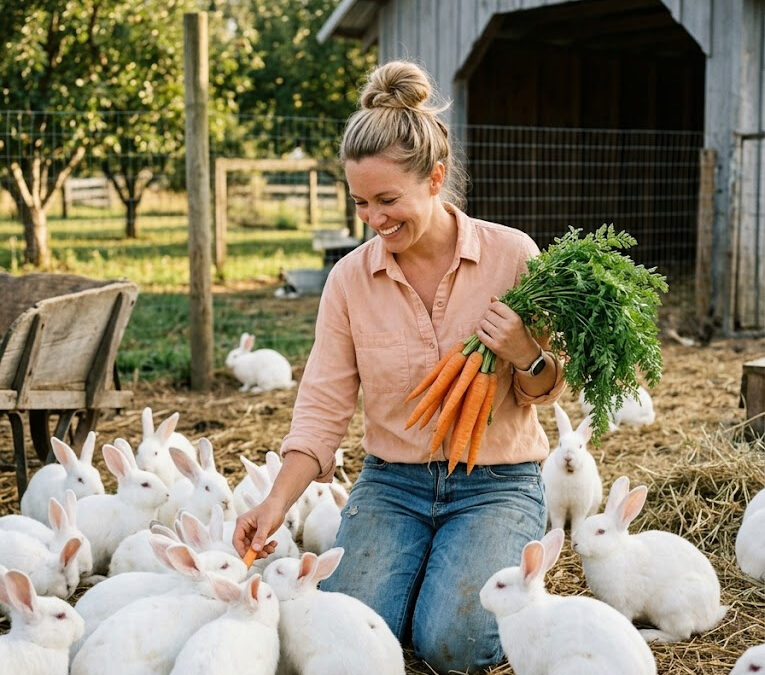
The rabbits hesitated at first, blinking into the open space. Then the first few hopped out, their white bodies ghostly against the dim grass. Within minutes, the orchard floor was alive with movement. They spread beneath the peach trees, nibbling at weeds and grass, soft paws thudding gently against the earth.
There was no engine roar. No diesel smoke. No chemical sting in the air.
Only chewing.
Heather stood there in the dusk, listening to two hundred small mouths begin the work her machines had failed to do.
In the weeks that followed, she learned that an idea could be simple and still demand everything from you. The rabbits were not magic. They needed care. They needed water twice a day in the worst heat. They needed shade. They needed protection. Every few days, Heather moved the fencing to a new section of orchard so they would graze evenly without stripping one place bare.
The rhythm was relentless. Build the paddock. Move the rabbits. Check the wire. Haul water. Watch the sky. Watch for coyotes. Watch for hawks. Watch for disease. Then begin again.
Neighbors slowed their trucks when they passed. Some stopped openly at the edge of the property, pretending to check a tire or adjust a cap while staring at the strange white flock moving under Heather’s trees.
By September, the jokes had spread through the valley.
At the feed store, a man asked if she was planning to sell lucky rabbit feet when the peaches failed.
At the diner, someone said Arthur Voss must be rolling in his grave.
Another grower told her, not unkindly, “Girl, rabbits belong in hutches, not orchards.”
Heather said little. Words would not prove anything. Only time could do that.
And time, at first, was not gentle.
The orchard looked messy compared with her neighbors’ clean, sprayed rows. Weeds did not vanish overnight. The rabbits preferred some plants over others. She had to learn what to cut by hand, what to leave, and how long to let them graze each strip. Her arms grew scratched from wire and brush. Her boots stayed muddy. Her bank account stayed dangerously thin.
Then winter came.
A storm rolled across the valley one night, cold and violent, tearing branches loose and flattening a stretch of fence near the south end of the orchard. Heather woke before dawn to the frantic noise of animals. She ran outside in rain so hard it felt like gravel against her skin.
By the time she reached the paddock, a coyote had already gotten in.
She chased it off screaming, soaked to the bone, but twelve rabbits were gone.
For the first time since she began, Heather nearly broke.
She spent the morning repairing the fence in the rain, her fingers numb, her throat tight. When the last post was reset, she went back to the porch and sat there shivering, mud streaking her jeans, Arthur’s old journal open in her lap. The orchard looked terrible: bare trees, gray sky, wet earth, scattered leaves plastered to the ground.
The debt was still there. The laughter was still there. The loneliness was worse than she had expected.
She turned the journal’s pages slowly until one line stopped her.
Nature is not tidy. The straightest rows do not always bear the best fruit. Trust the process.
Heather read the words once, then again.
The doubt did not disappear. It simply became quieter.
She closed the journal, stood up, and went back to work.
Part 3
The first year did not make Heather rich. It did not even make her safe. The harvest was small, and the peaches were only decent, not miraculous. She sold them at a farmers market under a faded canvas awning, smiling politely while customers squeezed fruit, asked for discounts, and wandered away.
Still, she survived.
That alone felt like a victory.
She had not bought fuel for the mower because the mower was gone. She had not bought herbicide because she had stopped spraying. She bought less fertilizer than ever before, then eventually none at all. The rabbits grazed, moved, ate, and left behind small dry pellets that disappeared into the soil after rain and irrigation. At first, it seemed too slow to matter.
But by the second spring, Heather began to notice changes that no one passing by in a pickup could see.
The soil under the trees felt different.
For years it had been hard and dusty, forming a crust after irrigation. Water used to run off in thin sheets instead of sinking in. When Heather dug beneath the surface, she often found pale, compacted earth that broke apart in clods. Now, when she pushed her fingers into the orchard floor, the soil gave way softly. It was darker, cooler, and alive with earthworms.
The rabbits had done what the machines never could. They had grazed the competition down without poisoning the ground. Their light bodies had moved constantly across the surface, disturbing it gently instead of crushing it. Their manure had fed the soil slowly, steadily, without the sharp chemical shock that forced growth without building life underneath.
The change moved upward.
The peach trees leafed out with a deeper green. Their branches looked stronger. The blossoms that spring seemed almost luminous in the morning sun, pink and white against the blue California sky. Bees came thick through the rows, humming around the flowers.
Heather walked beneath the trees each morning, touching bark, checking leaves, kneeling to smell the earth. She began keeping her own notes in Arthur’s journal, writing dates, observations, questions, and small discoveries.
Rabbits prefer young mustard before foxtail.
Move fencing faster after irrigation.
Soil under row seven holding moisture two days longer than last year.
Fruit set stronger near first winter paddock.
Her neighbors still laughed, but not as loudly. Some had noticed she was no longer buying certain supplies. Others had noticed her trees looked healthier than expected. They did not compliment her. Farmers were not generous with praise when a young woman’s strange idea threatened their certainty.
But Heather saw the side glances. She saw trucks slowing without jokes shouted from the windows.
That summer, the fruit improved.
It was not the largest crop in the valley, nor the prettiest by packing house standards. Her peaches varied in size. Some leaned slightly oblong. Some blushed dark on one side and gold on the other. They would not have pleased Mr. Davies’s spec sheet.
But they had fragrance.
At the farmers market, people began stopping before they reached her table.
“What is that smell?” a woman asked one Saturday, looking around.
Heather lifted a peach from a crate and handed it to her.
The woman took one bite, and her expression changed.
“Oh,” she said softly.
By noon, Heather had sold every box.
The next weekend, customers returned with friends. A restaurant cook bought two crates. A mother bought a whole flat and told Heather her children had eaten the peaches over the kitchen sink because the juice ran down their arms.
For the first time in years, Heather charged more than she had planned, and nobody complained.
That winter, she paid down a little debt. Not much, but enough to breathe.
In the valley, however, pressure continued to build. Fuel prices rose. Chemical bills rose. Bankers pushed growers to expand or modernize. Bigger tractors appeared. More acres were sprayed. More family farms borrowed against land their grandparents had once owned outright.
Heather watched it happen from her small porch, hearing the machines growl in the distance, and felt a strange sadness. She did not hate her neighbors. Many of them were good people trapped inside a system that punished hesitation and rewarded debt until the reward became a noose.
By the beginning of the third year, even those who doubted her could no longer deny that the Voss orchard had not collapsed.
It had awakened.
The rabbits had multiplied, though Heather managed the population carefully. She built better shelters, stronger fencing, and covered runs in the most vulnerable places. She learned which dogs could guard without chasing, which shade structures held in wind, which watering systems saved hours in July heat.
The orchard became a living pattern. Grass and weeds grew, rabbits grazed, manure fell, soil darkened, roots drank, trees strengthened, fruit sweetened. Each part fed the next.
Then came the spring of 1985.
Heather knew before anyone else that the year would be different. She felt it in the weight of the branches and saw it in the way the young fruit formed, firm and promising beneath the leaves. By early summer, the peaches began to color with a deep blush, not artificial-looking, not uniform, but rich and alive.
Their perfume drifted across the orchard before they were even fully ripe.
One morning, Heather picked the first mature peach and carried it to the porch. She sat in the same place where she had once watched the sunset and wondered if she was finished. For a long moment, she held the fruit in both hands.
Then she bit into it.
Juice ran over her fingers.
The flavor stunned her. It was sweet, but not flat. Bright acidity lifted it. The taste seemed to hold sunshine, rain, leaf, root, and memory all at once. It took her back to childhood, to standing beside Arthur while he sliced peaches with his pocketknife and handed her the best pieces.
Heather lowered the peach and looked out at the orchard.
She knew, with absolute clarity, that she would not sell this fruit for eighteen cents a pound.
Part 4
Mr. Davies never received a call.
Heather did not ask for a contract. She did not haul her fruit to his packing house. She did not let anyone with a clipboard and a cold office decide what her peaches were worth.
Instead, she packed a few dozen boxes herself in simple wooden crates lined with clean paper. She chose the fruit carefully, not by size, but by ripeness, fragrance, and feel. Then she loaded the crates into her dusty pickup and drove west toward San Francisco.
The city felt like another planet. The air was cooler, the streets crowded, the buildings tall and close together. Heather felt out of place in her work boots and sun-faded shirt, but she reminded herself that she had not come to impress anyone. She had come to let the fruit speak.
Her first stop was an exclusive gourmet grocery store known for selling produce to chefs, wealthy families, and people who cared more about flavor than price. The produce buyer was a sharp-eyed man in a crisp apron who looked from Heather’s truck to her wooden crates with visible doubt.
“We already have suppliers,” he said.
“I’m sure you do,” Heather replied.
“We don’t usually buy from people who just show up at the back door.”
“Then don’t buy,” she said, lifting one peach from a crate. “Just taste.”
He sighed, annoyed, and took the peach the way a man takes a flyer on the street, already planning to throw it away. He bit into it without enthusiasm.
Then he stopped.
Heather watched his face change.
He looked down at the fruit in his hand. He chewed slowly, then took another bite, this one deliberate. The irritation drained out of him, replaced by surprise, then concentration, then something close to wonder.
“Where did you get these?” he asked.
“I grew them.”
He looked at her again, this time seeing her properly. “How many do you have?”
“Not much,” she said. “I don’t grow for volume.”
“How much do you want?”
Heather named a price higher than she had ever dared to imagine asking. The buyer did not flinch. Instead, he leaned over the crate, selected another peach, smelled it, and said, “I’ll pay you two dollars a pound for everything you can bring.”
For a moment, Heather could not answer.
Two dollars a pound was more than ten times what Davies had offered her. It was not charity. It was recognition. The fruit had spoken, and the buyer had understood.
She drove home that evening with empty crates and a feeling in her chest so large she almost feared it. The next week, her peaches appeared in the store with a small handwritten sign: Voss Peaches. Grown in Harmony with Nature.
They sold out in two days.
The store called asking for more.
Then a chef called.
He owned a restaurant where reservations were made months ahead, and someone had brought him one of Heather’s peaches. He wanted enough to feature them on his summer menu. Another chef called after that. Then a bakery. Then a small specialty distributor who served restaurants that never bought from ordinary packing houses.
Within weeks, the story began to move through the culinary world.
There was a young woman in the Central Valley growing peaches with rabbits.
At first, people repeated it because it sounded ridiculous. Then they tasted the fruit and repeated it with reverence.
Back in the valley, the laughter faded.
Farmers who had mocked her at the diner now looked away when she walked in. The feed store men stopped making rabbit jokes. Some pretended they had never doubted her. Others said she had gotten lucky, as if luck could explain three years of sweat, grief, mud, and patience.
Heather did not argue with them.
She was too busy.
She harvested at dawn, sorted fruit by hand, delivered crates to the city, managed the rabbits, moved fencing, recorded soil conditions, repaired irrigation lines, and slept hard at night with her father’s journal on the bedside table.
Then, one afternoon, Mr. Davies drove up her long dirt road.
Heather saw the dust first from the porch. When the truck stopped, he climbed out more slowly than she remembered. In his office, he had seemed large, certain, untouchable. On her land, beneath her trees, he looked smaller.
He did not come directly to the house. He walked into the orchard.
Heather let him.
She watched him stand among the rows, looking at the rabbits grazing beneath branches heavy with fruit. He bent and picked up a handful of soil, rubbing it between his fingers. He looked at the dark earth, the leaves, the fruit, the quiet movement under the trees.
When he finally approached the porch, his face held none of the amusement she remembered.
“I heard what you’re getting in the city,” he said.
Heather nodded.
“I also heard chefs are calling you directly.”
“They are.”
He glanced back at the orchard. “How did you know this would work?”
Heather looked past him toward the trees her father had loved.
“I didn’t,” she said. “Not at first. But my father taught me to listen to the land. The land told me what it needed.”
Mr. Davies lowered his eyes to his clean, soft hands, then looked at hers. Heather’s hands were scratched, sun-browned, and calloused. They were the hands of someone who had paid for knowledge with labor.
After a long silence, he said, “I should have listened to you.”
The words landed quietly, but they carried the weight of every laugh, every dismissal, every time someone had called her foolish because she refused to fail the proper way.
Then Davies cleared his throat.
“The market is changing,” he said. “People are tired of fruit that looks good and tastes like nothing. I have buyers asking for peaches like yours. Name your price. I’ll pay it. And if you’re willing, I’ll pay you to teach some of my growers how you did this.”
Heather did not smile. Not immediately.
She thought of the day in his office when he had laughed until his face turned red. She thought of walking out with no contract and no safety net. She thought of two hundred rabbits in cages, rain on her face, broken fences, dead animals, unpaid bills, and her father’s handwriting telling her to trust the process.
At last she said, “I’ll name my price. But I won’t change my methods.”
Davies nodded. “I understand.”
“No,” Heather said gently. “You’re beginning to.”
Part 5
The years that followed did not turn Heather Voss into the kind of farmer Mr. Davies once believed she needed to become. She did not borrow heavily to expand across the valley. She did not buy enormous machines. She did not chase volume until her land became another exhausted factory of trees.
She remained careful.
Patient.
Stubborn.
When the struggling parcel next door came up for sale, she bought it only after she had saved enough cash. Thirty acres became fifty, and there she stopped. People told her she could become famous if she expanded faster. Investors approached. Distributors offered contracts with tempting numbers and hidden chains. Agricultural magazines wanted to call her a revolutionary.
Heather had no interest in becoming a symbol if the symbol required betraying the soil that had saved her.
She grew peaches. She raised rabbits. She listened.
Her reputation became stronger than any contract. Chefs reserved their summer allotments a year in advance. Families drove from the Bay Area to buy fruit directly from her small farm stand. Food writers described Voss peaches as impossible to forget. Customers said they tasted like childhood, like sunlight, like the peach they had been searching for without knowing it.
Heather paid off her father’s debts.
She repaired the farmhouse roof, replaced the cracked porch boards, and painted the kitchen a soft yellow because Arthur had always said mornings should have a cheerful room to enter. She kept his journal in a drawer by the table, though over time it became as much hers as his. Her handwriting filled the margins, then the blank pages, then new notebooks stacked beside it.
She wrote about rainfall, soil texture, rabbit rotation, blossom timing, insect patterns, drought stress, sweetness, failures, recoveries, and questions she still did not know how to answer.
That humility became part of her strength. She never claimed nature was easy. She never told young growers that rabbits were a miracle cure or that every farm should copy her exactly. When people came seeking a shortcut, she disappointed them.
“The rabbits are not the point,” she would say. “The point is paying attention.”
The valley changed around her.
Some of the men who had once laughed survived and adapted. A few came quietly to Heather for advice, pride bent but not broken. She helped them when they came honestly. Others doubled down on debt, machinery, sprays, and scale. In the 1990s, when fuel prices rose, markets shifted, and banks tightened their hands around family farms, many of those operations disappeared. Mailboxes with old names were removed. Orchards were sold to corporations whose owners never walked the rows at sunset.
The Voss orchard remained.
By the time Heather reached her sixties, her hair had gone silver at the temples, and the sun had drawn fine lines around her eyes. She moved more slowly, but she still walked the orchard every morning. Generations of rabbits, descended from the original two hundred, grazed beneath the trees. The system had become so natural to the land that visitors sometimes forgot how strange it had once seemed.
Young farmers came to learn from her. Some were college graduates with notebooks. Some were children of growers trying to save family land. Some were dreamers who had never held a pruning shear properly. Heather welcomed them all, but she never began with lectures.
She began by kneeling.
“Put your hands in the soil,” she would tell them.
They would glance at one another, uncertain.
“Go on.”
So they knelt beside her and pushed their fingers into the dark earth beneath the peach trees. Heather watched their faces as they felt what living soil was like: soft, crumbly, cool, fragrant, full of unseen work.
“This is where the fruit begins,” she said. “Not in the packing house. Not on a spreadsheet. Here.”
Sometimes she handed them Arthur’s journal, now repaired with tape and filled with two lives of observation. She let them see the line that had carried her through the storm.
Nature is not tidy. The straightest rows do not always bear the best fruit. Trust the process.
On certain summer evenings, when the peaches were nearly ripe and the air filled with their perfume, Heather would sit on the porch and watch rabbits move like pale shadows beneath the trees. She could still hear Mr. Davies laughing in that cold office. She could still feel the humiliation burning in her throat. But the memory no longer hurt the same way.
It had become part of the orchard’s story.
People had laughed because they saw rabbits and thought of weakness. They saw a young woman with no money and thought of failure. They saw messy rows and thought of poor management. They saw smallness and thought it meant defeat.
Heather had seen something else.
She had seen a loop waiting to be closed. She had seen soil asking to breathe. She had seen that a farm did not have to shout in order to survive. It could whisper, graze, bloom, and endure.
Mr. Davies had told her farming was a hard business, and he had not been wrong. But he had believed hardness meant force. Heather learned it could also mean patience. It could mean standing alone while others mocked you. It could mean trusting quiet evidence before the world applauded. It could mean refusing to sacrifice tomorrow’s soil for today’s numbers.
In the end, the land gave Heather more than a living.
It gave her a life rooted deeply enough to withstand laughter, debt, drought, fashion, markets, and time. And every summer, when people bit into a Voss peach and fell silent from the taste of it, the orchard answered for her.
Nobody was laughing anymore.
THE END
Disclaimer: This story is fictional and created for entertainment purposes only. Any names, characters, places, or events are fictitious or used fictitiously. No real person or organization is intended to be portrayed.








