The HOA Paved 17 Parking Spaces Across His Property and Buried 12 “Ugly” Lights Under Fresh Asphalt—But Those Fixtures Weren’t Landscaping. When Old Emergency Landing Records and One Damning Email Surfaced, the HOA’s $5 Million Clubhouse Project Had to Be Torn Open in Front of Everyone.
Part 3 of 3:
Vanessa refused to postpone the opening.
That told me everything I needed to know about her priorities.
She sent residents a community-wide email calling the property dispute a “last-minute attempt by an adjacent owner to obstruct a legally approved improvement.”
She did not mention that seventeen spaces crossed a surveyed boundary.
She did not mention the twelve fixtures.
She did not mention Ben’s email.
And she definitely did not mention that the county had now located the old emergency landing-site file.
The grand opening began at four o’clock Saturday.
Almost two hundred residents gathered around the clubhouse.
White canopy tents.
Catered appetizers.
Champagne.
Photographer.
A wide blue ribbon stretched across the main entrance.
The parking extension was nearly full.
I stood near the back with Douglas.
Vanessa walked to the microphone in a cream-colored suit.
“Today represents what happens when a community chooses progress over obstruction.”
Douglas glanced at me.
I said nothing.
“When we refuse to allow a few holdouts to stand in the way, everyone benefits.”
That word again.
Holdouts.
Not property owners.
Not neighbors.
People standing in the way.
Then two county vehicles entered.
No sirens.
No flashing lights.
They simply parked near the extension.
Vanessa stopped mid-sentence.
County enforcement officer Daniel Ruiz stepped out.
Maria Santos was with him.
Vanessa hurried away from the microphone.
“This is a private event.”
Ruiz opened a folder.
“We need the southern parking extension cleared.”
She stared at him.
“What?”
“The identified encroachment area cannot remain in use while the property and site issues are unresolved.”
“Our lawyers already explained the emergency easement.”
Ruiz shook his head.
“No recorded HOA easement across Mr. Mercer’s strip has been produced.”
Nearby conversations stopped.
Douglas walked forward.
He began replacing the survey stakes that paving crews had removed.
First stake beside a Mercedes.
Second between two SUVs.
Third directly through a painted parking line.
Residents started taking out phones.
Vanessa looked furious.
“This boundary is disputed.”
Ruiz answered calmly.
“Then dispute it through the proper process. Until then, do not use the area beyond the surveyed line.”
Maria unfolded the historic site drawing.
Twelve circles.
Twelve fixtures.
Vanessa saw them.
Her eyes moved across the page.
Then Ben Holloway walked through the crowd.
That changed her expression.
He carried the printed email chain.
Vanessa spoke immediately.
“I was told those were abandoned landscaping fixtures.”
Ben stopped.
“No, ma’am.”
Quiet.
Clear.
People leaned closer.
She pointed at him.
“That is what your company represented.”
Ben handed the emails to Ruiz.
“I asked what they were.”
The top page contained Vanessa’s answer.
REMOVE.
DO NOT ALLOW OBSOLETE LANDSCAPE FIXTURES TO DELAY PAVING.
One board member slowly lowered his champagne glass.
Another stepped away from the ribbon.
Vanessa looked at the email.
Then at the old county drawing.
Then at the row of survey stakes cutting through the parking lot.
For months, she had relied on the same phrases.
The board approved it.
Our professionals reviewed it.
Community standards require it.
Property values depend on it.
But board approval could not move my boundary.
A consultant’s drawing could not erase physical infrastructure simply because somebody failed to show it.
And calling the fixtures “obsolete” did not make them safely disconnected.
That last issue turned out to be more serious than anyone expected.
When my electrician and the county’s consultant inspected the remaining circuit records, they found that the lighting system had not been formally abandoned.
I had continued testing it.
The disconnect was still part of my maintained equipment.
Several fixtures had been cut from buried cable rather than properly isolated.
Nobody was electrocuted.
Nothing caught fire.
But that was luck, not process.
Ben’s company notified its insurer.
The HOA notified its carrier.
And the clubhouse engineer suddenly wanted every version of the base survey.
That was where the next mistake surfaced.
The earliest engineering base drawing actually showed several of the ground fixtures as “existing field lights.”
A later revision did not.
The symbol layer had disappeared.
No revision cloud identified the change.
No demolition note explained it.
No owner authorization existed.
No abandonment record existed.
I did not immediately accuse Vanessa of ordering someone to falsify a drawing.
That would have gone beyond the evidence.
What we could prove was enough:
The fixtures existed.
The contractor saw them.
Ben asked what to do.
Vanessa personally ordered removal.
The HOA did not own the strip.
And the final construction plan failed to identify equipment that earlier site information had shown.
The board hired independent construction counsel.
For the first time, Vanessa was not controlling the investigation.
Counsel asked the project engineer to explain the missing symbols.
The engineer blamed incomplete owner-supplied site information.
The HOA project manager blamed the engineer.
Vanessa said everyone understood the fixtures were obsolete.
Then Maria produced my maintenance records.
Annual test dates.
Resistance readings.
Seal replacements.
Photographs.
The most recent inspection was less than four months before construction.
“Obsolete” became difficult to defend.
Then came the question the board should have asked before breaking ground.
Why was the parking extension pushed so far south?
The original clubhouse plan already had a smaller parking configuration entirely inside HOA property.
It was tight.
But legal.
A later event-capacity projection increased the number of desired spaces.
Vanessa had promised residents that the clubhouse could host larger weddings and private functions without street overflow.
The simplest way to support that promise was to widen the south lot.
That required my land.
The purchase offer I had rejected suddenly became important.
So did the timing.
First, the HOA offered to buy the strip.
I refused.
Then I received a lighting violation.
Then Vanessa began claiming emergency-access rights.
Then the final parking plan crossed the boundary.
Then the fixtures disappeared.
None of those facts alone proved some grand conspiracy.
Together, they created a chronology the board could not ignore.
At an emergency meeting the following Tuesday, board member Thomas Avery asked Vanessa:
“When Mr. Mercer rejected the land purchase, did you instruct the project team to redesign the parking extension?”
“No.”
“Why not?”
“Because our consultants advised us the area was available.”
“Under what right?”
“The emergency corridor.”
“Where is it recorded?”
Vanessa’s jaw tightened.
“We’ve been over this.”
Thomas looked toward independent counsel.
Counsel answered.
“We have not located a recorded easement granting Brier Glen parking or general construction rights across Mr. Mercer’s parcel.”
Thomas turned back.
“Then why did we pave it?”
Vanessa said nothing.
That was when the board removed her from all authority over the clubhouse project.
She remained HOA president for another nine days.
Then she resigned.
No dramatic arrest.
No criminal indictment.
No judge arriving with handcuffs.
Just something far more realistic.
Insurers.
Engineers.
Lawyers.
Surveyors.
Contractors.
And a board suddenly realizing that five million dollars in construction did not excuse eleven feet of trespass.
The HOA’s insurer and paving contractor’s carrier negotiated responsibility for restoration.
The engineer’s professional-liability carrier also became involved over the site-plan issue.
My attorney kept our demand narrow.
Restore the encroached strip.
Repair the emergency-lighting circuit.
Replace damaged fixtures.
Restore drainage and soil conditions.
Pay documented surveying, engineering, legal, and temporary loss-of-use costs.
Formally acknowledge the boundary.
No punitive fantasy.
No demand to demolish the clubhouse.
I never wanted their clubhouse.
I wanted my field back.
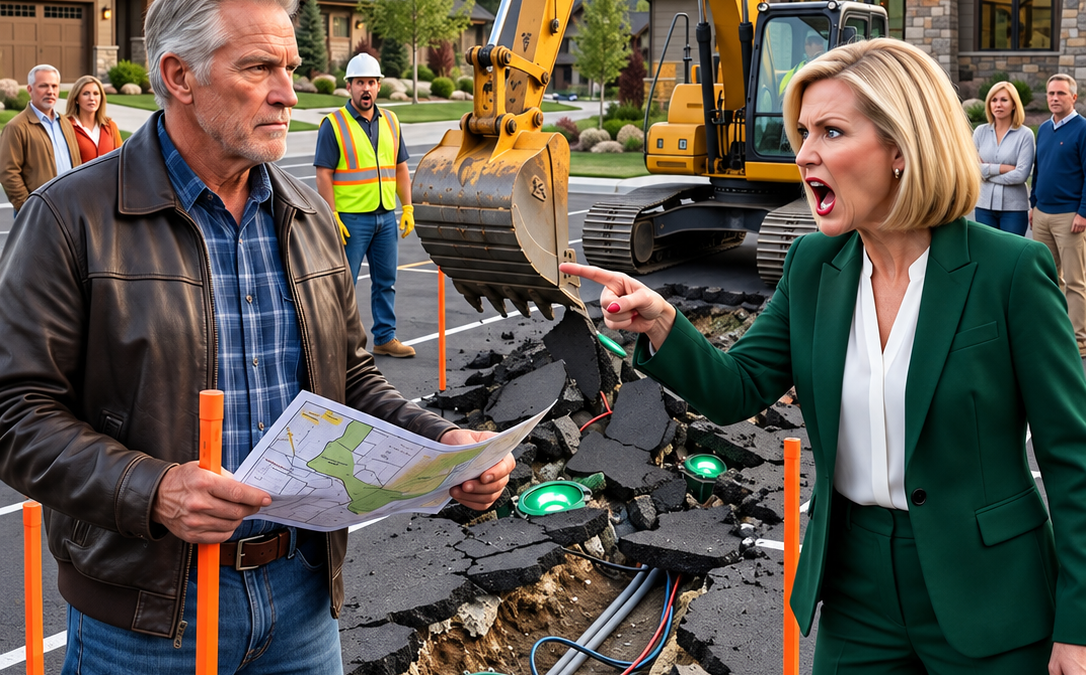
Two weeks later, an excavator returned.
This time, it was there to remove asphalt.
Residents gathered behind temporary barriers.
The bucket touched the new pavement.
Crack.
A black section lifted.
Gravel spilled from beneath it.
The operator pulled another piece.
Then another.
A worker climbed into the exposed area and brushed away dirt.
Green glass appeared.
Light 8.
Scratched.
Dirty.
Still in place.
Then Light 9.
Its housing had been damaged.
Light 10 had been buried beneath base material.
Three fixtures had been physically removed and discarded.
The rest had been paved over.
One by one, the locations reappeared.
Nobody cheered.
They did not need to.
The image was enough.
Brand-new parking lot being torn apart to recover infrastructure Vanessa had insisted was irrelevant.
The final restoration plan reduced the parking lot to the boundary Brier Glen actually owned.
Seventeen spaces disappeared.
The clubhouse remained open with reduced event capacity.
For larger functions, the HOA arranged overflow parking on another parcel through an actual written agreement.
Imagine that.
Permission.
The south field was rebuilt.
Conduit replaced.
Bases repaired.
New low-profile LED fixtures installed in the same pattern.
The county EMS office updated the site file too.
That was important.
Mercer South Field was never converted into some public landing facility.
I did not want helicopters appearing whenever they pleased.
The updated agreement described it accurately:
PRIVATE EMERGENCY LANDING AREA.
USE ONLY BY PRIOR COORDINATION WITH OWNER OR DURING A QUALIFYING EMERGENCY UNDER COUNTY PROTOCOL.
County dispatch had my number.
Fire and EMS had coordinates.
The field remained mine.
That was how Dad had intended it.
Available when genuinely needed.
Not permanently surrendered because it had once helped somebody.
After Vanessa resigned, the new HOA president, Thomas, came to see me.
He stopped at the property line.
Actually stopped.
“Can I come over?”
I smiled.
“Yes.”
He walked across.
“I owe you an apology.”
“You personally?”
“The board.”
“That I’ll accept.”
He looked over the repaired field.
“I thought they were landscape lights too.”
“Most people did.”
“Why didn’t you tell Vanessa immediately what they were?”
I thought about that.
“I tried telling her they were mine.”
Thomas nodded slowly.
“That should have been enough.”
Exactly.
The emergency purpose made the destruction more serious.
The old rescue made the story more emotional.
But none of that was required to respect the property line.
Even if those twelve fixtures had been useless decorations, Brier Glen still did not get to destroy them because the clubhouse needed parking.
That was the simplest lesson.
The most important one too.
A few months later, Maria called me.
County EMS was updating emergency landing options after a wildfire-response review.
“Do you still want Mercer South listed?”
I looked through the window.
Twelve green lenses sat low across the field.
“Yes.”
“Same conditions?”
“Call first whenever you can.”
“And if roads are cut and we cannot?”
“Use it if someone’s life depends on it.”
She was quiet.
“Your dad would like that answer.”
“I know.”
That winter, we tested the system after dark.
Maria came.
Two firefighters came.
My electrician came.
We walked the circuit from the disconnect outward.
Continuity good.
Insulation good.
Fixtures sealed.
Then I closed the switch.
Light 1 came on.
Then 2.
Across the field, twelve green points appeared in the darkness.
Not bright.
Not decorative.
Just enough to define a safe area.
For a second, I was back in the ice storm.
Dad beside me.
Freezing rain collecting on his fire jacket.
The distant thump of helicopter blades.
A landing light emerging beyond the trees.
That patient survived.
Dad never called himself a hero afterward.
The next morning, he simply walked outside with me.
He kicked one of the fixtures lightly with his boot.
“Ugly little things.”
Then he smiled.
“Worked, though.”
Standing there years later, I finally laughed.
Maria looked at me.
“What?”
“Nothing.”
The new HOA clubhouse glowed beyond the field.
Beautiful stone.
Beautiful windows.
Smaller parking lot.
Everything finally on the correct parcel.
Vanessa had cared about appearances.
Dad cared about function.
The board had treated the twelve fixtures as clutter because nobody stopped long enough to ask why an old airport electrician kept maintaining them.
That mistake cost them asphalt, legal fees, engineering work, insurance claims, and seventeen parking spaces.
But the real failure happened before the first paving machine arrived.
Vanessa saw something inconvenient.
She named it obsolete.
Then she kept moving until every document around her matched the decision she had already made.
That works right up until somebody opens the older file.
Because asphalt can hide a light.
It cannot erase a boundary.
It cannot erase an email.
And six inches of pavement cannot bury the truth deeply enough that a surveyor, an electrician, and a county archive cannot find it again.
The twelve lights are still there.
Every few months, I clean the lenses.
Check the seals.
Log the readings.
Same as before.
Nobody from Brier Glen fines me for them anymore.
Nobody calls them landscaping.
And whenever I test them after sunset, twelve green points stretch across the south field exactly where my father put them.
Ugly.
Useful.
And back where they belong.
The end
Disclaimer: This content is entirely AI-generated for fictional and entertainment purposes only. Any resemblance to actual persons, living or dead, events, or locations is purely coincidental, and the creator assumes no liability for any interpretation of this content.








