“You didn’t deserve this success,” he said. “Your sister did.”
Part 1 of 5:
My father raised his champagne glass in my backyard and told forty people that I did not deserve the success they had gathered to celebrate.
The string lights above us trembled in the June breeze. White folding chairs faced a long table covered with food I had paid for myself. My nursing-school diploma rested beside a vase of grocery-store sunflowers, and my sister Daphne sat in the best chair wearing a pale blue dress that cost more than my share of the mortgage that month.
Dad looked directly at me.
For a moment, no one moved.
Someone near the fence gave a nervous laugh, then stopped when nobody joined in.
My mother’s expression changed from surprise to relief, as if Dad had finally said something she had wanted to say for years.
“Daphne has always been the gifted one,” she added. “Whitney is just more persistent.”
The distinction mattered to her.
Gifted meant deserving.
Persistent meant inconvenient.
I felt heat rise across my face, but I did not look away. I had spent four years working overnight shifts, attending clinical rotations before sunrise, and studying pharmacology from flash cards while eating dinner in my car. I had memorized speeches for difficult patients, anxious families, demanding instructors, and supervisors who assumed exhaustion meant weakness.
I had even prepared a few words for my graduation party.
I never used them.
Instead, I lifted my glass.
“Great,” I said. “Then Daphne can pay your mortgage too.”
The silence that followed was cleaner than applause.
Dad lowered his drink.
Mom stared at me as though I had revealed private information rather than stopped concealing it.
Daphne’s smile faltered.
For eighteen months, I had transferred money into my parents’ account on the first Friday of every month. Dad’s contracting business had slowed, and Mom said they were only temporarily behind. I covered part of their mortgage, property taxes, and the insurance bill they claimed had increased without warning.
They had asked me not to tell anyone.
“We don’t want people thinking we can’t manage,” Mom had said.
So I kept quiet.
At my own graduation party, they publicly described me as the lesser daughter while eating food purchased by the same bank account keeping their house out of trouble.
I set my glass on the table before my hand could shake.
Then my phone buzzed inside the pocket of my dress.
The number was unfamiliar.
The message contained only three words.
We need you.
I almost ignored it.
Behind me, Dad cleared his throat and began telling the guests that family humor did not always land the way you expected. His voice had already shifted into its charming public version. Soon he would make the moment sound harmless. Mom would blame my stress. Daphne would offer me a sympathetic smile that allowed her to remain innocent without giving up the advantage.
I stepped past the folding chairs and entered the kitchen.
The screen door closed behind me, turning the voices outside into a muffled blur.
I called the number.
A woman answered on the second ring.
“Whitney Callaway?”
“Yes.”
“My name is Patricia Hale. I represent the estate of Ruth Callaway.”
My grandmother.
I gripped the edge of the kitchen counter.
I had not seen Grandma Ruth in eleven years.
Not because I chose to stop visiting.
My parents made that decision for both Daphne and me after an argument no one fully explained. Mom said Grandma was controlling. Dad called her impossible. Daphne accepted the story because she accepted most things that removed inconvenience from her life.
I was seventeen the last time I sat on Grandma’s porch.
She had taught me cursive there, guiding my fingers through the loops of capital letters. She kept lemon candies in a glass jar and treated questions as signs of intelligence instead of defiance.
“Has something happened?” I asked.
Patricia paused.
“Your grandmother passed away Tuesday morning.”
The kitchen seemed to move farther away.
I stared at a magnet on the refrigerator advertising a local plumber.
“I didn’t know she was ill.”
“She asked that your parents not be contacted until certain arrangements were complete.”
“Why are you calling me?”
“She left specific instructions. She wanted you informed privately before the formal reading.”
Outside, someone turned up the music.
A burst of laughter crossed the yard.
“Informed about what?”
Patricia took a measured breath.
“Ruth left the primary estate to you. The house, her investment accounts, several business interests, and the remaining personal property.”
I sat on the nearest chair.
“That doesn’t make sense.”
“It will make more sense after you read her letter.”
“What about my father?”
“He receives a small fixed distribution.”
“And Daphne?”
“Your grandmother established a restriction preventing Daphne from receiving, controlling, occupying, or borrowing against any estate asset.”
I looked toward the back door.
Through the glass, I could see my sister lifting her champagne while one of our cousins leaned toward her. She looked perfectly comfortable at the center of my celebration.
“Why?”
“Ruth documented her reasons. I would rather explain them in person.”
Dad’s laugh rose above the music.
I pressed my fingers against my forehead.
“When?”
“My office is two hours north. Monday morning would be ideal.”
“I’ll be there.”
After the call ended, I remained in the kitchen for several minutes.
I expected to cry.
Instead, I began laughing.
It was not joy. It was the strange sound a body makes when humiliation, grief, and disbelief arrive together and cannot decide which should be felt first.
When I returned outside, Mom was cutting the cake.
No one had waited for me.
Daphne had moved my diploma so the cake stand would fit in front of her. Dad was telling Uncle Raymond about the renovation he hoped to finish in the kitchen before Thanksgiving.
The renovation I had helped finance without knowing it yet.
I smiled for photographs.
I thanked my instructors.
I hugged the women from my hospital unit who had traded shifts so I could attend graduation.
I let my parents believe the evening had ended in their favor.
By midnight, the guests were gone.
Paper plates filled three trash bags. Melted ice floated in the drink tubs. A strand of lights had come loose above the patio.
Daphne sat at the kitchen island eating a second piece of cake.
“You embarrassed Dad,” she said.
I tied one of the trash bags.
“He embarrassed himself.”
“You know what he meant.”
“Yes.”
She licked frosting from her fork.
“He’s proud of you in his own way.”
“That phrase has protected him for years.”
“Not everything has to become a family crisis, Whitney.”
I looked at her dress, her manicured hands, and the diamond bracelet our parents gave her for turning twenty-five.
“I agree.”
She mistook that for surrender.
“You should apologize tomorrow.”
“No.”
Her eyebrows lifted.
“You always apologize.”
“Not anymore.”
I carried the trash outside.
The next morning, Mom called before eight.
I was packing my clinical textbooks into boxes for a younger student.
“What you said about the mortgage was cruel,” she began.
“What Dad said was cruel.”
“He was making a point about natural ability.”
“At my graduation party.”
“Daphne struggled after college. He wanted her to feel included.”
“So he excluded me.”
“You know your sister is sensitive.”
That word had followed Daphne her entire life.
Sensitive meant rules could bend around her.
Sensitive meant disappointment might damage her.
Sensitive meant everyone else should absorb what she did not want to feel.
“What do you need?” I asked.
Mom went quiet.
“What kind of question is that?”
“The mortgage transfer is due Friday. Is that why you called?”
“We still need help this month.”
“Ask Daphne.”
“Whitney.”
“Dad said she deserved the success.”
“That was not about money.”
“It became about money when my success started paying your bills.”
She exhaled sharply.
“You have changed since nursing school.”
“I hope so.”
I ended the call.
Then I opened my banking app and canceled the scheduled mortgage transfer.
My hand hovered over the confirmation button for only a moment.
The transfer disappeared.
For years, my parents had treated my reliability as a natural resource. They assumed it would remain available no matter how they spoke to me, because it always had.
That morning, I stopped supplying it.
On Monday, I drove north with the radio off.
The highway passed soybean fields, gas stations, church signs, and exits for towns I had not visited since childhood. A paper cup of coffee cooled in the holder beside me.
Patricia Hale’s office occupied the second floor of a renovated brick building near the courthouse square. She was younger than I expected, perhaps early forties, with dark hair cut just below her jaw and the focused expression of someone who preferred facts to performances.
She greeted me, closed the conference-room door, and placed a cream-colored envelope on the table.
My name was written across it in Grandma Ruth’s handwriting.
The same careful loops she used when teaching me to write thank-you notes on her porch.
I touched the envelope but did not open it immediately.
“When did she write this?”
“Six months ago.”
“Did she know I finished school?”
“She knew almost everything.”
I looked up.
“How?”
“She followed public records, graduation announcements, and occasional updates from people who still knew both of you. She also hired me to review several matters involving your credit.”
My stomach tightened.
“What matters?”
Patricia nodded toward the letter.
“Read that first.”
I opened the envelope.
Whitney,
If you are reading this, I have run out of time to correct my silence in person.
I watched your parents make you responsible for things that were never yours to carry. I told myself staying out of it would preserve the family. It did not. Silence rarely protects the innocent person. It protects whoever benefits from confusion.
Everything I can leave you is yours.
Not because you are better than Daphne.
Because you visited me when no one asked you to. You listened when I spoke. You never treated my house, my money, or my attention as something you had already inherited.
Your parents taught Daphne to expect rescue and taught you to provide it. Both lessons were harmful, but only one of you kept paying for them.
The house contains records you need to see before you decide what kind of future you want with this family.
Please do not confuse forgiveness with permission.
Love,
Grandma Ruth
By the final line, the page had blurred.
I turned away and pressed a tissue beneath my eyes.
“I did visit her,” I said. “After my parents stopped taking us. Three times.”
Patricia waited.
“I used money from my grocery-store job to buy bus tickets. The last time, Mom found the receipt in my backpack. She said Grandma was using me against the family.”
“Ruth remembered those visits.”
“They stopped me from going again.”
“I know.”
The grief was not only for Grandma’s death.
It was for the years I might have known her if my parents had not controlled the story.
Patricia opened a folder.
“The estate is substantial but not extravagant in the way people imagine when they hear the word inheritance. Ruth owned her house outright, had retirement and investment accounts, and retained shares in a regional medical-supply company founded by her brother.”
“How much?”
“After expenses and taxes, the estimated value is approximately 2.8 million dollars.”
I stared at her.
“My grandmother lived in a house with peeling paint.”
“She did not care about appearances.”
“That much is clear.”
“There is another issue.”
“The credit?”
“Yes.”
She closed the folder.
“Ruth became concerned eight months ago after receiving a call from a lender attempting to confirm your address.”
“Why would they call her?”
“One application listed her house as a prior residence.”
“I never lived there.”
“She knew that.”
Patricia stood.
“You should see the records where Ruth kept them.”
Grandma’s house sat at the end of a gravel road twenty minutes outside town.
The porch sagged slightly near the steps. Paint had peeled around the windows. A wind chime turned beneath the eaves, producing one low note whenever the breeze reached it.
Patricia handed me a brass key with red yarn tied through the top.
I recognized it.
Grandma had attached the yarn so she could find the key inside her purse.
The living room smelled like dust, cedar, and the faint lavender powder she used for as long as I remembered.
A crocheted blanket still covered the couch. The clock above the fireplace had stopped at 4:12. On a side table sat a photograph of me at seven, smiling with two missing front teeth while Grandma held a birthday cake.
There was no photograph of Daphne.
The absence made me uncomfortable.
“Why did she exclude my sister so completely?”
“Ruth believed Daphne had knowingly benefited from at least one unauthorized loan.”
“What loan?”
Patricia led me down the hallway.
Every room looked untouched except the study.
A new deadbolt had been installed on the door. Inside stood a fireproof filing cabinet that did not match the worn desk or faded curtains.
“Ruth purchased this last year,” Patricia said.
She entered a code and opened the top drawer.
Folders filled the cabinet.
Each label was written by hand.
Whitney Credit Reports.
Lexus Financing.
Kitchen Equity Agreement.
Cancún Line of Credit.
Mortgage Transfers.
Communications.
I stared at the words.
“What am I looking at?”
“Your parents used your identifying information to obtain credit three times.”
The room tilted.
I placed one hand against the desk.
“No.”
“The applications contain your Social Security number, employment history, and copies of signatures that do not match the examples Ruth gathered.”
“That is impossible.”
“Have you received collection calls you did not understand?”
I thought of a call two years earlier from a finance company asking about a Lexus payment.
I had told the representative she had the wrong person.
Another lender had mailed a late notice to my apartment for a home-improvement account. Mom said it was probably a clerical error because our names were connected on an old family insurance policy.
My credit score had dropped more than a hundred points during my final year of nursing school. I assumed student loans and a medical bill caused it.
“How much?” I whispered.
Patricia removed the first folder.
“The Lexus loan began at thirty-eight thousand dollars.”
Daphne drove a white Lexus.
Dad told relatives he had found a special lease through a client.
“The kitchen account was fifty-two thousand,” Patricia continued. “It funded the renovation at your parents’ home.”
The marble counters.
The custom cabinets.
The renovation Dad had discussed at my graduation party.
“The Cancún credit line was twenty-seven thousand.”
Photographs came back to me.
Daphne posing beside turquoise water.
Mom drinking from a coconut beneath a resort umbrella.
Dad posting that family memories were worth every sacrifice.
I had been studying for board examinations that week while eating instant noodles and sleeping four hours a night.
“They opened these in my name?”
“Using your information, yes.”
“Did Daphne know?”
“We have messages suggesting she knew the Lexus financing depended on your credit profile. Whether she understood every detail is less clear.”
Patricia handed me a page.
It was a printed exchange between Daphne and Mom.
Daphne: Why does the paperwork say Whitney?
Mom: It is only temporary. Her score is better, and she is not buying anything right now.
Daphne: Is she okay with it?
Mom: Your father is handling it.
Daphne: Fine. I want the pearl interior, not black.
My knees weakened.
I sat on the dusty floor.
The file contained copies of applications, signatures, statements, payment histories, and notes in Grandma’s handwriting. She had built a paper trail with the patience of someone assembling a bridge across years of denial.
My signature appeared on each application.
It looked almost like mine if someone had only seen the name written once.
The capital W looped in the wrong direction.
I never looped it at all.
“How did Grandma get these?”
“She contacted the lenders after the address discrepancy. Some records came through formal requests. Others were among papers your father stored here years ago and forgot.”
“Why would Dad keep anything here?”
“He used Ruth’s address for business correspondence after closing an office. She found a box in the attic.”
I opened the Cancún folder.
A copy of the credit agreement was followed by hotel invoices and photographs printed from social media. Grandma had written one sentence across a yellow note.
Whitney paid for this without being present.
I had not known.
That was the part that broke something inside me.
Not only that my parents used my name.
They had made me finance a celebration from which I was excluded, then allowed me to believe their generosity toward Daphne came from resources they could never spare for me.
I spent three hours on the floor reading.
When Patricia returned near dusk, I was holding the Lexus application.
“What happens now?” I asked.
“You freeze your credit immediately. We notify the lenders that the applications were unauthorized, request corrections, and preserve the records.”
“And my family?”
“You have options. Civil claims, formal complaints, negotiated repayment, or some combination. Certain deadlines may apply, so we should move carefully.”
The words sounded like they belonged to a stronger person.
“I don’t want them taken away in handcuffs.”
Patricia’s expression remained calm.
“We are discussing financial accountability, not writing a dramatic ending. You control which lawful options you pursue, but you should not minimize what happened simply because the people responsible share your last name.”
I looked at Grandma’s files.
“Did she want me to punish them?”
“No.”
“What did she want?”
“For you to possess the truth before they persuaded you that your confusion was the problem.”
That evening, I drove to a small motel rather than returning home.
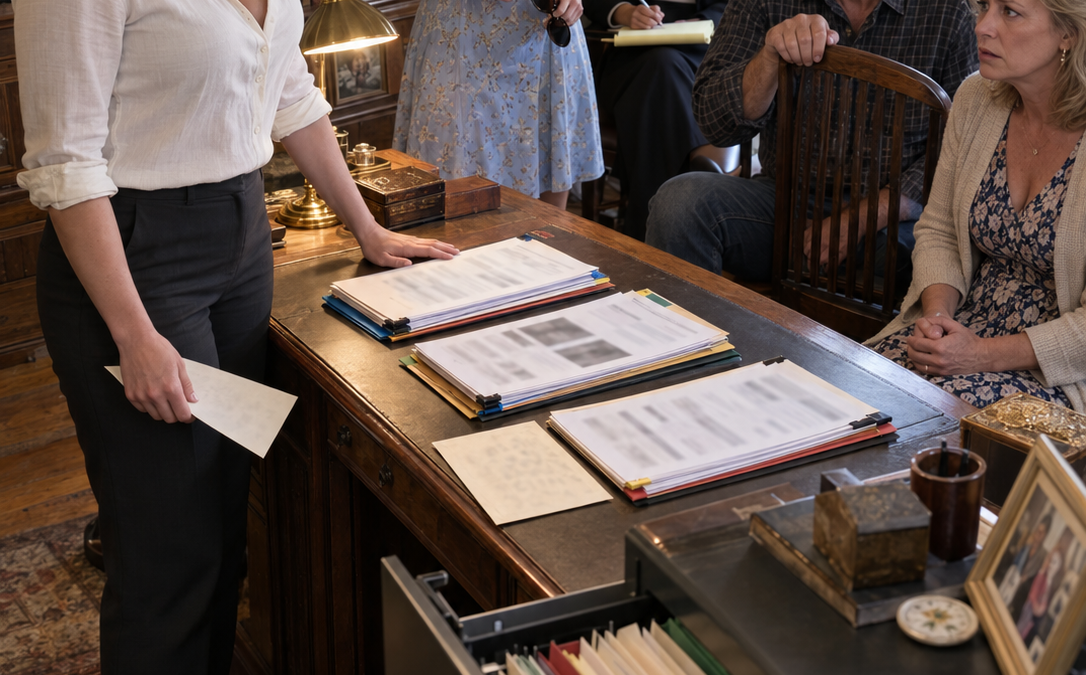
Part 2 of 5: The day after I froze my credit and secured my accounts, I called Daphne and told her to bring Mom and Dad to Grandma Ruth’s house at noon. When they arrived, Patricia was already waiting in the study beside the open filing cabinet. Dad immediately demanded to know why an attorney was there.
“To keep the conversation clear.”
Then I told them why.
“The people who opened accounts in my name are sitting in this room.”
Everything changed.
I placed the Lexus paperwork on Grandma’s desk. Daphne admitted she remembered seeing my name on the financing years earlier, though she claimed Mom had told her Dad was “handling it.” Then I revealed the second truth: Grandma Ruth had left me the house, her accounts, and most of her business holdings. My parents would receive only what her estate plan specifically designated, and Daphne had been restricted from benefiting from the remainder.
Before they could turn that into the argument, I spread out the financial records.
The Lexus.
The kitchen renovation.
Cancún.
Loan applications and signatures tied to my identity without my authorization.
Mom finally admitted the logic behind it.
“Your credit was better than ours.”
“That does not make it yours.”
They insisted they had intended to repay everything. I reminded them that some of those debts were already four years old and that their late payments had damaged my credit while I was working two jobs, completing nursing school, applying for apartments, and preparing for licensing exams.
Then Daphne said something that clarified years of our relationship.
“No one asked you to do all those things for me.”
She meant the fundraisers, family gifts, rescue calls, mortgage help, and every other responsibility I had quietly absorbed.
She regretted the sentence immediately.
I did not.
“You’re right. No one forced me. I kept hoping being useful would eventually make me equal.”
Patricia then confirmed that the disputed signatures did not match verified examples and warned Dad that denying the discrepancies would not make them disappear.
I placed a written proposal on the desk.
They had ninety days to repay every unauthorized balance, associated fee, and documented credit-repair cost. They would also sign statements confirming that I had never authorized the applications.
Mom stared at me.
“And if we can’t?”
“Then I use every financial and legal remedy available.”
“You would do that to your own parents?”
“You did it to your daughter. You just used my name so I wouldn’t see it happening.”
When Dad accused Grandma of being confused near the end, Patricia shut that down immediately. Ruth had undergone evaluations and executed her estate plan over multiple meetings.
They left without signing.
As Daphne reached the door, she told me I had always hated her.
“No,” I said. “I hated being taught that your comfort mattered more than my future.”
She insisted that was the same thing.
“It isn’t. You were taught that it was.”
Part 3 of 5: My knees started shaking only after their cars disappeared down Grandma’s gravel drive. Patricia reminded me that calm did not mean comfortable and that even if my family challenged the estate, the records would remain true.
That night, I slept in Grandma’s bedroom. The next morning, I found a small notebook in her nightstand. She had quietly recorded years of moments nobody else seemed to notice: my first clinical rotation, my academic honors, the graduation announcement my parents barely mentioned, and repeated credit inquiries connected to my name.
Beside her final entry she had written: “I waited too long to interfere. I hope leaving proof is not another form of waiting.”
Grandma had not protected me soon enough.
But eventually she stopped treating silence as virtue.
Four days later, my parents’ attorney contacted Patricia. They were not immediately challenging the estate. They wanted more time to repay me.
I refused.
Ninety days remained ninety days.
Then, amid all of it, I opened the nursing-board portal.
PASS.
I sat alone at Grandma’s kitchen table and cried.
Three weeks later, I began working as a registered nurse at a regional hospital. Instead of returning to my apartment, I decided to keep Grandma’s house. It was old and imperfect—the porch leaned, the gutters clogged, and the water heater complained—but nothing inside it pretended to be something else.
I paid for the porch repair with my own savings. Beneath an old railing, the carpenter discovered initials scratched into the wood.
R.C. and W.C.
Grandma Ruth and Whitney Callaway.
I had carved them there when I was eight.
I told him to preserve the board.
Meanwhile, without the money I had quietly been supplying, my parents began falling behind on their mortgage. Dad called and blamed me for removing support “without warning.”
“You were behind before I helped.”
“We may have to refinance.”
“You already used my name for the renovation.”
“That money preserved the property value.”
“Then the property can repay it.”
Halfway through the ninety-day period, Daphne appeared at Grandma’s house driving a small gray sedan.
The Lexus was gone.
“I sold it,” she said.
The proceeds had covered most of the remaining loan connected to my name. Then she handed me a check for the portion of the Cancún credit line associated with her airfare and hotel.
She still insisted she had not opened the accounts herself.
“You accepted the benefit after seeing my name.”
“I was twenty-three.”
“I was twenty-six and working two jobs to repair the damage.”
For once, she did not have an easy answer.
Then she asked whether I believed she could change.
“I think you can decide differently.”
“Is that the same thing?”
“It’s where change starts.”
She left without an embrace or dramatic reconciliation.
But she had sold the car.
She had brought a check.
For the first time, responsibility was costing her something.
Part 4 of 5: The ninety-day deadline arrived after a twelve-hour hospital shift. When I reached Grandma’s house that evening, Patricia’s email was waiting.
All agreed repayment funds have been received.
Daphne’s Lexus sale covered most of the vehicle debt. My parents refinanced and ultimately sold their house to clear the renovation account and remaining credit costs. They moved into a smaller townhouse.
Every documented dollar was repaid.
There was no apology attached.
I discovered I did not need one.
Patricia helped correct my credit reports. The collection calls stopped. The fraudulent accounts disappeared, and my score slowly recovered. I framed my nursing license and hung it in Grandma’s study. The old fireproof cabinet that once contained evidence became a bookshelf filled with medical references and nursing journals.
The following spring, I repaired the roof, planted hydrangeas along the drive, and painted the front door deep green.
For the first time, the money I earned was improving a life I had actually chosen.
Mom eventually offered an apology, although she began by explaining why they had been afraid of losing their house. When she told me they believed I would recover financially, I finally named the pattern.
“You always recover.”
There it was.
My resilience had become their permission.
“I’m not discussing this unless you can speak without using my strength as an excuse.”
After a long silence, Mom finally said, “I am sorry we used your name.”
It was incomplete.
It was also the first honest sentence she had offered.
Dad never apologized then. He simply mailed the final payoff statement with two words written across the bottom:
Satisfied in full.
Daphne and I began speaking occasionally. She sold most of the designer clothes she could no longer afford and took a job at a nonprofit arts center.
“I make less money,” she told me. “But it’s mine.”
“That matters.”
“I didn’t understand that before.”
Later, she visited Grandma’s house and stopped when she saw my nursing license hanging in the study. She admitted she had always known our parents treated us differently.
“Why didn’t you defend me?” I asked.
“Because being the favorite felt good.”
There was no excuse after it.
She simply said, “I’m sorry.”
“I believe you.”
We did not hug.
We did not pretend the past had disappeared.
Real repair, I learned, could begin with two adults standing in a quiet room and refusing to edit history for comfort.
Years later, when I was promoted to charge nurse, my coworkers celebrated with supermarket cake and paper cups of coffee. My manager praised the way I steadied the unit and helped overwhelmed people without asking them to do anything I would not do myself.
No one mentioned Daphne.
No one handed my achievement to somebody else.
This time, I accepted the praise.
Completely.
Part 5 of 5: Dad finally came to Grandma’s house years later carrying a grocery-store bouquet. He had seen an article about my promotion.
“You’ve done well.”
“I know.”
The answer surprised him.
Before leaving, he stopped at the bottom of the porch steps.
“I was wrong at your graduation.”
“You were.”
“You did deserve it.”
“I know that too.”
Some apologies arrive too late to rebuild what they damaged. They can still confirm that closing the door was necessary.
Grandma’s inheritance gave me property and financial security, but those were not the most important things she left behind. She gave me evidence that I had not imagined the imbalance, and permission to stop confusing forgiveness with access.
I did not win because Grandma chose me over Daphne.
I won because I stopped believing someone else had to lose before I was allowed to matter.
My parents sold the house they expected me to finance. Daphne sold the car my credit had supported. I kept Grandma’s old home because it contained something their polished life never had.
The truth.
My name was clear.
My house was mine.
My work mattered.
And the success my father once said belonged to someone else had become a life no one could ever borrow against again.
THE END








