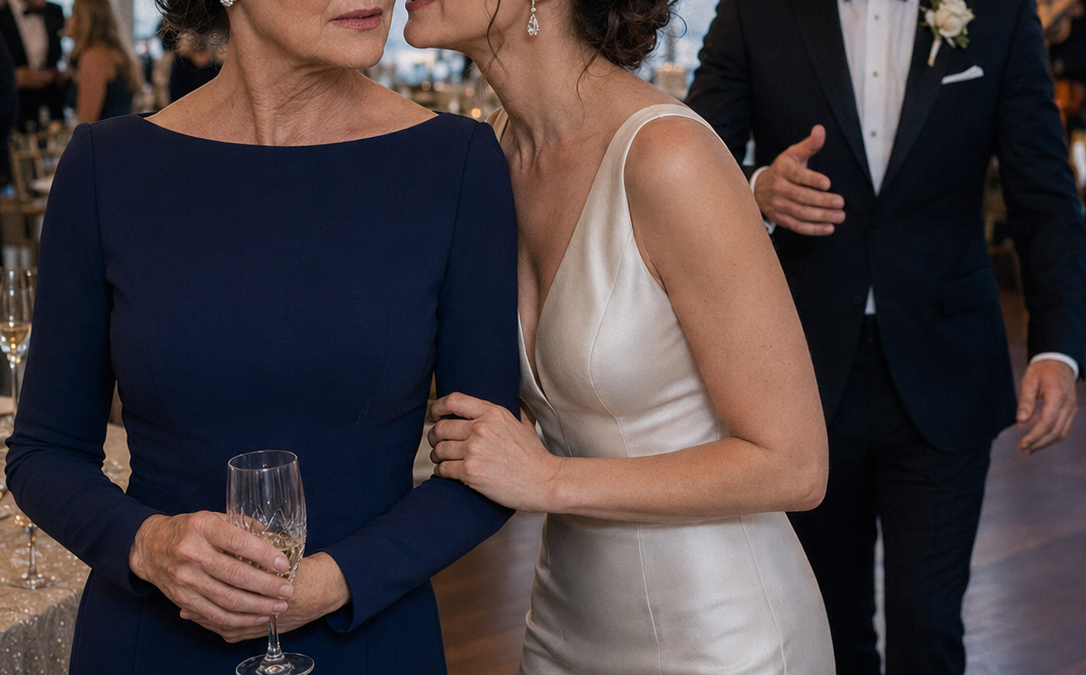
“If you truly love Nolan,” my new daughter-in-law whispered while smiling for the photographers, “you’ll disappear from our lives after tonight.”
Part 1 of 5:
Vanessa never stopped smiling.
She stood beside me beneath a ceiling draped in white fabric and warm string lights, one hand resting lightly around a crystal glass of sparkling cider. Beyond her shoulder, the lake reflected the final copper light of sunset. Guests moved between tables covered in white blossoms, laughing beneath the music while servers carried trays toward the ballroom.
To anyone watching, we looked like a new bride sharing an affectionate secret with her husband’s mother.
Only her eyes told the truth.
They were cool, steady, and completely certain I would obey.
My fingers tightened around my glass.
“What did you say?”
Her smile widened as a photographer turned toward us.
“Closer,” the photographer called. “Beautiful. Hold that.”
Vanessa leaned nearer, her cheek almost touching mine.
“Nolan is building a new life,” she whispered. “He doesn’t need you pulling him backward. Leaving us alone would be the greatest wedding gift you could give him.”
The camera flashed.
For one suspended second, the ballroom disappeared.
I could no longer hear the quartet near the windows or the conversations drifting across the room. I heard only Vanessa’s voice and the quiet click of my own understanding settling into place.
This was not an anxious bride asking for space.
It was not a poorly worded request made under the pressure of an exhausting day.
She wanted me gone.
And she believed the marriage certificate signed less than two hours earlier had given her the authority to make it happen.
My name is Beatrice Holloway. I was sixty-two years old when my only son married Vanessa Reed at a lakeside estate outside Charlotte, North Carolina.
For more than three decades, I had worked as a property and estate attorney. I had helped widows recover homes transferred without their knowledge, protected older clients from predatory relatives, and written trusts designed to prevent money from destroying families.
I had spent my career telling people that affection should never replace documentation.
Yet standing beneath those wedding lights, I realized I had ignored warning signs in my own family because I wanted my son to be happy.
Vanessa lifted her glass toward mine.
“Think about it,” she said.
“I already am.”
Something in my voice made her study me more carefully.
Then Nolan appeared behind her.
“There are my two favorite women.”
He slipped one arm around his bride and kissed her temple. His face was open and joyful, still carrying the wonder of a man who had spent the entire ceremony trying not to cry.
I looked at him and felt the full weight of what Vanessa had asked me to abandon.
Nolan was thirty-four. He had Richard’s dark eyes, my stubborn chin, and a habit of pressing his lips together when he was thinking. At five, he used to wait beside the front window for his father to return from work. At seventeen, he sat with me all night in the hospital when Richard had his first heart procedure. After Richard died, Nolan called me every evening for six months because he worried the quiet house would swallow me.
Now he stood beside a woman who had just ordered me out of his life.
“Mom?” he asked. “Are you okay?”
Vanessa answered before I could.
“She’s emotional.”
Her hand moved to my shoulder.
“Weddings bring everything to the surface.”
I met her eyes.
“They certainly do.”
Nolan smiled, unaware of the tension passing between us.
“The photographer wants us near the cake.”
“You go,” I said. “I need some air.”
“You sure?”
“I’m sure.”
Vanessa gave me a small, private look of satisfaction.
She believed I was retreating.
I placed my untouched cider on a passing tray and walked toward the terrace doors.
The evening air was cool against my face. Beyond the stone railing, the lake stretched beneath a deepening blue sky, its surface broken by the lights of distant boats. White petals had blown from the ceremony arbor and gathered near the edge of the terrace.
I rested both hands on the stone.
My first instinct was not legal.
It was maternal.
I wanted to find Nolan, take him somewhere private, and tell him exactly what his wife had said. I wanted him to look into my face and know immediately that I was telling the truth.
But love does not make people objective.
Sometimes it does the opposite.
Nolan had married Vanessa that afternoon in front of two hundred guests. He was surrounded by champagne, music, congratulations, and the belief that he had begun the happiest chapter of his life. If I confronted him without preparation, Vanessa would cry, deny everything, and describe my reaction as the emotional resistance of a mother unable to release her son.
She had probably prepared that explanation long before speaking to me.
I took out my phone and called Raymond Pierce.
He answered on the second ring.
“Beatrice? Is everything all right?”
“Where are you?”
“At home.”
“How far from Lake Arden?”
“Twenty-five minutes. Why?”
“I need you to activate Section Twelve of the Holloway family trust.”
Silence followed.
Raymond had known Richard and me for twenty-seven years. He was an estate adviser, accountant, and the independent trustee responsible for the assets Richard and I had placed beyond any one family member’s control.
“Are you certain?” he asked.
“Yes.”
“What happened?”
“Vanessa told me to remove myself permanently from Nolan’s life. Her exact words were that disappearing would be the greatest wedding gift I could give him.”
“Did anyone hear her?”
“I don’t know yet.”
“Does Nolan know?”
“No.”
Raymond drew a slow breath.
“Section Twelve allows an immediate temporary suspension. It does not determine final wrongdoing. We’ll need review and supporting evidence.”
“I understand.”
“Beatrice, once activated, the trustee must notify Nolan. The timing may affect the reception.”
“The timing is not my concern anymore.”
“That does not sound like you.”
“I have spent two years protecting everyone else’s comfort. Tonight I am protecting the trust.”
His voice softened.
“Richard included that clause because he worried someone might isolate Nolan.”
“I know.”
“I’ll start the suspension now.”
“Can you come here?”
“I can.”
“Bring the sealed letter.”
Another silence.
The sealed letter had been written by Richard four months before his death. Neither Nolan nor I had read it. Richard instructed Raymond to open it only if Section Twelve was triggered.
“I’ll bring it,” Raymond said.
I ended the call and remained on the terrace.
The decision did not make me feel powerful.
It made me tired.
Richard and I had spent our marriage building a life we believed would give Nolan freedom without teaching him entitlement. Richard owned a regional building-supply company that grew from one warehouse into seven distribution centers. I maintained my legal practice and helped manage the family investments.
We were comfortable, but we did not live theatrically.
Nolan attended public schools, worked summers at the warehouse, and drove Richard’s old pickup during college. He knew the family had resources, but not the full amount or legal structure.
That had been intentional.
Richard used to say, “Money tells you what people want before they learn how to hide it.”
He was not cynical. He was careful.
When Richard became ill, we revised the estate plan.
The family business shares, the investment portfolio, and the lake house were transferred into a protected trust. Nolan would eventually benefit, but control would arrive in stages tied to financial maturity, stable employment, and independent review.
Section Twelve was different.
It directed the trustee to freeze discretionary distributions if there was credible evidence that a spouse, partner, adviser, or family member was trying to isolate Nolan from long-standing relationships for access to trust assets.
Richard had insisted on the language.
I had called it overly cautious.
He had looked at me from his hospital chair and said, “Isolation is how manipulation becomes invisible.”
Standing on the terrace years later, I heard those words as clearly as if he were beside me.
The door opened behind me.
My sister Clara stepped outside.
She was sixty-eight, three inches shorter than I was, and incapable of entering a tense situation without noticing every detail.
“I saw you leave,” she said.
“I needed air.”
“You look like you need a witness.”
I turned toward her.
“Why would you say that?”
“Because I was in the hallway.”
My heart changed rhythm.
“What did you hear?”
Clara came closer.
“I heard Vanessa tell you to leave their lives.”
“All of it?”
“Enough.”
“Did she see you?”
“No. I was behind the service door waiting for a server to show me where the restroom was.”
The terrace lights came on automatically, casting a warm glow across the stone.
Clara studied my face.
“What are you going to do?”
“I called Raymond.”
Her eyes widened.
“You activated the trust provision.”
“Yes.”
“Good.”
The speed of her answer surprised me.
“You don’t think I should speak to Nolan first?”
“I think Vanessa counted on you doing exactly that.”
I looked at her.
Clara rested both hands on the railing.
“Bea, I have watched her separate him from us one reasonable request at a time.”
“She is his wife now.”
“That does not make the pattern less visible.”
I knew the pattern.
I simply had not wanted to name it.
When Nolan first brought Vanessa to Sunday dinner two years earlier, she arrived carrying peonies and a bottle of wine I had once mentioned liking. She hugged me before leaving and said, “I already feel like I’ve known you forever.”
She was beautiful in an effortless-looking way that probably required considerable effort. Her clothes were elegant without obvious labels. Her dark hair always seemed to catch the light. She listened closely, laughed at the right moments, and called me “Mom” before she and Nolan were engaged.
At first, I was grateful.
After Richard died, I worried Nolan would build his adult life around work and loneliness. He had dated, but no relationship lasted. Vanessa seemed warm, intelligent, and deeply interested in creating a family.
She sent handwritten thank-you notes after dinners.
She remembered Richard’s birthday and brought flowers to his grave.
She asked about the lake house and said she hoped future children could grow up with the same family traditions Nolan described.
I mistook curiosity for reverence.
The changes began after their engagement.
Sunday dinners became less frequent.
“We’re trying to establish our own traditions,” Nolan explained.
Phone calls shortened because Vanessa needed him.
Holidays became negotiations.
One Christmas, they arrived two hours late because Vanessa wanted breakfast with her friends first. At Easter, they left before dessert because she said my relatives overwhelmed her.
When I invited them to the lake house, Vanessa suggested I give them a key so they could use it privately.
“We need time there as a couple,” she said.
“You can schedule time.”
“It would feel different if it were ours too.”
I told her the trust owned the property.
Her expression had sharpened for half a second.
Then she smiled and asked how the trust worked.
I gave her no details.
After that, Nolan began asking questions he had never asked before.
How were the company shares structured?
Who would control the lake house after I died?
Could the trust make an early distribution for a home purchase?
Was Raymond truly independent, or did he simply follow my wishes?
Nolan always framed the questions as financial planning.
The language sounded like Vanessa.
Still, I answered patiently. I told myself marriage required adjustment. I told myself a mother who questioned every change would become exactly the controlling figure Vanessa probably described to her friends.
So I made myself smaller.
I stopped calling first.
I accepted canceled dinners.
I pretended not to notice when Nolan repeated phrases that did not sound like him.
Healthy boundaries.
A new household.
Emotional independence.
Reduced outside influence.
None of those ideas were wrong by themselves.
That was what made them useful.
Clara touched my arm.
“You gave her every chance.”
“I gave Nolan every chance.”
“Then let him see what she does with the truth.”
We returned to the ballroom.
The reception had entered its loudest hour. The band played near the dance floor. Guests gathered around the cake while photographers arranged the newlyweds beneath an arch of white roses.
Vanessa saw me immediately.
Her gaze moved from my face to Clara and back again.
I gave her a small smile.
Her shoulders relaxed.
She believed I had accepted her terms.
Nolan cut the first slice of cake and offered it to her. She laughed as frosting touched the corner of his mouth, then wiped it away with one finger while cameras flashed.
The scene was beautiful.
That was the danger of appearances.
They could carry the shape of love without any of its weight.
I walked toward the head table, where my purse remained beneath my chair.
Behind me, Vanessa’s voice rose above the conversation of three bridesmaids.
“The lake house needs a complete update,” she said.
One woman laughed. “You already have plans?”
“I have boards saved for every room.”
“Does Nolan’s mother know?”
“She’ll adjust.”
Another bridesmaid lowered her voice.
“Isn’t the house in a trust?”
“For now.”
Vanessa lifted her glass.
“Those arrangements always sound more permanent than they are. Nolan is the only child. Eventually everything comes to us.”
I stopped beside my chair.
Clara had heard it too.
Across the table, Harold Mason, one of Richard’s former business partners, looked up from his coffee.
Vanessa continued.
“The place is too traditional. Dark wood, old furniture, photographs everywhere. I want lighter floors, a new kitchen, and glass across the back so the lake becomes the entire view.”
“You’ll let Beatrice keep a room?” someone asked.
Vanessa laughed.
“She has her own house.”
Harold’s eyebrows rose.
I reached beneath the chair and lifted my purse.
Vanessa noticed me.
For the first time that evening, uncertainty appeared in her expression.
“Beatrice,” she called brightly. “We were discussing design.”
“I heard.”
She held my gaze.
“Then you know how excited we are about the family future.”
“I am beginning to understand it very clearly.”
Before she could answer, the ballroom doors opened.
Raymond entered carrying a black leather briefcase.
He wore a charcoal suit and a burgundy tie, the same combination he had worn to Richard’s memorial. At seventy, Raymond moved carefully, but there was nothing uncertain about him.
The band continued playing for several seconds.
Then Harold stood.
“Raymond?”
Nolan turned from the cake table.
“Mr. Pierce?”
Raymond walked directly toward me.
“I came as quickly as I could.”
Vanessa’s hand tightened around her glass.
“What is he doing here?” she asked Nolan.
“I don’t know.”
Raymond placed the briefcase on the head table.
Several nearby guests grew quiet. The silence spread outward in uneven circles as people noticed the family adviser standing beside the newlyweds.
Nolan approached us.
“Raymond, is something wrong?”
Raymond looked at me.
“It depends on what occurred tonight.”
Vanessa stepped closer to Nolan.
“This is inappropriate.”
Raymond opened his briefcase.
“I apologize for the setting. The trust requires prompt notification when a protection clause is activated.”
Nolan stared at him.
“What protection clause?”
“The Holloway Family Legacy Trust contains a provision addressing undue isolation, financial influence, and interference with established family relationships.”
Vanessa’s face changed.
Only slightly.
But I saw it.
“What does that have to do with us?” Nolan asked.
Raymond removed a formal notice and a sealed cream-colored envelope.
“Your mother contacted me this evening and reported a statement made by your wife.”
Every eye near the head table moved toward Vanessa.
She gave a short laugh.
“This is absurd.”
Nolan looked at me.
“Mom?”
I kept my voice level.
“Vanessa told me that disappearing from your lives would be the greatest wedding gift I could give you.”
His expression emptied.
“What?”
“She asked me to remove myself permanently if I truly loved you.”
Vanessa shook her head.
“I did not say that.”
“You did.”
“I told her we needed healthy boundaries. She twisted it.”
Nolan’s gaze moved between us.
“Mom, are you certain?”
The question hurt, though it was reasonable.
Before I could answer, Clara stepped forward.
“I heard her.”
Vanessa turned.
“You were listening to a private conversation?”
“I was in the corridor.”
“You heard part of it.”
“I heard you say Beatrice should disappear from their lives after tonight.”
The room became still.
Nolan looked at Vanessa.
“Did you say the word disappear?”
She reached for his hand.
“I was upset. Your mother has never respected our independence.”
My surprise was quieter than anger.
“I have not entered your home without permission. I have not questioned your wedding decisions. I have accepted every canceled dinner and unanswered call.”
“You make Nolan feel guilty.”
“I barely speak to him anymore.”
“Exactly. You withdraw so he notices.”
Nolan pulled his hand away from hers.
“Vanessa, answer the question.”
Her eyes filled instantly.
“I was trying to protect our marriage.”
“From my mother?”
“From constant influence.”
I looked at Nolan.
He was pale.
Raymond remained beside the table, his hands resting on the sealed letter.
Vanessa noticed the envelope.
“What exactly has been frozen?”
The question came too quickly.
Nolan turned toward her.
“Frozen?”
Raymond answered.
“Effective immediately, all discretionary trust distributions are suspended pending independent review.”
“What distributions?” Vanessa asked.
“The family trust holds business shares, investment assets, and real property.”
Her gaze flicked toward me.
“The lake house?”
“Yes.”
The color left her face.
“This is punishment.”
“No,” Raymond said. “It is risk control.”
“You can’t suspend Nolan’s inheritance because his mother misunderstood a conversation.”
“Nolan does not currently possess an unrestricted inheritance.”
Vanessa stared at him.
Raymond continued calmly.
“The assets were established to support long-term stability, family continuity, and responsible stewardship. They were never intended to reward pressure, isolation, or premature claims of ownership.”
Nolan looked at me.
“You knew about this clause?”
“Your father and I created it together.”
“Why didn’t you tell me?”
“Because it was designed as protection, not leverage.”
Vanessa folded her arms.
“This is exactly what I mean. She controls everything.”
Raymond shook his head.
“Beatrice does not control the suspension. I do.”
“Because she called you.”
“Because the trust document requires independent action when credible concerns arise.”
Vanessa looked around at the watching guests.
“This is a setup.”
Aunt Clara stepped closer.
“No one forced you to say what you said.”
Vanessa’s composure began to crack.
She pointed toward me.
“She has never wanted Nolan to grow up.”
I almost answered defensively.
Then I remembered the terrace.
I remembered how certain she had been that I would disappear quietly.
“I wanted him to grow into someone who could recognize love without surrendering judgment,” I said.
Nolan lowered his eyes.
Vanessa turned toward him.
“Tell them to stop this.”
He did not respond.
“Nolan.”
He looked at her.
“Did you marry me believing the lake house would become ours?”
Her lips parted.
“That isn’t fair.”
“Answer me.”
“We discussed a future.”
“You told your friends you were remodeling it.”
Her eyes moved toward the bridesmaids.
One of them looked away.
Nolan’s voice became quieter.
“You told them nothing could stand in your path.”
“I was joking.”
“Were you joking when you asked my mother to leave?”
“I was setting boundaries.”
“Did you expect her to stop calling me?”
Vanessa glanced toward the guests.
“We should discuss this privately.”
“That is what Mom tried to do for two years. Everything became private until I couldn’t see what was happening.”
His words changed the atmosphere more than Raymond’s announcement.
The power in the room shifted.
Vanessa had expected to negotiate against an emotional mother. Instead, she now faced her husband, a trustee, a witness, and her own public statements.
Nolan looked at Raymond.
“What is in the envelope?”
Raymond’s hand rested on the cream paper.
“A letter from your father.”
“My father wrote me a letter?”
“He wrote it before he died and instructed me to open it only if Section Twelve was activated.”
Nolan stared at the handwriting on the front.
Richard had written his son’s name in blue ink.
Nolan.
Vanessa stepped closer.
“This is becoming theatrical.”
Raymond looked at her.
“Richard Holloway was not theatrical.”
Harold gave a quiet nod from across the table.
Nolan touched the envelope.
“Can I read it?”
“It is addressed to you.”
His fingers shook as he broke the seal.
The ballroom remained silent enough for me to hear the paper unfold.
Nolan read privately at first.
Then he stopped.
His throat moved.
“What does it say?” Vanessa asked.
He did not answer.
He returned to the beginning and read aloud.
Son,
If Raymond has given you this letter, then the trust’s isolation provision has been activated. I hope the concern proves mistaken. If it does not, I need you to remember that love never asks you to erase everyone who loved you before.
Money attracts people who admire the life it can purchase. Character is revealed by how they treat those who cannot advance that life.
Your mother has spent her career protecting people from losing their homes, their dignity, and their judgment under pressure. Do not mistake her restraint for weakness. Do not mistake another person’s urgency for your obligation.
The lake house, the company shares, and the investments are not prizes. They are responsibilities. If anyone makes you choose between wealth and the people who knew you before wealth mattered, step away from the wealth until you can see clearly.
Nolan stopped reading.
Vanessa stared at the letter.
The musicians near the dance floor lowered their instruments.
Richard’s words remained in the room.
Part 2 of 5: The wedding reception had barely begun when Raymond arrived with the trust documents and the sealed letter Richard had written years earlier. Nolan had just learned that Vanessa told me the greatest gift I could give him was disappearing from his life. She called it frustration. Nolan called it exactly what it was.
Then the trust review exposed something larger than one cruel sentence.
Vanessa had already been planning renovations to the family lake house, exploring a luxury event business, and treating Nolan’s future inheritance as if marriage would automatically unlock it. She had hired a financial adviser who prepared collateral projections using trust property Nolan did not control.
When Nolan asked why she had done any of this before they were married, Vanessa said she was planning their future.
“With assets you knew I didn’t control,” he replied.
She insisted he would control them eventually.
“That is what you counted on,” I said.
Vanessa immediately accused me of freezing the trust because I could not tolerate my son choosing another woman. Nolan stopped her before the accusation could grow.
“My mother did not tell you what to say.”
He told Vanessa he needed space.
She assumed they would go upstairs together.
“No,” he said. “I need space from you.”
The entire room felt the difference.
Nolan did not end the marriage publicly that night, but he refused to pretend nothing had happened. Vanessa left with her parents while Nolan stayed with an old friend.
Before I left, he stopped me near the terrace.
He apologized for not seeing the pattern sooner.
I told him that being deceived was not failure.
“Failure is refusing to see the truth after it appears.”
Then he asked whether Vanessa had really told me to disappear.
“Yes.”
He closed his eyes.
“I don’t want that gift.”
Neither did I.
Part 3 of 5: Raymond’s formal review uncovered the evidence Nolan needed.
Emails between Vanessa and her adviser went back nine months before the wedding. They discussed future trust distributions, possible use of the lake house as collateral, and the business she planned to build once Nolan had greater access to family assets.
The most damaging messages were about me.
“Once Nolan is legally tied to me, Beatrice’s influence becomes easier to manage.”
Another said that I was sentimental but would retreat if Nolan believed I was causing stress.
Then came the sentence that explained everything:
“If necessary, I will ask her to step away completely. She has too much pride to fight publicly.”
Vanessa had studied my restraint and mistaken it for surrender.
Nolan read the messages separately and called me afterward. He sounded devastated. He had told Vanessa how losing his father affected us, why the lake house mattered, and how much of Richard’s memory lived there.
“She used information I gave her in trust.”
“Yes.”
“I feel like a fool.”
“You made a foolish decision. That does not make you a fool forever.”
The marriage was dissolved several months later. There was no dramatic courtroom battle because the records left little room for Vanessa to claim rights over the trust or family property.
Yet Raymond did not immediately reopen Nolan’s discretionary access.
That surprised him.
The review concluded he needed time to recover before making large financial decisions.
For once, Nolan accepted a limit he disliked without treating it as control.
He moved into a modest townhouse and returned to the kind of work he had loved before Vanessa encouraged him toward projects tied to family assets. He designed libraries, community centers, and affordable housing.
His income became less impressive.
His life became more recognizable.
Six months later, Raymond called us back to his office.
The trust freeze would remain.
But one project would receive funding.
Nolan’s community-housing initiative.
Richard had created a dormant fund years earlier with instructions that it could support Nolan if he ever chose work based on service rather than personal gain.
Nolan read the note his father left behind.
“Build something that makes another person safer.”
For the first time since the wedding, he smiled without shame attached to it.
Part 4 of 5: Nolan and I rebuilt the lake house carefully. We repaired what needed repair without turning the property into a museum or a luxury product. Richard’s old photographs stayed. The oak cabinets stayed. The dock was fixed. The guest rooms were repainted.
No one claimed the house.
We cared for it.
The community-housing project eventually opened with thirty-two apartments, childcare, a shared garden, and a small legal clinic for residents who needed help understanding property documents. Nolan asked me to supervise the volunteer program.
I reminded him I was retired.
“You’re selectively retired.”
He was right.
One afternoon, a young woman brought me paperwork a relative was pressuring her to sign. Halfway through our review, she apologized for not understanding it.
“You should be allowed to ask,” I told her.
Outside the window, Nolan was carrying boxes beside volunteers, sweating and laughing. Watching him, I realized what Richard had actually been trying to protect.
Not wealth.
Choice.
Vanessa had assumed the trust was treasure waiting for marriage to provide a key. In reality, it was built to slow decisions down when love, pressure, money, and fear became tangled together.
Two years after the failed wedding, Nolan and I returned to the same lakeside venue because his firm was designing a public garden there.
Standing on the terrace, he asked what I thought would happen after I called Raymond that night.
“I thought the trust would freeze.”
“I mean with us.”
I told him the truth.
“I thought you might choose her.”
He looked at me quietly.
“I almost did.”
“I know.”
“Does that still hurt?”
“Yes.”
He did not defend himself or ask me to soften the answer.
That mattered more than an apology.
Before we left, Nolan handed me a small box containing a silver key to a private office at the housing center’s legal clinic.
Beneath it was a card.
“For Mom. Thank you for refusing to leave.”
Years earlier, Vanessa believed absence would prove my love.
Nolan finally understood that staying—without controlling him—had been the harder gift.
Part 5 of 5: Our family did not become stronger simply because Vanessa left. It became stronger because Nolan and I stopped performing for each other.
We asked direct questions. We accepted answers that hurt. We learned that boundaries could protect a relationship without becoming punishment.
Richard’s trust had never been designed only to preserve property. It protected Nolan’s ability to make choices without someone else’s financial urgency deciding for him.
And it protected me too.
I could remain his mother without becoming the manager of his life.
Years later, standing beside Nolan at the lake, I understood why refusing to disappear mattered so much.
Vanessa thought my quietness meant I would retreat.
She was wrong.
Restraint was not surrender.
Love was not ownership.
And staying present did not mean holding on too tightly.
Sometimes the most loving thing you can do is remain visible long enough for the truth to be seen—then step back and let the person you love decide what happens next.
Neither Nolan nor I intended to disappear again.
THE END








