She invited twelve strangers to my cabin as if it were her private hotel. I didn’t argue—I simply reminded her whose name was on the deed.
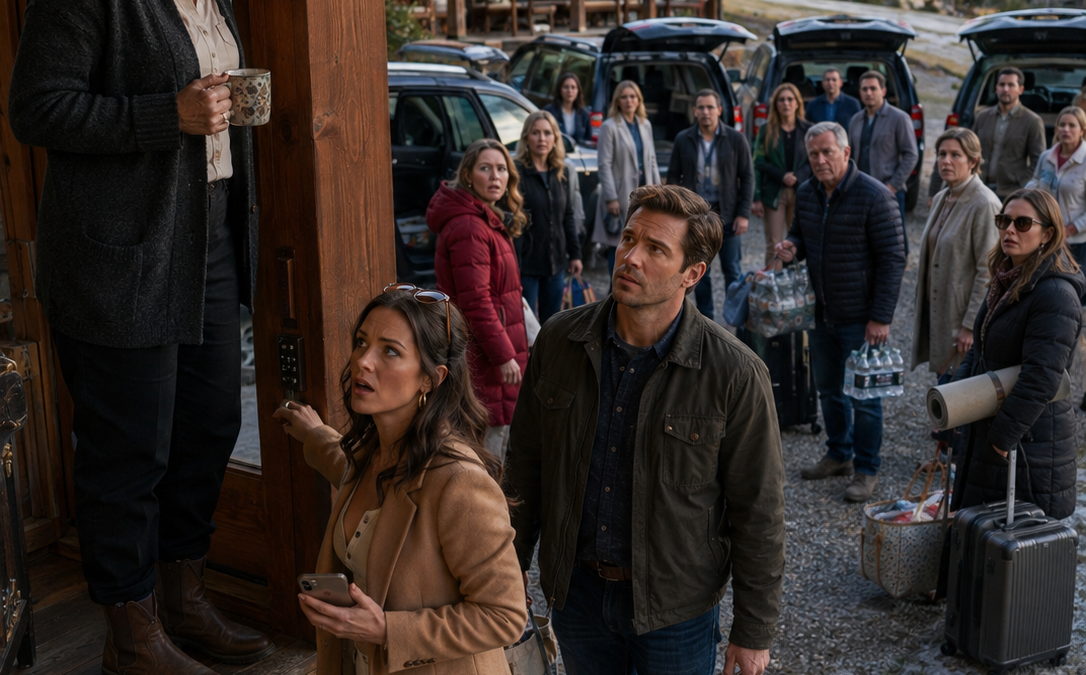
By five, two guests packed their luggage into one vehicle and left. Naomi was among them. Before driving away, she waved from the passenger seat.
The remaining group grew quieter.
Chloe did not appear again before dark.
I made soup and read beside the fireplace.
At eight forty-five, I put on my winter coat and walked down the long driveway.
The front gate had been installed fifteen years earlier, when Allan and I still imagined we might someday own land. He bought it at an estate sale, restored the iron himself, and stored it behind our suburban garage until I accused him of collecting architecture.
When I purchased the cabin property, Mark helped me transport it.
We installed it at the bottom of the drive to keep livestock and unauthorized vehicles from entering after dark.
The bunkhouse rules clearly stated that the gate locked at nine.
At nine, I closed it.
I threaded the chain through the iron bars and secured the padlock.
Then I walked back up the hill beneath a sky dense with stars.
At ten twelve, headlights flashed across my bedroom wall.
A horn sounded.
Once.
Then repeatedly.
My phone rang.
Mark.
“Mom, the gate is locked.”
“I lock it at nine.”
“We went into town for food.”
“The rule was posted.”
“We have meals for everyone.”
“You may park safely near the roadside and walk up.”
“It’s freezing.”
“It is a quarter mile.”
“Open the gate.”
“No.”
Chloe’s voice erupted in the background.
“She cannot do this.”
I spoke calmly.
“This is private property. The gate schedule was provided in writing. You chose to return late.”
“Mom, please.”
“You are wearing coats?”
“Yes.”
“Use flashlights.”
I ended the call and turned off my lamp.
From the upstairs window, I watched phone lights move slowly up the driveway. Mark carried two large food bags. Chloe followed without carrying anything. Three guests walked behind them.
The wind pushed at their coats.
I did not feel pleasure.
I felt stillness.
There is a difference.
Pleasure would have meant I wanted them uncomfortable.
Stillness meant I no longer believed discomfort required my rescue.
Sunday morning brought a thin layer of snow.
Not enough to make travel dangerous, but enough for the county plow to leave a ridge near the roadside entrance. The vehicles parked outside the gate were partially blocked.
I made coffee and watched sunlight enter the valley.
At nine thirty, Mark crossed the yard.
He had not shaved. His coat was zipped incorrectly, one side higher than the other.
“Morning.”
“Good morning.”
“Chloe wants to leave.”
“She is free to.”
“The cars are blocked by the plow ridge.”
“Shovels are in the equipment shed.”
He nodded.
“There is another issue.”
I waited.
“She tried to reserve hotel rooms last night.”
“And?”
“Her card was declined.”
“That is unfortunate.”
“She thought the emergency card would work.”
“It was canceled Tuesday.”
His face changed.
“You canceled it before we arrived?”
“I canceled it after discovering unauthorized charges.”
“She says you should have warned us.”
“I told both of you.”
“She didn’t think you meant permanently.”
“That is another problem with assumptions.”
Mark looked toward the main cabin windows.
“We need a card to hold rooms for the guests.”
“No.”
“Just overnight. We can repay you.”
“No.”
His voice strained.
“Mom, they are furious.”
“With whom?”
He glanced toward the bunkhouse.
“Chloe.”
“Then they understand more clearly than you think.”
He lowered his voice.
“She is falling apart.”
“I am sorry she is distressed.”
“Can you help me?”
“I can tell you the location of the shovels.”
“That’s not what I mean.”
“I know.”
He stood silently.
Then he said, “You planned all of this.”
“I protected my property and closed financial access after it was misused.”
“You knew they would be miserable.”
“I knew they were unprepared.”
“You could have prevented it.”
“So could you.”
He looked down.
The mountain was quiet enough that I could hear snow sliding from a pine branch.
“I hate fighting with her,” he said.
“I know.”
“When she is upset, everything stops.”
“For you.”
“For everyone.”
“No, Mark. You have spent years making her feelings everyone’s emergency. That is why she does not regulate them herself.”
He stared at me.
“I’m not saying that to insult your wife. I’m saying it because you need to hear the structure you helped build.”
His eyes reddened.
“I thought being a good husband meant supporting her.”
“Support does not require surrendering judgment.”
“What if she leaves?”
The question revealed the fear beneath every compromise.
I stepped closer.
“Then you will grieve. You will survive. And you will know whether the marriage depended on your love or your compliance.”
He absorbed the words.
“I can’t fix this for you,” I said. “And I won’t finance another attempt to avoid it.”
Mark nodded.
Then he turned toward the equipment shed.
Within fifteen minutes, twelve adults stood near the gate holding old shovels.
Designer coats collected snow. Expensive boots sank into mud. The group worked in tense silence, clearing the ridge one section at a time.
No one filmed.
No one played music.
Chloe stood near the lead vehicle speaking sharply to Mark. He answered once, then returned to shoveling.
She crossed her arms.
For the first time all weekend, he did not abandon his task to manage her expression.
It took nearly two hours to clear enough space.
By noon, luggage began moving down the driveway.
The guests packed quickly. Several placed trash bags and used linens outside the bunkhouse without speaking to Chloe. One man gave Mark a brief handshake. Naomi had already gone.
The woman in the red coat’s friend approached my porch.
“Mrs. Whitmore?”
“Yes?”
“I want you to know we’re requesting refunds directly from Chloe. No one expects anything from you.”
“Thank you.”
“She told us you had become forgetful since your husband died.”
The sentence entered quietly.
“She said that?”
“She said that was why she handled arrangements. She implied Mark had authority over the property because you sometimes became confused about details.”
I felt the world sharpen.
Chloe had not only treated my home as hers.
She had preemptively damaged my credibility in case I objected.
The tactic was familiar from decades of financial investigations. When someone fears an audit, they discredit the auditor before the records appear.
“Do you have that in writing?” I asked.
The woman unlocked her phone.
A message thread showed Chloe responding to a question about whether I had approved the group.
Don’t worry about Clara. She gets anxious and forgets conversations sometimes, so Mark and I handle the cabin logistics now.
I asked her to send me the screenshot.
She did.
“Thank you.”
“I’m sorry.”
“So am I.”
When she walked away, I opened my notebook and added the message.
False representation regarding owner’s mental capacity and son’s authority.
Documentation preserved.
The weekend had crossed another line.
This was no longer merely rude.
It was a narrative designed to take control.
Chloe approached the porch after the final suitcase had been loaded.
Her cream pants were stained at the cuffs. Mud covered her boots. Her hair had escaped the knot entirely.
She stopped at the bottom step.
“You destroyed my reputation.”
I remained inside the doorway.
“No.”
“My friends hate me.”
“They learned the weekend was misrepresented.”
“You could have let us use the house.”
“You could have asked.”
“You knew they paid me.”
“I learned yesterday.”
Her face shifted.
“Naomi had no right to tell you my business.”
“You used my home as the product.”
“I planned everything.”
“You planned access you did not possess.”
“I created an experience.”
“You created invoices around someone else’s property.”
Her eyes filled.
“You have never respected me.”
“I respected you until you repeatedly confused kindness with permission.”
“You have always thought I wasn’t good enough for Mark.”
“This is not about whether you are good enough. It is about whether you are honest.”
“I was going to repay the card.”
“You spent guest deposits before providing the service.”
“I had expenses.”
“You told people I was forgetful.”
She froze.
The color left her face.
“Who showed you that?”
“It does not matter.”
“She took it out of context.”
“What context makes falsely questioning my memory acceptable?”
“I was trying to reassure them.”
“By suggesting I could not manage my own property.”
“You were being unpredictable.”
“I said no clearly.”
“You changed the code without warning.”
“I told you the main cabin was unavailable.”
“You made me look like a liar.”
“I stopped participating in the lie.”
Her breathing quickened.
For years, guilt had been the lever she used on me.
Without guilt, her words had nowhere to attach.
“I am revoking all access to this property,” I said. “You are not permitted to organize events here, use the address, share interior photographs for business purposes, or represent Mark as an owner.”
She stared.
“You cannot ban your son’s wife.”
“I can control access to my home.”
“You’ll lose Mark.”
“That is his decision.”
The answer unsettled her more than anger would have.
She had counted on my fear of losing my son.
She had not considered that I could love him without surrendering to her.
“You ruined everything,” she whispered.
“No, Chloe. You invited twelve people to a house you did not own, collected money for accommodations you could not provide, spent part of it, and used my account to cover the rest. Your choices ruined the weekend.”
I rested one hand on the door.
“I simply declined to hide them.”
For a moment, she looked young.
Not innocent.
Unprepared.
“Goodbye, Chloe.”
I closed the door and turned the lock.
The click echoed softly through the entryway.
Outside, luggage doors closed. Engines started. Gravel shifted beneath tires.
I did not stand at the window to watch her reaction.
I poured tea.
When I eventually stepped onto the porch, Mark was carrying the final bag toward the vehicles.
He stopped beside the steps.
“Mom.”
I waited.
“I am sorry.”
“For what?”
His face tightened.
“For arriving when you said no.”
I said nothing.
“For letting Chloe use the card.”
He looked toward the vehicles.
“For pretending I didn’t know things because knowing would require me to act.”
That was the first apology of the weekend that named a choice instead of a result.
“I appreciate you saying that.”
“I should have told her no.”
“Yes.”
“I thought avoiding a fight with her kept our marriage stable.”
“It transferred instability to everyone else.”
“I know.”
“Do you?”
He met my eyes.
“I am beginning to.”
I looked at my son standing in the cold with his coat unzipped and exhaustion across his face.
“You are always my son.”
His eyes filled.
“But this property is closed to both of you until I decide otherwise.”
He nodded.
“I understand.”
“And my financial support is finished.”
“I understand that too.”
“No emergency card. No covering business shortfalls. No loans to refund the guests.”
He swallowed.
“We’ll figure it out.”
“Yes.”
The words were not cruel.
They were confidence I should have placed in him years earlier.
He could figure it out.
I did not have to rescue him to prove I believed in him.
Mark glanced toward the SUV.
“I don’t know what happens after we go home.”
“Then pay attention.”
He almost smiled.
“That sounds like Dad.”
“It does.”
He stepped closer as if he might hug me, then waited.
I opened my arms.
He held me tightly for several seconds.
When he released me, he looked older.
Perhaps growth always makes a person look older at first.
He walked down the driveway.
Chloe sat in the passenger seat, staring straight ahead.
She did not wave.
I did not expect her to.
The three vehicles moved through the open gate and disappeared down the mountain road.
Dust and thin snow settled behind them.
I walked to the gate, closed the iron panels, threaded the chain, and locked the padlock.
Then I returned to the bunkhouse.
The interior was a mess.
Used towels lay across bunks. Grocery wrappers covered one table. A decorative lantern had melted slightly near the stove. Empty coffee cups filled the sink.
For one sharp second, resentment rose.
Then I opened the windows.
Cold air swept through the room, carrying away perfume, smoke, and stale food.
The cleanup took three hours.
I worked at my own pace.
No one complained.
No one filmed.
No one asked whether the towels were soft enough.
When I finished, the bunkhouse smelled like pine soap and winter air.
I stood in the doorway looking toward the main cabin.
My home was mine again.
That evening, snow began falling steadily.
I lit the fire, warmed leftover soup, and sat in Allan’s chair.
The silence did not feel empty.
It felt restored.
On Monday morning, I called an estate attorney.
My existing documents left a portion of the cabin property to Mark. I did not remove him entirely, but I changed the structure. The land would enter a trust after my death. Mark could use the main cabin under written conditions, but he could not sell it, borrow against it, use it for business purposes, or transfer access without approval from an independent trustee.
I also created a separate fund for conservation and maintenance.
If Mark learned to respect the property during my lifetime, the trust terms could later change.
If not, the land would eventually pass to a mountain preservation organization.
The attorney asked whether I was acting from anger.
“No,” I said. “I am acting from evidence.”
He nodded as though accountants answered that way often.
Next, I sent a formal notice to Chloe.
It stated that she had no ownership interest, agency authority, rental authority, management role, or permission to use photographs of the property for commercial purposes.
I attached copies of the deed and the purchase records showing the cabin had been acquired solely by me after Allan’s death.
I copied Mark.
Chloe responded within an hour.
This is unbelievably hostile.
I forwarded the message to my attorney and did not reply.
Then the guest refunds began causing trouble.
Naomi emailed to confirm that several participants had disputed the charges. Chloe’s business account could not cover all refunds because she had already spent more than half the money.
Mark did not ask me for help.
That mattered.
Instead, he sold a motorcycle he rarely used and arranged payment plans with the remaining guests. Chloe closed the promotional page for her retreat business.
For three weeks, I heard nothing.
Then Mark called.
“I moved into a hotel,” he said.
I set down my coffee.
“Are you safe?”
“Yes.”
“Is Chloe?”
“Yes.”
“What happened?”
“She says I betrayed her by agreeing the guests deserve refunds.”
“They do.”
“I know.”
The sentence sounded different now.
“She says the weekend failed because you wanted to control us.”
“What do you think?”
He was silent.
“I think she built a business around things she did not own because she assumed I would make them available.”
“That is accurate.”
“I also think I encouraged the assumption.”
“That is accurate too.”
He breathed out.
“I don’t know whether our marriage survives this.”
“I’m sorry.”
“Are you?”
“Yes. I can believe the relationship has become unhealthy and still grieve that you are hurting.”
His voice broke slightly.
“I keep waiting for you to tell me what to do.”
“I know.”
“You’re not going to?”
“No.”
“Why?”
“Because I want you to learn that your decisions belong to you.”
He laughed once, without humor.
“That is terrifying.”
“It is also adulthood.”
He remained in the hotel for two weeks.
Then he and Chloe began couples counseling.
I did not ask for details.
Mark called occasionally. He sounded clearer each time, though clarity often brought more pain before relief.
He admitted he had stopped opening joint credit-card statements because Chloe became defensive about spending.
He admitted she had used his mother’s future inheritance as part of several financial plans.
He admitted he had reassured her that I would “come around” whenever I said no.
That final admission hurt.
“You were using my eventual surrender as a marital resource,” I said.
“I know.”
“Stop saying you know when you mean you just realized.”
He paused.
“I just realized.”
“Good.”
Three months passed.
Winter settled across the mountain.
Snow covered the driveway. Ice formed along the creek. I baked bread, finished several novels, and learned to use the cross-country skis Allan had purchased but never mastered.
The quiet grew deeper.
Not fragile.
Not borrowed.
Mine.
In late March, the snow began retreating from the southern slope. Green returned beneath the pines. Water ran from the cabin roof in steady lines.
My phone rang one afternoon.
Mark.
“Hi, Mom.”
“Hello.”
“Is this a bad time?”
“No.”
He took a breath.
“Chloe and I are still in counseling.”
“I’m glad you continued.”
“We moved back into the townhouse together.”
“How is that going?”
“Slowly.”
I waited.
“She refunded everyone.”
“How?”
“She sold some clothes and equipment. I covered part of it from the motorcycle sale. She took extra work.”
“That sounds responsible.”
“She still believes you could have handled the weekend differently.”
“I could have opened the door.”
“Yes.”
“I chose not to.”
“I know.”
The old phrase.
Then he corrected himself.
“I understand why you chose not to.”
That was new.
“She admitted she lied about owning the cabin,” he continued. “She admitted she used your card because she thought repayment would make permission irrelevant.”
“It does not.”
“She knows that now.”
“Does she?”
“She is beginning to.”
I smiled slightly.
He had learned to distinguish knowledge from recognition.
“Can I visit next month?” he asked.
“Alone?”
“Yes.”
“Why?”
“I miss you.”
The answer was simple.
I let it remain simple.
“You can come.”
“I’ll stay in the bunkhouse.”
“No.”
He became quiet.
“The guest room is available.”
“Are you sure?”
“Yes.”
“I will ask before opening any cabinet.”
“That may be excessive.”
“I’m relearning.”
“I noticed.”
He arrived in April with one duffel bag, a bag of groceries, and no assumptions.
The front gate was open.
He parked near the cabin and waited on the porch until I opened the door.
“Hi, Mom.”
“Hi.”
He held up the groceries.
“I brought dinner ingredients. May I use the kitchen?”
“Yes.”
The question was almost ceremonial.
We cooked together.
Mark chopped vegetables while I prepared chicken. He washed each dish as we used it, perhaps from guilt, perhaps from training.
After dinner, we sat near the fire.
Allan’s photograph rested on the mantel.
Mark looked at it.
“Dad would have been disappointed in me.”
“Your father was disappointed in himself often. He just hid it with jokes.”
Mark smiled.
“He would have changed the code before you did.”
“Yes.”
“He would have let me in later.”
“Maybe.”
“Would you?”
“Not that weekend.”
He nodded.
“I’m glad you didn’t.”
The admission surprised me.
“Why?”
“Because if you had opened the door, Chloe would still believe the plan almost worked. I would still believe smoothing things over was the same as solving them.”
He leaned forward, elbows on his knees.
“I needed the boundary to be real enough that I couldn’t carry it back to you.”
I looked at my son.
“I wish it had not required twelve witnesses.”
“So do I.”
“Are you happy?”
He considered carefully.
“I am more honest than I was.”
“That was not my question.”
“No.”
The word entered the room without drama.
“I am not happy yet.”
“I’m sorry.”
“I think I can become happy.”
“That matters.”
He looked toward the windows.
“Chloe may never like you.”
“I can live with that.”
“She says you judge her.”
“I judge specific actions.”
“She does not feel the distinction.”
“Then she has work to do.”
He nodded.
“So do I.”
We sat in silence.
Outside, wind moved through the pines.
Mark slept in the guest room.
The next morning, he woke before me and made coffee. Not espresso. Ordinary drip coffee from the machine I kept for guests.
He poured two mugs and carried mine to the porch.
The valley was pale with early spring light.
“I forgot how quiet it is here,” he said.
“That is why I bought it.”
“I used to think you moved here because you were lonely.”
“I moved here because I wanted to hear my own thoughts.”
“Were they worth hearing?”
“Eventually.”
He smiled.
Before leaving, Mark walked down to the bunkhouse.
He returned carrying the plastic-sleeved rules.
“Do you want to keep this posted?”
“For now.”
He read the final line.
If these conditions are unsuitable, several motels are located in town.
“You knew exactly what would happen.”
“I knew what could happen when people met the resources they actually possessed.”
He laughed softly.
“That is the most accountant sentence anyone has ever said.”
I took the rules from him.
“Your father would have liked it.”
Mark hugged me before getting into his car.
At the gate, he stopped, closed it behind himself, and returned the chain to its hook without being asked.
Small details matter.
Chloe did not visit that spring.
She sent a handwritten letter instead.
Clara,
I have rewritten this several times because every version sounded like an explanation instead of an apology.
I used your property without permission. I used your money after agreeing not to. I lied to my friends about the cabin, and I said things about your memory because I wanted them to trust my version instead of asking you.
I was trying to create a successful event, but wanting success did not give me the right to use what belonged to you.
I am sorry.
I do not expect access to the cabin or forgiveness. Mark asked me to write only if I could name what I did without blaming you. This is my attempt.
Chloe
I read it twice.
Then I placed it in my desk drawer.
I did not call her.
An apology can be meaningful without immediately restoring access.
That summer, I allowed Mark and Chloe to join me for lunch in town.
Not at the cabin.
A neutral restaurant with wooden booths and large windows overlooking the river.
Chloe arrived wearing simple clothes and no camera equipment. She looked nervous.
“Thank you for meeting me,” she said.
“You wrote a clear letter.”
“I should have written it sooner.”
“Yes.”
Mark glanced between us.
I raised one hand.
“He does not need to manage this conversation.”
Chloe nodded.
“You’re right.”
For a while, we discussed ordinary things. Her work. Mark’s new position. Repairs to their townhouse.
Then Chloe placed a small envelope on the table.
Inside was a check.
Two thousand one hundred forty-six dollars and sixty-eight cents.
The exact amount of the disputed purchases and fees.
“I know the card company reversed most of it,” she said. “This is reimbursement to you, not the bank.”
I looked at the check.
“The money was not the only issue.”
“I know.”
“What is the money meant to repair?”
“Nothing by itself.”
That was a better answer than I expected.
“It is proof that I am not asking you to absorb the cost.”
I folded the check into the envelope.
“Thank you.”
Her eyes filled, but she did not use the tears as leverage.
“I won’t ask to visit the cabin,” she said.
“That is wise.”
“Maybe someday?”
“Maybe.”
The answer was not punishment.
It was honesty.
Another year passed before Chloe returned to the mountain.
The visit was not her idea.
It was mine.
Mark called in early October to say he and Chloe had completed a full year of counseling. They had separated their business and personal accounts, created spending agreements, and closed Chloe Lane Experiences.
Chloe had begun working for a nonprofit event-planning team where every venue required contracts, deposits, and written authorization.
“Ironically,” Mark said, “she is excellent at compliance now.”
“Experience is expensive.”
“It was.”
I invited them for one afternoon.
No overnight stay.
No guests.
No social posts.
They arrived at noon carrying soup, bread, and a pie from a bakery in town.
Chloe waited at the gate until I opened it remotely.
At the cabin door, she stopped.
“May I come in?”
“Yes.”
She entered slowly.
Her eyes moved across the living room she had once promised to twelve strangers.
“I understand why you protected it,” she said.
I looked toward Allan’s chair.
“So do I.”
We ate lunch at the kitchen table.
No one photographed the food.
Afterward, we walked to the bench above the creek.
Mark told Chloe about the initials Allan had carved beneath the armrest. She crouched to see them but did not touch.
“This was yours together,” she said.
“Yes.”
“I told people Mark inherited it.”
“Yes.”
“I think I needed to believe I was closer to a certain life than I really was.”
“What life?”
“Beautiful homes. Events. People admiring me. Feeling important.”
“And now?”
She looked toward the valley.
“I want the life I can actually afford emotionally and financially.”
That was not a dramatic transformation.
It was better.
It was specific.
We returned to the cabin before dusk.
At the door, Chloe placed the guest-room key on the entry table even though she had never used it.
“I know this doesn’t belong to me,” she said.
“No.”
“Thank you for letting me visit.”
“You respected the conditions.”
The acknowledgment mattered to her.
It also mattered to me.
Setting a boundary had not destroyed my family.
It had destroyed an arrangement in which maintaining the family required my constant surrender.
What survived was smaller, slower, and more honest.
Mark visited regularly after that.
Sometimes alone.
Sometimes with Chloe.
They always asked.
Chloe never brought another guest without permission. She never used my address for business, never shared interior photographs, and never assumed the emergency card would return.
It did not.
Trust rebuilt through behavior does not require recreating every old access point.
My finances remained private.
The cabin remained mine.
My estate plan remained protected.
Mark understood.
Chloe eventually did too.
On the third anniversary of the uninvited retreat, I woke before dawn and made coffee.
Snow had fallen overnight.
The bunkhouse roof carried a white layer. The iron gate stood dark against the road. Deer moved near the tree line.
My phone buzzed.
A message from Mark.
Good morning. Chloe and I are thinking of driving up next weekend. Just us. Would that work for you?
A question mark.
I smiled.
Next weekend works, I wrote. Guest room is available.
A minute later, Chloe responded.
Thank you. We’ll bring groceries. Please send a list of anything you need.
I looked through the window at the quiet property.
For years, I believed kindness meant leaving the door unlocked.
I was wrong.
Kindness without limits had taught people that my home, money, and patience existed for their convenience. The first time I secured those things, they called me cold.
But a locked door is not always rejection.
Sometimes it is an invitation to knock.
Sometimes the people who respect you most are the ones willing to wait outside until you answer.
I finished my coffee and walked onto the porch.
The mountain air was crisp enough to sting my lungs. Sunlight had begun touching the highest pines. The valley below remained blue with shadow.
Allan’s bench stood above the creek, half-covered in snow.
The cabin was quiet.
Not the fragile quiet of someone hoping no one would demand anything.
The deep quiet of ownership.
My time was mine.
My money was mine.
My home was mine.
And the people who entered it now understood that love opened the door.
Entitlement never would.
THE END








