My husband told me to take our son and leave—22 years later, his family came asking for the one person they never expected to need.
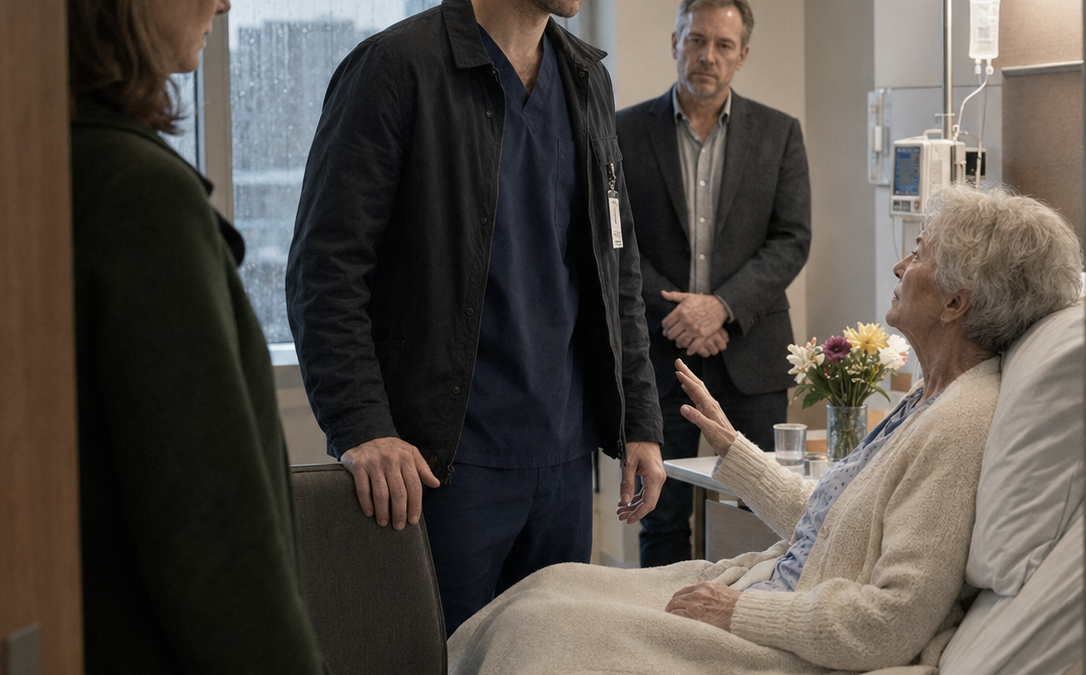
22 years after the night Lorraine told me to take my child and leave, Ethan was 27 years old and finishing his last clinical year of medical school. He had kept the promise he made in the car after ringing that hospital bell. Not in some dramatic overnight way. He had worked for it. Four years of college, long nights studying for entrance exams, more years of medical school with shifts that left him exhausted, and a quiet determination that had always reminded me of the little boy who learned to swallow medicine even when it left him feeling awful. He wanted to work in pediatrics. “I remember what it felt like,” he told me once when I asked why he had chosen it. “Kids know when adults are scared. They know when they’re being rushed. I want them to feel like somebody sees them.” By then I lived in a small townhouse outside Cleveland. My medical billing job had become steady enough that I could finally look at a future without bracing for the next unpaid bill. Ethan rented an apartment closer to the medical center, but he still came home for Sunday dinners whenever his rotations allowed it. Those dinners were simple. Roast chicken potatoes, a green vegetable Ethan would complain had been overcooked even while he took a second serving. We talked about his patients in ways that protected their privacy, about Rose’s latest church fundraiser, about ordinary things.
I loved ordinary things. They had taken me a long time to earn. Daniel had stayed on the edge of Ethan’s life. After graduation, he had begun sending more frequent messages. A card on holidays, a short text before exams. Once he mailed Ethan an expensive stethoscope with a note that said, “Proud of you, son.” Ethan thanked him, but he did not pretend the gift repaired the years before it. Lorraine was quieter, too. She sent birthday cards through Daniel. Sometimes she included a handwritten sentence asking how Ethan was doing. He rarely answered. I never pushed him to. A relationship cannot be rebuilt just because the person who caused the damage has grown older. Ethan had the right to decide what distance kept him safe.
Then one rainy Thursday evening in October, Daniel called me. I almost did not answer. His name had not appeared on my phone in months, and something about the late hour made my stomach tighten before I even picked up. “Hello?” For a moment, all I heard was breathing. Then Daniel said, “Claire.” His voice sounded different, smaller. “Is Ethan with you?” he asked. “No, he’s at the hospital.” “Why?” There was another pause. “It’s Mom.” I sat down slowly at the kitchen table. Daniel explained that Lorraine had been unwell for several months. At first, she had been tired all the time. Then came unexplained fatigue, recurring temperature changes, and concerning lab results. The doctors had diagnosed her with a serious medical condition that would require a stem cell transplant if treatment was going to have a real chance of working.
I listened without interrupting. “She’s been admitted twice already,” Daniel said. “They’ve tested the family. I looked through the rain-streaked window above my sink, “and I’m not compatible.” His voice caught on the word. My sister isn’t either. They’re still looking through the registry, but the transplant team said they said Ethan could be evaluated as a possible related donor. For a few seconds I said nothing. It had been so long since Lorraine had ordered me out of her house that I sometimes wondered whether I had made the whole scene larger in my mind than it really was. Then I would remember Ethan’s face in the backseat. Did Dad mean I cost too much? No, I had not imagined it. Daniel cleared his throat.
I know I have no right to ask anything from him. It was the closest he had ever come to saying it without being forced. But please, he continued, tell him his grandmother needs him. I felt anger rise in me. Not loud anger, not the kind that needed to be spoken. It was the old protective anger of a mother who remembered every time her son had been treated like an inconvenience. But I also heard fear in Daniel’s voice. Real fear. And I had spent too many years learning that fear can make people unkind. I would not let it make me unkind, too. “I won’t decide for Ethan,” I said carefully. “And neither will you.” “I know.” “If he agrees to be evaluated, it will be because he chooses to.
No pressure, no guilt, no acting as if he owes anyone a thing.” “I understand.” After we hung up, I stood in my kitchen for a long time with the phone still in my hand. I did not call Ethan right away. He had spent enough of his life having adults bring hard news into the room and wait for him to be brave. I wanted to tell him in person. Sunday came 3 days later. Ethan arrived late, still wearing hospital scrubs beneath his coat. He looked tired, but he smiled when he walked in and smelled dinner. “Please tell me you made mashed potatoes,” he said. “I did. Then I forgive you for the green beans.” I laughed and for a few minutes I let us have that normalcy.
We ate, we talked about his latest rotation. He told me about a frightened little boy he had met that week and how a nurse had convinced him to take medicine by promising him a dinosaur sticker afterward. “He picked the green one,” Ethan said. “Obviously the best dinosaur color.” When the plates were cleared, I made coffee for him and tea for myself. Then I sat across from him at the table. “There’s something I need to tell you.” He looked at my face and immediately stopped smiling. “What happened?” “Your father called Thursday night.” Ethan leaned back in his chair. I told him everything Daniel had told me. I kept my voice calm. I gave him only the facts.
Lorraine was ill. A transplant might be necessary. The doctors wanted to know whether Ethan would be willing to be evaluated. When I said her name, Lorraine Morgan, his hand tightened around his coffee mug. He went completely still. For the first time in years, I saw not the young man in front of me, but the five-year-old boy in the blue sweater. The one who had thought he cost too much. Ethan did not say anything for a long time. The kitchen clock kept ticking above the stove. Rain tapped softly against the window and the tea in my cup had gone cold between my hands. Finally, he looked at me. “What exactly did Dad ask for?” “He said the transplant team wants to know whether you would be willing to be evaluated as a possible donor,” I said.
“That is all.” Ethan gave a short, humorless laugh. “After all these years?” “I know.” He looked down at his hands. They were no longer the hands of the little boy I had carried out of Lorraine’s house. They were steady hands now. The hands of a young man learning how to examine patients, how to read charts, how to speak gently to frightened families, but I could still see the tension in them. “I don’t even know what I feel,” he said. “You do not have to know tonight.” “What would you do?” The question caught me off guard. For 22 years, I had made decisions around Ethan’s needs. I had chosen medications, appointments, schools, insurance plans, neighborhoods, jobs, but this was different.
This was his body, his history, his choice. “I would tell you the truth,” I said. “Your grandmother failed you deeply. Your father failed you deeply. They do not get to rewrite that because they need something from you now.” Ethan’s eyes stayed on mine. “But I would also tell you that whatever you decide,” I continued, “you should decide because it lets you live with yourself, not because they pressure you, not because you want revenge, and not because you think you owe them.
” He nodded slowly. “I need to talk to the doctors first.” “That sounds wise.” The next week, Ethan called the transplant coordinator himself. He asked questions I would not have known to ask. What testing would be required? What would donation involve? Would it affect his health or his rotations? Were there other options still being explored? Daniel was not included in that first call. Neither was Lorraine. Ethan told me later that he wanted to hear the facts before he heard anyone’s guilt. The transplant team explained that Lorraine still had other treatment underway, and that a donor search was continuing. But time mattered. Ethan could be tested as a related donor to see whether he might be a medically usable option.
He agreed to the evaluation. Daniel called me the moment he found out. “Thank you,” he said, his voice unsteady. “I didn’t convince him,” I replied. “He made his own decision.” “I know. I just thank you.” There was a silence between us. Then Daniel said, “Could I talk to him?” “That is up to Ethan.” For once Daniel did not argue. Ethan went through compatibility testing and additional screening at the transplant center. The process took weeks. During that time Lorraine’s condition worsened enough that she remained under close care. I did not hear from her directly, not until one afternoon when Ethan came to my townhouse after his hospital shift.
He stood in the doorway with his backpack still over one shoulder, looking tired in a way that had nothing to do with medical school. “The results came back,” he said. I set down the dishtowel in my hands. “And they said I’m a compatible haploidentical donor.” I waited. “Not a perfect match,” he explained, “but a viable related donor option. The doctors think the transplant can proceed if Grandma agrees and her team decides it is still the right course.” I heard the word Grandma and felt something twist inside me. Ethan had not called her that in years. “What do you want to do?” I asked. He walked to the kitchen table and sat down in the chair across from mine. “I don’t know yet.
Ethan did not decide about the donation in one clean, noble moment. I think that matters. For several days after he learned he was a viable related donor option, he moved through life as if two versions of himself were arguing quietly inside him. One was the doctor he was becoming, trained to separate emotion from medical facts long enough to make a careful decision. The other was still the little boy who had sat in a blue sweater and listened to adults speak as if his needs were an inconvenience. On Monday, he came over after work and opened my refrigerator without saying hello. “You have nothing to eat.”
“I have food.” “You have mustard, yogurt, and half an onion.” “That is technically food.” He stared at me. Then we both laughed. It was a small moment, but I could see how tired he was. While I made grilled cheese, he sat at the kitchen counter and said, “I keep thinking about what happens if I say no.” I put the spatula down. “Nothing happens to your character if you say no.” “I know.” “Do you?” He looked toward the window. “The doctors are clear that this is voluntary. They keep saying that.” “Because it is.” “But Dad keeps sounding like every hour matters.” “His fear is real. It still does not belong on your shoulders.”
Ethan rubbed both hands over his face. “I hate that part of me wants him to understand what it felt like to need someone and not know if they would show up.” I did not rush to correct him. “That does not make you a bad person.” “It makes me feel like one.” “No. It makes you human. What you do with the feeling is what matters.” The next day, Ethan requested another conversation with the transplant team without Daniel or Lorraine present. He spoke with the coordinator, a physician, and an independent donor advocate whose job was to focus only on Ethan’s welfare and consent. When he told me about it later, I was relieved.
“They asked me what I would decide if no one in the family ever found out why I decided it,” he said. “That’s a good question.” “Yeah.” “What did you say?” He smiled faintly. “I said I would still need more time.” The donor advocate also reminded him that changing his mind before the procedure would be his right. That sentence affected him more than I expected. For years, so many family decisions had been presented to him as obligations disguised as love. Knowing that he could step away at any point gave him back a sense of ownership. Daniel struggled with that boundary. One evening he called Ethan three times during a hospital shift.
Ethan did not answer. Daniel then called me. “Can you tell him to call me?” “No.” “Claire, this is serious.” “I know.” “My mother is getting weaker.” “I understand.” “So why are you acting like we have unlimited time?” I held the phone away from my ear for a second, not because he was shouting, but because the old pattern was suddenly so familiar. Daniel was afraid. Daniel wanted relief. Therefore someone else had to carry his urgency. “He is a possible donor,” I said. “He is not a solution you get to schedule.” Daniel went quiet. “I didn’t mean it like that.” “I know. But that is how it sounds.”
For once, he did not argue. By the end of that week, Ethan told me he had reached one conclusion even though he had not reached a final decision. “I need to talk to her.” “Lorraine?” He nodded. “Before I agree to anything.” I did not ask what he planned to say. I knew better than to turn his preparation into my script. Instead I asked, “What do you need from the conversation?” He thought for a long time. “I need to know whether she remembers.” “Remembers the dinner?” “Not just the dinner. Me.” That answer stayed in the room. He did not need Lorraine to perform guilt for him. He needed to know whether the five-year-old boy in the blue sweater had ever existed in her memory as a person, or only as a problem attached to me.
“What if she apologizes because she needs something now?” he asked. “Then you may hear that in the way she speaks.” “What if I can’t tell?” “You do not have to judge her entire life in one conversation.” He gave me a tired smile. “You’re annoyingly reasonable.” “I worked very hard to become this irritating.” That got a real laugh. Then his expression grew serious again. “If I do this, I don’t want everyone acting like it fixes us.” “Then say that.” “To Dad?” “To anyone who needs to hear it.” He nodded. Before leaving that evening, he stood near the front door with one hand on the knob. “I keep thinking about those old pictures you saved.”
“The drawings?” “Yeah. Mom and me. People who stay.” I looked toward the hallway closet where the folder still sat in a storage box. “Those were your pictures.” “I know.” He paused. “I think I spent years believing family meant the people in the picture. Maybe it really meant the people who earned a place there.” I had no better answer, so I simply said, “Maybe.” After he went home, I took the folder out and placed the drawings on the kitchen table. MOM + ME under the oversized yellow sun. PEOPLE WHO STAY beneath the school hallway heading. I realized Ethan’s eventual decision would not change the truth in either picture.
If he donated, Lorraine would not suddenly become someone who had stayed. If he declined, he would not become unkind. The past was not a debt ledger, and no medical procedure could balance it. That understanding was the only thing that made the waiting bearable. ” That evening Daniel called Ethan directly. I was in the living room pretending to read when I heard Ethan’s quiet voice through the partly open door. “No, Dad. Don’t say I’m her only hope.” A pause. “I know you’re scared, but you don’t get to put that on me.” Another pause. Then Ethan said, “I need to speak with her first.
The next day he drove to the hospital. He asked me not to come. “I need to do this alone,” he said. I wanted to tell him that he did not have to face them alone. I wanted to sit beside him the way I had sat beside his hospital bed when he was small, but I understood. So, I kissed his cheek and said, “Call me whenever you’re ready. ” Hours passed. By the time he returned, the sun had set. He found me waiting at the kitchen table with a bowl of soup covered in foil. He took off his coat, but did not sit down right away. “She looked so small,” he said. I could hear no triumph in his voice, only sadness. “Was Daniel there?” I asked. “He left us alone after a few minutes.
And what did Lorraine say?” Ethan pulled out the chair across from me. “At first, she tried to explain it away.” His voice was calm, but his eyes had changed. “She said she was under stress back then. She said Dad was worried about money. She said everyone was scared.” I closed my eyes briefly. Those were not apologies. They were excuses dressed in softer clothes. “Then I asked her if she remembered what she said to us,” Ethan continued. I looked at him. “She did.” His jaw tightened. “She said she remembered telling you to take me and leave. She said she remembered calling me your kid.” For a moment, neither of us spoke. Then Ethan looked down at the soup I had made him.
“I told her, ‘You called me her kid when I was going through treatment, but Mom never once treated me like I was too much.’” My throat closed. Ethan swallowed hard before he continued. “She cried, really cried. Not like she was trying to make me feel sorry for her. She said she had spent years telling herself she was protecting Dad, but the truth was she only protected what was easiest for him. ” “What did you say?” I told her I wasn’t there to make her feel better. I reached across the table and took his hand. I asked what came next. Ethan looked at me with the same quiet steadiness he had carried through every hard thing in his life. Then I told her I would donate. My breath caught. Not because she deserves it, he said, and not because Dad asked.
I’m doing it because I don’t want them to decide the kind of man I become. I squeezed his hand. That sounds like you. He gave me a faint smile. A few days later the transplant team confirmed the plan. Ethan completed the final medical screening and signed the consent forms after the doctors reviewed every risk and every step with him. The night before the procedure, Daniel asked to speak with him alone. I saw them standing together in my driveway after dinner. My son tall and composed, and the man who had once mistaken providing money for being present. When Daniel finally left, Ethan came back inside. He stood by the door for a moment. What did he say? I asked.
Ethan looked tired. He asked if there was any chance I’d ever forgive him. And what did you tell him? Ethan looked toward the hallway where an old photo of us after his final childhood treatment still hung on the wall. I told him I didn’t know yet. Then he added quietly, but I told him saving Grandma would not erase what happened. The transplant took place in early December. By then, the first snow had settled along the curbs outside the hospital turning Cleveland gray and quiet. I remember standing by the window in the waiting area before sunrise watching people hurry through the cold with their heads down. 22 years earlier I had sat in hospitals terrified that my little boy might not come home.
Now I was there again watching that same boy grown into a man prepared to give something of himself to the woman who had once made him feel unwanted. There was no satisfaction in it, only the strange weight of knowing how far Ethan had come. The procedure itself went as the transplant team had explained. Ethan’s donation was carefully planned, monitored, and completed without complications. He was tired afterwards, sore, and pale, but he tried to make a joke when I came into his recovery room. “Good news,” he said weakly. “I can confirm hospital gelatin is still terrible.” I laughed, though my eyes filled with tears. “You gave me 22 years of experience with hospital food,” I told him.
“You should know better than to eat it.” He smiled, and for a moment I saw the 5-year-old boy who had needed me to hold his hand before every lab tests. I kissed his forehead. “You did something very brave.” Ethan looked away toward the window. “I hope it helps her,” he said. That was all. He did not ask whether Lorraine had thanked him. He did not ask whether Daniel had cried. He had made his choice, and he had done it for the reason that mattered to him. Because he refused to let old past harshness shape his heart. The transplant was successful, but Lorraine’s recovery was slow. The doctors had warned us that it would be. A transplant was not a magic ending. There were long weeks of monitoring medication, weakness, and uncertainty.
Daniel stayed close to her during that time. At first, I assumed fear would make him return to his old habits. Talking about how hard everything was for him, looking for someone else to carry the emotional weight. But something in him had changed. Or perhaps life had finally made it impossible for him to keep looking away. A few months later, he called Ethan and asked if they could meet for coffee. Ethan said yes. Not because everything was forgiven. Because he was willing to see whether his father could finally be honest. When Ethan came home afterward, I did not rush to ask. I put a plate of leftovers in front of him and waited.
Finally, he said, “Dad started counseling.” I looked up. “He said he’s been going for a while,” Ethan continued. “He said he spent years blaming everyone else because it was easier than admitting he failed us.” The room was quiet. He also said he’s working with an attorney about the child support arrears. I had not expected that. Daniel had paid what the court required after the divorce, but there had been years when missed payments, delayed reimbursements, and excuses had forced me to cover more than I should have. I had stopped expecting him to make it right, not because it did not matter, because I had learned not to build my peace around what Daniel might someday become.
“What did you say?” I asked Ethan. He shrugged gently. “I told him paying what he owed was not the same as fixing the past.” I smiled a little. That sounds right. He said he knew. That was the beginning of it. Not a grand reunion, not a movie scene where everyone cried, hugged, and suddenly became the family they should have been all along. Just small conversations. Daniel began calling when he said he would call. He asked Ethan about his pediatric residency applications and listened to the answer. He came to dinner once and helped clear the plates without being asked. Ethan remained careful. He did not call him Dad.
He did not pretend the pain had disappeared. But he allowed Daniel the chance to show consistency one ordinary act at a time. Lorraine asked to see me several months after she left the hospital. I almost said, “No.” Then I thought about how much of my life had been spent wishing someone would simply acknowledge what they had done. Not excuse it. Not soften it. Acknowledge it. So I agreed to meet her at a quiet cafe near my office. She looked smaller than I remembered. Her hair had thinned, and her hands trembled slightly as she wrapped them around her cup of tea. For a while, neither of us spoke. Then Lorraine looked at me and said, “I owe you an apology.” I waited.
“For that night,” she continued, “and for every way I made you feel like caring for Ethan was nothing. I saw what you were doing. I saw how tired you were. Her voice broke. “And I still chose Daniel’s over both of you.” There it was. No mention of stress, no blame placed on money fear or someone else. Just the truth. “I made a little boy feel like he was a burden,” she said. “And I made his mother feel like she had no value because she did the work nobody else wanted to do.” I looked at her for a long moment. Then I said, “Thank you for saying it plainly.” Her eyes filled. “I’m sorry, Claire.” “I believe you are,” I said.
“But an apology does not take away what Ethan carried.” “I know. And if you want a place in his life, you have to let him decide what that looks like.” She nodded. “I will.” That was enough for me. I did not forgive her in one dramatic moment. I did not pretend we became close. But I no longer needed her shame to prove that I had been right to leave. I had known that the night I buckled Ethan into his car seat. Years later, when Ethan began his pediatric residency, he hung a small framed note above his desk. I had written it for him after he received his acceptance letter. It said, “You were never too much to love.” One evening, he sent me a picture of it beside his white coat.
I stared at that photo for a long time. My answer to the past had never been seeing Daniel or Lorraine struggle. It was raising my son without teaching him to become unkind. It was watching him grow into the kind of man who could remember every painful chapter and still choose dignity. A man who understood that compassion was not weakness and that forgiveness, if it came at all, had to be earned. If this story touched you, I hope you will share what you believe makes a real family: shared DNA, promises, or the people who stay when life becomes hard. And if you enjoy stories about dignity, healing and quiet strength, please like, subscribe and join us for the next one.
THE END








