The developer dumped compacted fill into my farm’s washwater reservoir to create a bigger lawn for a model home—then blamed my equipment when the packing line shut down. So I agreed to one full-demand test of their “replacement” system. When the alarm screamed again, their own engineer had only one answer: dig the dirt back out.
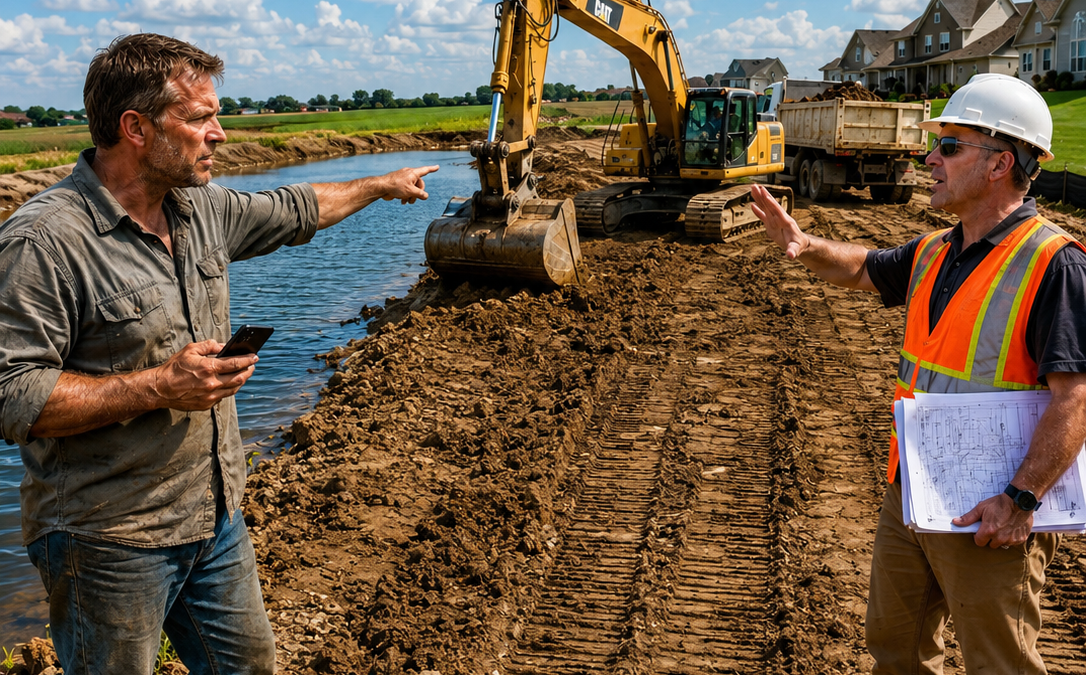
Part 3 of 3: The first thing I did after the reservoir came back was walk the entire shoreline.
Not because I expected another excavator.
Because restoration can look complete from fifty feet away while still leaving problems underneath.
Aaron came with me.
So did a civil engineer retained through the claims process.
We checked the repaired liner.
The intake location.
The reconstructed side slope.
The overflow elevation.
The transition where the developer’s grading stopped and my reservoir began.
That line mattered now.
Before all this, the pond edge had felt like an ordinary piece of farm infrastructure.
Afterward, I wanted nobody confusing “close to the drainage easement” with “available for redesign.”
The recorded easement stayed.
I never disputed it.
The neighboring development had a legitimate right to access a narrow drainage corridor for specific maintenance purposes.
That did not make the pond theirs.
It did not make the full shoreline a construction zone.
And it definitely did not convert my water-storage capacity into extra lawn.
That was the mistake at the center of everything.
The developer’s team had started with a real right.
Then stretched it until it served a completely different purpose.
Their drainage easement became a grading limit.
The grading limit became a landscape opportunity.
The landscape opportunity became a model-home backyard.
By the time the excavator arrived, everyone on the crew had a drawing telling them the dirt belonged there.
Nobody in the field needed to feel dishonest.
The dishonesty had happened earlier.
Somewhere between legal survey lines and design drawings, somebody had stopped asking what the easement was actually for.
That is one reason I never blamed the excavator operator.
He had stakes.
A plan.
A foreman.
Instructions.
When I told him to stop, he stopped after the foreman gave the order.
The larger failure belonged higher up.
The development company had allowed a landscape objective to occupy space that was actively performing a farm function.
And once the mistake became expensive to reverse, they kept searching for a way to make my operation adapt to their mistake.
That bothered me more than the original fill.
People make layout mistakes.
Plans conflict.
Survey information gets interpreted badly.
Construction happens in the wrong place.
Those things can be fixed.
What turns a mistake into a fight is the moment someone decides the cheaper solution is for the damaged party to permanently change how he operates.
The temporary water tank was useful.
I was grateful for it.
It kept product moving.
But useful during an emergency did not mean acceptable forever.
The outside packing company saved one of my orders.
That did not mean I should start hauling produce off-site every time the farm hit peak harvest.
Reduced demand kept the wash line alive.
That did not mean half-speed production was equivalent to what I had before.
Each temporary measure solved a moment.
None restored the operation.
That distinction became the whole dispute.
The developer kept saying some version of:
“You still have water.”
And they were right.
There was water.
But quantity, timing, storage, pressure, and demand all matter.
A drinking glass contains water.
So does a reservoir.
That does not make them interchangeable.
The original system worked because the well and reservoir did different jobs.
The well provided steady supply.
The reservoir provided time.
That was the part their early designs missed.
On a light packing run, the smaller basin could look perfectly adequate.
Water came in.
Water went out.
Pressure held.
Everybody smiled.
On a heavier ordinary run, demand temporarily exceeded well production.
That was normal.
The reservoir absorbed the difference.
Reduce the storage, and the same normal demand suddenly becomes a failure.
Once we measured performance instead of arguing about appearances, the problem became much simpler.
Aaron said it best during one meeting.
The project manager insisted their smaller basin was “functionally sufficient.”
Aaron asked:
“Sufficient for what load?”
Nobody had a good answer.
That question forced the engineers to use real production data.
They stopped designing around what would fit behind the model home.
They started designing around what the packing shed actually required.
That was when their permanent alternative became absurdly complicated.
A larger tank.
Then more tank capacity.
Then another feed connection.
Service access.
Level controls.
Maintenance requirements.
Freeze protection.
Inspection.
Replacement schedules.
Emergency provisions.
Every revision created another permanent thing I would depend on because somebody else wanted a flatter lawn.
At one point, their civil consultant asked me:
“If we provide equivalent storage and accept maintenance responsibility, would you consider it?”
I said yes.
That surprised the project manager.
He had apparently decided I was emotionally attached to the shape of my reservoir.
I wasn’t.
If somebody could safely replace its function with an equivalent system, without creating new long-term costs or operational dependence for me, I would evaluate it.
I run a farm.
I care whether systems work.
That answer mattered because it made the final test fair.
I had to accept that their design might succeed.
The written protocol went both ways.
If it passed, I could not reject it merely because I preferred open water.
If it failed under normal documented demand, they could not respond with yet another smaller workaround.
They had to restore what they removed.
For the first time, both sides knew what failure meant before the test started.
That was why the alarm at the end mattered.
Not because it was dramatic.
Because nobody could argue afterward about what the next step was.
The developer’s own civil engineer looked at the agreement and said:
“This one failed.”
Two days later, the dirt started coming out.
The model-home landscape architect was not happy.
I know because I saw the revised plan.
Instead of a broad lawn sweeping toward my reservoir, the yard ended earlier.
A retaining feature handled the grade change.
Planting softened the transition.
The development lost some showcase grass.
The world survived.
The model home still sold.
People still drove through Cedar Ridge Heights and admired the landscaping.
Children still played in the backyard.
Nobody stood there wishing desperately for the additional stretch of lawn that would have required burying part of my farm reservoir.
That is another thing worth remembering.
During a dispute, people often talk as if the contested feature is essential.
The bigger yard was essential.
The clean grade was essential.
The view was essential.
Until restoring my pond became mandatory.
Then the design team found another solution.
Professionals usually can.
They just need the incentive pointed in the right direction.
My damage claim took longer.
The easy costs were the invoices.
Temporary tank rental.
Tanker deliveries.
Outside packing fees.
Additional hauling.
Service technicians.
Reservoir restoration.
Those had paper behind them.
The harder losses involved reduced throughput and labor inefficiency.
Luis had kept detailed production logs.
That helped.
We could show how much product normally moved through the shed during comparable runs and what happened on the reduced days.
I did not claim every imagined dollar.
That was important to me.
If an order shipped, I did not pretend it was lost.
If a worker remained productive, I did not pretend the whole hour was wasted.
We documented what we could support.
The developer and its insurer disputed some items.
We negotiated.
Eventually, it resolved.
No one handed me a life-changing check.
I was compensated for documented costs and losses.
That was enough.
I had never wanted to profit from a damaged pond.
I wanted the farm put back.
The relationship with the development changed afterward.
Not friendly exactly.
Professional.
The construction director assigned one contact person for any work near my property.
Before crews entered the drainage corridor, I received notice describing:
where they needed access,
what they intended to do,
which equipment would be used,
and how long the work would take.
The limits were staked from the recorded easement, not from somebody’s landscape concept.
The first time this happened, the email almost made me laugh.
Proposed work remains entirely within drainage maintenance corridor. No disturbance to reservoir footprint.
I wrote back:
Approved.
That was it.
No lawyers.
No alarms.
No excavator parked in open water.
Permission is boring when done correctly.
I have come to appreciate boring.
The packing shed returned to its old rhythm.
Luis liked to say he could hear whether the line was running correctly from outside.
The pumps have one sound when pressure is stable.
The sprays have another.
Conveyors add their own rhythm.
Fans run constantly.
When everything works, you stop hearing individual machines.
It becomes one background noise.
For a while after the incident, I listened too closely.
Every pressure fluctuation made me look toward the panel.
Every pump cycle sent me outside to check the reservoir.
Aaron finally said:
“You know the alarm is supposed to alarm.”
“I know.”
“You don’t have to watch it so hard that it becomes your full-time job.”
He was right.
Eventually, I stopped.
That autumn, harvest ended.
The reservoir recovered fully.
Winter rains came.
Water rose along the restored shoreline.
Grass established on the repaired slope.
The scars around the excavation faded.
One morning, I walked out after frost and could barely see where the compacted shelf had been.
The model home stood beyond the property line.
Lights on.
Smoke coming from the chimney.
Someone had bought it.
A family, apparently.
I met the owner months later.
His name was Ryan.
He was walking near the back property line and waved.
“You’re the farmer?”
“That depends who’s asking.”
He laughed.
“I heard there was some huge fight over this backyard.”
“Not really.”
He looked toward the reservoir.
“The sales agent said there were drainage revisions.”
“That is one way to describe it.”
He seemed embarrassed.
“For what it’s worth, I like the retaining wall.”
“So do I.”
He looked at the pond again.
“Is that irrigation?”
“Packing water.”
“For vegetables?”
“Among other things.”
He nodded.
Then said:
“Glad they didn’t fill it.”
I smiled.
“So am I.”
Ryan had nothing to do with the dispute.
That mattered.
New homeowners did not inherit blame because a developer made bad choices before they arrived.
We became ordinary neighbors.
He waved when I passed.
I waved back.
His kids occasionally watched tractors from the fence.
Nobody argued over ponds.
The drainage easement was used twice the following year.
Once for debris removal.
Once for inspection.
Both times the contractor stayed inside the corridor.
Both times my reservoir remained untouched.
The system worked exactly as boundaries are supposed to work.
Quietly.
I kept the signed acceptance protocol.
Not because I expect another lawsuit.
Because it contains the sentence that finally changed everything.
If the replacement system failed to support documented normal operating demand due to insufficient usable storage, the developer would restore reservoir capacity.
Simple.
Performance-based.
No argument about whether the pond was attractive.
No argument about whether a tank looked modern.
No argument about how much lawn buyers wanted.
Could the replacement do the job?
It couldn’t.
So the pond came back.
There was never a single dramatic document proving I was right from the beginning.
The drainage easement was real.
The developer had legitimate work nearby.
Their first temporary fix really did run my line.
Their final replacement design was not ridiculous.
That is what made the dispute difficult.
Their solution worked—
until the farm asked it to do the ordinary work it had always done.
That is the lesson I kept.
A substitute is not equivalent because it works for twenty minutes.
An emergency measure is not permanent infrastructure because it saves one afternoon.
And “still functioning” is not the same as “restored.”
Sometimes the best way to end an argument is to stop debating intentions and agree on a test.
Define normal.
Define failure.
Define what happens next.
Then let the system answer.
Mine did.
The alarm sounded.
The dirt came out.
And the reservoir went back to doing the quiet job nobody appreciated until someone tried to turn it into a lawn.
The end
Disclaimer: This content is entirely AI-generated for fictional and entertainment purposes only. Any resemblance to actual persons, living or dead, events, or locations is purely coincidental, and the creator assumes no liability for any interpretation of this content.








