The HOA locked my farm’s water valve and accused me of stealing from their system—while 63 cattle stood beside drying troughs. Then a state inspector tested the flow direction and discovered the truth: Cedar Ridge wasn’t supplying my farm. Their luxury neighborhood had been secretly pulling water from my line for years.
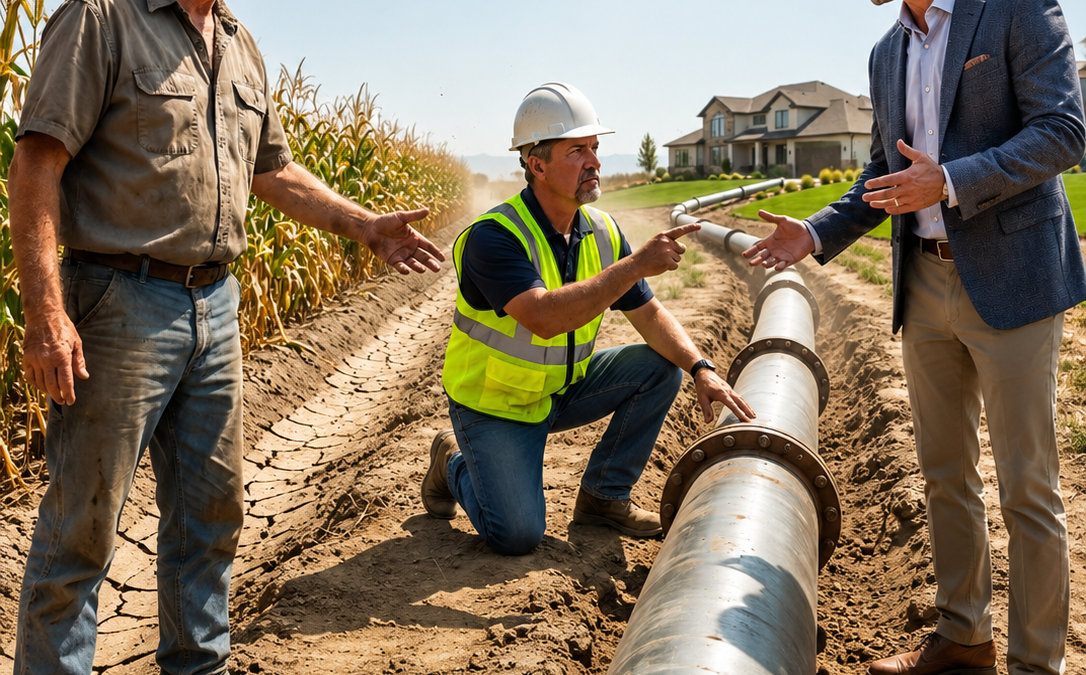
Part 3 of 3: Daniel Mercer didn’t make a speech.
That was one reason people believed him.
He turned the entire morning into measurements.
Pressure before isolation.
Pressure after isolation.
Flow direction.
Meter changes.
Pump-station alarms.
Irrigation response.
Fountain response.
North-loop pressure.
Everything went into the state file.
Before leaving, he issued written instructions prohibiting Cedar Ridge from interfering with my farm connection while the investigation remained open.
My water stayed on.
The cattle stopped crowding the troughs.
And for the first time in days, my morning routine became ordinary again.
Almost.
Three days later, Daniel called while I was repairing fence along the south pasture.
“We found the older utility records.”
“What do they show?”
“The agricultural line predates Cedar Ridge by decades.”
I already knew that.
But hearing the state say it mattered.
He continued.
“The original developer received temporary permission to access agricultural infrastructure during construction.”
“Temporary?”
“Yes.”
“Permanent connection?”
“We haven’t found one.”
“What about the six-inch branch?”
“It does not appear on the final approved utility plan.”
I rested one boot on the bottom fence rail.
“So Cedar Ridge never owned my line.”
“That’s not a conclusion I’m giving you over the phone.”
Typical Daniel.
Careful.
Exact.
Then he added:
“But they have not produced a document establishing ownership.”
That was enough.
The county ordered Cedar Ridge to submit a correction plan.
The association would have to create a lawful independent connection for its irrigation, lake refill, and pressure systems.
Engineering.
Permits.
Excavation.
New pipe.
Restoration.
Actual money.
That was when residents started asking questions.
Not because everyone suddenly cared about my cattle.
Because they cared about their assessments.
Rachel called the following Thursday.
“We’re holding an emergency meeting.”
“I have water again.”
“You should still come.”
“Why?”
“Because Victoria told everyone you were stealing from us.”
Tom was standing beside me when I hung up.
“You going?”
“No.”
“You should.”
“I hate HOA meetings.”
“You’re not in their HOA.”
“That makes it worse.”
Tom smiled.
“You let her use a room full of homeowners to accuse you. Might as well let them hear the other half.”
He had a point.
So we went.
The Cedar Ridge clubhouse looked exactly like you’d expect.
Stone fireplace.
Decorative beams.
Framed photographs of community events.
A glass case containing architectural awards.
Outside, the lawns were still green despite weeks of heat.
I noticed that differently now.
Every blade of grass seemed to have a pipe attached to it.
The meeting room was packed.
Victoria sat at the front beside Gregory Sloan, the association attorney.
Paul Reeves sat at the far end of the table looking like he hadn’t slept.
Rachel stood near a projector.
Two other board members sat beside her.
Tom stayed in the back with his cardboard box of photographs.
Victoria opened.
“This situation involves infrastructure inherited from the original developer.”
Already different.
No mention of my unauthorized connection.
No mention of me stealing community water.
Now it was inherited infrastructure.
She continued.
“Historic utility modifications were not always documented with modern precision.”
Rachel let her speak.
Then projected Victoria’s first email to residents.
A neighboring agricultural property has been receiving water through community infrastructure.
People read it.
Rachel switched slides.
State flow diagram.
Arrow pointing north.
From my farm.
Into Cedar Ridge.
A resident raised his hand.
“So which direction was the water actually moving?”
Paul answered before Victoria could.
“Into Cedar Ridge.”
Murmurs moved across the room.
Victoria leaned toward her microphone.
“The system is interconnected.”
Rachel changed the slide.
Victoria’s email:
The farm line could become a useful asset if control of the valve can be established.
This time the room went completely quiet.
Victoria looked at Rachel.
“That email is being taken out of context.”
“Then explain the context.”
“We had concerns about utility security.”
Rachel projected Paul’s warning.
Restricting Walker’s connection may raise questions about the supplemental source feeding our irrigation and north loop.
Then Victoria’s response.
Ownership is unclear. Establish control before the issue is challenged.
A man near the second row said:
“You knew the line was feeding us before you locked him out?”
Victoria shook her head.
“I knew there were unresolved questions.”
“Then why tell us he was stealing our water?”
“I never used the word stealing.”
She was right.
Technically.
She had written it so everyone else would use that word for her.
That distinction didn’t help.
Another homeowner stood.
“Why did security block his tanker?”
Victoria answered:
“Commercial weight restrictions.”
I spoke for the first time.
“The tanker had used that road before.”
She looked toward me.
“You were not recognized as an authorized service vehicle.”
“My cattle had no water.”
“The association was protecting its roads.”
Tom laughed from the back.
Not loudly.
Just enough.
People turned toward him.
He lifted one of his photographs.
“This road existed before half your houses.”
Rachel invited him forward.
Tom placed the eighteen-year-old photograph beneath the document camera.
My father’s fence.
Fresh Cedar Ridge trench.
Excavator.
Pipe.
Date.
He pointed at the trench.
“Developer told us this was temporary.”
A woman asked:
“Temporary for eighteen years?”
Nobody answered.
Rachel turned toward Paul.
“When did you first learn Cedar Ridge was drawing from the agricultural line?”
Paul looked toward Gregory.
Gregory gave a slight nod.
“Several years ago.”
Victoria stared at him.
“How many?”
“Three or four.”
“And did you tell the board?”
“I told Victoria.”
That hurt her.
You could see it.
Paul continued.
“Summer pressure dropped. We traced part of the supplemental supply. I warned her the farm connection needed legal review.”
Victoria interrupted.
“You said ownership records were incomplete.”
“Yes.”
“So I acted to protect the association.”
Rachel’s voice stayed calm.
“By locking the farmer out of the line that was supplying us?”
“I was establishing control until ownership could be resolved.”
There it was.
Not inspection.
Not safety.
Control.
A homeowner asked what the new independent utility connection would cost.
The engineer Cedar Ridge had hired gave a preliminary estimate.
High enough that several people groaned.
Victoria immediately said the cost demonstrated why the association had needed to preserve existing infrastructure.
Rachel looked at her.
“Existing infrastructure we did not verify we had the right to use.”
“That is a legal technicality.”
That sentence ended her presidency.
Not literally.
The vote came twenty minutes later.
But that was when the room turned.
People will forgive complicated infrastructure.
They understand old development records can be messy.
What they do not forgive easily is being told ownership is a technicality after their president has accused someone else of taking what wasn’t his.
Rachel called for a leadership vote.
Victoria objected.
Gregory advised the board it could proceed under the bylaws.
The vote removed her as president pending completion of the utility review.
Rachel became interim chair.
Victoria stayed seated for several seconds after the vote.
Then collected her papers.
As she passed me, she stopped.
“You’re going to cost these people a fortune.”
I looked at her.
“No.”
“You could simply allow the connection.”
“You never asked.”
Her face tightened.
“We shouldn’t have to negotiate for infrastructure we’ve maintained for years.”
“That sentence is the whole problem.”
She walked away.
The next few weeks were surprisingly quiet.
No emails about unauthorized farm water.
No security trucks at my valve.
No residents photographing tanker deliveries.
Because there were no tanker deliveries anymore.
The troughs filled automatically every morning.
Exactly as they had before Victoria touched the lock.
The state investigation continued.
The county compared old utility permits, temporary construction agreements, archived developer plans, and current system layouts.
The final conclusion was narrower than some residents wanted.
No one issued a dramatic declaration that Cedar Ridge had “stolen water for eighteen years.”
The records did not support that kind of clean headline.
What they did support was enough.
My agricultural line predated Cedar Ridge.
The developer’s original construction access had been temporary.
No permanent recorded transfer of ownership to Cedar Ridge was found.
The six-inch connection supplying the development did not appear on the approved final utility plan.
And Cedar Ridge could not continue relying on the branch without creating a documented legal arrangement.
They had two choices.
Negotiate with me.
Or build their own connection.
Rachel called.
“Would you consider an easement?”
“Maybe.”
She paused.
“Really?”
“Yes.”
“What would it take?”
“Survey.”
“Okay.”
“Engineering study.”
“Okay.”
“Metered use.”
“Obviously.”
“Compensation.”
“Fair.”
“Maintenance responsibility in writing.”
“Agreed.”
“And nobody from Cedar Ridge locks a valve on my side again.”
She laughed.
“I think I can get that one through unanimously.”
For two weeks, engineers studied whether keeping the branch made sense.
In the end, Cedar Ridge chose to build its own line.
The legal, maintenance, and metering complications of continuing across my property made independence more attractive.
I respected the decision.
It cost them more.
That did not make it wrong.
Sometimes doing something properly is more expensive than pretending the old shortcut is permanent.
Construction started in early September.
The new line followed an approved corridor entirely within Cedar Ridge property and public utility easements.
Permits were posted.
Survey stakes matched the plans.
Inspectors came.
Nobody needed to enter my pasture.
Paul resigned several weeks later.
I heard he cooperated fully with the records review.
I never held much anger toward him.
He had known enough to be uncomfortable but not enough courage to stop Victoria.
That is still a choice.
But it is different from creating the plan.
Rachel later sent me copies of revised Cedar Ridge procedures.
Any utility crossing outside association property required documented title review.
Temporary developer permissions had to be distinguished from permanent rights.
Board approval was required before restricting service to any neighboring parcel.
Again, rules that sounded obvious after someone demonstrated why they were necessary.
Then came the issue of my expenses.
Emergency tanker water.
Extra hauling mileage.
Legal consultation.
Survey work.
Damage to the lock and valve housing.
Cedar Ridge’s insurer became involved.
We resolved those costs without a lawsuit.
I didn’t receive some giant windfall.
I didn’t want one.
I wanted to be made whole.
There is a difference.
Tom refused repayment for his time.
“You saved me a lot of trouble with those photographs.”
“I took them because they were making dust.”
“Still.”
“Buy me lunch.”
So I did.
At the diner in Millbrook.
He ordered the most expensive thing on the menu just to be difficult.
Months later, Rachel invited me to Cedar Ridge’s annual meeting.
I declined.
“You sure?”
“Very.”
“We’re giving an update on the new utility.”
“Good.”
“You were kind of central to the whole thing.”
“I’m a farmer. Not an HOA mascot.”
She laughed.
“Fair enough.”
The new connection became operational before winter.
The following spring, I walked the northwest pasture with Daniel Mercer.
The old six-inch Cedar Ridge branch had been permanently disconnected.
The junction was capped.
Mapped.
Documented.
The state file was closed.
Daniel tapped the old agricultural line with his boot.
“Your father’s system?”
“Older than me.”
“Still works.”
“Usually.”
He smiled.
Then looked toward the hill.
Cedar Ridge’s sprinklers were running.
This time on water coming through its own lawful connection.
Daniel said:
“Looks like everybody has water.”
“That was always the goal.”
He glanced at me.
“Was it?”
I thought about Victoria.
Maybe not for everybody.
But for me, yes.
I never wanted Cedar Ridge dry.
I didn’t want their lawns brown.
I didn’t want their lake empty.
I didn’t want families without water pressure.
I wanted my cattle watered.
And I wanted the line on my farm treated like something that required permission before someone else took control of it.
There was a difference between defending ownership and wanting someone else deprived.
Victoria never seemed to understand that.
For her, control was binary.
Either Cedar Ridge controlled the valve or I did.
Either the line was theirs or I was taking advantage.
The actual answer was simpler.
The old farm line was mine.
The hidden branch benefited them.
That created a problem that should have been solved with records, engineering, and negotiation.
Instead, she solved it with a padlock.
I kept that padlock.
For a while.
It sat on a shelf in the barn beside spare fittings.
One morning I picked it up.
Heavy brass.
Bright scratches from the day the deputy watched it being removed.
I realized I didn’t want it.
So I threw it in the scrap bucket.
The pipe mattered.
The records mattered.
The water mattered.
The lock didn’t.
Years from now, nobody will know it was ever there.
That is probably the right ending.
The pasture looks normal again.
Cattle drink.
Hydrants work.
The northwest valve box stays closed but unlocked.
The old water line still hums faintly when the troughs refill.
Sometimes I put my hand on the metal and feel the vibration.
Now I know exactly which direction it is moving.
Home.
The end
Disclaimer: This content is entirely AI-generated for fictional and entertainment purposes only. Any resemblance to actual persons, living or dead, events, or locations is purely coincidental, and the creator assumes no liability for any interpretation of this content.








