The chair scraped across Grandma Pearl’s kitchen floor the moment I said I was moving, and every person at the table stopped pretending not to judge me.
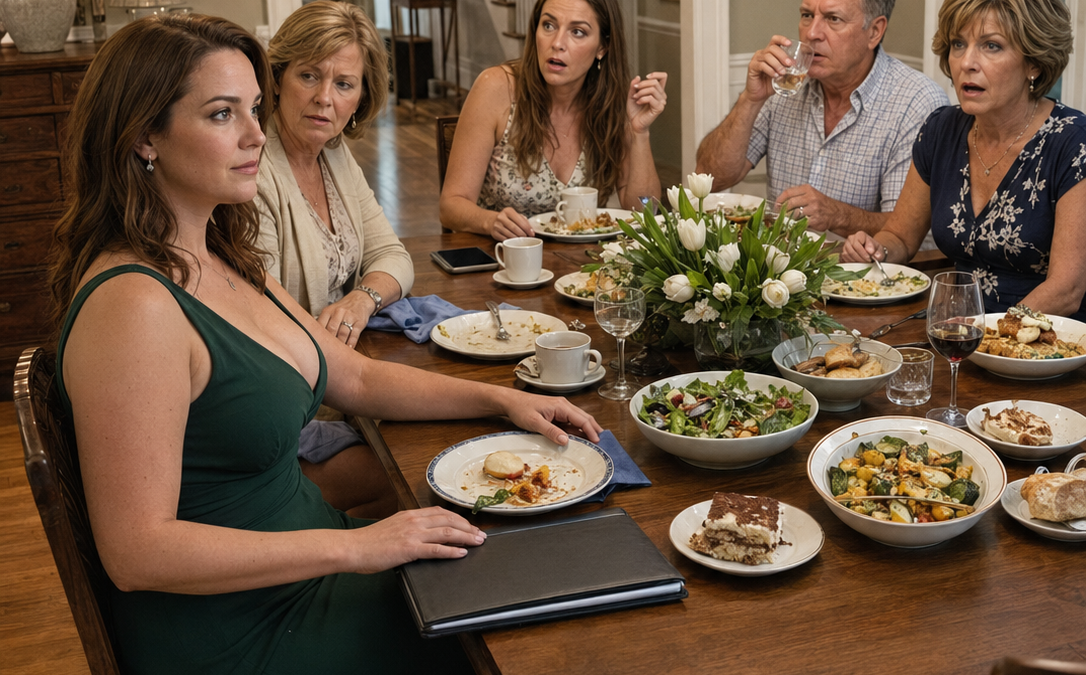
In November, I hosted Grandma Pearl’s Sunday dinner at my house because her oven broke and she refused to let anyone order pizza on the Lord’s day. Reuben helped me bring over her roasting pan. Aunt Fern made sweet tea. Marlo brought salad she actually chopped herself. Uncle Oscar carried in folding chairs without commenting on their price.
Grandma Pearl arrived last, using a cane and wearing lipstick the color of cranberries.
She stepped into the foyer and looked around without saying a word.
Everyone went quiet.
That was the way our family measured important things. We waited for Grandma Pearl to name them.
She touched the banister.
Then the wall.
Then my face, briefly, with one soft hand.
“Well,” she said, “look what patience built.”
I swallowed hard.
“Do you like it?”
“I liked it before I saw it.”
“That’s not an answer.”
“It is if you understand love.”
At dinner, she refused the head of the table and took the chair beside me.
Uncle Oscar looked displaced for three full seconds before choosing another seat.
The chair did not wobble.
Grandma Pearl noticed.
“Solid chairs make people lazy.”
“I can loosen one leg if you want.”
“Don’t you dare.”
Everyone laughed.
Halfway through dinner, she raised her glass of sweet tea.
“To Amelia,” she said.
My family turned toward me.
I braced myself out of habit.
But Grandma Pearl continued.
“Not because she bought a house. Houses are wood, pipes, paperwork, and taxes. They’re useful, but they’re not character. To Amelia because she let people underestimate her and did not let their small version become her own.”
The room fell silent.
My mother wiped her eyes.
Marlo looked down at her plate.
Uncle Oscar cleared his throat.
Grandma Pearl sipped her tea.
“And to the rest of you,” she added, “because some of you needed a brass plate on a gate to recognize what was sitting at your own table.”
Aunt Fern whispered, “Pearl.”
“What? I said some.”
Uncle Oscar laughed first.
Then all of us did.
Not because the truth was light.
Because it had finally become breathable.
A year after I moved in, I stood at the same front window and watched Marlo pull into the driveway in her white Civic.
She had asked me to walk through a duplex listing with her.
She arrived carrying coffee and a folder.
“I made a spreadsheet,” she announced.
“I’m proud and concerned.”
“Both are fair.”
We sat at the kitchen island, and she showed me the numbers. Some were wrong. Some were hopeful. Some were surprisingly good.
“Do you think I can do it?” she asked.
I looked at her.
“You can. But not if you want it to look impressive before it becomes stable.”
She sighed.
“That’s annoying advice.”
“It’s true advice.”
“I know.”
She looked around the kitchen.
“I used to think you got lucky.”
“I know.”
“I think I needed that to be true.”
“Why?”
“Because if it wasn’t luck, then maybe I had been wasting time making jokes instead of building anything.”
The honesty moved between us gently.
I did not rescue her from it.
“You can start now,” I said.
She nodded.
“I know.”
That was the closest we came to an apology that day.
It was enough.
Not everything has to arrive wearing the correct language to be real.
People will size you up from whatever is visible.
The car you drive.
The apartment you rent.
The clothes you repeat.
The job title they think they understand.
The invitations you decline.
They will build an entire story about your worth from surface information because asking real questions requires humility, and humility is harder than judgment.
You do not owe anyone a running commentary on your plans just to earn belief.
Quiet work is still work when no one claps for it.
A small room can be a strategy.
An old car can be a choice.
A second job can be a staircase.
A foreclosure nobody wants can become the first door to a life nobody expected you to own.
Years later, when people ask me whether that dinner was about proving my family wrong, I tell them no.
Not completely.
At first, maybe. I am human enough to admit that part of me wanted to see their faces at the gate. I wanted Aunt Fern to squint at the brass plate. I wanted Marlo to put down her phone. I wanted Uncle Oscar to hear his own “with what money” echo in a room my money had rebuilt.
But the deeper truth is this: I did not invite them to witness a performance.
I invited them to meet the woman they had been overlooking.
Some did.
Some are still learning.
So am I.
On the second anniversary of moving in, I finally fixed the last thing on my original repair list.
The back patio.
Reuben came over with pavers, tools, and the same unimpressed expression he wore the first day at Yearling Road.
“Took you long enough,” he said.
“I had other rooms to save first.”
“That’ll preach.”
By sunset, the patio was level. The garden beds had fresh soil. The maple near the fence threw shade across the new stone, and I stood barefoot in my own backyard holding a glass of iced tea while the house glowed behind me.
My phone rang.
Grandma Pearl.
“You outside?” she asked.
“How did you know?”
“Your voice sounds like sky.”
I smiled.
“The patio’s finished.”
“Good.”
“I wish you could see it.”
“I can.”
“Grandma.”
“Describe it.”
So I did.
The pavers.
The fence.
The herbs.
The old porch light I had replaced myself.
The kitchen windows Reuben and I had reglazed in ninety-one-degree heat without enough water.
When I finished, she was quiet for a long moment.
Then she said, “You remember what I told you?”
“Which thing? You say memorable things for sport.”
“Don’t let them make you small at your own table.”
“I remember.”
“You understand it now?”
I looked through the window at the dining room, where the blue napkins were folded in a drawer, where my mother had cried and listened, where Uncle Oscar had apologized badly but sincerely, where Marlo had begun taking notes, where Grandma Pearl had toasted not the house but the woman who built her way toward it.
“Yes,” I said. “I understand.”
And I did.
The table was never only the table.
It was the place where people tried to decide how much space I was allowed to take up.
For years, I accepted the corner of it.
Then I built my own.
Not louder.
Not meaner.
Not to shame anyone.
Just solid enough that when they finally sat there, the truth had nowhere to wobble.
THE END








