Haley came to the porch at midnight asking for a key to a house she had already decided I had no right to protect.
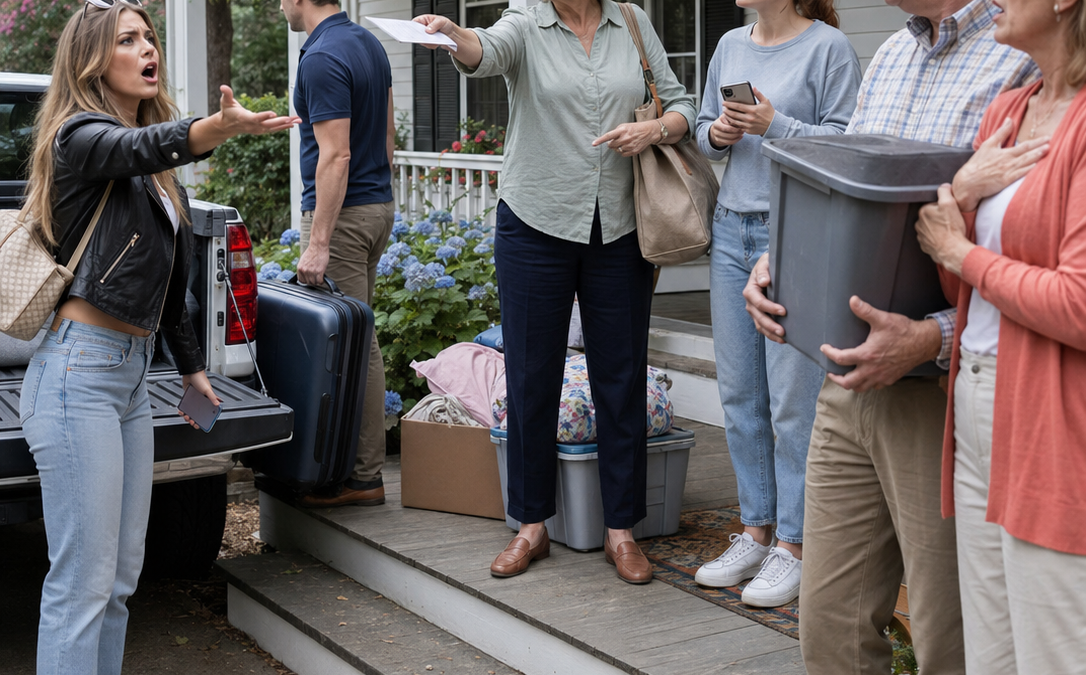
Clara stepped beside me. Her face was pale, but her voice was steady.
“Dad, Haley doesn’t want to study here. She wants somewhere to come after nights downtown. She wants somewhere you and Mom can’t see what time she gets in.”
“That is not true,” Haley snapped.
Austin crossed his arms. “It is.”
Elena turned toward Haley. “You told us your grades were suffering because of the commute.”
“They are.”
Clara took out her phone.
“I didn’t want to do this,” she said, and I believed her. “But you need to see what she’s been posting.”
She opened Haley’s public page.
Photo after photo appeared. Friday night at a lounge. Saturday at a rooftop bar. A receipt tucked beside a cocktail. A caption complaining about curfew. A video of Haley laughing in the passenger seat of a car at one in the morning. Nothing criminal. Nothing dramatic. Just enough truth to puncture the story she had sold her parents.
Elena’s face changed slowly.
Not anger first.
Recognition.
That was worse.
George turned to Haley. “Is this where your allowance went?”
Haley’s eyes filled, not with remorse, but with panic at being seen.
“Clara is trying to make me look bad.”
Clara lowered the phone. “No, Haley. You did that part yourself.”
For the first time, Haley had no immediate answer.
George looked at the bins on the porch. Then at Austin. Then at me.
“I think,” he said slowly, “we did not have the full picture.”
“No,” I said. “You had the picture Haley framed for you.”
Elena covered her mouth with one hand. “Haley, did you really tell Vivien she had no right to speak in her own house?”
Haley looked away.
That silence was finally useful.
George picked up one of the bins.
It scraped against the porch boards.
“Put the rest back in the truck,” he said.
“Dad.”
“Now.”
Haley stared at him as if he had become a stranger. Maybe he had. Maybe a parent becomes unfamiliar the first time they stop standing between a child and reality.
Austin lifted the suitcase and carried it back to the pickup. Clara picked up the second bin before Elena reached for it. For a few minutes, everyone moved quietly under the bright Savannah sun, undoing an invasion that had arrived wrapped as concern.
When the last box was loaded, George turned to me.
“I’m sorry, Vivien.”
I nodded. “I believe you.”
He seemed relieved.
“But apology does not create access,” I added.
The relief faded.
“Haley is not to come here without Austin and Clara’s invitation. She is not to have a key. If she appears again demanding entry, I will send a formal no-entry notice through my attorney.”
Haley’s mouth opened. George pointed toward the truck.
“Get in.”
She did.
The door slammed.
Elena lingered at the passenger side, looking at Clara.
“I thought I was helping her.”
Clara’s eyes shone. “You keep helping her avoid growing up.”
Elena flinched.
Not because it was cruel.
Because it was true.
The pickup backed out of the driveway and rolled down the street. For a long moment, the three of us stood there listening to the silence it left behind.
Then Clara sat down on the porch step as if her knees had finally given themselves permission to be tired.
Austin sat beside her.
I sat on the top step, careful of my hip, and looked out at the garden we had planted together the first weekend they moved in. Tomatoes, basil, rosemary, two hydrangeas that still looked undecided about survival. Clara leaned her shoulder against my knee.
“Thank you,” she whispered.
I put my hand on her hair for one brief second, the way I might have if she had been born mine.
“You were not alone.”
“I know that now.”
Austin looked at me. “She won’t stop trying.”
“Maybe not.”
“What do we do?”
I looked at the front door. The brass knob. The lock. The welcome mat Clara had chosen with tiny blue flowers along the edge.
“A house is wood, nails, wiring, and taxes,” I said. “A home is a boundary. It is the place where the people inside get to decide what peace costs and who is allowed to spend it.”
Clara wiped her face with the heel of her hand.
“I feel guilty.”
“Of course you do. You were trained to.”
She let out a shaky breath.
“But guilt is not an instruction,” I said. “It is only a feeling. You can feel it and still keep the door closed.”
That evening, before I drove home, Austin made dinner. Nothing fancy. Tomato soup and grilled cheese, because none of us had the emotional strength for anything requiring a recipe. Clara ate two bites, then laughed because the sandwich had burned on one side. Austin said it was rustic. I told him rustic was what people called mistakes when they had enough confidence.
For the first time all day, the house felt like itself again.
After dinner, Clara brought me a small envelope.
Inside was a spare key on a simple brass ring.
“I want you to keep this,” she said.
I looked at her. “You already gave me one.”
“I know. This is different.”
Austin leaned against the counter behind her, smiling softly.
Clara swallowed. “I used to think family meant anyone could come in if they needed enough. But I’m learning that family also means trusting someone to help guard the door.”
I closed my hand around the key.
It was warm from her palm.
“I can do that,” I said.
Months passed, as they always do, making some storms look smaller without making them meaningless. Haley did not move in. She did get a part-time job after George froze what he called “emergency spending.” Her parents began driving her to campus twice a week until she found a ride share, which made Clara laugh so hard she cried into a dish towel. There were tense holidays and careful phone calls, but the porch never again filled with boxes.
The garden thrived.
The hydrangeas made up their minds in June and bloomed blue.
One Sunday afternoon, I came over for lunch and found Haley’s car parked at the curb. My first instinct was to straighten. Clara met me at the door before I knocked.
“She called first,” she said.
That alone felt like progress.
Inside, Haley stood near the kitchen island with a paper bag from a bakery. She looked different without the armor of drama. Younger. Nervous. Less polished.
“I brought muffins,” she said.
I looked at her.
“Did you pay for them?”
Her face flushed. “Yes.”
“Then thank you.”
Nobody laughed, but Austin’s mouth twitched.
Haley shifted the bag from one hand to the other. “I came to apologize.”
Clara looked at the floor for a second, then back at her sister.
Haley continued, voice tight but sincere enough to be a beginning. “I thought if I needed something, everybody was supposed to help me get it. I didn’t think about what it would cost you. Or what I was asking to bring into your house.”
She looked at me then.
“I shouldn’t have spoken to you that way.”
“No,” I said. “You shouldn’t have.”
The silence that followed was uncomfortable.
Good.
Comfort had been overused in her life.
Haley nodded. “I know.”
I watched Clara’s face soften, but not collapse. That mattered. Forgiveness, when it came too quickly, often became another door left unlocked. Clara did not invite Haley to stay the night. Austin did not offer a key. I did not rescue the moment by making it warm before it was honest.
We ate muffins at the kitchen table.
Haley left after an hour.
She took her own trash to the outside bin before she went.
Small things matter when a person is learning respect.
That night, I sat on Clara’s porch with my son while the sky turned purple over Savannah. The house behind us was lit gold through the windows. Clara was inside cleaning the kitchen, humming softly to herself. The key she had given me rested in my purse, heavier somehow than the deed folded in my file cabinet.
Austin leaned back in his chair.
“You know,” he said, “when you bought this place, I thought you were saving us from rent.”
“I was.”
He smiled. “You were saving us from more than that.”
I looked at the front steps where Haley had once stood demanding entry, where George had set down boxes, where Clara had finally learned that no could be a complete sentence if someone stood beside her while she said it.
“I bought a house,” I said. “You two made it a home.”
He reached over and squeezed my hand.
The porch boards creaked softly beneath our chairs. Somewhere in the garden, a sprinkler clicked on and began its slow rhythm over the tomato plants. Down the street, a neighbor’s child laughed, and the sound floated through the warm evening air.
I thought of all the doors I had opened in my life for other people. Classrooms. Offices. Homes. Opportunities. Second chances. I did not regret most of them. But age teaches a woman something youth cannot: every open door needs a lock, not because the world is cruel, but because peace is valuable.
Haley had wanted a key.
She got a lesson instead.
And in the end, that lesson may have been worth far more than any room she was never owed.
THE END








