I did not argue. The old study sat to the left of the foyer, all dark wood, leather chairs, shelves of books nobody in my family read anymore, and Grandpa’s rolltop desk beneath a brass lamp. I slipped inside and pulled the door nearly closed, leaving a narrow crack.
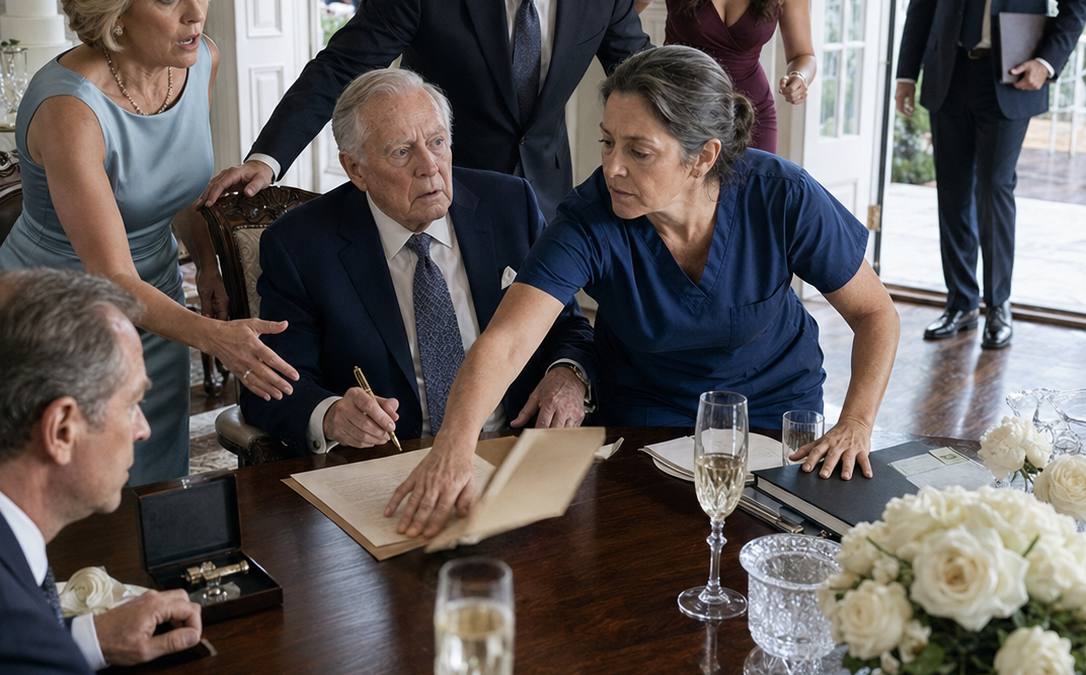
She looked at Grandpa, then at my parents, then at the unopened cake behind them and the documents on the table.
“Oh,” she said.
It was such a small word for such a large collapse.
My grandfather looked suddenly exhausted, but clearer than he had in days. He lifted a hand toward me.
I went to him.
He held my fingers, and for a brief second I was eight years old again, running through the garden while he pretended the hedges were a maze built for princesses and pirates and grandchildren who were never supposed to grow up into rooms like this.
“I want cake,” he said.
I laughed.
I could not help it.
It came out broken, but real.
“Then cake is what you get.”
We did not make an announcement that night.
Graham and Elena agreed it was better not to turn Arthur’s birthday into a public spectacle. The guests returned to the ballroom. The candles were lit. My mother stood beside the cake with a face so carefully blank it looked painted on. My father gave a short toast about legacy and family, every word now hollow to the people who had been in the room.
Grandpa blew out the candles slowly.
Afterward, he ate half a slice of cake and asked Mrs. Bell whether the gardenias near the east wall had finally bloomed.
That was the first sign of him coming back.
Not the cake.
Not the guests.
The gardenias.
Over the next several weeks, Dr. Hadley adjusted his medication plan, and Elena stayed on as his care manager. Without the wrong pills in his organizer and without my parents hovering over every decision, Grandpa’s mind cleared in stages. Not magically. Not like a movie. He still had tired days. He still forgot small things. He still needed help. But the fog thinned. His humor returned first. Then his temper. Then his habit of correcting my grammar when I used “literally” in a way he considered reckless.
My parents tried to reframe the party.
They said there had been a misunderstanding.
They said they had only wanted to help.
They said Elena overstepped.
They said Graham was being unnecessarily formal.
They said I had let outsiders make family business cold.
Grandpa listened once.
Only once.
Then he said, “Family business was cold before they entered the room.”
That ended the conversation.
Graham revised the estate plan over the following month. Not in secret. Not in panic. With doctors’ letters, witness statements, and a careful record of Grandpa’s capacity at every meeting. My parents were removed from every decision-making role. The house was placed under a protected trust with strict instructions. My name was added as a future steward, not owner. Grandpa said he did not want to hand anyone a prize. He wanted to leave responsibility only where care had already been proven.
He also made a decision that surprised everyone.
He sold Whitmore House.
Not to developers who wanted to flatten the gardens.
Not to my parents, who suddenly spoke of legacy as if they had not nearly signed it away.
He sold it to a historic preservation foundation that agreed to maintain the grounds, open parts of the house for educational tours, and keep the old ballroom intact.
“I am tired of guarding a monument,” Grandpa told me one morning on the porch. “I would rather live in a home.”
With the proceeds, he bought a cottage near Beaufort, smaller than the east wing of Whitmore House but brighter in every way that mattered. It had a screened porch, a view of the marsh, and a kitchen he could cross without needing to rest twice. Elena helped set up his care routine there. Mrs. Bell visited every Thursday. I drove down on weekends, and sometimes we sat with coffee while egrets moved through the grass like folded paper.
My parents were furious.
Not publicly. Publicly, they were wounded and dignified. Privately, they sent emails that read like pressed flowers over thorns.
After all we have done.
You have influenced him.
This is not what family does.
Grandpa read one, set down his glasses, and said, “They are very upset they failed to protect me from my own wishes.”
I kept that sentence.
Six months after the birthday, my father asked to meet.
I agreed only because Grandpa wanted me to hear him once before deciding how much of the door to close. We met at a café downtown, neutral ground, bright windows, people in business casual typing on laptops around us. My father arrived in a navy blazer and the expression of a man prepared to be gracious if the outcome benefited him.
“Cressa,” he said, sitting across from me, “your mother and I made mistakes.”
Mistakes.
A word soft enough to cover almost anything if no one lifted the edge.
I stirred my coffee. “Which ones?”
His jaw flexed.
“We were under financial pressure.”
“I know.”
“And your grandfather was declining.”
“He was being mismanaged.”
“That is an unkind interpretation.”
“It is the documented one.”
He looked toward the window. For a moment, I could see how tired he was. Not old. Not sorry. Tired from losing command.
“The estate would have solved a great deal,” he said quietly.
“At whose expense?”
His eyes returned to mine.
There was no answer he could give that would not reveal him.
So he said nothing.
That was the last real conversation we had.
My mother sent letters for a while. Beautiful stationery, careful handwriting, sentences that arranged blame in softer rooms. She missed me. She missed her father. She did not recognize the family anymore. She hoped one day I would understand that difficult decisions were made out of concern.
I saved every letter and answered none.
Elena stayed in our lives.
Not as a dramatic heroine, though I sometimes thought she deserved the title. She was too practical for that. She corrected Grandpa’s meal schedule, argued with the pharmacy, made sure he walked when he wanted to sit too long, and taught me what good care looked like when it was neither sentimental nor controlling. She never said, “I saved him.” She said, “He needed a proper record.”
Once, on the marsh porch, I asked if she had been afraid when she stopped the pen.
She looked at me over her tea.
“Of course,” she said.
“You didn’t look afraid.”
“That is because I had the chart.”
I laughed then.
So did Grandpa.
He lived three more years in the cottage.
Good years, considering everything. Not perfect. Bodies age. Minds tire. The world narrows. But he had mornings with light on the marsh, afternoons with books, evenings where he could decide whether he wanted soup or fish or the peach pie Mrs. Bell brought in a basket. He had his own pen. His own papers. His own voice.
When he passed, it was quiet.
No ballroom.
No champagne.
No sealed folders waiting to trap him.
Just me holding his hand, Elena sitting nearby with tears she did not wipe quickly enough, and the sound of wind moving through marsh grass.
His final estate plan was read two weeks later in Graham’s office.
This time, my parents were not surprised by the main terms. They had already been notified of what mattered. There was no grand reveal, no cake, no guests, no performance. They received small personal items my grandfather chose carefully but no control over his money or property. My mother’s face tightened when Graham read it, but she did not speak.
The trust provided for the preservation foundation, for his care expenses, for Mrs. Bell, for Elena’s professional service bonus, and for me.
Not everything.
Not an empire.
A future with responsibility attached.
Grandpa left me the cottage, the remaining trust income under strict stewardship guidelines, and a letter.
Graham handed it to me last.
On the envelope, Grandpa had written my name in his careful slanted hand.
I opened it in the parking lot because I could not wait.
Cressa,
You came when the room was quiet. You listened when everyone else was performing. Do not confuse inheritance with reward. The only thing I ever wanted to leave you was the ability to choose a life without begging anyone to call it family.
Arthur.
I sat in my car and cried with the letter in my lap.
Not because of the money.
Because he had seen me.
Years have passed since that eightieth birthday. Whitmore House still stands. Schoolchildren tour the ballroom now and learn about architecture, not family secrets. The roses in the south garden bloom better under people who actually know what they are doing. A small plaque near the entrance lists Arthur Whitmore as the donor who preserved the estate for public education.
My parents moved out of their club circle eventually. Too many unpaid illusions, too few remaining invitations. They live smaller now, which is not punishment. It is simply truth catching up to square footage.
I live part of the year in the marsh cottage and part in Charleston, where I work in nonprofit development and drink too much coffee near windows. Elena retired last spring. We still have lunch once a month. She orders soup no matter the weather and always asks whether I am sleeping enough.
Sometimes, when the sky is low and silver over the marsh, I think about the moment my mother placed that pen in Grandpa’s hand.
How close it came.
How soft the room looked while something ugly tried to happen inside it.
How many people would have clapped for a birthday party and never known a life was being redirected beneath the cake and music.
But I also think about Elena’s hand sliding over the document.
About one small word.
No.
There are moments when a family does not need another argument.
It needs a record.
It needs a witness.
It needs someone brave enough to stop the pen before the ink makes the lie look official.
That night, my parents thought the house was finally theirs.
They were wrong.
The house was never the real inheritance.
The real inheritance was my grandfather’s last clear lesson: love does not guide your hand toward a signature you do not understand.
Love pulls the paper away.
THE END








