He told me Italy was not for women my age, then packed his best suitcase for Rome with another woman’s name printed beside his on the itinerary.
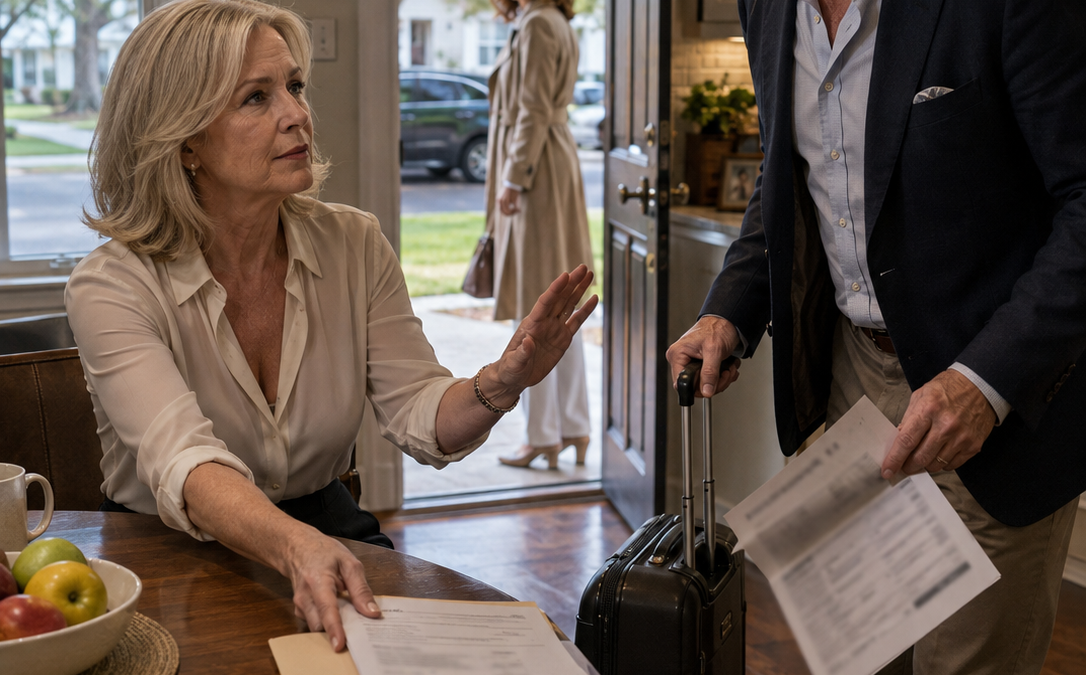
For the first time since he entered the house, Martin put down his suitcase.
He picked up the paper. His eyes moved quickly, then stopped. The tan from Italy did nothing to hide the color draining from his face.
“What is this?”
“You know what it is.”
“You filed?”
“Yes.”
He looked up. “While I was gone?”
“While you were in Italy with Elise.”
The name landed between us.
He recovered quickly, or tried to. “That was a business trip.”
I slid the itinerary across the table.
“Two rooms at the same hotel. Private transfers. Dinner reservations. Vineyard day tour. Very busy meetings.”
His mouth opened.
Closed.
There are few sounds more revealing than a man discovering the lie he brought home is no longer useful.
“You went through my things,” he said.
“It printed in our den.”
“That doesn’t give you the right to assume—”
“I’m done assuming.” My voice was calm. That seemed to unsettle him more than anger would have. “I’m done explaining your behavior to myself in ways that make it hurt less.”
He stepped closer. “You’re being dramatic.”
I almost smiled.
There it was, the old lever. Call me dramatic, make me defend my tone, distract from the facts. For decades, it had worked.
Not now.
“I moved my share of the joint funds,” I said. “Certain accounts are protected. Joint credit lines are frozen. The car is sold. The petition is filed. Margaret will contact your attorney when you choose one.”
His eyes widened. “You emptied the accounts?”
“No. I protected what I am legally entitled to. There is a difference.”
“You think a lawyer can tell you what to do with my money?”
“Our money,” I said. “That was the phrase when you wanted me to manage the house, pay bills, host dinners, and support your career. It remains the phrase now.”
His face changed.
Not to guilt. To fury.
“You ungrateful woman,” he said, voice low.
I raised one hand.
He stopped.
Maybe it surprised him. Maybe it surprised both of us.
“No,” I said. “You don’t get to do that anymore.”
His lips pressed into a hard line.
“For years,” I continued, “you made jokes about my age, my clothes, my dreams, my body, my energy. You told me I was too old for adventure because it made you feel young to leave me behind. You told me Italy would be too much for me while you packed your bags to take the one place I dreamed of seeing with someone else.”
He looked away.
I did not let him hide there.
“Look at me, Martin.”
Slowly, unwillingly, he did.
“I am not too old. I am not too slow. I am not waiting in this house to be useful when you return from humiliating me. I am done.”
The kitchen held a silence so complete I could hear the clock above the pantry door.
Martin reached for the chair, perhaps because his legs were less certain than his pride.
“You can’t just end a marriage.”
“I didn’t.” I looked at him steadily. “You did. I only put it in writing.”
He sat down heavily.
For a moment, he looked almost old.
That stirred something in me, but not enough to move me back toward him. Pity is not the same as permission. I had confused those two things for too long.
“What do you want?” he asked.
I had imagined that question for years without realizing it. I used to think I wanted him to apologize, to confess, to see me. I wanted him to finally understand the damage. I wanted to be worth tenderness again.
Now, sitting across from him, I realized I wanted something simpler and far more powerful.
“My life,” I said.
His eyes narrowed. “And what exactly do you think that looks like without me?”
The question was meant to frighten me.
Instead, it opened something.
I thought of the painting class, Grace laughing on the boardwalk, Diane’s porch, basil in the window, a quiet room full of my own music. I thought of Venice not as something he had stolen, but as something still waiting. I thought of the woman in the mirror who no longer looked like a fading wife, but like a person returning to herself after a long absence.
“Peaceful,” I said.
His face tightened, and I knew that answer hurt him more than any accusation.
He stood abruptly, grabbing the suitcase handle. “You’ll regret this.”
“No,” I said. “I’ve already regretted enough.”
He looked around the kitchen, perhaps searching for the old Clarine, the woman who would soften, apologize, say maybe we should talk tomorrow. She was not there. She had left sometime between the printer humming in the den and the clerk stamping the papers at the courthouse.
Martin walked to the door.
At the threshold, he turned.
“You’ll be nothing without me.”
For the first time that day, I laughed.
Not loudly. Not cruelly. Just honestly.
“Without you,” I said, “I may finally become something.”
The door closed behind him.
Not slammed, not dramatically. Just closed.
That was better.
A slam is anger. A closed door is final.
I sat at the kitchen table for a long time after he left. The folder remained open. The itinerary lay face up, a paper map to a betrayal that had become a beginning. Outside, the empty driveway held the late afternoon light. The place where his car had been no longer looked vacant.
It looked clear.
In the weeks that followed, the divorce proceeded with the ordinary frustrations of paperwork and negotiation. Martin hired an attorney who wrote stern letters. Margaret answered them with facts. Martin complained that I had embarrassed him. Margaret pointed to the itinerary. He argued about the car. Margaret pointed to the title. He objected to the protected accounts. Margaret pointed to decades of shared contributions and careful documentation.
Slowly, his outrage lost momentum.
That is what facts do.
They do not have to shout. They simply remain.
Elise did not remain.
I heard through a mutual acquaintance that she left the company within two months. Apparently, Italy had been romantic when Martin was spending freely and pretending to be misunderstood. It became less romantic when lawyers, asset disclosures, and the reality of a middle-aged man with a wounded ego arrived at the gate.
I did not gloat.
Not much.
What mattered was not that his little story collapsed. What mattered was that mine began.
I kept painting. My lemons improved. My first attempt at a Tuscan hillside looked like a green blanket dropped over a chair, but Paul said my skies had feeling, and I decided that was enough. I joined a book club. I hosted Lauren and the grandchildren for dinner and let the children help make pasta from scratch. Flour dusted the counters. Sauce splattered the stove. Nobody complained about the mess.
One Saturday in early spring, I went to the passport office.
The woman behind the counter looked at my application, then at me.
“First passport?”
“Yes.”
“Exciting.”
“It is.”
I had no travel companion yet. No fixed itinerary. No man beside me deciding how much walking I could handle. I only had a small blue book on its way and a savings account in my own name. That was more than enough.
By summer, the house felt like mine.
Not because Martin’s things were gone, though many were. Not because lavender candles burned openly on the mantel, though they did. Not because his criticism no longer lived in the air, though the air was certainly lighter.
It felt like mine because I had stopped asking invisible permission.
I slept better. Walked farther. Bought a red dress and wore it to dinner with Grace and Diane. Planted tomatoes, basil, and lavender in the backyard and called it my little Tuscany. Some mornings, I sat with coffee by the window and realized I had not thought of Martin for hours. Those were the best mornings, not because memory had disappeared, but because it had taken its proper size.
The divorce was finalized on a rainy Thursday.
Margaret called just after lunch.
“It’s done,” she said.
I stood in the kitchen, looking out at water running down the window glass.
“Clarine?”
“I heard you.”
“How do you feel?”
I considered saying relieved. Free. Sad. Grateful. All of those were true, but none of them fit exactly.
“I feel like I can hear myself,” I said.
Margaret was quiet for a moment.
“That is a very good place to begin.”
That evening, I opened a bottle of wine I had been saving without knowing for what. I poured one glass, lit a candle, and took out the Italy magazine that had started as a wound and become a promise. On the table beside it was my passport, new and stiff and almost comically official.
I opened to a page showing Venice at sunrise.
This time, I did not imagine Martin beside me.
I imagined myself.
Silver hair. Comfortable shoes. Red scarf. Walking slowly if I wanted to. Stopping whenever I pleased. Sitting by the water with a coffee and no one sighing because I had taken too long to enjoy the view.
A month later, I booked the trip.
Not because I needed Italy to heal me.
I had already begun healing in my own kitchen, my garden, my attorney’s office, my painting class, my sister’s porch.
I booked it because I wanted to go.
That was reason enough.
When the confirmation email arrived, I printed it and held the page in my hands. Two years earlier, a different itinerary had nearly broken me. This one steadied me.
One passenger.
Clarine Hale.
I placed it on the refrigerator with a small magnet shaped like a tomato from my little garden. Then I stood back and smiled.
Martin had been right about one thing, though not in the way he intended.
Italy was not for the old version of me.
The woman who begged to be included, who swallowed every insult, who waited at home while someone else decided the size of her life, would not have known what to do with that trip.
But the woman standing in my kitchen now?
She was ready.
And this time, nobody was going to tell her she would slow them down.
THE END








