My son called on a Tuesday morning and told me he had already moved to Texas, as if he had merely forgotten to mention a delayed package.
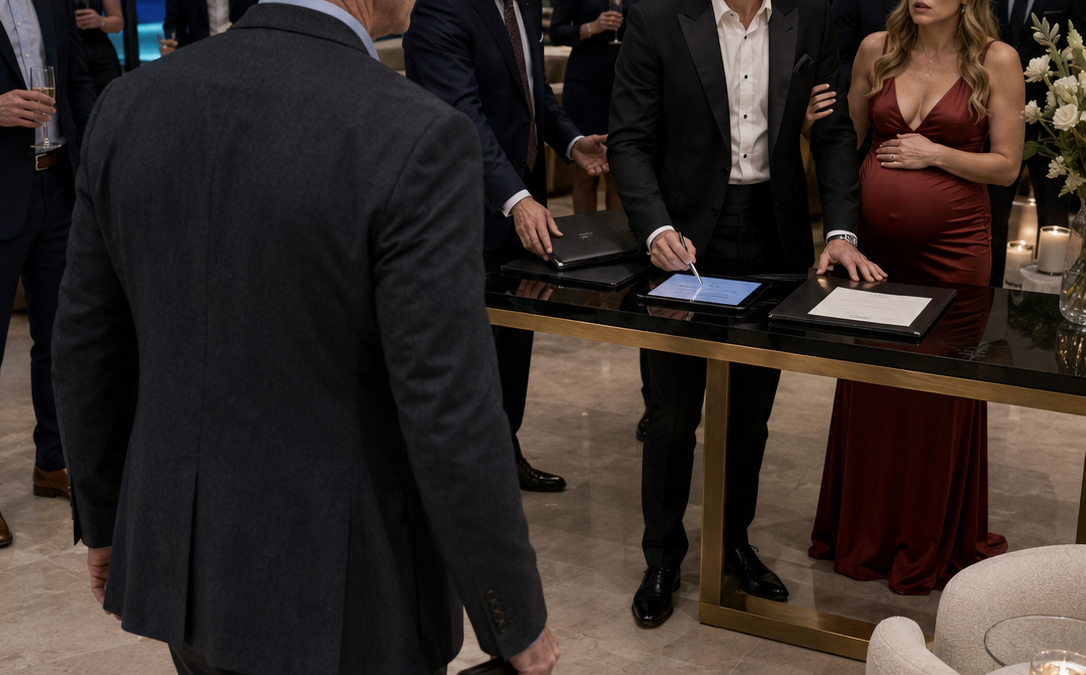
Inside the house, guests applauded as Derek gave a toast.
A transcript of the event audio came through the compliance stream because the acquisition representative had opened the virtual signing room on a tablet at the center table. Derek’s voice was confident.
“My father built something meaningful,” he said. “But the next generation has to move faster. Monica and I are proud to take Lawson capital into a new era.”
I looked at the words on my screen.
My father built something meaningful.
He spoke of me like a brand asset he had already acquired.
Monica stood beside him in a red gown, one hand on her belly, smiling as if motherhood itself had authenticated her choices. The guests admired them. Young couple. New fortune. Bold move from New York to Texas. A fresh start. A company launch. Every lie was dressed well enough to pass under soft lighting.
At 9:00, the Apex representative opened the digital agreement.
Derek took the stylus.
He did not hesitate.
He signed.
The system requested funding verification.
For three seconds, the screen in the SUV showed pending.
Then red.
Transaction declined. Authority dispute. Funds restricted pending review.
Inside the house, the Apex representative tried again.
Red.
The music faded as if someone had lowered it in embarrassment.
Derek’s voice came through the system, sharper now. “There must be a technical issue.”
Monica said, “Use the secondary account.”
A second verification request hit the gateway.
Red.
A third.
Red.
Then the bank’s compliance hold activated fully, locking every transaction linked to the disputed authority documents.
On my laptop, a cascade of confirmations appeared.
Power authorization suspended.
Capacity evaluation withdrawn.
Asset collateral freeze active.
Share administrator hold active.
Miriam’s notice received.
Harrison’s filing received.
Derek’s acquisition agreement entered into record.
I closed the laptop.
“Now,” I said.
We did not storm the mansion. No sirens. No shouting. No spectacle beyond the one Derek had built himself.
Harrison entered first, accompanied by the Apex compliance counsel and the bank’s senior risk officer. Wyatt and I followed.
The front door opened into a foyer of white stone and glass. Conversation died in layers as people turned. The air smelled of wine, citrus, and money trying to behave casually. Guests stepped aside when they saw Harrison’s folder, the bank officer’s expression, and me.
Derek saw me from across the room.
Every trace of color left his face.
Monica’s smile fell so quickly that for a moment she looked like a stranger wearing it.
I walked slowly across the marble floor. My dress shoes sounded louder than they should have. Guests moved away from me as if truth had a physical temperature.
Derek whispered, “Dad.”
I stopped in front of him.
For three seconds, I said nothing.
It seemed only fair.
Then I looked at my son and said, “You forgot to tell me you moved. And I forgot to tell you that I designed the system you tried to bypass.”
The room went completely still.
Harrison opened the folder and placed the first document on the table.
“The authority documents used to support tonight’s financing are under formal dispute,” he said. “The medical evaluation has been withdrawn by the physician who signed it. The asset administrator has frozen all attempted transfers. The bank has suspended the credit facility. The acquisition cannot proceed.”
The Apex representative stepped back from Derek as if distance could protect reputation.
Derek looked at the paper, then at me. “Dad, I can explain.”
“You can,” I said. “But not to me first.”
Monica recovered faster. “This is a family misunderstanding.”
Harrison placed the second document beside the first.
“Then you will have no trouble explaining why the New York documents were removed from Mr. Lawson’s safe before your relocation, why a third-party capacity evaluation was submitted without examination, and why Mr. Lawson’s funds were routed into this property purchase under a renovation authorization.”
Guests began whispering.
Monica’s hand moved instinctively to her belly. For one moment, I felt the sharp, complicated pain of that. My grandchild. Innocent. Unaware. Growing inside a woman who had helped turn my own home into a ledger entry.
That child would not pay for their parents’ choices.
But I would not let those parents use the child as a shield either.
Derek’s eyes filled. “Dad, please. Not here.”
“Here is where you chose to spend my money.”
He flinched.
I looked around the room at the investors, the champagne, the hill-country view, the polished story Derek had built on stolen silence.
Then I turned back to him.
“You wanted an audience for your success,” I said. “You have one for the truth.”
Harrison signaled the bank officer, who read a formal statement confirming the freeze, the review, and the preservation of documents. The words were dry. Legal. Devastating.
Guests began leaving.
Quietly at first, then faster.
The Apex team packed their tablets. One investor took a business card from Harrison and avoided Derek’s eyes. A woman near the pool whispered, “Did he say his father’s safe?”
Monica gripped Derek’s sleeve.
“Do something,” she hissed.
Derek did nothing.
For the first time in his life, my son had no system left that I would fix for him.
He stepped closer, voice low and breaking. “Dad, I was scared. Monica’s pregnant. We needed a start.”
“No,” I said. “You wanted a shortcut.”
His mouth trembled.
“I’m your son.”
“I know.”
That was the worst part.
I knew exactly who he was.
The next morning, I sat in Harrison’s Austin office signing revised estate documents. Derek’s name was removed from every discretionary inheritance provision. Every asset moved behind independent trustees. Every future request for access would require review by people who did not love him enough to be manipulated.
But Laura and I had raised him once.
And Monica’s child had done nothing.
So I created a separate trust for the baby, managed by an independent guardian and released only for education, healthcare, and basic security. Derek and Monica would never control it. They would never borrow against it. They would never use it as a stage prop for a life they had not earned.
When I signed the final page, Harrison asked, “Are you sure?”
I thought of Derek as a boy, running across our backyard with untied shoes. I thought of the man in West Lake Hills calling stolen money a new era. I thought of the empty safe.
“Yes,” I said.
That afternoon, I flew back to New York.
The house was still empty when I returned, but it no longer felt robbed. It felt cleared. The silence had teeth now, but it also had shape. I restored the safe. Replaced the painting. Sent Laura’s old tote to be cleaned and folded it into a cedar chest because I refused to let betrayal take every object it touched.
Weeks later, the reports came quietly. Derek and Monica lost the Texas house. The acquisition collapsed. The bank pursued recovery through formal channels. The physician’s withdrawal turned their capacity claim into a liability instead of a weapon. Their social circle vanished the way social circles do when money stops glowing.
Derek called once.
I let it go to voicemail.
His voice sounded smaller than I remembered.
“Dad, I don’t know how it got this far.”
I saved the message, forwarded it to Harrison, and did not call back.
Some people call that cold.
Maybe it is.
But after a lifetime designing systems, I have learned one hard truth: love without boundaries is not love. It is an open port waiting for the wrong person to walk through.
Blood does not guarantee loyalty.
Trust must be maintained.
And when someone you love becomes the breach, the only way to save what remains is to close the door, rebuild the firewall, and stop apologizing for protecting your own life.
THE END








