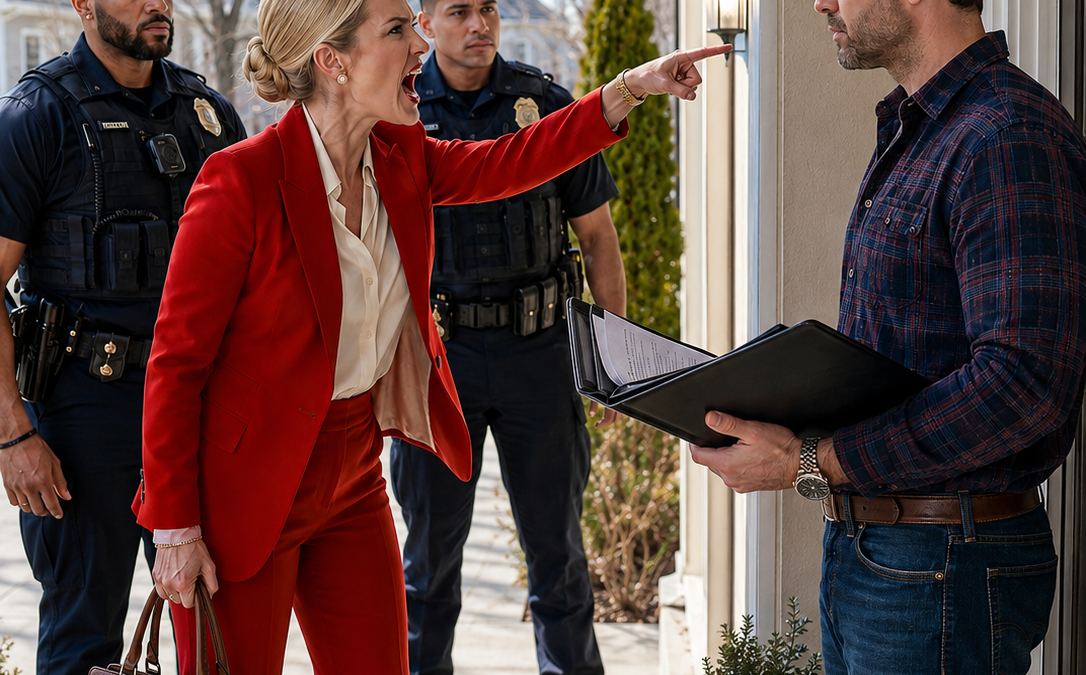
THE HOA CALLED THE POLICE TO FORCE ME TO TEAR DOWN A WORKSHOP THEY CLAIMED VIOLATED COMMUNITY RULES — but they had never bothered to check the deed, survey, or even their own original covenant. I handed the officers one black folder, and within seconds their questions stopped being about me. Then they turned to the HOA board member and asked why she had used police to enforce rules that didn’t exist.
Part 3
The first homeowner to stand was Denise Parker.
She had lived in the neighborhood almost twenty years.
“Two years ago,” she said, “I got fined for an unapproved shed.”
Marla looked confused.
Denise continued.
“I never built a shed.”
A few people laughed.
Denise didn’t.
“I called and said you had the wrong property. I was told the board had photographic evidence and that fighting the fine would increase my legal costs.”
Howard leaned forward.
“Did anyone show you the photograph?”
“No.”
“How much did you pay?”
“Three hundred dollars.”
Marla finally spoke.
“I don’t remember that case.”
Denise nodded.
“I do.”
That sentence changed the mood.
Until then, people had been watching my dispute.
Now they were remembering their own.
A man named Victor raised his hand.
He had repainted his garage trim after receiving a color violation.
“Where is the approved color list?”
Patricia, the board secretary, searched through the governing documents.
“There isn’t one.”
Victor stared at Marla.
“You told me there was.”
“I said colors needed to remain consistent with community standards.”
“You gave me a specific paint code.”
No answer.
Another homeowner described being threatened over a trailer parked behind a closed fence.
Another had paid a late fee after receiving a notice mailed to the wrong address.
None of those incidents proved some massive criminal scheme.
That wasn’t the point.
The point was that enforcement had become whatever Marla said it was.
And because most people hated conflict, they complied.
Howard asked for the original violation log.
Marla resisted.
“It contains private homeowner information.”
The association’s attorney, who had been invited precisely because nobody trusted the meeting anymore, interrupted.
“The board is entitled to review its own enforcement records.”
Marla looked at him.
He did not look away.
Patricia produced the files.
What followed was tedious.
That is where bad systems usually reveal themselves.
Not through one dramatic confession.
Through repetition.
Some violation notices contained covenant citations.
Others did not.
Some had photographs.
Others simply said “board observed.”
Some homeowners received a warning period.
Others were fined immediately.
Friends of board members appeared to receive more informal treatment.
People Marla argued with received formal letters.
Again, favoritism by itself did not automatically mean anything illegal.
But it showed the association had stopped applying its own process consistently.
Then Patricia revealed something I hadn’t known.
Several months earlier, she had questioned Marla privately about my workshop.
“I asked whether Calder’s rear parcel was covered by the declaration.”
Marla stared at her.
Patricia continued.
“You told me legal had already confirmed it.”
The HOA attorney frowned.
“I was never asked.”
The room erupted.
Marla raised both hands.
“I may have said management confirmed it.”
The management representative shook his head from the side wall.
“We did not.”
Another silence.
Then Howard asked the cleanest question of the night.
“Marla, before sending Calder the seventy-two-hour removal order, who actually verified that the HOA had jurisdiction over the land where the workshop sits?”
No answer.
“Anyone?”
Marla looked down at her notes.
“That parcel is clearly part of the community.”
“That isn’t what I asked.”
She looked toward me.
For months, she had wanted me angry.
I finally understood why.
An angry opponent lets you discuss behavior instead of facts.
So I stayed seated.
Hands folded.
Quiet.
Howard tried again.
“Who verified the boundary?”
Marla finally said:
“I relied on existing understanding.”
There it was.
Not the deed.
Not the survey.
Not the declaration.
Understanding.
Assumption wearing a nicer shirt.
The motion came from Patricia.
Immediate suspension of Marla’s enforcement authority pending independent review.
Howard seconded.
Then someone requested a full board vote on removal.
The association bylaws required a specific procedure, so they couldn’t simply erase her from office in one dramatic minute.
Instead, the board voted to suspend her operational authority that night and schedule the formal removal vote required by the bylaws.
That mattered to me.
If we were rebuilding a system around written rules, we needed to follow them even when the person benefiting from due process was Marla.
A week later, after proper notice and the required homeowner vote, she was removed by a wide margin.
I didn’t attend.
By then, my part was finished.
The independent review began almost immediately.
Ellen Pruitt, a retired accountant who lived near the entrance, volunteered to organize the records with outside counsel.
She had the temperament of someone who considered a missing receipt a personal insult.
For three weeks, she went through violation files.
Payment histories.
Meeting minutes.
Email records.
Amendments.
Fine schedules.
Appeals.
She found mistakes.
A lot of them.
Some were Marla’s.
Some predated her.
That distinction mattered.
The HOA had spent years operating informally.
Presidents changed.
Files moved between garages.
Rules were discussed at meetings but never properly amended.
Old boards sometimes treated suggestions as policies.
Marla had inherited a sloppy structure.
Her mistake was not creating every flaw.
It was turning sloppiness into authority and then refusing to verify anything that might reduce her power.
The review identified nearly a dozen fines that deserved reconsideration.
Denise got her $300 back.
Victor received reimbursement for the paint he had purchased after being directed to a nonexistent color code.
Others received partial refunds or written reversals.
A few complaints turned out to have been legitimate under actual covenant provisions.
Those homeowners didn’t get refunds simply because Marla had become unpopular.
That was another important moment.
The new board was learning that correction is not revenge.
You don’t reverse everything the old administration ever did just because you dislike the person who signed it.
You check.
Then you fix what was wrong.
My workshop case was easy.
The county survey confirmed the structure sat on the rear parcel outside the association’s declaration.
The county also confirmed the building itself met applicable setback and permit requirements.
The HOA withdrew every notice connected to it.
Then came the letter I hadn’t expected.
County land records had reviewed an old indexing issue connected to the subdivision’s expansion.
My rear parcel had always remained separate, but several later mapping systems displayed it visually as though it formed one continuous HOA lot with my house.
That probably explained how the assumption began.
The county corrected the public parcel display and added a reference making the recorded boundary easier to understand.
It didn’t create new rights for me.
It documented more clearly the rights I already had.
I framed nothing.
I had lived with enough paper.
The black folder went back into my filing cabinet.
Howard became HOA president.
Nobody would have described him as exciting.
Perfect.
At his first meeting, he introduced a new violation procedure.
Every notice had to contain four things:
The exact governing provision.
Specific facts supporting the alleged violation.
Any photographs or records being relied upon.
Clear instructions explaining how the homeowner could challenge the notice before a penalty became final.
Simple.
Almost embarrassingly simple.
Then Patricia added another requirement.
No board member could call law enforcement merely to assist with HOA compliance.
If there was an actual crime, emergency, or immediate safety issue, call police.
If there was a covenant dispute, use the association’s civil process.
Everyone approved it.
I heard about that rule from Officer Delgado.
He stopped beside my driveway one afternoon while passing through the neighborhood.
“Workshop still standing?”
“Unfortunately.”
“Unfortunately?”
“I built the door slightly crooked.”
He laughed.
“No HOA complaint?”
“Not yet.”
He looked toward the backyard.
“You know, when we arrived that morning, I assumed you had ignored some order.”
“I figured.”
“Then you handed me that folder.”
“I’m sorry.”
“For what?”
“It was heavy.”
He shook his head.
“I’ve had worse Saturdays.”
Then he became serious.
“You did the smart thing.”
“What?”
“You gave us documents instead of trying to win the argument on the porch.”
I thought about that afterward.
People sometimes mistake documentation for passivity.
It isn’t.
Writing something down can be an action.
So can waiting.
For months, friends asked why I hadn’t exposed Marla earlier.
I could have shown the survey after the first workshop letter.
Probably ended my own problem immediately.
But by then I had started seeing something larger.
Marla would abandon one accusation and invent another.
Fence disappeared.
Then paint.
Paint disappeared.
Then truck.
Truck disappeared.
Then tool hours.
Then workshop.
If I won one argument at a time, the process itself stayed untouched.
So I stopped chasing each accusation separately.
I preserved the pattern.
That does not mean everybody should sit silently while somebody abuses authority.
Sometimes immediate action is necessary.
In my case, I knew my property was safe.
The HOA could send letters.
It could not lawfully demolish my building because Marla printed a deadline.
I had time.
So I used it.
The record eventually became impossible to explain away.
Her own letters contradicted one another.
Her meeting statements established what she knew.
Her email showed personal intent.
Her police call revealed the escalation.
My responses showed I had repeatedly asked for documentation instead of refusing legitimate rules.
None of those things alone destroyed her credibility.
Together, they did.
Marla remained in the neighborhood.
That surprised some people.
They expected her to sell immediately.
She didn’t.
She stopped attending meetings.
Sometimes I saw her walking her dog in the evening.
We never became friends.
We also never became enemies in the theatrical sense.
No shouting across lawns.
No sarcastic signs.
No revenge violations from the new board.
She became another resident.
Which, ironically, was what she should have been whenever she stepped outside the limited authority of her position.
Months later, I was staining the workshop when Marla walked past.
She stopped.
I expected something.
She looked at the building.
“It came out nice.”
“Thanks.”
A long pause.
Then she said:
“I still think you could have told me about the parcel sooner.”
There were a dozen responses I could have made.
Most would have felt satisfying for six seconds.
Instead I said:
“I asked you to verify it.”
She looked down.
“Yes.”
Then she kept walking.
That was our final conversation about the dispute.
Denise eventually started attending HOA meetings regularly.
Victor joined the architectural committee, mostly because he never wanted another person receiving a fictional paint code.
Ray became treasurer.
Patricia remained secretary and posted detailed minutes online.
Howard’s meetings ran longer than Marla’s.
People complained.
Then Howard reminded them:
“Minutes are cheaper than lawsuits.”
Hard to argue with that.
The neighborhood didn’t transform into some perfect democracy.
People still fought about parking.
Trash cans.
Tree removal.
Holiday decorations.
One meeting spent forty minutes discussing whether basketball hoops counted as temporary structures.
Human beings remain human beings even after reform.
But the arguments changed.
People asked:
“What does the covenant actually say?”
That sentence became normal.
I considered that a victory.
Not mine.
The system’s.
By autumn, the workshop was finished.
Dark cedar stain.
Metal roof.
One workbench inside.
Tool cabinets along the back wall.
Nothing special.
A neighbor walking her dog stopped by while I was installing the final shelf.
“Looks like you won.”
I shook my head.
“Nobody won.”
She looked toward the workshop.
“Marla’s gone from the board. Your building stayed.”
“That isn’t the important part.”
“What is?”
I looked down the street.
“The rules finally mean what they say.”
She smiled.
“That sounds like something someone who reads governing documents for fun would say.”
“I do not do it for fun.”
“Sure.”
She continued walking.
That evening, I sat inside the workshop with the door open.
No music.
No power tools.
Just coffee.
The street sounded ordinary.
Lawn mower in the distance.
Garage door closing.
Kids on bicycles.
A dog barking at something invisible.
No yellow envelope taped to my door.
No patrol car at the curb.
No neighbor peeking through blinds because somebody had told them I was unstable.
I thought about the black folder.
People still mention it when telling the story.
The dramatic folder that supposedly destroyed Marla.
It didn’t.
The folder contained nothing magical.
A deed.
A survey.
HOA documents.
Emails.
Letters.
Minutes.
Things anyone could have read.
The real problem for Marla was that she never expected anyone to place them in order.
She believed authority meant her version of events would become the official version simply because she said it first and said it confidently.
Then one Saturday morning, she brought two police officers to my house.
Men whose job required them to stop and compare statements against evidence.
She believed uniforms would make me surrender.
Instead, uniforms created the first neutral audience she had encountered in months.
And once that happened, the story changed in less than five minutes.
Not because I shouted louder.
Because Delgado turned a page.
Then another.
Then another.
Sometimes that is all truth needs.
Someone willing to read past the first page.
The end
Disclaimer: This content is entirely AI-generated for fictional and entertainment purposes only. Any resemblance to actual persons, living or dead, events, or locations is purely coincidental, and the creator assumes no liability for any interpretation of this content.








