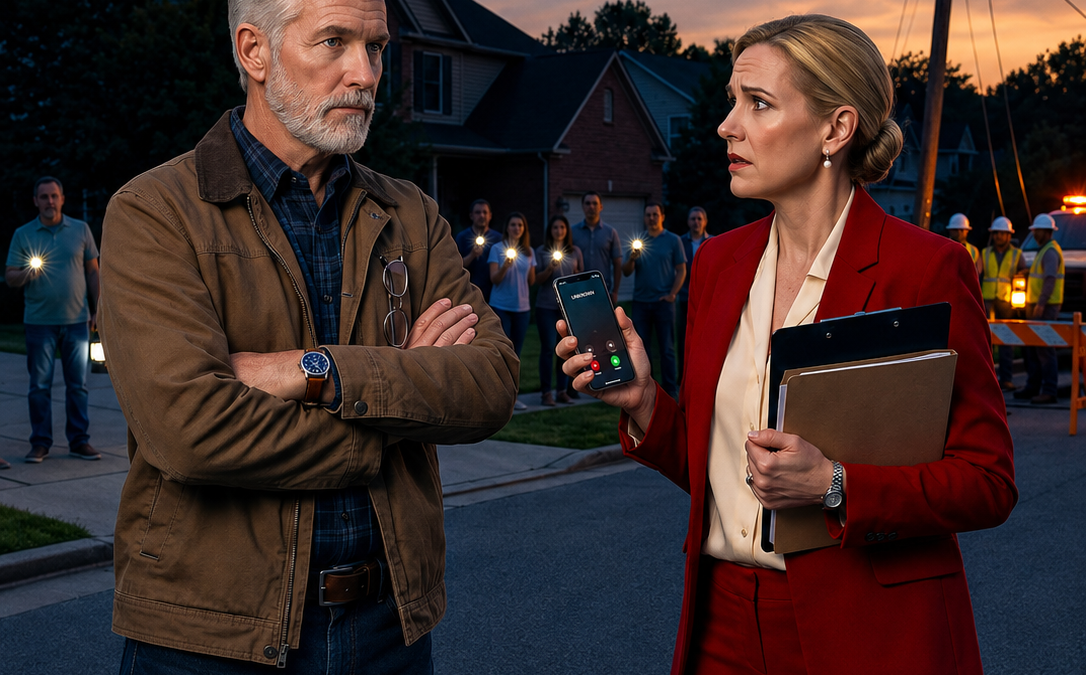
THE HOA PRESIDENT ORDERED A CONTRACTOR TO CUT DOWN THE POWER POLE ON MY PROPERTY BECAUSE IT “VIOLATED COMMUNITY STANDARDS” — I warned her she had no idea what that pole actually controlled. Seven minutes later, my house went dark… then 98 more homes followed. But the blackout was only the beginning, because the fake utility diagram behind her order exposed something far bigger hidden inside the HOA.
Part 3
The power came back in sections.
First twelve homes near the entrance.
Then twenty more farther down the lane.
A cheer rose when the streetlights flickered on.
It wasn’t dramatic like a movie.
Mostly people sighed.
Refrigerators hummed again.
Garage-door openers beeped.
Phones started charging.
A woman near the corner hurried inside because her husband used an electric medical device with battery backup, and she had spent the previous hour watching that battery percentage fall.
That was the moment my anger finally arrived.
Not when Marabel ignored me.
Not when the chainsaw started.
Not even when the pole hit the ground.
It arrived when I realized how casually ninety-nine households had been placed at risk because one person believed a clipboard gave her authority over infrastructure she did not understand.
I did not yell.
I had spent too much of my career around failures to believe yelling repaired anything.
Failures are solved by sequence.
What happened?
What should have happened?
What changed?
Who authorized the change?
And what record proves it?
Selene Armitage understood that immediately.
She had served on the HOA board for almost four years and had never liked Marabel’s management style.
“She pushes things through,” Selene told me after the utility crews restored the backup route. “If you question her, she says you’re slowing the board down.”
“Did you vote on the electrical modifications?”
“I remember a modernization package.”
“Did you see engineering drawings?”
“No.”
“Utility approval?”
“No.”
“Then what did you approve?”
Her face tightened.
“A budget.”
That answer mattered.
Marabel had spent years encouraging board members to believe that approving money was the same as approving whatever happened afterward.
It was not.
By 9:00 that night, Hollow Bend’s board called an emergency meeting.
Nobody went home.
Residents dragged folding chairs into the community room.
Nearly every household sent someone.
Marabel sat at the front table.
Her clipboard was gone.
I sat in the back.
I was not an HOA director.
I didn’t want to become one.
The association’s vice president opened the meeting.
Before Marabel could control the agenda, Selene made a motion for an independent financial and infrastructure audit.
Marabel objected immediately.
“On what basis?”
Selene stared at her.
“Ninety-nine homes lost power this afternoon because a contractor acting under an HOA work order cut infrastructure the HOA did not own.”
“That is under investigation.”
“Exactly.”
The motion passed four to one.
Marabel was the only no vote.
Then Orson Vale arrived.
Orson had served on the board before Selene and resigned after repeated fights with Marabel.
He carried a binder.
Inside was Contract 17.
Not a mysterious paper stolen from some hidden vault.
A certified copy he had requested years earlier from the municipal records office after a dispute over easements.
The contract had been signed when Hollow Bend’s common areas were transferred from the developer.
It defined the HOA’s authority in painful detail.
Landscaping.
Private roads.
Community entrance.
Playground.
Small common green.
Nothing about operating, altering, or removing electrical distribution equipment.
A separate clause stated that utility infrastructure remained under utility-provider jurisdiction unless a specific written agreement transferred responsibility.
No such agreement existed.
The contractor who cut the pole had never been given utility authorization.
Neither had Marabel.
Then Orson reached the clause that made three board members visibly uncomfortable.
Any individual directing unauthorized work on protected utility infrastructure could be held personally responsible where their actions exceeded association authority.
Marabel interrupted.
“That is a legal interpretation.”
“No,” Orson said. “That is the contract language.”
The room murmured.
Marabel looked toward me.
“You knew this document existed.”
“I knew there were old infrastructure agreements.”
“Why didn’t you tell the board?”
“Why would I?”
Her eyes narrowed.
“You let this happen.”
That accusation finally drew noise from the room.
I waited until it stopped.
“Marabel, I told you not to cut the pole.”
“You could have shown us these documents earlier.”
“You arrived at my house with a contractor and ordered work before verifying whether you had authority.”
“That pole was on your property.”
“The location of a utility pole does not make it mine.”
She had no answer.
Then the financial questions began.
Three years earlier, Hollow Bend residents had paid a special assessment of $2,400 per home.
Ninety-nine homes.
$237,600.
The stated purpose was electrical and water modernization.
Residents remembered the assessment because many had paid it in installments.
The association’s annual reports showed infrastructure expenditures.
But when Selene began reading vendor names aloud, one kept appearing.
Hale Civic Infrastructure Consulting.
Victor Hale.
I knew Victor’s name from the altered plan.
Orson knew something else.
Victor had worked with Marabel before either of them moved to Hollow Bend.
Marabel immediately disclosed that relationship only after Selene asked her directly.
“We had a business relationship fifteen years ago.”
“Was that disclosed when the board hired his company?” Selene asked.
“I don’t recall.”
“You signed the contract.”
“That does not mean I selected the vendor.”
“Did you disclose the relationship?”
Silence.
A retired accountant named Charles Benton lived two houses from me.
By midnight, he had volunteered to help the independent auditor organize the records once access was granted.
He refused to speculate about theft.
That was important.
We had discrepancies.
We had conflicts.
We had missing technical work.
We did not yet have proof that Marabel had stolen anything.
Those are different statements.
I said so repeatedly.
Some residents wanted a villain by breakfast.
Reality usually takes longer.
The professional audit began the following week.
The first findings were less cinematic than neighborhood gossip and more damaging because they were documented.
Hollow Bend had indeed paid Hale Civic Infrastructure Consulting substantial amounts from the special assessment.
Some work had been performed.
Transformer studies.
Water-pressure analysis.
Infrastructure condition reporting.
So the entire contract was not fake.
But invoices also contained consulting phases that could not be matched to completed work.
Project-management charges overlapped.
Several subcontractor expenses were unusually high.
Most troubling, the revised electrical schematic that removed the redundancy notation had been submitted as part of Hale’s modernization package.
The utility provider had never approved that revision.
Neither had the municipality.
Someone had updated the HOA’s internal files without updating the actual infrastructure.
That was why Marabel’s contractor believed the pole served a limited function.
The map was fiction.
The neighborhood was still wired according to reality.
Then auditors found payments from Hale Civic Infrastructure to a separate management-services company.
That company had once been co-owned by Victor Hale and Marabel.
By the time Hollow Bend hired Hale, Marabel’s name was no longer on the business registration.
But financial records showed she still received consulting payments from an older revenue-sharing agreement.
That created a serious undisclosed conflict of interest.
Whether every payment was unlawful became a matter for attorneys and regulators.
I refused to turn accounting questions into criminal accusations from my driveway.
But the board had enough to act internally.
Marabel was suspended pending investigation.
She fought the suspension.
She quoted bylaws.
She challenged notice periods.
She accused Selene of organizing a coup.
The strange thing was that six months earlier, most residents might have believed her.
Now they asked for documents.
That was the real change.
“Show us the vote.”
“Show us the contract.”
“Show us the invoice.”
“Show us the utility approval.”
Marabel had built her authority on the assumption that nobody wanted to read the paper.
Now everybody wanted copies.
The contractor also cooperated.
His foreman produced the work order Marabel had signed.
It instructed the crew to remove the pole as an “obsolete visual obstruction.”
Attached was the altered diagram.
One handwritten notation stood out:
No active neighborhood distribution function. Removal approved.
The foreman said that note was why his crew proceeded.
He believed the HOA had already coordinated with the utility.
That assumption was reckless.
His company admitted that later.
But it was not the same as intentionally cutting power to ninety-nine houses.
Their insurer paid a portion of the repair costs.
The HOA insurer disputed other portions because Marabel appeared to have acted beyond her authority.
Lawyers handled the rest.
I was satisfied to stay out of that fight.
My job, as I saw it, had ended when the facts were preserved.
Then utility technicians discovered something else.
The neighborhood’s redundancy system had not been removed.
Only isolated.
A control cabinet installed during the modernization project had left the backup feed unavailable under ordinary failure conditions.
That meant Hollow Bend residents had paid for modernization that actually reduced resilience.
The utility demanded a formal engineering review.
This time, nobody from the HOA touched anything.
Licensed utility engineers inspected the entire system.
Every undocumented modification was cataloged.
Unauthorized control equipment was removed or corrected.
Updated diagrams were created.
Copies went to the utility, municipal office, and HOA.
Not just one copy in a cabinet Marabel could control.
I suggested that residents receive digital access too.
Nobody objected.
During that review, technicians found voltage irregularities from the previous months.
At first, several neighbors thought that proved someone had deliberately sabotaged the grid.
It didn’t.
The engineering report eventually found a much more ordinary explanation.
The improperly configured control equipment had been creating switching inconsistencies under peak load.
That was important to me.
Rumors had already transformed Marabel into someone intentionally destabilizing electricity so she could sell another project.
The evidence did not support that.
She had done enough without inventing crimes for her.
The serious facts were already serious.
She had directed work without utility authority.
She had relied on a false infrastructure record.
She had failed to disclose a financial relationship involving the consultant whose work produced that record.
She had pushed board decisions through without meaningful technical review.
And when I warned her directly that the pole served a larger system, she chose confidence over verification.
That was plenty.
An outside investigation eventually followed the audit.
I was not privy to every detail.
Nor should I have been.
Some vendor charges were refunded.
The association recovered money through insurance and civil settlement.
Certain financial matters involving Hale’s company were referred for further review.
Marabel resigned before the HOA could complete permanent removal proceedings.
Victor Hale’s firm lost its Hollow Bend contract.
Residents never got the dramatic courtroom finale gossip had promised.
What they got was better.
Control.
The HOA rewrote its contracting rules.
No related-party vendor could be hired without disclosure and independent review.
Contracts above a set value required competing bids.
Infrastructure work required written confirmation from the responsible utility or municipal authority.
Board members received documents at least seven days before major votes.
And no president could unilaterally authorize work affecting essential services.
Selene asked me to run for president.
“No.”
She laughed.
“That was fast.”
“I just helped remove one person who had too much concentrated authority. Why would I volunteer to become the next one?”
“You’d be good at it.”
“That isn’t the point.”
Instead, I agreed to sit on a temporary infrastructure advisory committee.
No enforcement authority.
No fines.
No landscaping rules.
Just technical review.
Three meetings later, we dissolved it because the work was finished.
That suited me.
Months after the outage, Selene stopped by while I was repairing a gate.
She leaned against the fence.
“I owe you an apology.”
“For what?”
“When Marabel told everyone you were obstructive, I believed some of it.”
“That seems survivable.”
“You’re not angry?”
“I was.”
“Past tense?”
I looked toward the replacement pole.
“Electricity came back. Records got fixed. Nobody got hurt.”
“That’s enough?”
“No.”
She waited.
“But it’s what I have.”
That answer surprised even me.
I had spent years believing systems failed because somebody made one catastrophic mistake.
Usually they don’t.
Usually failure accumulates.
One assumption.
One shortcut.
One rushed signature.
One person who doesn’t want to slow the meeting down.
One contractor who assumes somebody else checked.
One board member who thinks, Surely the president knows.
Then somebody starts a chainsaw.
The new pole at the edge of my property was installed by the utility company.
Same location.
Same function.
Different wood.
Fresh, pale, almost yellow compared with the weathered poles farther down the lane.
The utility attached a small identification plate.
Nothing decorative.
Nothing attractive.
No HOA approval required.
For the first few weeks, every time Marabel drove past, I wondered whether she saw it.
Then she sold her house.
She left Hollow Bend quietly.
No final confrontation.
No speech.
A moving truck came on a Tuesday.
By sunset, she was gone.
Some neighbors celebrated.
I didn’t.
There was nothing to celebrate about a community needing a blackout to learn how little it understood about its own governance.
But Hollow Bend changed.
Board meetings got longer.
Not because people argued more.
Because they read.
Residents asked questions.
Directors admitted when they didn’t know something.
The new president said “I need to check” more often than Marabel had ever said it.
I considered that progress.
One evening, almost a year after the outage, I walked outside at 4:17.
I hadn’t planned it.
I noticed the time because that was when the chainsaw had started.
The street looked completely ordinary.
A kid rode a bicycle past my driveway.
Someone was grilling two houses down.
Sprinklers clicked.
A dog barked.
Then the porch lights began coming on as daylight faded.
One.
Then another.
Then another.
Ninety-nine homes.
Every one of them pulling electricity through a system that had finally been documented correctly.
Selene came walking down the sidewalk.
She stopped beside me.
“You still think about that day?”
“Sometimes.”
“What part?”
I looked at the pole.
“Not the blackout.”
“The money?”
“No.”
“Marabel?”
I shook my head.
“The warning.”
She waited.
“I told her she didn’t know what she was disconnecting.”
“And she didn’t believe you.”
“That’s not the lesson.”
“What is?”
I watched another porch light come on.
“She didn’t have to believe me.”
Selene frowned.
“She only had to stop long enough to check.”
That was the whole thing.
Authority should slow you down when consequences are large.
Not speed you up.
The bigger the system, the less acceptable certainty becomes when certainty is unsupported.
Marabel thought hesitation looked weak.
In engineering, hesitation at the right moment is called verification.
It keeps bridges standing.
It keeps machines from destroying themselves.
And sometimes it keeps ninety-nine houses from going dark because somebody with a clipboard decided an ugly wooden pole offended community standards.
The pole still stands there.
Nobody notices it anymore.
That is exactly how infrastructure should be.
Boring.
Reliable.
Ignored until needed.
Sometimes I stand on my porch after sunset and listen to the neighborhood.
Air conditioners.
Garage doors.
Televisions behind windows.
Refrigerators humming inside kitchens.
A hundred ordinary electrical loads doing what they are supposed to do.
No applause.
No emergency meeting.
No arguments about authority.
Just power.
Stable.
Quiet.
And every time I hear it, I remember the afternoon the whole street learned something Marabel never understood until it was too late.
A title can give you responsibility.
It can give you a vote.
It can give you a key to the clubhouse.
But it does not give you ownership over things you never bothered to understand.
And it definitely does not turn a clipboard into permission to cut the power.
The end
Disclaimer: This content is entirely AI-generated for fictional and entertainment purposes only. Any resemblance to actual persons, living or dead, events, or locations is purely coincidental, and the creator assumes no liability for any interpretation of this content.








